

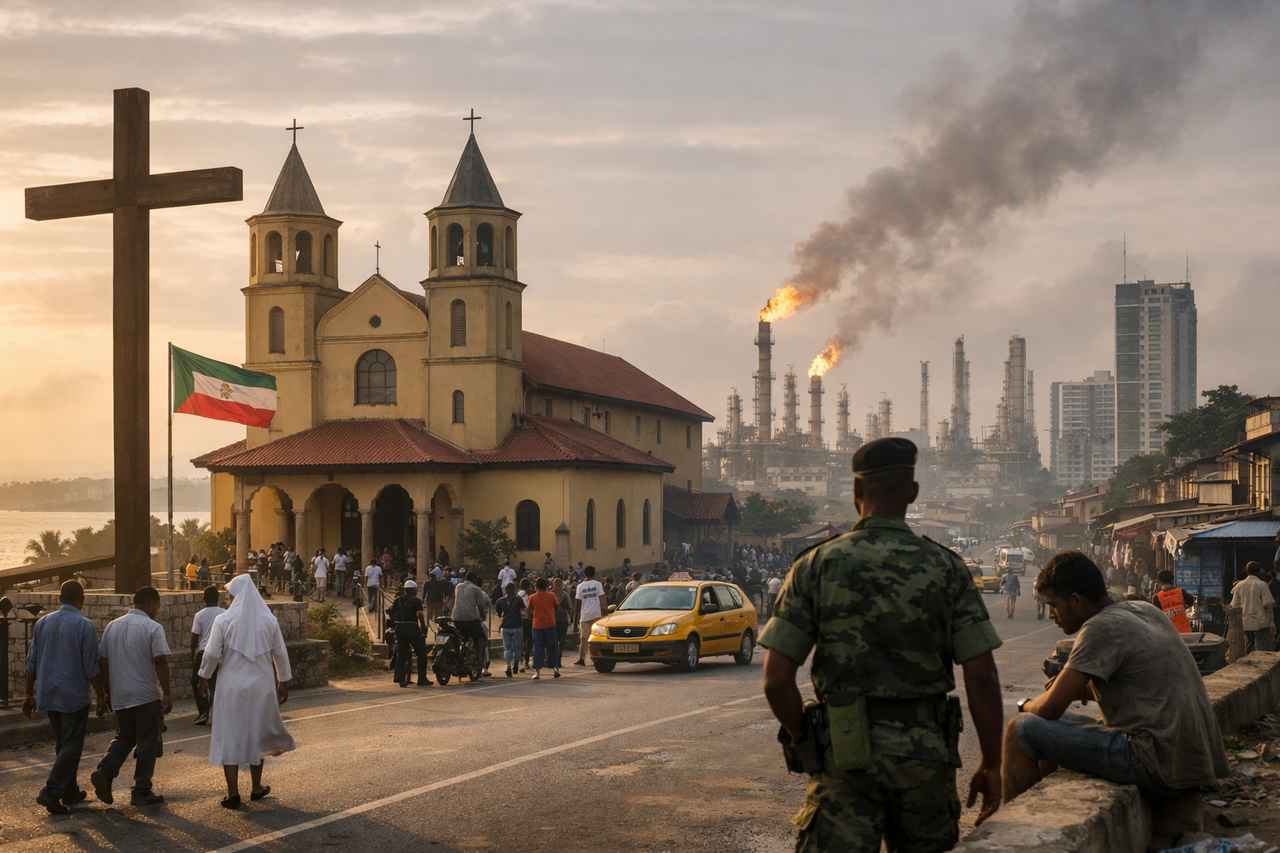
Equatorial Guinea is a country where Christian identity is widespread, yet public life remains tightly controlled. Most people identify as Christian, but the state gives favored treatment to certain churches, keeps a close grip on dissent, and governs through an authoritarian system marked by censorship, arbitrary detention, and weak accountability. At the same time, long-running oil decline has deepened economic strain, and April 2026 brings an unusual moment of public Christian attention through Pope Leo XIV’s visit. This is a country to pray for with sobriety, compassion, and hope.
1. Why This Country Needs Prayer Now
Equatorial Guinea needs prayer now because the burden on the country is not only economic or political. It is also moral and spiritual. A deeply entrenched ruling system has narrowed public space for truth-telling, criticism, and independent civic life. In that atmosphere, churches can continue to exist, and many believers do worship openly, yet pastors, lawyers, activists, and independent voices know that speaking too boldly about justice, abuse, or corruption can come at a cost. Prayer is needed for courage, wisdom, and integrity in a place where fear often shapes what people dare to say.
The country also needs prayer because economic decline is pressing on everyday life. The World Bank says falling oil revenues and weak diversification have produced a prolonged recession that has reversed gains and jeopardized social progress, while the IMF said in February 2026 that the economy was estimated to have contracted by 6.4% in 2025 as hydrocarbon production fell sharply. In an oil-rich state where wealth has long been unevenly distributed, this kind of strain touches families, churches, young people, and the credibility of public institutions alike.
2. Country Snapshot
Equatorial Guinea is a small Central African country made up of a mainland territory and several islands in the Gulf of Guinea. The World Bank’s latest population series shows about 1.89 million people in 2024. Christianity is the dominant faith: the U.S. State Department’s 2023 International Religious Freedom report cites a 2020 World Religion Database estimate of 90% Christian, 4% Muslim, and 6% other or no religious belief. Politically, it remains a tightly controlled presidential system under Teodoro Obiang Nguema Mbasogo, who was still listed as president in CIA World Leaders last updated July 7, 2025.
The church, then, is not a tiny hidden minority. It is woven into the country’s life. That makes the prayer burden more nuanced. The central question is not simply whether Christians exist, but how faithfully and freely they can live, lead, disciple, and speak in a setting where the state closely manages public life and grants unequal treatment among religious communities.
3. Main Pressures Facing Christians
The main pressures facing Christians in Equatorial Guinea come less from widespread mob violence than from unequal regulation, selective state favor, and the broader climate of repression. The State Department reports that the Roman Catholic Church and the Protestant Reformed Church of Equatorial Guinea are the only major religious groups not required to register with the Ministry of Justice, Religious Affairs, and Penitentiary Institutions. Other groups can face registration demands, leadership-credential requirements, inspections, fines, and even closure if they are judged noncompliant.
That means smaller evangelical, Pentecostal, and other independent churches may bear heavier pressure than the country’s most favored Christian bodies. The same legal environment that regulates religion sits inside a wider political system that restricts association, expression, and dissent. So even where Christians are not prevented from gathering outright, there can still be strong incentives to stay quiet, avoid public criticism, and keep ministry away from anything that authorities might interpret as political challenge.
4. What Life Is Like for Christians in Equatorial Guinea
For many Christians in Equatorial Guinea, ordinary church life remains possible. People attend services, Christian identity is publicly visible, and the faith is not socially marginal in the way it is in some harder environments. Yet that does not remove the burden. Where public institutions are weakly accountable, where surveillance expands, and where dissidents, lawyers, and activists can be detained, Christians who preach repentance, justice, honesty, or human dignity must think carefully about how those words will be heard.
In practice, this can produce a quiet but real pressure. Pastors may feel the need to stay well inside political red lines. Independent ministries may worry about paperwork, recognition, or official scrutiny. Believers who work in government, law, media, or education may feel the tension between prudence and truthfulness. And families living under economic strain may find that spiritual needs and material anxieties constantly meet at the same table. The result is not always dramatic. Often it is the slower burden of caution, fatigue, and compromise. That is exactly the kind of burden Christians should learn to pray for.
5. Recent Developments
Recent developments have made that burden clearer. Amnesty International says that in 2024 a cybercrime bill raised new concerns over freedom of expression, arbitrary arrests and detentions of defenders continued, and plans for mass surveillance intensified. Freedom House likewise reported arrests and detention of activists and dissidents during 2024, including the cases of Anacleto Micha Ndong and Joaquín Elo Ayeto, as well as punishment of lawyers who tried to defend critics of the regime. On Annobón island, protests over environmental damage in July 2024 were followed by arrests and communications restrictions.
These pressures also touched explicitly Christian life. Freedom House reported that pastor and former justice minister Rubén Mayé Nsue Mangue, who had been detained since 2022 after allegedly criticizing the government in sermons and on social media, was pardoned and released in July 2024. But the same report says the Justice Ministry permanently closed the church Luz de Naciones: Isaías 60 in November 2024, accusing its leaders of contempt of authority and disturbing public order. That combination of release and closure is revealing: there are signs of mercy, but also clear reminders that church life can still be constrained when it crosses political sensitivities.
Economically, the pressure remains serious. The World Bank warned in March 2025 that declining oil revenues and weak diversification had already produced a prolonged recession and jeopardized social progress. The IMF then said in February 2026 that output was estimated to have contracted by 6.4% in 2025 because of a large fall in hydrocarbon production. In a country where oil wealth once promised broad prosperity, that continuing decline affects employment, household resilience, and the social environment in which churches minister.
There is also one notable current opening. The Vatican’s official program shows that Pope Leo XIV is scheduled to visit Equatorial Guinea from April 21 to 23, 2026, with events in Malabo, Mongomo, and Bata. AP reports say the visit is expected to address corruption, governance, inequality, and the moral challenges facing an oil-rich but impoverished and authoritarian state. That does not solve the country’s problems, but it does create a rare moment when faith, justice, and public responsibility may receive unusual visibility.
6. How to Pray
- Pray that pastors, priests, and church leaders would have courage joined to wisdom: bold enough to be faithful, and discerning enough to speak truth without unnecessary recklessness in a tightly controlled public space.
- Pray for smaller and independent churches, especially evangelical and Pentecostal congregations, that they would not be crushed by selective registration rules, credential barriers, or fear of closure.
- Pray for believers who serve in law, education, media, and public office, that they would resist corruption, love truth, and act with Christian integrity even where compromise is normalized.
- Pray for those unjustly detained, silenced, or intimidated, including activists, lawyers, and ordinary citizens, that justice would be done and that the Lord would preserve their faith and health.
- Pray for families under economic pressure, especially the poor, the young, and those whose hopes have been damaged by decline, that churches would be places of mercy, practical help, and steady gospel hope.
- Pray that the April 2026 papal visit would bring more than ceremony: ask God to use it to strengthen believers, expose injustice, encourage repentance, and direct public attention toward truth, reconciliation, and care for the vulnerable.
7. Give Thanks
- Give thanks that the gospel has deep roots in Equatorial Guinea and that the vast majority of the population still identifies as Christian.
- Give thanks that Rubén Mayé Nsue Mangue was pardoned and released in July 2024 after years in detention.
- Give thanks for this unusual April 2026 moment of public Christian visibility, and for the possibility that it may strengthen believers and stir wider reflection on justice and truth.
8. Last Verified
Last verified: April 12, 2026.
This post especially needs rechecking after Pope Leo XIV’s April 21–23, 2026 visit and after any new developments in church regulation, detention cases, or surveillance law.
Last Updated note
Last updated: April 12, 2026.
Next review due: May 2026, or immediately if there are new developments in religious regulation, detainee releases, Annobón-related repression, or the papal visit.
Key Sources Consulted
- U.S. Department of State, 2023 Report on International Religious Freedom: Equatorial Guinea — used for religious demography, church-registration rules, favored status for the Catholic and Protestant Reformed churches, and leadership-credential requirements.
- U.S. Department of State, 2024 Country Reports on Human Rights Practices: Equatorial Guinea — used for current human-rights conditions, especially arbitrary detention, censorship, torture concerns, and lack of accountability.
- Freedom House, Freedom in the World 2025: Equatorial Guinea — used for the 2024 overview of authoritarian conditions, activist arrests, Annobón repression, the release of Rubén Mayé, and the closure of Luz de Naciones: Isaías 60.
- Amnesty International, Equatorial Guinea 2024/25 country report — used for the 2024 cybercrime-bill concerns, surveillance plans, Annobón crackdown, and key detention cases.
- World Bank Data, Population, total – Equatorial Guinea — used for the latest population figure in the snapshot.
- World Bank, Equatorial Guinea Country Economic Memorandum – Building the Foundations for Renewed, More Diversified and Inclusive Growth (March 4, 2025) — used for the long-term economic context of recession and social strain.
- IMF, Republic of Equatorial Guinea: Staff Report for the 2025 Article IV Consultation and First and Second Reviews Under the Staff-Monitored Program and IMF Management Approves the Third Review of the Staff Monitored Program (Feb. 6, 2026) — used for current economic trajectory and contraction estimates.
- CIA, World Leaders: Equatorial Guinea — used to verify current leadership.
- Holy See / Vatican, Apostolic Journey of Pope Leo XIV to Algeria, Cameroon, Angola and Equatorial Guinea (13–23 April 2026) — used to verify the visit dates and program.
- AP reporting on Pope Leo XIV’s April 2026 Africa trip — used for current framing of how Equatorial Guinea is being viewed in connection with corruption, governance, and inequality.


