

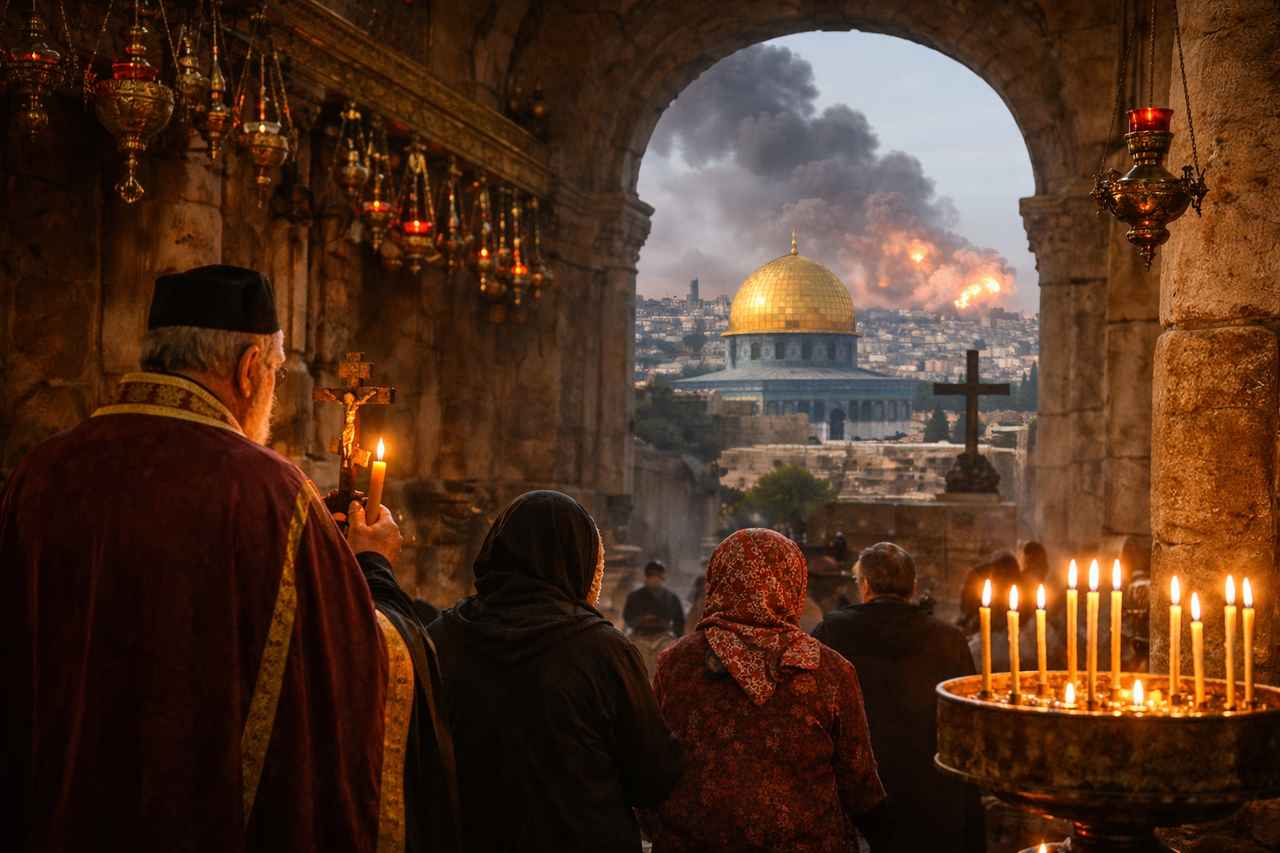
Israel calls for careful Christian prayer not only because of its biblical significance, but because its present burdens are heavy and layered. As of early April 2026, the country is living through a widening war involving Iran, an unfinished Gaza crisis, and security restrictions that have even disrupted Holy Week and Easter worship in Jerusalem. Beneath the headlines, local Christians are trying to remain faithful in a land marked by grief, fear, polarization, and deep spiritual weariness.
1. Why This Country Needs Prayer Now
Israel needs prayer now because national crisis is pressing into ordinary worship, family life, and public witness. In early April 2026, AP reported continuing Israeli strikes on Iran and Iranian retaliation, while Reuters and AP reported that Holy Week observances in Jerusalem were restricted, with access disputes and limits affecting the Church of the Holy Sepulchre and other Christian gatherings.
Yet the burden is not only the widening war. The Gaza war is not simply “over.” AP reports that a ceasefire has halted the heaviest fighting and increased aid, yet reconstruction remains stalled, deeper political questions remain unresolved, and a proposal for Hamas disarmament is still under discussion. That means Israel is still living with war trauma, moral strain, and uncertainty about what peace, justice, and security will look like next.
For Christians, this matters directly. Believers in Israel do not live outside the country’s conflicts. Ancient churches, Arabic-speaking congregations, Messianic believers, clergy, and Christian families are all trying to keep worship, witness, and community life alive while the wider national atmosphere grows more fearful and brittle. All of this should deepen the church’s prayer, not reduce it.
2. Country Snapshot
Israel sits on the eastern Mediterranean. The World Bank lists a total population of 9,974,400 in 2024. Israeli official statistics show that at the end of 2024 the population included about 7.213 million Jews, 1.816 million Muslims, 181,800 Christians, and 153,000 Druze. Israel is a parliamentary democracy, and the Prime Minister’s Office identifies Benjamin Netanyahu as prime minister as of early April 2026.
Its legal and social setting is mixed. Open Doors’ country dossier notes that Israel’s basic laws and courts provide meaningful protection for religious practice. Even so, the country’s self-definition as a Jewish and democratic state, the special standing of some religious institutions, and continuing conflict all create tensions that are felt unevenly by minorities, including Christians.
3. Main Pressures Facing Christians
The pressures facing Christians are not all the same. Arab Christians often carry the burden of being both a small religious minority and, in many places, part of a Palestinian community deeply affected by the wider conflict. Messianic Jewish believers can face suspicion, prejudice, and complications when their Christian identity becomes publicly known.
A second pressure is everyday harassment. The Rossing Center’s 2025 report documented 155 incidents against Christians in Israel and East Jerusalem, including 61 physical attacks, 52 attacks on church property, 28 harassment cases, and 14 incidents involving defacement of public signs. The report says clergy were especially targeted, and that spitting, verbal abuse, vandalism, and humiliation around Christian sites have become a recurring pattern.
A third pressure is the slow wearing down that comes with exhaustion. Even when churches remain open, war, empty pilgrimage seasons, public tension, and fear about the future can make Christian life feel fragile. The question is not only whether believers can worship today, but whether historic Christian communities can remain rooted for the long term without being worn down.
4. What Life Is Like for Christians in ISRAEL
For many believers, daily faithfulness now means carrying on with worship under strain. Holy Week 2026 made that visible. Reuters material from Jerusalem described canceled public Palm Sunday processions, temporary closure of the Holy Sepulchre to ordinary worshippers, closed-door liturgies, and sharply reduced attendance because of security restrictions linked to the war.
For clergy and visibly Christian workers, the burden can be intensely personal. Rossing Center says some clergy in places such as Mount Zion and the Armenian Quarter describe harassment as so routine that even stepping outside can bring abuse. That kind of pressure is not always dramatic enough to make global headlines, but it can steadily wear down courage and belonging.
For families and congregations, life is shaped by more than one grief at a time. There is concern for relatives and fellow believers across the wider land, fear created by war, loss of normal pilgrimage rhythms, economic strain, and the recurring temptation to emigrate. In that setting, ordinary Christian perseverance becomes one of the quiet miracles that outsiders can easily overlook.
5. Recent Developments
The most immediate recent development is the widening war involving Israel and Iran. AP reported on April 6, 2026, that Israel struck key targets in Iran while Iran continued retaliatory attacks, underscoring how unstable and dangerous the present moment remains. This broader war is not a side issue for the church; it is already shaping worship, movement, public gatherings, and the emotional atmosphere of the country.
A second major development is the disruption of Holy Week and Easter observances in Jerusalem. Reuters reported that authorities ordered closures affecting public spaces and holy sites, and church leaders said Easter liturgies would be celebrated with very few people and, in some cases, behind closed doors. Even where access was partially restored, the episode showed how directly national security crises are now pressing into Christian worship.
A third development is the unresolved state of Gaza. AP reports that the ceasefire is still in place, but the deeper political process is incomplete, reconstruction remains stalled, and further violence has continued despite the truce. That unfinished crisis keeps Israel and the wider region in a state of moral, political, and emotional tension.
A fourth development is the worsening climate documented by local Christian monitors. Rossing Center’s 2025 report says harassment and violence against Christians in Israel and East Jerusalem continued and expanded during 2025, within a wider atmosphere of war, polarization, and increasingly exclusionary national-religious pressure.
6. How to Pray
These prayer points flow directly from the present war, the strain on worship in Jerusalem, the unfinished Gaza crisis, and the documented rise in harassment against Christians.
- Pray for peace with truth and justice: that the widening regional war would be restrained, that lives would be spared, and that leaders would be turned away from pride, vengeance, and reckless escalation.
- Pray for the protection of worship and holy places: that churches in Jerusalem and elsewhere would be able to gather faithfully, wisely, and without fear.
- Pray for local Christians not to lose heart: that Arab Christians, Messianic believers, clergy, and Christian families would be kept steadfast, gentle, and courageous.
- Pray against hatred in public life: that harassment, contempt, and attacks against Christians and other communities would be checked, exposed, and answered with justice.
- Pray for believers carrying layered grief: those mourning the dead, fearing for loved ones, or wondering whether they can remain rooted in the land.
- Pray for gospel integrity: that Christians in Israel would not be swallowed by nationalism, bitterness, fear, or despair, but would bear witness to Christ with humility and truth.
- Pray for mercy across the wider land: that the suffering connected to Gaza and the wider conflict would move the church worldwide to deeper compassion, wiser speech, and more faithful intercession.
7. Give Thanks
Give thanks that, even under severe restrictions, Holy Week and Easter worship were not extinguished in Jerusalem. Church leaders still labored to keep the central liturgies of the faith alive.
Give thanks for the enduring Christian presence itself. Israeli official statistics still record a real, historic Christian community in the land, even though it remains small.
Give thanks for clergy, church workers, and ordinary believers who continue to serve, guard holy places, and keep visible Christian witness alive under pressure.
8. Last Verified
Last updated: April 6, 2026.
Next review due: May 2026, or sooner if the Israel-Iran war, Holy Site access, or Gaza ceasefire status changes materially.
Key Sources Consulted
- Associated Press, April 2026 reporting on the Israel-Iran war and its regional escalation.
- Associated Press, April 2026 reporting on Gaza ceasefire status, reconstruction, and Hamas disarmament discussions.
- Reuters, March 31, 2026, remarks by the Latin Patriarch and Custos of the Holy Land on reduced Easter access at the Church of the Holy Sepulchre.
- Reuters / Reuters Connect, March 29, 2026, reporting and imagery on Palm Sunday restrictions and Holy Site closures in Jerusalem.
- Reuters / White House briefing, March 29, 2026, on U.S. concern over holy-site closures in Jerusalem.
- Rossing Center for Education and Dialogue, Attacks on Christians in Israel and East Jerusalem (report on 2025 incidents, published March 2026).
- World Bank country data for Israel.
- Israel Central Bureau of Statistics, official table Population of Israelis, by Religion and related 2025 statistical materials.
- Government of Israel, Prime Minister’s Office landing page.
- Open Doors, Israel – WWL 2024 Full Country Dossier.


