

Every year, Women’s Day gives us an opportunity to pause, give thanks, and speak with greater care about the place of women in God’s world. That gratitude matters. But for Christians, the question is not only whether we should honor women. The question is how we should honor them faithfully.
The church should not simply repeat the language of the surrounding culture, whether that language is shallow praise on one side or dismissive suspicion on the other. We should think biblically. We should speak gratefully. And we should learn to see women in the light of God’s redemptive purposes.
When we do that, one truth becomes wonderfully clear: women are not an afterthought in the story of redemption. They are not ornaments at the edge of God’s work. They are recipients of his grace and, in many ways, significant participants in the unfolding of his saving plan.
Women are woven into the story of redemption
From the opening pages of Scripture, women are presented as bearing the dignity of the image of God alongside men. That truth alone gives women immeasurable worth. But as the history of redemption unfolds, Scripture also shows us that God, in his wisdom and grace, repeatedly gives women meaningful places in the advancement of his purposes.
This should not surprise us. The God of the Bible is not embarrassed to work through those whom the world may overlook. Again and again, he delights to display his power through human weakness, his wisdom through unlikely means, and his grace through those whom society may undervalue.
That pattern appears in the lives of many women in Scripture. We think of Miriam, Deborah, Jael, Abigail, Esther, Huldah, Anna, Priscilla, and the daughters of Philip. These women do not all serve in the same way, and Scripture does not erase all distinctions of calling or office. Yet together they bear witness to a glorious truth: God has long been pleased to use women in the preservation of his people, the strengthening of faith, the speaking of truth, and the advancement of his kingdom purposes.
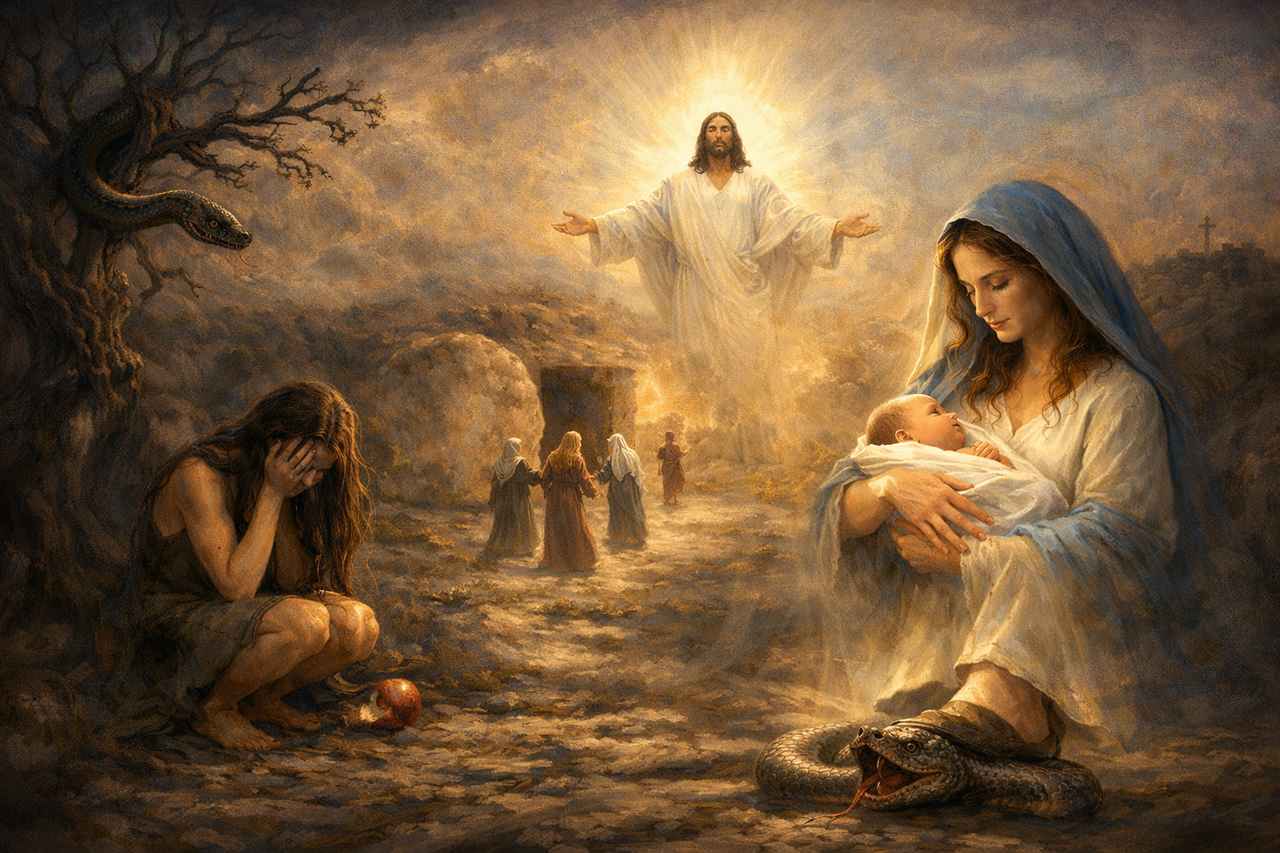
It is also striking that where the history of the fall first involved the woman, the history of redemption also gave the woman a place of remarkable honor. We should say this carefully: Scripture teaches that sin entered the world through Adam as covenant head. Yet in Genesis 3:15, at the very scene of humanity’s ruin, God announced hope in the promise of the seed of the woman who would crush the serpent. From the earliest pages of the Bible, then, God was already showing that his saving purpose would unfold in a way that honored the very one whom the fall might seem to place under shame. That promise was ultimately fulfilled in Jesus Christ, born of Mary, who came to destroy the works of the devil.
The resurrection account gives women a place of remarkable honor
One of the clearest places where this shines is in the resurrection narratives.
When God chose to announce the resurrection of Jesus Christ, he gave a remarkable honor to women. They were among the first witnesses to the empty tomb and among the first to carry the news that Christ had risen. That is not a minor detail. It is a striking feature of the gospel record.
In the world of first-century Palestine, women were often treated with social contempt and their testimony was frequently discounted in public life. Yet in the wisdom of God, these women were not pushed to the margins of the resurrection story. They were brought near to it. The risen Christ was pleased that the first heralds of that world-changing news should include women.
That matters deeply. The resurrection is not a side doctrine. It stands at the center of the Christian faith. Christ was crucified for our sins and raised for our justification. Death has been conquered. Hope has entered the grave and come out victorious. And at this central turning point in history, women were given the privilege of being among the first witnesses and messengers of that astonishing news.
This is not because women are inherently more virtuous than men, nor because Scripture is trying to shame the male disciples by simplistic comparison. Rather, it is because God is free and gracious in the way he displays his glory. He honors whom he pleases, and he often does so in ways that humble human pride.
There is a similar pattern in John 4. After meeting the Lord Jesus, the Samaritan woman went and told others about him. Her testimony became the means by which many in her town came to hear of Christ. Once again, we see that the Lord is pleased to make women instruments through whom others are brought face to face with the truth.
The coming of Christ also gives unique honor to a woman
If the resurrection gives women a place of remarkable honor, the incarnation does the same.
In the fullness of time, God sent forth his Son, born of woman. That phrase is short, but it is weighty. The eternal Son of God took on flesh and entered the world through the womb of Mary. By God’s sovereign grace, Mary was given a unique and unrepeatable calling in the history of redemption: she was chosen to bear the promised Messiah.
We should speak carefully here. Redemption rests entirely on the saving work of Christ, not on Mary as though she were the source of salvation. Yet we should also say with reverence that God bestowed on her a singular honor. No woman has ever received a calling exactly like hers. She was the mother of our Lord according to his human nature. That is no small thing. It is part of the Bible’s own testimony that in the coming of Christ, God dignified womanhood in a profound way.
Women continue to serve meaningfully in the life of the church
The biblical pattern does not end in the great moments of redemptive history. It continues in the ordinary life of the church.
Paul speaks in Romans 16 with deep gratitude for women who labored for the Lord and supported the work of the gospel. That chapter alone should teach us to beware of speaking as though women’s contribution to the church were negligible. It was not negligible then, and it is not negligible now.
In every faithful congregation, the fingerprints of women’s service are everywhere. Women teach children. Women disciple younger believers. Women show hospitality. Women visit the sick. Women comfort the grieving. Women pray faithfully. Women counsel quietly. Women give generously. Women sing, serve, organize, encourage, and persevere.
Some of that labor is public. Much of it is hidden.
A woman who intercedes in secret may strengthen a church more than many visible leaders realize. A woman who teaches children the Scriptures may be shaping souls for generations to come. A woman who cares for the suffering, prepares meals, welcomes strangers, or quietly helps the needy is not doing “small” work. In Christ’s kingdom, such service is precious.
And this must also be said: we should not only honor women for spectacular contributions. We should honor them for ordinary faithfulness. Not every woman will be publicly recognized. Not every woman will be widely praised. Some carry burdens that few people see. Some serve in weakness. Some grieve silently. Some feel forgotten. But the Lord does not overlook the hidden faithfulness of his daughters.
So let the church be grateful
For all these reasons, the church should be deeply grateful for women.
We thank God for mothers, though not only for mothers. We thank God for women who have nurtured children, shaped homes, strengthened churches, and steadied communities. We thank God for women who have taught Sunday school, welcomed worshipers, sung in choirs, served the poor, visited the sick, and comforted the bereaved. We thank God for women whose names are known by many, and for women whose faithfulness is seen by almost no one except the Lord.
And our gratitude should not be polite flattery offered once a year. It should be sustained, thoughtful, and sincere. The church should be a place where women are treated with honor, spoken to with dignity, and appreciated with biblical seriousness.
Not because the church is borrowing its values from the world, but because the church has been taught by Scripture to see what the world often misses.
God’s grace gives the final meaning
At the deepest level, the significance of women in the church is not explained by talent alone, achievement alone, or social usefulness alone. It is explained by grace.
The same grace that saves sinners in Christ also dignifies lives, calls people into service, and writes them into the story of God’s purposes. Women matter because they are made in God’s image. Women are honored because God has shown them honor in the unfolding of redemption. Women are to be cherished in the church because Christ himself has not treated them as peripheral to his saving work.
So as we reflect on Women’s Day, let us do more than celebrate women in general terms. Let us thank God for them. Let us honor them in truth. Let us learn from the way Scripture speaks. And let us remember that in the story that matters most, the story that leads to Christ, women are not forgotten.
They never were.


