

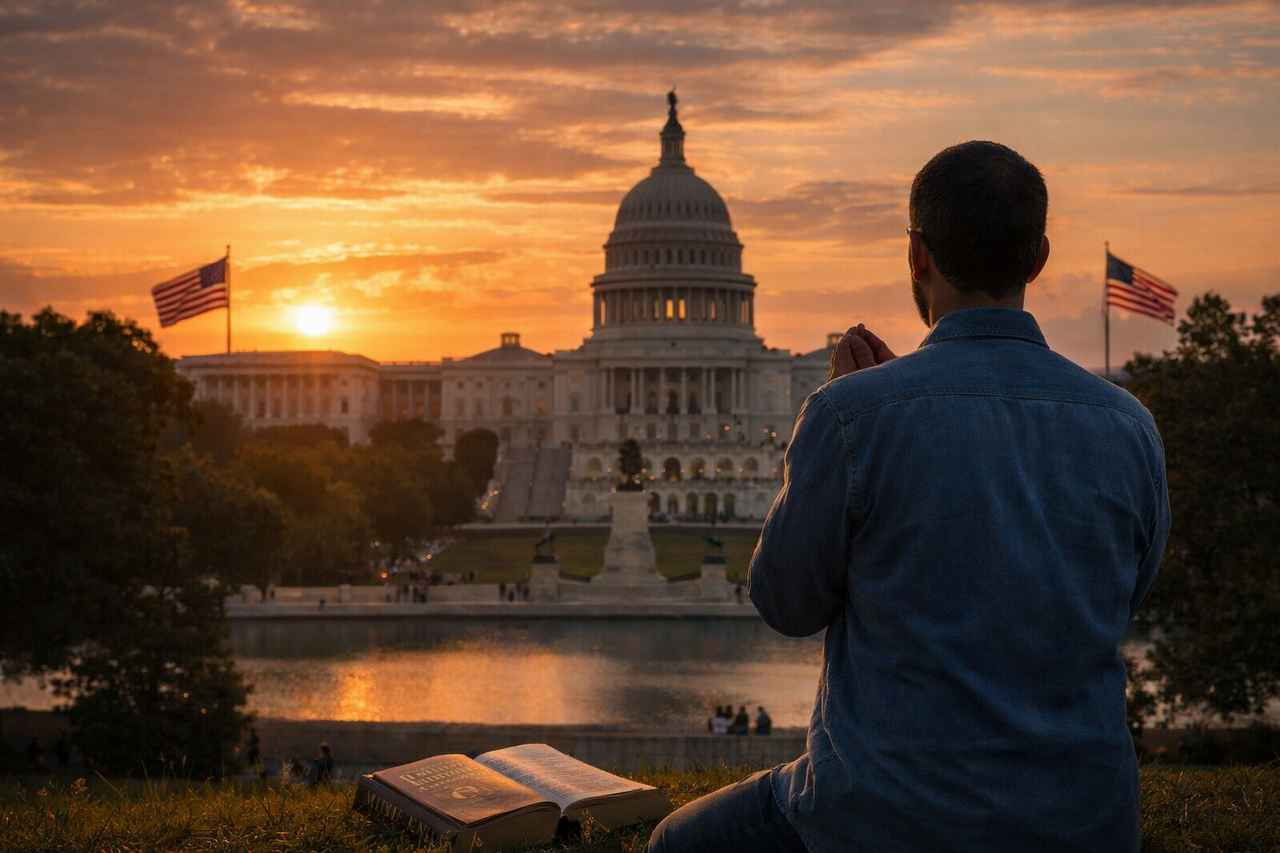
The United States is home to one of the largest Christian populations in the world. It has wide legal freedom for worship, vast ministry resources, and churches of many kinds spread across the country. Yet it is also a nation marked by deep moral confusion, political strain, weakening trust, and fierce arguments about the place of faith in public life. As of April 2026, that burden has grown heavier because the country is also involved in a live war with Iran. This is not a nation that needs prayer only because it is powerful. It needs prayer because freedom can be wasted, influence can be misused, and public religion can drift far from humble faith in Christ.
1. Why This Country Needs Prayer Now
The United States needs prayer now because several pressures are meeting at the same time. On one hand, Christianity is still deeply present in American life. Pew’s 2023–24 Religious Landscape Study found that 62% of U.S. adults identify as Christian. On the other hand, 29% are religiously unaffiliated, and the broader story of recent decades has been one of long decline, even if that decline may have slowed for now.
That alone would be reason for prayer. But the present burden is larger than secular drift. Many Americans now feel a growing clash between their beliefs and mainstream culture, and the country is sharply divided over whether religion should have a stronger or weaker public role. At the same time, the United States is now part of a live war with Iran, which adds fear, uncertainty, and a fresh temptation to speak about national power in ways that are morally reckless or spiritually proud. All of this affects the church’s witness. It shapes how Christians speak, how they pray, and how they are seen by their neighbors.
2. Country Snapshot
The United States is a large federal republic in North America. As of April 2026, the White House identifies Donald J. Trump as the current president. The country’s population is roughly 349 million in 2026 by current widely used demographic estimates. It remains the world’s third most populous nation.
Religiously, the country is still majority Christian, though far less uniformly so than in earlier generations. Pew reports that 40% of U.S. adults are Protestant, 19% are Catholic, and 3% belong to other Christian traditions. The church in America is broad and varied: evangelical, Catholic, mainline Protestant, Orthodox, historically Black churches, immigrant congregations, campus ministries, rural churches, urban networks, and many smaller fellowships. It has exceptional freedom and extraordinary access to Scripture, publishing, education, and global mission. Yet it is also burdened by fragmentation, politicization, and uneven spiritual health.
3. Main Pressures Facing Christians
For most Christians in the United States, the main pressures are not imprisonment or formal bans on worship. They are quieter than that, but still serious. One is the pressure of secularization. Many believers are trying to remain faithful in a society where Christian conviction is often treated as outdated, narrow, or politically suspect. Another is the pressure of confusion. Questions about truth, identity, sexuality, authority, and conscience are no longer distant cultural debates. They now touch schools, workplaces, homes, and churches directly.
A second major pressure is politicization. Christians are constantly tempted to tie the name of Christ too closely to party identity, national grievance, or ideological combat. That makes faithful public witness harder. Pew found that Americans are about evenly divided on whether the federal government should declare the U.S. a Christian nation, and slightly more than half say religious organizations are too involved with politics. That does not mean religion has no place in public life. It means the church’s public voice is contested, and often distorted, from more than one direction.
A third pressure is uneven vulnerability. Some churches, especially immigrant congregations, face fears that many other churches do not. In 2025, more than two dozen Christian and Jewish groups sued over a Trump administration policy giving immigration agents more leeway to conduct arrests at houses of worship. A federal judge later blocked enforcement for some plaintiff groups while the case continues. For those churches, the strain is not theoretical. Fear can reach the Sunday service itself.
4. What Life Is Like for Christians in United States of America (USA)
For many believers in the United States, daily Christian life still includes remarkable freedom. Churches can gather openly. Pastors can preach without state censorship. Bibles and Christian books are widely available. Ministries can be built, schools can be founded, and missionaries can be sent. These are great mercies, and they should not be treated lightly.
And yet ordinary faithfulness can feel harder than the country’s legal freedoms might suggest. Parents are trying to raise children in a culture where moral formation is fiercely contested. Pastors are trying to shepherd congregations where political loyalties can run deeper than shared discipleship. Students and workers often feel pressure to stay quiet about convictions that may be ridiculed or misunderstood. In some churches, the struggle is to remain courageous. In others, it is to remain humble. In many, it is both at once.
For immigrant congregations, the strain may be even more immediate. AP reporting in October 2025 described a Catholic church in Washington, D.C., where church leaders said more than 40 parishioners had been detained, deported, or both, and where many worshippers became afraid to attend Mass, buy food, or seek medical care. That does not describe every church in the country. But it does show how national policy can quickly become a pastoral burden inside local congregations.
Even so, there are still signs of grace. Pew found that 80% of Americans say religious organizations help bring people together and strengthen community bonds, while 78% say they play an important role in helping the poor and needy. In a polarized country, many churches are still quietly serving, teaching, consoling, and holding communities together.
5. Recent Developments
The most urgent recent development is the current war involving the United States and Iran. AP reported on April 6, 2026, that mediators had proposed a 45-day ceasefire and reopening of the Strait of Hormuz, but neither Iran nor the U.S. had accepted the proposal at that point. This conflict has already brought deaths, damage, and fresh regional instability. For Christians in the United States, that should shape prayer in at least two ways: for peace and restraint in public life, and for moral clarity in how war, power, and national language are handled.
Another important development is the legal and pastoral fallout from immigration enforcement around places of worship. In February 2025, a coalition of Christian and Jewish groups challenged the administration’s policy change in court, arguing that it spread fear and disrupted worship and ministry. Later that month, a federal judge blocked the policy for certain plaintiff groups while the case proceeds. These developments matter because they show that even in a country with broad constitutional protections, some congregations now carry fear directly into their church life.
A further development came in Mahmoud v. Taylor, decided on June 27, 2025. The Supreme Court held that parents challenging the introduction of certain “LGBTQ+-inclusive” storybooks, together with the denial of notice and opt-outs, were entitled to a preliminary injunction. The decision does not settle every wider dispute about schools, parents, and religion. But it does show how live and serious the nation’s conflicts over conscience, religious exercise, and public education have become.
6. How to Pray
- Pray that Christians in the United States would love Christ more than party, tribe, ideology, or national identity.
- Pray for pastors, elders, parents, teachers, and ministry leaders who are trying to disciple people with wisdom and courage in a confused age.
- Pray for immigrant congregations and vulnerable families, that they would worship without fear and be upheld by the compassion and faithfulness of the church.
- Pray for national leaders, judges, educators, and public servants, that God would restrain evil, expose falsehood, and grant humility, justice, and wisdom.
- Pray for peace and restraint in the current war with Iran, and for protection for civilians, service members, chaplains, and all who are caught in the conflict.
- Pray for spiritual renewal across the country, not merely for stronger religious identity, but for repentance, deeper faith, renewed hunger for Scripture, and genuine conversion.
7. Give Thanks
- Give thanks that the United States still has wide legal freedom for Christian worship, preaching, publishing, discipleship, and mission.
- Give thanks that Christianity remains deeply rooted in the country, even after many years of decline, and that the church is still present in every region and in many traditions.
- Give thanks for the many churches and ministries that continue to strengthen communities, care for the poor, and bear faithful witness in ordinary places.
Last Updated note
Last updated: April 6, 2026.
Suggested next review: May 2026, or immediately if the Iran war, immigration-enforcement litigation, or major religion-related court rulings change materially.
Key Sources Consulted
- AP News, “The Latest: Iran and US receive proposal for 45-day ceasefire and reopening of Strait of Hormuz” (published April 6, 2026).
- AP News, “Trump says US forces will ‘finish the job’ soon in first prime-time speech since starting Iran war” (published April 1, 2026).
- AP News, “Trump won’t block immigration arrests in houses of worship. Now these 27 religious groups are suing” (published February 11, 2025).
- AP News, “Judge blocks Trump immigration policy allowing arrests in churches for some religious groups” (published February 24, 2025).
- AP News, “Immigration crackdown stokes fear and solidarity at a Catholic church in DC” (published October 27, 2025).
- The White House, “Donald J. Trump” administration page.
- U.S. Census Bureau, “U.S. and World Population Clock” (2026 projection).
- Pew Research Center, “2023–24 Religious Landscape Study: Executive summary” (February 26, 2025).
- Pew Research Center, “Religious identity in the United States” (February 26, 2025).
- Pew Research Center, “Views of separation of church & state, and religion’s role in public life” (February 26, 2025).
- Pew Research Center, “Growing Share of U.S. Adults Say Religion Is Gaining Influence in American Life” (October 20, 2025, based on 2025 surveys).
- Supreme Court of the United States, syllabus in Mahmoud et al. v. Taylor et al., No. 24-297 (decided June 27, 2025).
- USCCB, “2026 Religious Liberty Annual Report” (published February 17, 2026).


