


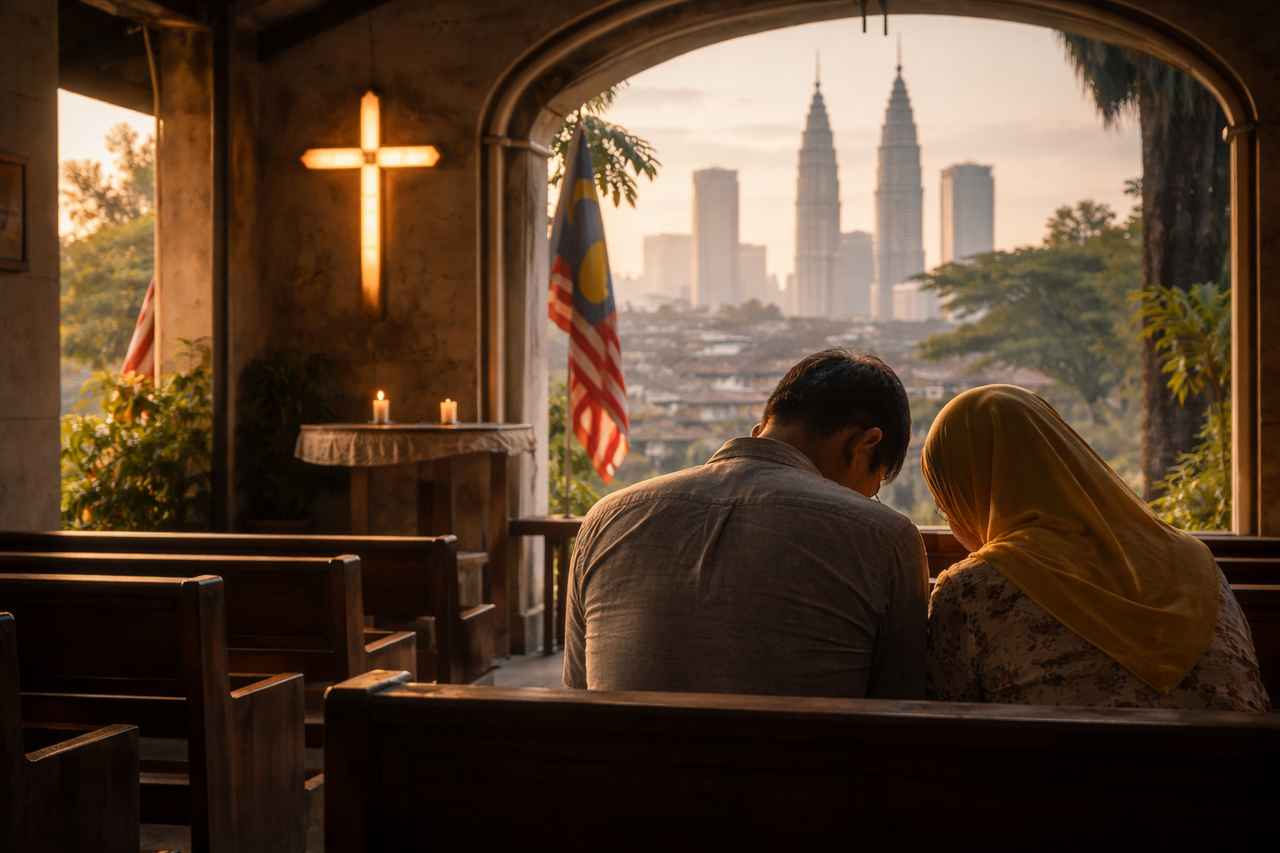
Malaysia is modern, busy, and often publicly stable. Christians there do not live in a country where Christian faith is simply outlawed, and many churches are able to gather openly. Yet religious freedom is not equal in every direction. The nation’s legal and social order gives Islam a privileged place, conversion away from Islam is deeply constrained, and public religious disputes can become tense very quickly. That makes Malaysia a country where believers need wisdom, courage, patience, and hope firmly grounded in Christ.
Pray for Malaysia’s churches to speak clearly of Christ, for believers from Muslim backgrounds to be strengthened and protected, for justice in unresolved disappearance cases, and for wisdom where law, conscience, conversion, and public religious life meet.
Last verified: May 2026
Why Malaysia Needs Prayer Now
Malaysia needs prayer because churches are visibly present, religious diversity is part of public life, and Christians face serious limits around conversion, religious speech, and witness to Muslims.
Malaysia needs prayer because religious life there is both public and contested. The constitution identifies Islam as the religion of the Federation while also allowing other religions to be practiced in peace and harmony. In daily life, that means Christians and other religious minorities may worship openly in many settings, yet the legal and social order still gives Islam a privileged place and places special limits around Muslims, conversion, and religious speech. The U.S. Department of State’s 2023 religious-freedom report describes a parallel legal system in which certain civil matters for Muslims fall under sharia, or Islamic religious law, and where the relationship between civil and sharia law remains unresolved in important areas.
This matters because the pressure is not merely theoretical. It affects real families, real congregations, and real believers trying to walk faithfully without needless provocation and without fearful silence. Associated Press reporting in November 2025 described a High Court ruling that found the government and police responsible in the enforced disappearances of Christian pastor Raymond Koh and Muslim activist Amri Che Mat. Koh’s whereabouts remain unknown. The ruling brought a measure of public acknowledgment, but it also reminded the country that abuses linked to religion and conscience can wound families for years.
Malaysia therefore calls for prayer that is neither exaggerated nor complacent. The church is visible, especially in parts of East Malaysia, and many believers are able to gather, worship, and serve. Yet Christians also need wisdom where public religious questions can quickly become sensitive, and believers from Muslim backgrounds may face pressures that are costly, hidden, and difficult to explain from the outside.
Country Snapshot
A brief orientation to Malaysia’s location, people, government, religious setting, and Christian life context.
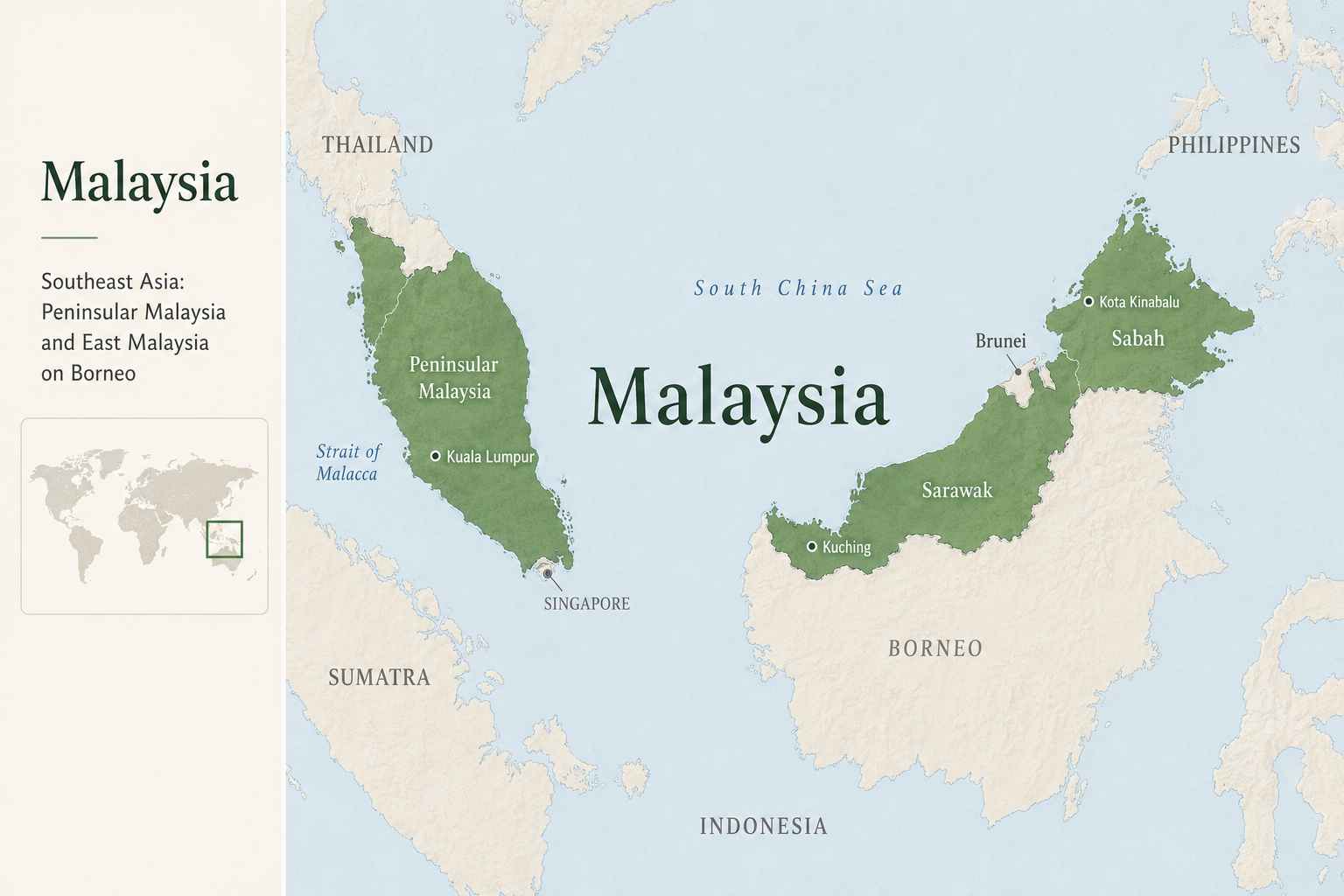
World Bank data lists Malaysia’s 2024 population at 35,557,673. The U.S. Department of State’s 2023 religious-freedom report, citing Malaysia’s 2020 census, says 63.5% of the population practices Islam, 18.7% Buddhism, 9.1% Christianity, and 6.1% Hinduism. The same report notes that two-thirds of Malaysia’s Christian population lives in Sabah and Sarawak, the East Malaysian states on Borneo.
Restrictions and Opposition Facing Christians and Churches
Restrictions are not the same in every part of Malaysia, but Christians face serious limits where faith intersects with Islam, family life, conversion, and public law.
Conversion and religious identity
One major restriction concerns Muslims who seek to leave Islam. The State Department report says Muslims who seek to convert to another religion must first obtain approval from a sharia court, and that such requests are seldom granted, especially for those born Muslim and ethnic Malay. For a believer from a Muslim background, following Christ may therefore carry legal, family, and social consequences that go far beyond private belief.
Restrictions on ministry to Muslims
Malaysia’s constitution gives federal and state governments power to control or restrict propagation of religious doctrine among Muslims. The State Department report also says the law forbids proselytizing of Muslims by non-Muslims, with penalties varying by state. Churches therefore need wisdom and restraint without losing gospel conviction.
Religious-sensitivity enforcement
Public discussion about religion can quickly become tense. Authorities have used laws concerning sedition, religious offense, and public order in cases involving speech or expression deemed insulting to Islam or harmful to religious harmony. This does not affect Christians alone, but it can make churches, publishers, teachers, and ordinary believers more cautious in public Christian speech.
Worship space and registration pressures
State governments have authority over land allocation and construction for houses of worship. The State Department report says some non-Muslim groups have reported difficulty obtaining permission to build new places of worship, leading some communities to meet in buildings zoned for other purposes. These restrictions are often administrative, but they can still affect where churches gather, how visible they are, and how easily congregations can serve their communities.
Christian Life and Witness in Malaysia
Many Malaysian Christians worship openly, especially in Sabah and Sarawak, while believers from Muslim backgrounds may face legal, family, and social costs that are not always publicly visible.
For many Christians in Malaysia, daily life includes real freedoms. Churches exist openly. Christian families worship, serve, raise children in the faith, and participate in ordinary public life. In Sabah and Sarawak, Christian communities have a deep and visible presence. That is a genuine mercy, and it should be acknowledged with gratitude.
Yet the burden is not only whether churches exist. It is also how freely Christians can live and speak when law, identity, and religion overlap. For ordinary believers, faithfulness may mean learning when to speak plainly and when to speak carefully. It may mean refusing fear while avoiding needless provocation. It may mean raising children in the truth while helping them understand a public environment where religion can quickly become politically sensitive.
For believers from Muslim backgrounds, the cost can be deeper still. Marriage, burial, child custody, identity documents, and family belonging can become difficult when a person’s faith is treated not merely as a matter of conscience, but as a legal and communal identity question. Even when these pressures do not become national news, they can affect marriage, family relationships, church fellowship, identity documents, and ordinary obedience to Christ. These believers need the prayers of the wider church for courage, protection, fellowship, and wise pastoral care.
Recent Developments
Recent legal and public-religion developments show why Malaysia needs prayer for justice, restraint, conscience, and wise Christian witness.
-
January 2024
Filmmakers charged over religious-offense claims
Associated Press reporting said the director and producer of the Malaysian film Mentega Terbang were charged with offending the religious feelings of others. The case was not a church case, but it showed the sensitivity of public religious discussion in Malaysia.
How this guides prayer: Pray for wisdom, restraint, and truthfulness in public life, and for Christians to witness without fear or carelessness.
-
February 2024
Federal Court limits Kelantan state religious-criminal laws
Associated Press reporting said Malaysia’s Federal Court invalidated 16 sharia-based criminal laws in Kelantan after ruling that the state had legislated beyond its authority in matters covered by federal law. The court also clarified that the ruling did not challenge Islam’s constitutional status.
How this guides prayer: Pray for legal restraint, wise governance, and justice where religious authority, state law, and civil law meet.
-
November 2025
Court rules in Raymond Koh and Amri Che Mat disappearance cases
Associated Press reporting said Malaysia’s High Court ruled that the government and police were responsible for the enforced disappearances of Christian pastor Raymond Koh and Muslim activist Amri Che Mat. The court ordered investigations reopened and awarded damages, while the Attorney-General’s Chambers said it would appeal.
How this guides prayer: Pray for truth, accountability, comfort for the families, and the restraint of every abuse of power.
Converts from Islam
One of Malaysia’s clearest prayer burdens is the vulnerability of those who come to Christ from a Muslim background.
A Muslim who comes to trust in Christ does not enter a neutral legal position. In Malaysia, questions that should be handled pastorally can become entangled with state systems, family claims, identity documents, and public religious expectations. The State Department report says sharia courts seldom grant requests by Muslims to be legally recognized as converts out of Islam, and some state laws criminalize apostasy.
That means converts often need more than courage in the moment. They need long endurance, careful shepherding, trustworthy fellowship, and wise help through complex practical questions. Praying for Malaysia should therefore include not only visible congregations, but also the hidden, vulnerable, and easily isolated believer whose obedience may carry a very high personal cost.
How to Pray
Pray for Malaysia with love, sobriety, and hope, asking the Lord to strengthen His church and make Christ known with wisdom and courage.
-
Pray for churches to remain faithful to Scripture and clear about Christ. Ask the Lord to keep Malaysia’s churches strong in holy, patient witness rather than fear, confusion, or compromise.
-
Pray for believers from Muslim backgrounds. Ask God to protect those who may face family pressure, legal difficulty, isolation, or quiet suffering because they follow Christ, and to give them wise pastoral care, trustworthy fellowship, and endurance.
-
Pray for pastors, elders, and church leaders. Ask the Lord to give them courage joined with humility, so they can shepherd wisely in a setting where questions of religion, law, and public life often meet.
-
Pray for justice, truth, and restraint in public life. Ask God to bring fuller truth into the open in unresolved disappearance cases, to restrain every abuse of power, and to establish what is just where there has been concealment, fear, or wrongdoing.
-
Pray for peace and fairness where religious tensions rise. Ask the Lord to restrain hostility, soften hardened hearts, and grant that Christians, Muslims, and others would not be driven further into suspicion, anger, or public agitation.
-
Pray for ordinary believers in daily faithfulness. Ask God to strengthen Christians who must live carefully, speak wisely, raise families in the faith, and remain loving and truthful in settings where witness may be costly.
-
Pray for gospel fruit across the whole country. Ask the Lord to build up faithful churches in Peninsular Malaysia, Sabah, and Sarawak, and to deepen unity across ethnic, linguistic, and regional lines for the honor of Christ.
Give Thanks
Give thanks honestly for the mercies God has preserved in Malaysia, even while praying seriously about religious restrictions, unresolved injustice, and the needs of vulnerable believers.
-
Give thanks that Christ has preserved a visible church in Malaysia. Christian congregations and longstanding Christian communities remain present, especially in Sabah and Sarawak, and the gospel has not been extinguished there.
-
Give thanks for signs of legal restraint and public accountability. Some court decisions have checked legal overreach, and the 2025 ruling in the Raymond Koh case publicly named grave wrongdoing.
-
Give thanks for the real freedoms that still remain. In many places, believers are still able to gather, worship, read Scripture, disciple one another, and bear witness, even within an uneven and pressured setting.
-
Give thanks for God’s common grace in Malaysia’s public life. The country is not defined only by tension. There remains social order, institutional structure, and space for ordinary Christian faithfulness, which are mercies worth recognizing with honesty and gratitude.
Review Status
This note helps readers understand when the guide was reviewed and which developments may affect future prayer use.
Review Status
Reviewed for current prayer use
This guide reflects a May 2026 review of Malaysia’s current national leadership, population data, religious-freedom framework, recent high-profile religion-and-conscience cases, and the main restrictions and social pressures affecting Christian witness and discipleship.
Later developments in the Raymond Koh and Amri Che Mat cases; further court or policy decisions affecting the relationship between civil law and state religious enforcement; and new public controversies or prosecutions tied to religious offense, conversion, worship spaces, or Christian witness.
Key Sources Consulted
The main public sources used to prepare this Malaysia prayer guide.
- Prime Minister’s Office of Malaysia, “PM’s Profile” — used to verify the current prime minister and basic leadership context.
- World Bank, “Malaysia | Data” — used for current population data.
- U.S. Department of State, 2023 Report on International Religious Freedom: Malaysia — used for religious demography, constitutional and legal framework, conversion restrictions, sharia-civil law context, and worship-space pressures.
- Associated Press, “Families of missing Malaysian pastor and activist win landmark lawsuit against government” — used for the November 2025 Raymond Koh and Amri Che Mat ruling.
- Associated Press, “Malaysia’s top court invalidates state’s Islam-based laws on incest, sodomy and other offenses” — used for the February 2024 Federal Court ruling concerning Kelantan state laws.
- Associated Press, “Two Malaysian filmmakers are charged with offending the religious feelings of others in banned film” — used for recent public-religion and religious-expression context.
Source Context
- Population and religion data: The population figure comes from World Bank 2024 data; the religious-composition figures come from Malaysia’s 2020 census as reported in the U.S. Department of State’s 2023 religious-freedom report.
- Religious-freedom framework: Malaysia’s situation varies by state, religious background, ethnicity, and legal category. The country should not be understood as either uniformly free or uniformly closed.
- Recent cases: The Raymond Koh and Amri Che Mat ruling is included because it matters for prayer about justice, accountability, and religious freedom. The case should not be taken to represent every Malaysian authority or every part of Malaysian public life.
A Closing Prayer for Malaysia
A concise prayer gathering Malaysia’s present burden before the Lord.