

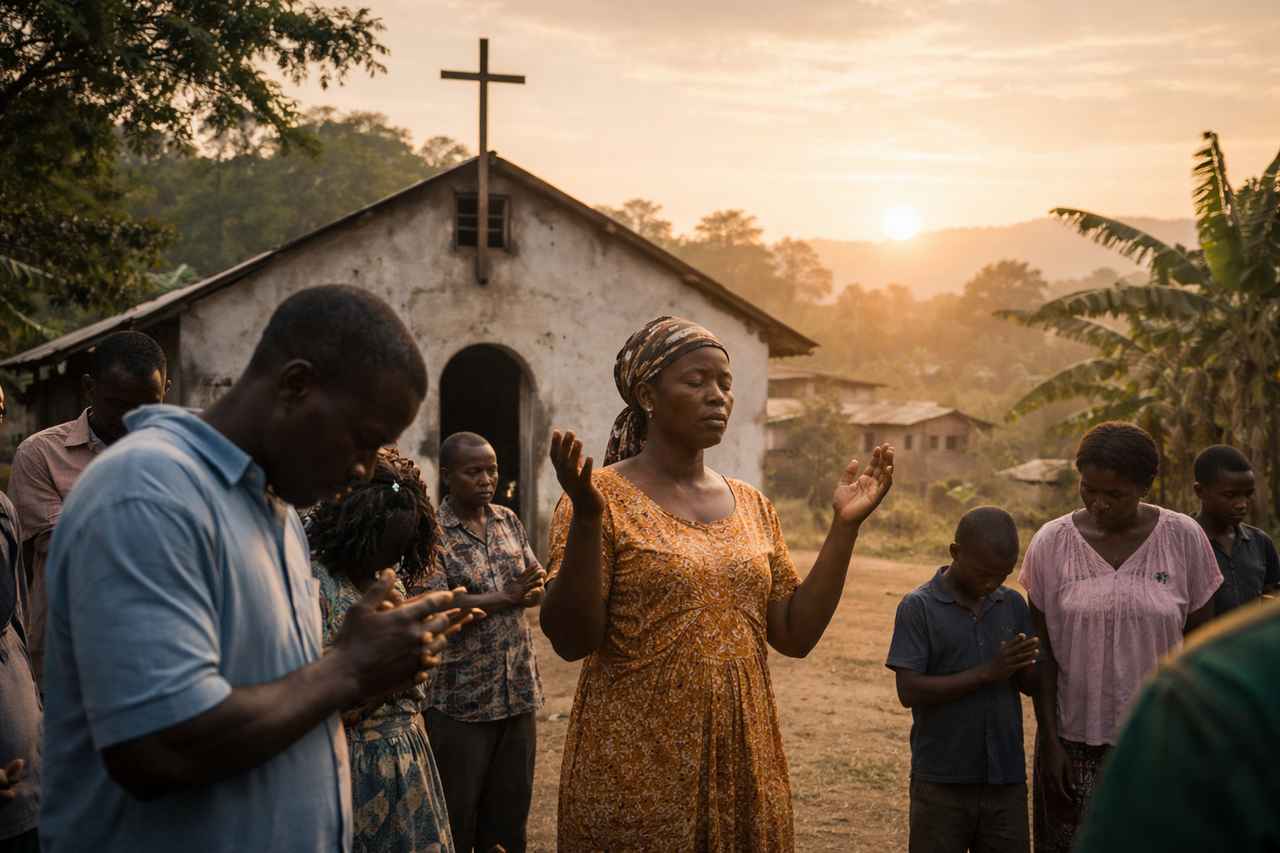
Pray for Uganda as a country where Christian profession is widespread and church life is publicly visible, yet where believers and leaders still need courage, truthfulness, and deep faithfulness in a tense public moment. Pray that the Lord would preserve his people from fear, political co-option, and merely outward religion, and would make the church in Uganda steady, holy, and full of gospel hope.
Opening Burden / Summary
Uganda needs prayer with both gratitude and sobriety. The country is numerically and publicly majority Christian, and ordinary worship is not generally hidden or forbidden. At the same time, political power remains highly concentrated, the January 2026 election period was marked by credible reports of repression and intimidation, Allied Democratic Forces (ADF)-linked security threats still create real concern around major Christian gatherings, and churches face pastoral pressures in a society where Christian identity is common but public life is strained. Uganda also carries a major regional mercy burden as one of Africa’s largest refugee-hosting countries, with nearly two million refugees and asylum seekers placing pressure on host communities, schools, clinics, aid workers, and churches seeking to serve vulnerable families. Pray that Christ would strengthen his people to live and speak faithfully.
Why This Country Needs Prayer Now
Uganda needs prayer now because several burdens are pressing at once. The country has passed through a disputed and tightly controlled election season. Official presidential election results were announced on 17 January 2026, while opposition leaders rejected the result. Rights bodies and international reporting also described repression and intimidation before the vote; Human Rights Watch reported on 14 January 2026 that authorities ordered at least 10 nongovernmental organizations to cease operations indefinitely, and Uganda imposed an internet shutdown ahead of the election.
On 26 February 2026, Uganda’s Supreme Court allowed former presidential candidate Robert Kasibante to withdraw his petition challenging the declared result of the 15 January 2026 presidential election. On 5 May 2026, Parliament passed the Protection of Sovereignty Bill after amendments and public controversy. Supporters presented it as a safeguard against foreign interference, while critics warned of possible effects on civil society, public speech, foreign-funded work, and humanitarian or development activity. Uganda also continues to host nearly two million refugees and asylum seekers, making mercy ministry, public-service strain, and care for displaced families an important prayer burden. At the same time, security concerns remain real, as shown by the 3 June 2025 interception of suspects linked to the ADF near Munyonyo Martyrs’ Shrine ahead of Martyrs’ Day celebrations. Uganda also has a very young population, with roughly half the country under age 18 according to the May 2024 census, which makes faithful discipleship, pastoral care, and truthful witness especially important.
Country Snapshot
Uganda is a landlocked East African country whose capital is Kampala. The Uganda Bureau of Statistics reports a total population of 45,905,417 in the May 2024 census. The same census reports that Christians make up 81.7% of the household population and Muslims 13.2%. Within the Christian population, the largest reported groups are Roman Catholic at 36.2%, Anglican / Church of Uganda at 29.0%, and Pentecostal / Evangelicals at 14.3%. The United Nations High Commissioner for Refugees (UNHCR) Uganda data portal reported 1,999,576 refugees and asylum seekers in Uganda as of 31 March 2026, based on Government of Uganda Office of the Prime Minister and UNHCR data.
Uganda’s constitution provides that there is no state religion and protects freedom of thought, conscience, belief, and religious practice. It also prohibits religious discrimination and political parties formed on a religious basis. Freedom House reports that freedom of worship is generally respected in practice, even while political power remains heavily concentrated around President Yoweri Kaguta Museveni and the ruling National Resistance Movement.
Main Pressures Facing Christians
Uganda should not be treated as a simple persecution country. The main pressures are more specific. Rights reporting and recent election-period coverage indicate that Ugandan public figures, journalists, activists, and dissenting voices have faced intimidation and restrictions; church leaders therefore need wisdom and courage when speaking truthfully in public life. A second pressure is security risk in ADF-affected contexts and around symbolic Christian events. A third is pastoral: churches must walk with wisdom and mercy in a morally and politically charged public setting, including after the Anti-Homosexuality Act, 2023 and the Constitutional Court ruling of 3 April 2024. Another pressure is mercy-ministry capacity: churches and Christian organizations serving refugees, vulnerable children, and host communities may face growing needs at the same time that aid systems, public services, and civic organizations are under strain.
What Life Is Like for Christians
Christians are highly visible in Ugandan public life, and church life is not generally illegal or underground. Catholic, Anglican / Church of Uganda, Pentecostal / Evangelical, Seventh-day Adventist, Orthodox, and smaller communities all have a public presence. Ordinary Christian life therefore includes real freedom to gather and worship, but it also unfolds in a setting where public religion is common, political pressure can shape what leaders feel free to say, and some communities live with sharper concern about security and instability than others.
Recent Developments
- 3 April 2024: Uganda’s Constitutional Court generally upheld the Anti-Homosexuality Act, 2023, while nullifying Sections 3(2)(c), 9, 11(2)(d), and 14.
- 31 December 2024: UBOS published the National Population and Housing Census 2024 Final Report Volume 1, which now provides the strongest current population and religion figures for the country.
- 3 June 2025: Authorities said two suspects linked to the ADF were intercepted near Munyonyo Martyrs’ Shrine ahead of Martyrs’ Day celebrations.
- 9 January 2026: The UN Office of the High Commissioner for Human Rights (OHCHR) warned that Uganda’s elections would take place in an environment marked by widespread repression and intimidation against opposition figures, journalists, human-rights defenders, and dissenting voices.
- 13 January 2026: Uganda imposed an internet shutdown ahead of the 15 January election.
- 14 January 2026: Human Rights Watch reported that authorities ordered at least 10 nongovernmental organizations to cease operations indefinitely ahead of the vote.
- 17 January 2026: Uganda’s Electoral Commission declared President Museveni the winner of the presidential election with 71.65% of the vote; opposition leader Bobi Wine rejected the result.
- 20 January 2026: Human Rights Watch described the election result as coming amid repression and documented continuing restrictions on opposition figures and civic space.
- 26 February 2026: Uganda’s Supreme Court allowed Robert Kasibante to withdraw his petition challenging the declared election result.
- 31 March 2026: UNHCR’s Uganda data portal reported 1,999,576 refugees and asylum seekers in Uganda.
- 5 May 2026: Parliament passed the Protection of Sovereignty Bill after amendments and public controversy.
How to Pray
- Pray for pastors and church leaders to speak truth with courage, humility, and wisdom, without being captured by party power or silenced by fear.
- Pray for believers across Uganda to grow in sincere faith and obedience to Christ, not resting in public Christian identity alone.
- Pray for churches to disciple children, teenagers, and young adults faithfully, since roughly half the country is under age 18.
- Pray for protection for worshipers, church institutions, and major Christian gatherings, especially where ADF-linked threats have raised anxiety.
- Pray for refugees and asylum seekers in Uganda to receive mercy, protection, dignity, and practical care.
- Pray for host communities, churches, clinics, schools, aid workers, and public servants under pressure as they serve displaced families and vulnerable children.
- Pray for wisdom, truthfulness, restraint, and justice in public life as leaders and citizens navigate contested legislation and civic-space concerns.
- Pray for churches to show doctrinal clarity together with pastoral tenderness in morally charged questions, speaking truthfully and acting with neighbor love.
Give Thanks
- Give thanks for the broad public visibility of Christian witness and for the many churches and ministries present across Uganda.
- Give thanks that Uganda’s constitution protects religious worship and does not establish a state religion.
- Give thanks for longstanding Christian institutions and public Christian memory, including the enduring witness associated with the Uganda Martyrs.
- Give thanks for Uganda’s long record of receiving refugees and for churches, communities, public servants, and humanitarian workers who serve displaced and vulnerable families.
- Give thanks that the suspected June 2025 ADF-linked threat near Martyrs’ Day celebrations was intercepted before it became a mass-casualty attack.
Last Updated
Last updated: 2026-05-07
Key External Sources Consulted
- Uganda Bureau of Statistics, National Population and Housing Census 2024 Final Report Volume 1, published 31 December 2024.
- Constitution of the Republic of Uganda (1995).
- Freedom House, Freedom in the World 2025: Uganda.
- U.S. Department of State, 2023 Report on International Religious Freedom: Uganda.
- Judiciary of Uganda press release on the Constitutional Court ruling on the Anti-Homosexuality Act, dated 3 April 2024.
- Human Rights Watch, 20 January 2026, on Museveni’s declared election victory amid repression.
- UN Office of the High Commissioner for Human Rights (OHCHR), 9 January 2026, on repression and intimidation in the election period.
- Human Rights Watch, 14 January 2026, on suspension of civic groups ahead of the election.
- Human Rights Watch, 15 January 2026, on Uganda’s internet shutdown.
- Associated Press, 17 January 2026, on the official presidential election result.
- Daily Monitor, 26 February 2026, on the withdrawal of Robert Kasibante’s petition challenging the declared election result.
- Parliament of Uganda, report on passage of the Protection of Sovereignty Bill, posted 6 May 2026.
- UNHCR Uganda data portal, refugee and asylum seeker total, last updated 31 March 2026.
- WHO Regional Office for Africa, 13 February 2026, on Uganda’s health system serving more than 1.92 million refugees.