


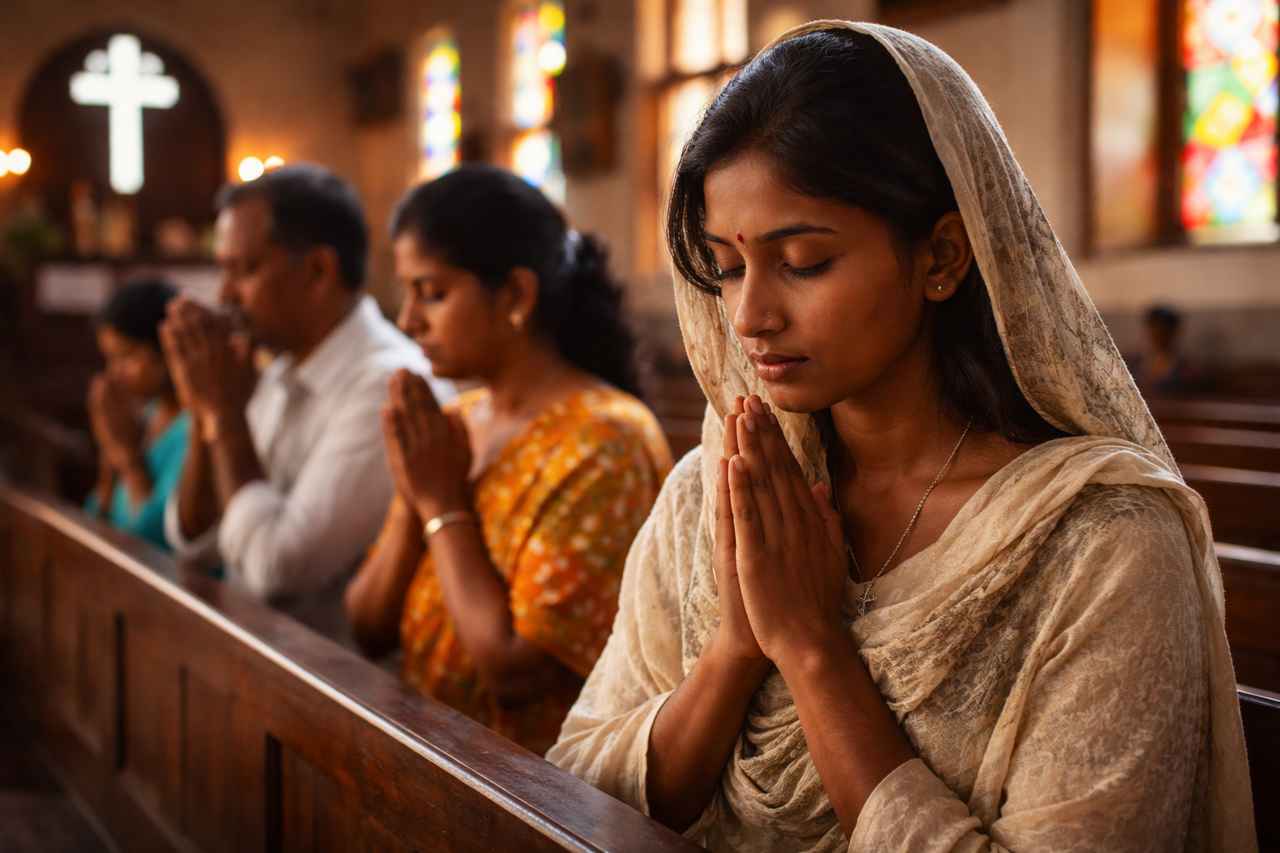
India is one of the world’s most influential nations. It is a vast federal parliamentary republic of about 1.45 billion people, led by Prime Minister Narendra Modi, and marked by extraordinary religious, linguistic, and cultural diversity. Yet Christians in India need prayer now because, in many places, faithful Christian life is becoming harder. Legal pressure, social suspicion, mob hostility, and unresolved regional violence are all shaping the church’s present burden. Open Doors ranks India 12th on its 2026 World Watch List, a ranking that helps show the seriousness of present pressures without pretending that one list tells the whole story. In all of this, believers need grace to stand firm in Christ, whose rule is not threatened by any nation’s turmoil.
Why This Country Needs Prayer Now
India’s burden is not simple, and it should not be described in simple terms. The country still has formal constitutional protections for freedom of conscience, and its public life still includes courts, institutions, and legal avenues that matter. Those are real mercies and should not be ignored. Yet formal freedoms do not always mean equal safety on the ground. In many places, Christians live under a growing cloud of suspicion, especially where ordinary Christian witness can be recast as unlawful conversion activity.
That is why India needs prayer now. The burden is not only the risk of open violence. It is also the quieter strain of false accusation, community hostility, legal uncertainty, and the long weariness of trying to remain faithful where faithfulness is increasingly mistrusted. Christians need prayer for protection, but also for holiness, patience, courage, and love under pressure.
Country Snapshot
India is in South Asia and is now the world’s most populous country, with about 1.45 billion people. It is a federal parliamentary republic, and the current prime minister is Narendra Modi. Pew Research describes India as a country with a large Hindu majority and significant Muslim, Christian, Sikh, Buddhist, Jain, and other minority communities. Christians are a small minority nationally, though some northeastern states have large and longstanding Christian populations.
That diversity matters. Christian life in India is not uniform. A Christian family in the northeast, a village convert in central India, and a pastor in a major city may all face different pressures. The national picture matters, but local realities often determine what daily faithfulness actually costs.
Main Pressures Facing Christians
One major pressure comes from state anti-conversion laws. Open Doors says such laws are in force in 12 states, and it describes them as contributing to intense pressure on Christians across the country. In March 2026, Christian Solidarity Worldwide, a religious-freedom advocacy organization, reported that Maharashtra’s legislature passed the Freedom of Religion Bill 2026, which would add another such law if it received the governor’s assent. Supporters say these laws are meant to stop forced or fraudulent conversions. Critics argue that vague wording can make ordinary Christian ministry and witness vulnerable to accusation.
A second pressure comes from mob hostility and escalating attacks. In February 2026, the U.S. Commission on International Religious Freedom, an American government advisory body, warned that religious minorities in India were suffering escalating attacks. For Christians, that means accusations can quickly become intimidation, disruption of worship, or outright violence.
A third pressure comes through regulation and institutional constraint. Open Doors says restrictions under the Foreign Contribution Regulation Act, India’s law governing foreign funding, have become part of a wider squeeze on Christian organizations and ministries that receive support from abroad. In practice, legal pressure and social pressure often work together.
The burden often falls heaviest on converts from Hindu backgrounds. Open Doors says these believers frequently face family pressure, social rejection, harassment, and violence because their faith is seen not only as a private religious choice, but as a break with community loyalty and inherited identity.
What Life Is Like for Christians in India
For many Christians in India, the pressure is not always loud, but it is deeply felt. A church meeting may be interrupted. A pastor may be reported to the police. A prayer gathering in a home may be treated with suspicion. Christian witness online may draw unwanted attention. Complaints about religious activity can become tools for harassment.
In some places, believers learn to live carefully. They still gather, still pray, still teach their children, and still bear witness to Christ. But they do so with a growing awareness that ordinary acts of faithfulness may be misread, challenged, or deliberately twisted. For converts, the burden is often even more personal, touching family peace, livelihood, safety, and belonging.
At the same time, India should not be painted in only dark colors. The church in India is not absent, silent, or extinguished. Christian communities remain visible in many places, and longstanding churches, schools, hospitals, and ministries still serve the public. Even under pressure, the Lord has not left Himself without a witness.
That mix of strain and endurance is especially visible in Manipur. Reuters reported in April 2026 that fresh violence killed four people after months of relative calm. The wider conflict, which first erupted in 2023 between the mostly Hindu Meitei community and the mainly Christian Kuki tribes, has killed around 260 people and displaced more than 60,000. For Christians there, daily faithfulness is bound up with grief, trauma, displacement, and the longing for real peace.
Recent Developments
Several developments in 2026 make prayer especially urgent.
First, in February 2026, the Supreme Court of India sought responses from the central government and 12 states after a petition from the National Council of Churches in India, a large ecumenical church body, challenged anti-conversion laws. That does not mean those laws have been overturned, but it does mean the legal questions remain active and significant.
Second, anti-Christian attacks remained visible in early 2026. The U.S. Commission on International Religious Freedom said religious minorities were suffering escalating attacks, showing that the burden is not limited to older incidents from past years.
Third, Maharashtra’s legislature passed a new anti-conversion bill in March 2026. Christian Solidarity Worldwide reported that the bill requires prior notice before conversion and carries serious penalties. Supporters defend it as protection against coercion or fraud. Critics warn that it could criminalize legitimate Christian ministry and embolden further harassment.
Fourth, the April 2026 violence in Manipur ended a period of relative calm and reminded the church that unresolved regional wounds remain dangerous. India’s prayer burden is therefore shaped not only by legal pressure and social hostility, but also by the fact that fragile peace can break again with terrible speed.
How to Pray
- Pray that Indian Christians would remain steadfast in Christ: humble, brave, truthful, and full of love, not swallowed by fear or bitterness.
- Pray especially for converts and for pastors, who often face the sharpest accusations, family pressure, police scrutiny, or mob hostility.
- Pray for believers in Manipur: for displaced families, grieving churches, injured communities, and all those living with trauma. Ask God for restraint, repentance, justice, mercy, and lasting peace.
- Pray for judges, police, and civil authorities. Ask the Lord to grant wisdom and integrity so that genuine coercion is distinguished from false accusation, and that no one is punished simply for peaceful Christian worship or witness.
- Pray for Christian ministries and congregations that serve quietly and faithfully. Ask God to strengthen schools, hospitals, charities, local churches, and house fellowships so that they continue to shine with truth and love.
- Pray that the gospel would continue to bear fruit across India, and that the church would answer hostility not with compromise or rage, but with holiness, patience, and bold witness to Christ.
Give Thanks
- Give thanks that India’s constitutional order still includes formal protection for freedom of conscience and religion, even where those protections are unevenly tested in practice.
- Give thanks that legal challenge is still possible. The willingness of the Supreme Court to hear petitions on anti-conversion laws is one sign that God’s restraining mercy has not vanished from public life.
- Give thanks for the continued presence and endurance of the church. Christians remain a visible part of India’s public life, and in some regions there are deep-rooted Christian communities that continue to worship, serve, and bear witness.
- Give thanks for signs of common grace that still remain: for every measure of public restraint, every faithful church, every just decision, and every mercy by which God preserves space for witness in a pressured climate. Let that gratitude lead not to naivety, but to deeper trust in Christ, who rules over nations and preserves His people by grace.
Last Verified
Last updated: April 16, 2026. The most volatile claims in this version were checked against current official officeholder information, recent legal reporting, recent Reuters reporting from Manipur, and current 2026 religious-freedom materials.
Key sources consulted
- National Portal of India, Who’s Who.
- World Bank Data, India country page.
- Pew Research Center, Key findings about the religious composition of India.
- U.S. Commission on International Religious Freedom, Religious Minorities in India Suffer Escalating Attacks (February 6, 2026).
- Christian Solidarity Worldwide, Maharashtra State passes anti-conversion bill (March 23, 2026).
- PTI in The Week, SC issues notices to Centre, 12 states on PIL by Christian body against anti-conversion laws (February 2, 2026).
- Open Doors, India — World Watch List 2026 country profile and Open Doors World Watch List 2026: India country dossier.
- Reuters, Four killed after violence flares in India’s Manipur state (April 2026).


