

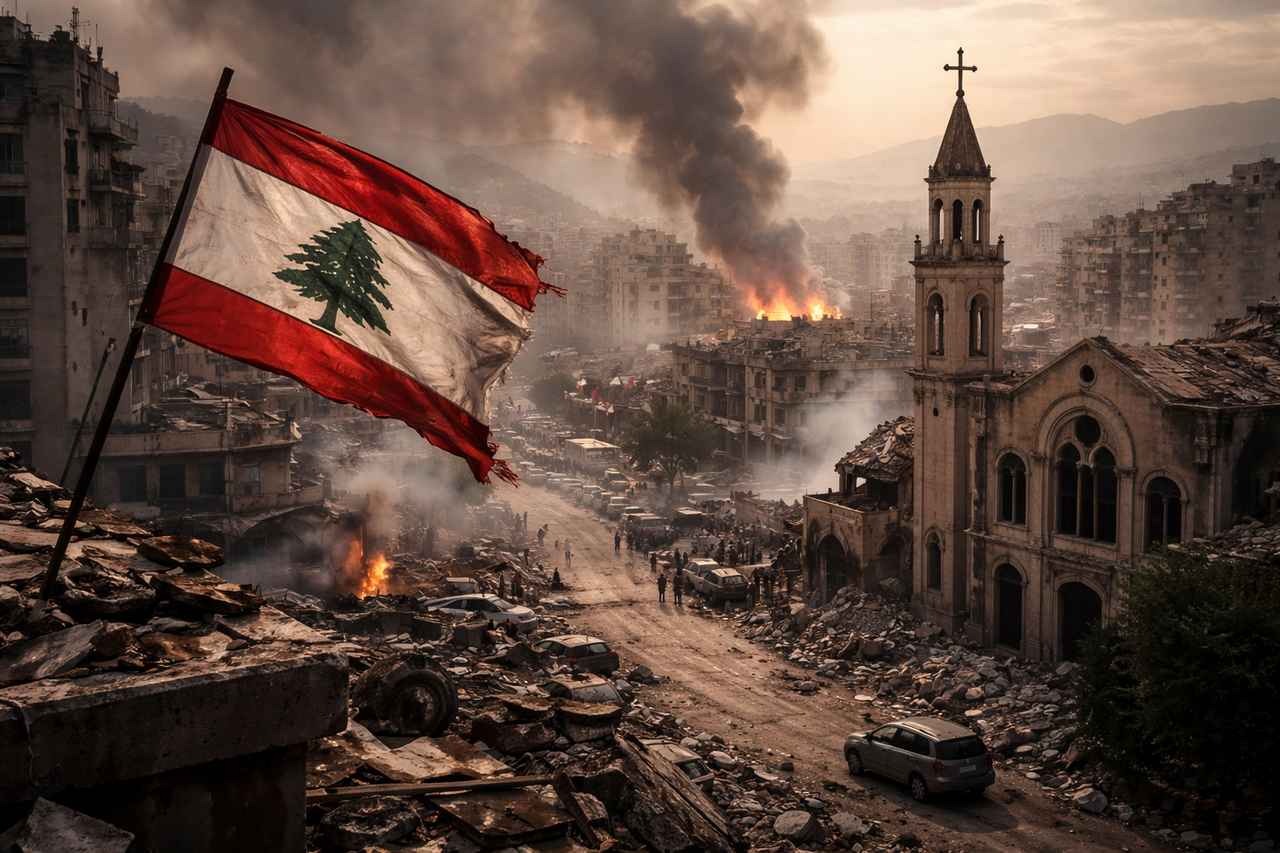
Lebanon calls for informed Christian prayer because the country is living through a fragile pause, not a settled peace. After weeks of devastating fighting, a 10-day ceasefire began on April 17, 2026, following rare direct talks with Israel in Washington. Yet the wounds left by the war are deep, the humanitarian burden is still heavy, and the pressures weighing on the country did not disappear when the guns briefly quieted.
For believers in Lebanon, this means ordinary faithfulness is still being lived out in grief, uncertainty, and strain. Churches are still gathering, families are still trying to hold together, and many ordinary people are still waiting to see whether this moment will become a real turning point or only a short breath before further trouble.
1. Why This Country Needs Prayer Now
Lebanon needs prayer now because even this ceasefire has come after immense loss. By April 17, AP reported that the conflict had killed more than 2,000 people in Lebanon and displaced more than one million, while UNICEF’s April updates described a devastating toll on children and deepening humanitarian strain.
That matters because the burden is not only national or military. It is personal. Families have lost homes. Parents are trying to keep children safe. Churches are serving people who are grieving, uprooted, or exhausted. Even where public worship continues, it does so in a country where fear and uncertainty have come close to the surface of daily life.
Yet the burden is not only the fighting itself. Lebanon is also trying to steady public life, reassert state authority, and pursue long-delayed reform while still carrying the effects of earlier economic collapse. In March 2026, a Lebanese presidency statement reported cabinet decisions declaring armed military activity outside state institutions unlawful, calling for implementation of a plan to restrict weapons north of the Litani River, and again insisting on an end to Israeli attacks on Lebanese territory.
All of this should shape Christian prayer. Lebanon needs prayer for peace, for truth, for restraint of evil, for wise leadership, for the church’s endurance, and above all for the Lord’s mercy in a country where many are tired, anxious, and uncertain what comes next.
2. Country Snapshot
Lebanon is a small Eastern Mediterranean country centered on Beirut, and its public life is shaped by a long-standing sectarian power-sharing system. After more than two years of presidential deadlock, parliament elected Joseph Aoun as president in January 2025. Nawaf Salam was designated prime minister soon after, formed a 24-member cabinet in February 2025, and his government later won a parliamentary confidence vote. That ended a long vacuum, but it did not remove Lebanon’s deeper instability.
Lebanon’s religious makeup is politically sensitive and difficult to state with exact precision because the country has not held an official census for decades. Even so, a substantial Christian presence remains part of Lebanon’s public life in ways that are unusual in much of the region. Churches are visible. Christian institutions still matter. Historic Christian communities remain woven into the country’s life.
That is important to remember. Lebanon is not a place where the church is absent. But neither is it a place where visibility guarantees ease. The church lives in a country marked by strain, uneven freedoms, political fragility, and recurring crisis.
3. Main Pressures Facing Christians
The first pressure is the wider national crisis. War, displacement, damaged infrastructure, and recurring instability are not background issues that sit outside church life. They press directly into it. Congregations are affected when members are displaced, when roads become harder to travel, when schools close, when livelihoods collapse, and when ministry shifts from ordinary rhythms into emergency care.
A second pressure falls especially on converts to Christ from Muslim or Druze backgrounds. In Lebanon, Christianity is publicly present, but that does not mean every form of Christian discipleship carries the same social cost. Some converts still face serious family or community pressure, and churches often move carefully because open visibility may bring real personal consequences.
A third pressure is structural unevenness. Lebanon recognizes a number of religious communities and does provide real space for Christian presence, but not every group experiences that space in the same way. Some communities still face practical complications around legal recognition, marriage, or personal-status issues. So the country should not be described either as broadly closed or as simply free and uncomplicated. The reality is more mixed than either shortcut suggests.
A fourth pressure is long exhaustion. Lebanon’s financial collapse did not vanish when the political deadlock eased. In January 2026, the World Bank described Lebanon’s economy as showing a fragile rebound tied to uneven reform progress, and in February 2026 the International Monetary Fund said deeper banking and fiscal reforms were still critical. Now the fresh damage of war has fallen on top of that older weariness.
4. What Life Is Like for Christians in Lebanon
For many historic Christian communities, church life in Lebanon is still public, rooted, and visible. Churches gather openly. Christian schools and networks remain meaningful. Christian presence in national life has not disappeared. That is a real mercy, and it should be acknowledged plainly.
But public presence is not the same thing as peace.
For many believers, daily life now carries layers of strain at once. Some are worried first about shelter, medicine, schooling, and the safety of relatives. Others are carrying the slower grief of watching instability drain strength from churches, businesses, schools, and families. In affected areas, ordinary faithfulness may now look very simple and very costly: finding a safe place to sleep, checking on neighbors, keeping worship going, caring for the displaced, and resisting despair.
For converts, the burden can be quieter and more hidden. Their greatest fear may not be a national decree, but the reaction of relatives, neighbors, or social networks if their allegiance to Christ becomes known. In practice, this often means careful conversations, guarded discipleship, and a real cost attached to open witness.
Still, Lebanon’s Christians are not called merely to survive. They are called to remain the church: to worship God, love neighbor, speak truth with wisdom, care for the weak, and bear witness to Christ in a land where many people are longing for mercy, steadiness, and hope.
5. Recent Developments
Lebanon’s recent story has moved quickly. In early 2025, the country finally emerged from a long presidential deadlock. Joseph Aoun became president in January, Nawaf Salam was designated prime minister, and a new government was formed and approved in February. That gave Lebanon a measure of institutional reset after a long season of paralysis.
Even so, the deeper burdens remained. Through early 2026, the World Bank and IMF continued to describe Lebanon’s recovery as fragile and heavily dependent on reform, fiscal credibility, and banking-sector repair. Even before the latest escalation, Lebanon was still trying to recover while standing on weakened foundations.
Then the situation worsened sharply again in March 2026. UNICEF reported renewed large-scale displacement, mounting civilian harm, and growing pressure on children and basic services. During that same period, a Lebanese presidency statement said the cabinet again asserted that war-and-peace decisions belong to the state and that military activity outside state institutions is unlawful. That official position matters, not because it settles every moral question, but because it shows the government’s own attempt to reclaim authority in a moment of grave weakness.
In April 2026, diplomacy accelerated. Lebanon and Israel held direct talks in Washington on April 14, the first such diplomatic meeting in decades. On April 17, a 10-day ceasefire went into effect. Yet even that development was marked by uncertainty. AP reported that the pause was fragile, and that Israel said it intended to retain troops within a 10-kilometer zone on Lebanese territory near the border for the time being. This is not yet a settled peace. It is a moment of possible restraint, and it should be prayed over as such.
6. How to Pray
- Pray that the Lord would preserve this ceasefire and restrain those forces that would quickly pull Lebanon back into another cycle of destruction. Ask Him to spare civilians, quiet the guns, and grant a more durable peace marked by truth, restraint, and justice.
- Pray for displaced families, the injured, the grieving, and especially for children carrying fear, trauma, and deep uncertainty. Ask God to provide shelter, food, medicine, schooling, and patient mercy for households whose ordinary life has been torn apart.
- Pray for Lebanon’s churches to remain steady in worship, faithful preaching, practical mercy, and gospel witness. Ask that pastors and congregations would not simply endure the crisis, but would serve with wisdom, tenderness, courage, and Christ-centered hope.
- Pray for believers whose discipleship is quieter and more costly, especially converts from Muslim families and from Druze communities. Ask the Lord to guard them from fear, isolation, and pressure, and to provide wise fellowship, sound teaching, and persevering faith.
- Pray for Lebanon’s leaders to act with truthfulness, justice, restraint, and humility. Ask God to frustrate corruption, curb factional ambition, strengthen what serves the common good, and grant public decisions that protect life rather than deepen ruin.
- Pray that Christ would use even this dark and unsettled season to draw many to repentance, faith, and living hope in Him. Ask that suffering would not harden hearts, but that the church would shine with holiness, compassion, and quiet confidence in God’s sovereign mercy.
7. Give Thanks
- Give thanks that Lebanon still has a visible and historically rooted Christian presence, and that churches, schools, and Christian communities remain part of the country’s public life.
- Give thanks for every sign of common grace in this troubled season: humanitarian mercy, neighbors caring for one another, churches serving the displaced, and acts of compassion that help weary people keep going.
- Give thanks that the long political deadlock was broken in 2025, opening at least some path toward steadier public life, reform, and reconstruction, even if that path remains fragile.
- Give thanks for this present ceasefire window, however uncertain it may be. Receive it as a mercy worth praying over, not as a finished peace, and thank God for every moment in which further bloodshed is restrained.
8. Last Verified
Last updated: April 17, 2026. This version preserves still-valid background material, but refreshes the time-sensitive burden around the March-April 2026 fighting, the April 14 talks, the April 17 ceasefire, and the government’s renewed state-authority position.
Next review due: Late April 2026, or sooner if the ceasefire breaks down, deepens into a broader agreement, or gives way to a new escalation.
Key Sources Consulted
- AP, Lebanon and Israel hold first direct diplomatic talks in decades in Washington (April 14, 2026)
- AP, A 10-day ceasefire in Lebanon goes into effect (April 17, 2026)
- UNICEF, Statement on intensified strikes on Lebanon and the devastating impact on children (April 9, 2026)
- UNICEF Lebanon, Humanitarian Flash Appeal / Flash Updates page with April 2026 updates
- Lebanese Presidency, March 2026 cabinet statement on armed activity, state authority, and Israeli attacks on Lebanese territory
- World Bank, Lebanon: Economic Rebound Marks Cautious Recovery amidst Progress on Reforms (January 22, 2026)
- IMF, IMF Staff Concludes Visit to Lebanon (February 13, 2026)