

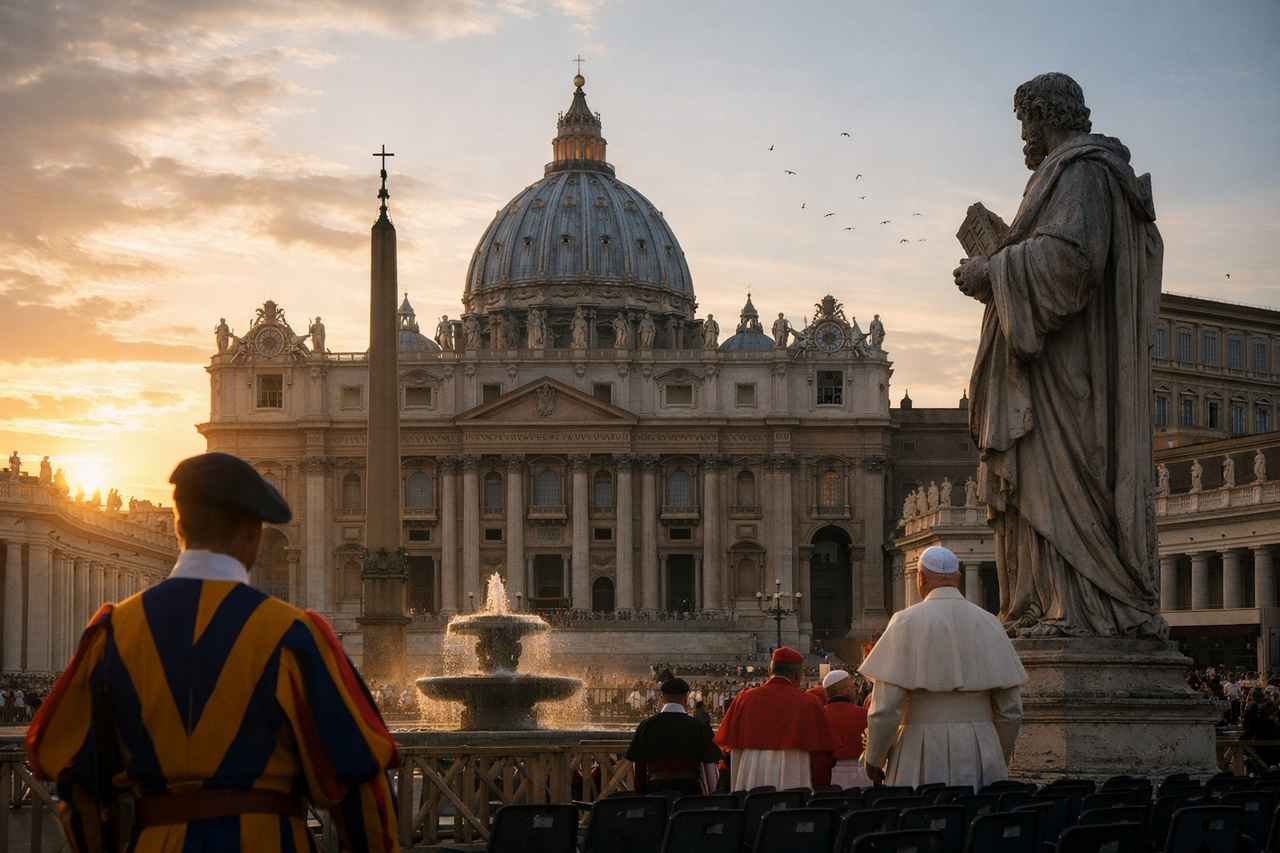
The Vatican is tiny in territory, yet immense in influence. What is said and done there can shape worship, doctrine, diplomacy, and public witness far beyond Rome. In April 2026, it stands in a weighty season: the first year of Pope Leo XIV’s pontificate, renewed public appeals for peace amid war, continuing safeguarding concerns, and unresolved questions about institutional credibility. All of that makes the Vatican a place not merely to watch, but to remember before God in prayer.
1. Why This Country Needs Prayer Now
The Vatican needs prayer now because its influence is moral and spiritual before it is territorial. A change in tone, leadership, or public witness there can affect millions of people across continents. Pope Leo XIV was elected on May 8, 2025, and his early pontificate has already been marked by appeals for peace, concern for persecuted communities, and a visible effort to speak into world affairs.
Yet the burden is not only outward. The Vatican also carries old wounds that have not been healed by time alone. Abuse scandals, safeguarding failures, and questions about financial integrity continue to press on the Church’s witness. These are not minor administrative problems. They touch truth, justice, repentance, and trust.
For evangelical Christians, prayer for the Vatican is not an endorsement of every doctrine or practice associated with Rome. It is a recognition that the Lord Jesus rules over nations, churches, leaders, and institutions, and that where influence is great, accountability is weighty. The Vatican needs prayer that Christ would be honored above ceremony, truth above image, and repentance above defensiveness.
2. Country Snapshot
Vatican City State arose from the Lateran Treaty of 1929, which established it as a sovereign state in order to guarantee the Holy See visible independence in the international sphere. Official Vatican sources describe it as the world’s smallest independent state. The Supreme Pontiff is the head of state and holds full legislative, executive, and judicial authority.
Official Vatican statistics updated to December 31, 2024, report 882 residents in the state. The Vatican is therefore not simply another European microstate. It is the territorial base from which the Holy See exercises a global role in church governance, diplomacy, and public moral witness.
3. Main Pressures Facing Christians
The Vatican does not face the kind of pressure many other country prayer posts must describe. The issue is not violent persecution at home. It is the pressure that comes when spiritual responsibility is joined to institutional power.
One pressure is doctrinal clarity. When a body speaks constantly to the world and claims spiritual authority over millions, confusion can spread widely if the truth of the gospel is blurred. That is why prayer for the Vatican must include a plea for greater faithfulness to Christ, greater submission to Scripture, and greater clarity wherever human tradition threatens to overshadow the saving work of the Lord Jesus.
A second pressure is moral credibility. In March 2026, the Pontifical Commission for the Protection of Minors again stressed survivor engagement, global safeguarding standards, and the centrality of protection within the Church’s life. Those themes matter because the wounds behind them are real. Safeguarding cannot be treated as a public-relations duty. It is a matter of justice, holiness, and neighbor love.
A third pressure is institutional integrity. In March 2026, the Vatican appeal court ordered a partial mistrial in the Holy See financial-management case and required fuller disclosure of investigative materials by April 30, 2026. Whatever the final legal outcome, the case shows why prayer for honesty, fairness, and transparency remains necessary.
A fourth pressure is global diplomacy. The Vatican’s words and agreements can affect churches far beyond Rome, especially in places where believers live under pressure. The Holy See’s October 2024 extension of its provisional agreement with China on the appointment of bishops remains relevant here. It is not a small procedural matter. It touches pastoral care, church order, and the difficult question of how Christian witness is carried in tightly controlled environments.
4. What Life Is Like for Christians in the Vatican
Life in and around the Vatican is shaped by worship, administration, diplomacy, and constant visibility. It is a place of liturgy, offices, audiences, statements, ceremonies, and decisions that ripple outward into the life of the wider church. That means the spiritual dangers there are often quiet ones rather than dramatic ones.
The danger is that sacred things can become routine. Bureaucracy can dull spiritual urgency. Reputation can be guarded more carefully than truth. Power can hide behind ceremony. For those who sincerely desire to serve Christ within that world, faithfulness may mean resisting precisely those temptations.
In practice, that may look like humility in office, honesty in judgment, courage in reform, tenderness toward the wounded, and a willingness to place truth above institutional comfort. This is why prayer for the Vatican should not stop at headlines. It should also remember the ordinary people who labor there and ask that they would fear God more than men, love the truth, and walk in sincere obedience.
Many sincere Roman Catholics also look to Rome for guidance, comfort, and moral direction. That makes the need for biblical clarity all the more urgent. Where Christ is proclaimed truly, we should give thanks. Where he is obscured, we should pray for deeper repentance, reformation, and submission to the Word of God.
5. Recent Developments
The clearest recent development is the continuing first year of Pope Leo XIV’s pontificate. He was elected on May 8, 2025, as the 267th Bishop of Rome. In the early months of his papacy, outside observers such as USCIRF publicly welcomed the Holy See’s stated commitment to advancing freedom of religion or belief for persecuted communities.
In April 2026, Leo XIV called the church to a prayer vigil for peace in St. Peter’s Basilica as conflicts continued in the Middle East and elsewhere. During that vigil, he urged world leaders to stop planning arms and death and to choose dialogue and mediation instead. Around the same time, he began an 11-day trip to Africa, with Algeria as the first stop, placing peace, coexistence, and justice near the center of his public witness.
Other developments point inward. In March 2026, the Pontifical Commission for the Protection of Minors reaffirmed safeguarding as central to the Church’s mission, again highlighting survivor engagement and stronger global standards. That same month, the Vatican appeal court’s partial mistrial ruling in the Holy See financial case showed that questions of due process, transparency, and institutional trust remain active.
One older but still important development also continues to shape the Vatican’s present posture: the Holy See’s October 2024 extension of its provisional agreement with China for another four years. Though it is not new, it still belongs in the current picture because it bears directly on how the Vatican balances diplomacy, church order, and the welfare of Catholics living under state pressure.
6. How to Pray
- Pray that Pope Leo XIV and those who serve with him would fear God, love the truth, and be governed by Scripture rather than by image, habit, or worldly approval.
- Pray that the true gospel of Jesus Christ would shine with greater clarity wherever ceremony, tradition, or institutional self-protection has dimmed it.
- Pray for genuine repentance, justice, and tenderness in every matter related to abuse, so that victims would be heard, protected, and treated with truth and mercy.
- Pray for integrity in financial stewardship, legal processes, and internal governance, so that hidden wrongdoing would be exposed and honesty would prevail.
- Pray that the Vatican’s diplomacy would be marked by wisdom and courage, especially in matters touching war, peace, religious freedom, and the welfare of vulnerable churches.
- Pray for clergy, staff, diplomats, and worshipers in and around the Vatican to walk humbly before God, love what is true, and bear witness to Christ with sincerity rather than ceremony alone.
7. Give Thanks
- Give thanks that no institution lies beyond the sovereign rule of God and that Christ is able to purify, humble, and reform what is weak or compromised.
- Give thanks for every sincere confession of Christ, every faithful act of service, and every genuine effort toward justice, protection, and truth within the wider Roman Catholic world.
- Give thanks that the Vatican has continued to speak publicly about peace and has also publicly reaffirmed the importance of safeguarding and concern for persecuted communities.
8. Last Verified
Last updated: April 14, 2026
Key Sources Consulted
- Vatican official pages on Pope Leo XIV, Vatican City State governance, population, and the Roman Curia.
- Vatican News coverage of the Pontifical Commission for the Protection of Minors’ March 2026 assembly.
- Vatican News coverage of the Vatican appeal court’s March 2026 partial mistrial ruling in the Holy See financial-management case.
- Vatican News / Holy See Press Office materials on the Holy See’s China agreement and April 2026 peace-vigil preparations.
- AP reporting on Pope Leo XIV’s April 2026 peace vigil and Africa trip.
- USCIRF statement welcoming the Holy See’s commitment to advance freedom of religion or belief for persecuted communities.


