


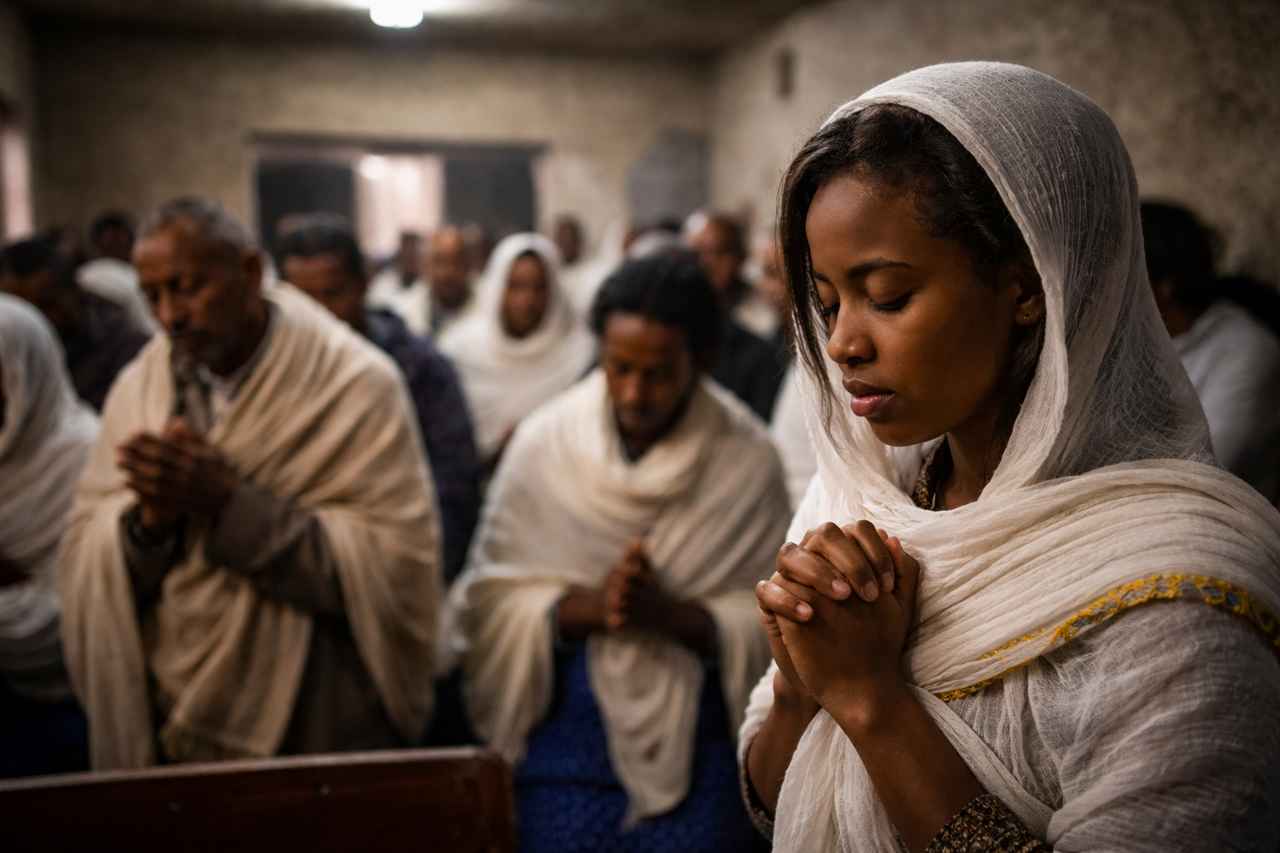
Eritrea calls for sustained Christian prayer because the country’s burdens are both long-standing and painfully current. As of 2026, the government still keeps tight control over religious life, many citizens remain trapped in indefinite national service, and Christians outside state-approved structures continue to face the risk of arrest, surveillance, and long detention without due process. At the same time, tensions with Ethiopia rose again during 2025, so Eritrea’s present burden cannot be seen only as an internal church-pressure story. The wider regional climate may yet deepen fear, instability, and repression.
1. Why This Country Needs Prayer Now
According to Open Doors’ 2026 World Watch List, Eritrea ranks fifth among the countries where Christians face the most severe persecution. Open Doors says the government recognizes only four religious groupings: the Eritrean Orthodox Tewahedo Church, the Roman Catholic Church, the Evangelical Lutheran Church, and Sunni Islam. Christians who worship outside those state-sanctioned structures face intense surveillance, raids, and indefinite imprisonment.
That burden is made heavier by the kind of state Eritrea remains. Human Rights Watch’s World Report 2026 says the country has had no elections since independence in 1993, that President Isaias Afwerki has remained in power since then, and that no political party other than the ruling People’s Front for Democracy and Justice is allowed to exist. In such a setting, the church is not simply trying to live faithfully in a difficult society. It is trying to endure under a government that keeps a close grip on religious life, civil society, and public speech.
The burden is also larger than Eritrea’s internal repression alone. In March 2025, Reuters reported warnings from Tigray officials that Ethiopia and Eritrea could be on a path toward war, and in December 2025 the Associated Press reported Eritrea’s withdrawal from IGAD, the East African regional bloc, amid renewed tensions with Ethiopia and U.N. concern about possible escalation. That does not mean a new war is already underway. It does mean Christians should pray for Eritrea with the wider Horn of Africa in view.
2. Country Snapshot
Eritrea is a small country in the Horn of Africa on the Red Sea, bordering Sudan, Ethiopia, and Djibouti, with Asmara as its capital. Christianity and Islam are both deeply present in the country, but the state allows legal recognition only to the Eritrean Orthodox Tewahedo Church, the Roman Catholic Church, the Evangelical Lutheran Church, and Sunni Islam. That limited recognition shapes much of the country’s religious life, because communities outside that framework face severe restrictions.
As of 2026, Eritrea is still led by President Isaias Afwerki, who has ruled since independence in 1993. Human Rights Watch says the constitution has not been implemented, the legislature has not met since 2010, and civic space remains tightly closed. That broader political reality touches nearly every part of public life, including worship, church leadership, and Christian witness.
3. Main Pressures Facing Christians
One major pressure is legal exclusion. The Eritrean state has not opened the door for new religious communities to be formally recognized. As a result, believers outside the approved groups may be prevented from gathering, opening places of worship, or organizing normal church life. What many Christians elsewhere would consider ordinary fellowship can be treated in Eritrea as unlawful religious activity.
A second pressure is surveillance and detention. Open Doors says Christians in unregistered churches face intense surveillance, police raids, and indefinite imprisonment. Human Rights Watch likewise reports unlawful detention of people from “non-recognized faiths,” including children. This creates an atmosphere in which ordinary faithfulness often has to be practiced with great caution.
A third pressure comes from indefinite military and national service. Human Rights Watch says national service should legally end after 18 months, but in practice it has been extended indefinitely, often for years or decades, and is used to control the population. That affects Christians deeply. It can separate families, interrupt education, disrupt discipleship, and place young people inside systems marked by coercion, fear, and harsh punishment.
There is also social and family pressure, especially for converts and members of evangelical or Pentecostal fellowships outside the state-approved system. Open Doors says converts from Islam or from the Eritrean Orthodox Church may face rejection by their families and social exclusion in addition to state persecution. So the burden is not only public and political. For many Christians, it is also deeply personal.
4. What Life Is Like for Christians in Eritrea
For many believers in Eritrea, following Christ means learning to live quietly, carefully, and faithfully under pressure. A Christian in a recognized church may still feel watched, especially if the authorities suspect too much independence. A Christian in an unrecognized fellowship may know that even meeting with a few others for prayer carries real risk.
This means the Christian life is often marked by caution. Worship may be restrained. Fellowship may be limited. Leadership training may be difficult. Young believers may struggle to find stability. Families may live with uncertainty about sons or daughters drawn into national service. Church leaders may carry the added burden of protecting others while also enduring pressure themselves. These are not abstract pressures. They shape daily Christian obedience.
Some believers also live with the ache of loved ones in prison. In Eritrea, detention is not merely a threat spoken of in the abstract. It is a lived reality. Families may wait for months or years with little clarity about when someone might be released, what condition they are in, or whether a release will last. That kind of uncertainty wears people down. Yet it is also where Christian endurance often shines most quietly and most beautifully.
For those who flee the country, the burden does not always end. Human Rights Watch reports continuing vulnerability for Eritrean refugees and asylum seekers, along with transnational intimidation and insecurity in host countries. So whether inside Eritrea or outside it, many believers live with a sense of exposure and fragility that calls for the prayers of the wider church.
5. Recent Developments
Recent reporting shows that repression in Eritrea has not simply become an old story. USCIRF’s 2026 annual report, which documents conditions through 2025, says that in January 2025 authorities detained 44 Christians, including 27 teenagers, at a private service in Asmara. The same report says that by May 2025 the government had reportedly picked up, interrogated, and released 245 Christians while detaining 100 others long term. These details matter because they show that the pressure facing Christians is not merely historical memory. It is still present and concrete.
There was, however, one limited sign of mercy. In January 2026, Christian Solidarity Worldwide reported that 177 Christians from proscribed churches had been released between November and December 2025, though most of those releases were conditional. That is worth acknowledging with gratitude. Still, it should not be mistaken for broad reform. A partial release is a mercy, but it does not mean the underlying system has changed.
At the national level, the regional picture also grew more tense during 2025. The Associated Press reported in December 2025 that Eritrea withdrew from IGAD while the United Nations expressed concern over renewed tensions with Ethiopia. In a country where the church already lives under close control, that matters. Periods of military tension often bring even stronger state suspicion, tighter restrictions, and greater hardship for ordinary believers.
6. How to Pray
- Pray for Christians in prison—that the Lord Jesus would sustain them in body and soul, keep them from despair, and strengthen them to remain steadfast in faith, hope, and love through isolation, uncertainty, and mistreatment.
- Pray for pastors, elders, and quiet fellowship leaders—that God would grant them wisdom, courage, doctrinal faithfulness, and tenderness as they shepherd believers under surveillance and pressure.
- Pray for young believers and families affected by indefinite national service—that the Lord would preserve them from bitterness, fear, and spiritual weariness, and help parents, churches, and older saints encourage the next generation in Christ.
- Pray for converts and other vulnerable believers who face rejection at home or in their communities—that they would not be left alone, but would know the comfort of Christ, the help of His people, and the steadying grace of the Holy Spirit.
- Pray for the restraint of state oppression and for true justice—that God would curb arbitrary arrests, expose falsehood, soften hard hearts, and grant rulers wisdom, restraint, and repentance where it is needed.
- Pray for peace and stability in the wider region—that renewed conflict with Ethiopia would be averted, and that Eritrea’s churches would not be crushed under heavier fear, militarization, or instability if tensions rise further.
- Pray for gospel endurance and fruit—that even in a tightly controlled society, Christ would preserve His church, strengthen ordinary worship and discipleship, and cause the gospel to bear quiet but lasting fruit.
7. Give Thanks
- Give thanks that Eritrea’s suffering believers have not been forgotten—their condition is still being reported, remembered, and carried before God by the wider church, and that continued attention is itself a kindness of providence.
- Give thanks that Christ has preserved His church in Eritrea—despite years of pressure, surveillance, detention, and fear, believers still endure, worship, and bear witness. This continued faithfulness is a real sign of God’s preserving grace.
- Give thanks for the release of 177 detained Christians in late 2025—even though many of those releases were conditional, they remain a mercy worth acknowledging before the Lord with sober gratitude.
8. Last Verified
Last updated: April 18, 2026
Next review due: July 2026, or sooner if Eritrea-Ethiopia tensions escalate sharply, new arrests rise significantly, or further prisoner releases materially change the picture.
Key Sources Consulted
- USCIRF, 2026 Annual Report — release page for the 2026 report documenting religious-freedom conditions through 2025.
- Open Doors, World Watch List 2026 — ranking table showing Eritrea at number 5.
- Open Doors Eritrea country profile — summary of the government’s recognition of only four religious groupings and the pressures faced by Christians outside state-sanctioned churches.
- Human Rights Watch, World Report 2026: Eritrea — background on indefinite national service, unlawful detention, lack of elections, repression of religion, and refugee vulnerability.
- Associated Press, December 2025 — Eritrea’s withdrawal from IGAD and renewed tensions with Ethiopia.
- IGAD statement, December 12, 2025 — confirming Eritrea’s withdrawal from the regional body.
- Christian Solidarity Worldwide, January 30, 2026 — report on the release of 177 detained Christians, mostly conditionally, in late 2025.