

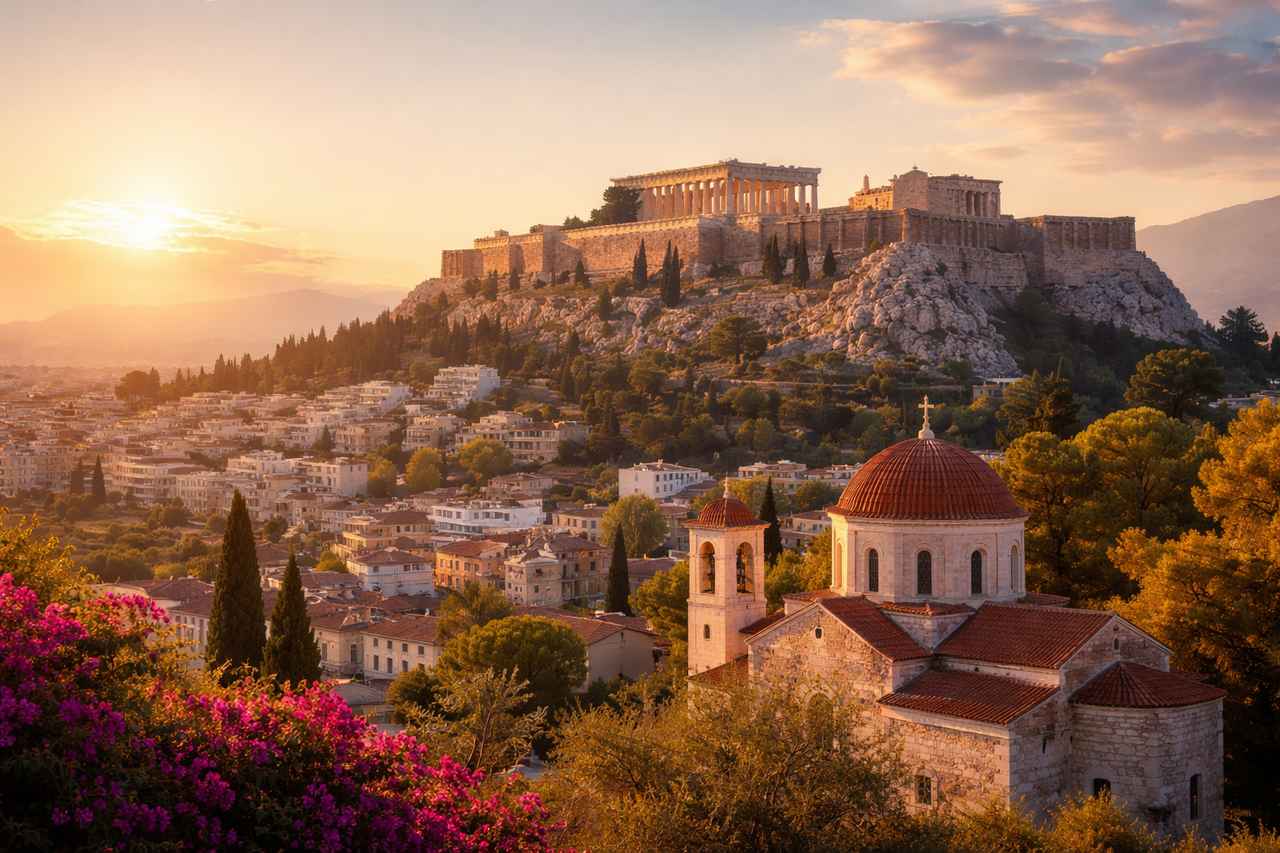
Greece is a country where the Christian faith is still publicly visible, historically rooted, and woven into national memory. Yet that very familiarity can hide deep spiritual need. As public trust has been shaken by tragedy, political scandal, migration pressures, and renewed social tensions, believers in Greece need prayer not only for stability in the nation, but for renewed faithfulness in the church. This is a country that calls for informed Christian intercession — for truth, justice, mercy, and fresh gospel life.
Why This Country Needs Prayer Now
Greece does not chiefly call the global church to prayer because most Christians there must worship in secret. Churches are open, Orthodox Easter is still marked publicly, and Christianity continues to shape the country’s calendar, memory, and public imagination. Yet Greece still needs earnest, informed prayer. The country is carrying a deep crisis of public trust in the long aftermath of the 2023 Tempi rail disaster, and fresh political strain has widened with the April 2026 farm-subsidy scandal. At the same time, Greece remains exposed to the human pressures of Mediterranean migration and to the moral tests that come with them.
That combination matters because it shapes the atmosphere in which churches live and witness. Believers in Greece are called to follow Christ in a nation with deep Christian heritage, yet also with public frustration, secular drift, and the constant temptation to confuse religious identity with cultural inheritance. So the prayer burden here is not mainly hidden-church survival. It is renewal, integrity, compassion, justice, and faithful witness in a society that still knows Christianity historically, but often needs to rediscover it spiritually.
Country Snapshot
Greece is a parliamentary republic in southeastern Europe. The World Bank lists its population at 10,405,134 in 2024. The latest accessible U.S. State Department report on religious freedom describes 81% to 90% of the population as Greek Orthodox, about 2% as Muslim, and 4% to 15% as atheist, with other communities including Catholics, Protestants, Jews, Armenian Orthodox Christians, and others.
The same State Department report says the constitution recognizes Greek Orthodoxy as the “prevailing religion,” while also providing legal space for a range of other religious communities through public-law status, religious-legal-entity status, or civil-association standing. It also notes that the constitutional prohibition on “proselytizing” is rarely enforced.
Main Pressures Facing Christians
The first pressure in Greece is spiritual rather than clandestine. In a country where Orthodoxy is historically dominant and publicly visible, churches must resist the temptation to let Christian identity settle into memory, ethnicity, or ceremony without deep repentance, living faith, and serious discipleship. Pew’s 2025 research on religious switching shows that Greece is among the countries where many religiously unaffiliated adults were raised within religion, and that 14% of Greeks currently identify as unaffiliated.
A second pressure is that Christian life is not experienced on exactly the same footing across the board. Greece is not a country where Christians are widely hunted or driven underground, and that distinction matters. Still, smaller churches and minority Christian communities may face more administrative friction, less cultural familiarity, and a lingering sense that their place is tolerated more than understood. The State Department report points to that unevenness by noting that some communities continue to operate mainly through civil-association status and may face administrative or fiscal difficulties.
A third pressure is national moral strain. Public anger after Tempi, the widening farm-subsidy scandal, migration tensions, and renewed concern about antisemitism all shape the social environment in which Christians speak and serve. In such a setting, believers are called not simply to preserve religious tradition, but to display truthfulness, neighbor love, mercy, and moral courage in a climate where cynicism can spread quickly and public speech can harden.
What Life Is Like for Christians in Greece
For many Christians in Greece, faith is still lived in public view. Orthodox worship remains open and visible, and Reuters’ April 2026 coverage from Athens showed large candlelit Easter services that still carry real public weight. That visibility is a mercy. But it also creates its own challenge. Where the church is familiar, spiritual seriousness can be assumed rather than practiced. The gospel can be honored ceremonially while its call to repentance, holiness, and living faith grows faint.
For evangelicals, Pentecostals, minority Orthodox bodies, migrant congregations, and other believers outside the main cultural stream, daily Christian life may involve patient explanation as much as open worship. Greece provides real legal room for many communities, yet not all stand in the same institutional position. So ordinary faithfulness may include navigating bureaucracy, living with misunderstanding, and continuing to bear witness without bitterness. The pressure is often quiet, but it is real.
For Christians serving in Athens, Piraeus, Thessaloniki, Crete, and other places touched by migration, discipleship often takes visibly practical forms. UNHCR, the United Nations refugee agency, says its work in Greece focuses on supporting access to asylum, refugee inclusion, employability, and support for vulnerable groups. In that setting, Christian love is tested not only in what believers confess in worship, but also in how they show hospitality, patience, truth, and compassion when public fear and social pressure are running high.
Faithful life in Greece also includes moral memory. In January 2026, the Central Board of Jewish Communities in Greece warned that antisemitism is appearing in “new forms and under different guises.” That means Christians in Greece need grace not only to preserve doctrine, but also to practice truthful remembrance, reject hatred, and love neighbors whom history, outrage, or propaganda can easily push to the margins.
Recent Developments
In March 2026, a criminal trial opened in Larissa over the February 2023 Tempi train collision that killed 57 people, many of them students. AP reported that investigators have pointed to malfunctioning signal systems, poor staffing, and years of delayed safety upgrades as contributing factors. The case has become a national symbol of institutional failure and public anger. For Christians, that means prayer should include not only comfort for grieving families, but also truth, justice, and repentance where responsibility has been evaded.
A second major development came in early April 2026, when the European Public Prosecutor’s Office sought the lifting of immunity for 11 active members of the Hellenic Parliament in an investigation into alleged organized fraud involving agricultural funds. AP later reported that three Greek ministers resigned amid the scandal. This is not a church-specific story, but it is part of Greece’s present prayer burden because it deepens mistrust, tempts public cynicism, and affects ordinary livelihoods, especially in the countryside.
Migration also remains a live national burden. In February 2026, AP reported that about 30 people were feared dead after a migrant boat capsized off Crete. The tragedy followed continuing debate over Greece’s migration and asylum response. These developments keep pressing the same question on the country: whether security, justice, and compassion for the vulnerable will be held together with wisdom rather than torn apart by fear or hardening rhetoric.
Yet recent months have also shown signs of common grace. In February 2026, UNHCR Greece highlighted a joint employment initiative with Inditex Hellas through which eight refugees entered work in Athens and Piraeus. UNHCR also said that since 2022 it and its partners have helped more than 4,000 refugees secure employment and supported more than 17,000 refugees and asylum-seekers with employability services. Such efforts do not erase deeper tensions, but they do show that mercy, practical help, and a measure of social welcome are not absent from the Greek story.
How to Pray
- Pray that many in Greece would not rest in Christian memory, national custom, or holiday familiarity, but would be brought by God to true repentance and living faith in Christ. Ask the Lord to renew churches with reverent worship, faithful preaching, and deeper discipleship.
- Pray for justice, truth, and wise accountability in the long aftermath of the 2023 Tempi rail disaster. Ask God to comfort bereaved families, restrain cynicism, and bring to light whatever must be exposed.
- Pray for integrity in public life as Greece faces the 2026 farm-subsidy fraud scandal. Ask the Lord to restrain corruption, give wisdom to rulers and investigators, and raise up public servants who fear God more than party loyalty or personal advantage.
- Pray that churches in Greece would respond to migration and asylum pressures with both truth and mercy. Ask God to give believers wisdom as they serve refugees, asylum-seekers, and local communities, so that compassion is not swallowed by fear and public tensions do not harden hearts.
- Pray for evangelical churches, migrant fellowships, and smaller Christian communities to stand firm in holiness, unity, and clear witness. Ask God to protect them from weariness, social misunderstanding, and the temptation either to withdraw in caution or to speak without love.
- Pray against antisemitism, historical amnesia, and hateful public rhetoric. Ask God to make Christians in Greece people of truthful memory, neighbor love, and moral courage, especially when prejudice is disguised as patriotism, grievance, or online commentary.
Give Thanks
- Give thanks that Christian worship in Greece remains open and publicly visible, and that believers are not forced into secrecy to confess Christ.
- Give thanks for every faithful church, pastor, and ordinary believer who continues to hold out the gospel in a country where Christianity is still widely known, yet still deeply needs spiritual renewal.
- Give thanks for legal space that allows a range of religious communities to worship and organize, even though not every group stands on exactly the same footing.
- Give thanks for signs of common grace in practical care for refugees, including recent work that has helped people find employment, dignity, and a stronger sense of belonging in Greece.
- Give thanks for remembrance efforts that resist forgetting, including Holocaust commemoration and public warnings against antisemitism. Ask God to use such work to preserve truth and restrain hatred.
Last Verified
This post was prepared with current reporting checked through April 18, 2026, while older religious-freedom and demographic material was used only for stable legal and background context.
Last Updated
Last updated: April 18, 2026
Next review due: July 2026, or sooner if major developments reshape Greece’s public-trust crisis, migration situation, or religious-freedom landscape.
Key Sources Consulted
- U.S. Department of State, 2022 Report on International Religious Freedom: Greece.
- World Bank Data, Greece country page.
- Pew Research Center, “The religiously unaffiliated: Switching into and out of the group in 22 countries” (March 26, 2025).
- Reuters, “Greeks celebrate Orthodox Easter in Athens” (April 11, 2026).
- AP, “After years of grief, trial opens over Greek rail disaster that killed college students” (March 2026).
- European Public Prosecutor’s Office, “Greece: New developments in EPPO’s probe into large-scale agricultural subsidy fraud” (April 1, 2026).
- AP, “3 Greek ministers quit as EU investigates alleged farm subsidy fraud” (April 2026).
- AP, “About 30 people are feared dead after a migrant boat capsized off Crete” (February 2026).
- UNHCR Greece, “UNHCR and Inditex celebrate ‘ALMA,’ opening pathways to employment and belonging for refugees in Greece” (February 27, 2026).
- UNHCR Greece, “About UNHCR in Greece” and Greece country page.
- eKathimerini, “Greek Jewish community says antisemitism present ‘under different guises’” (January 27, 2026), and the Central Board of Jewish Communities in Greece, “Message on Holocaust Remembrance Day 2026.”