

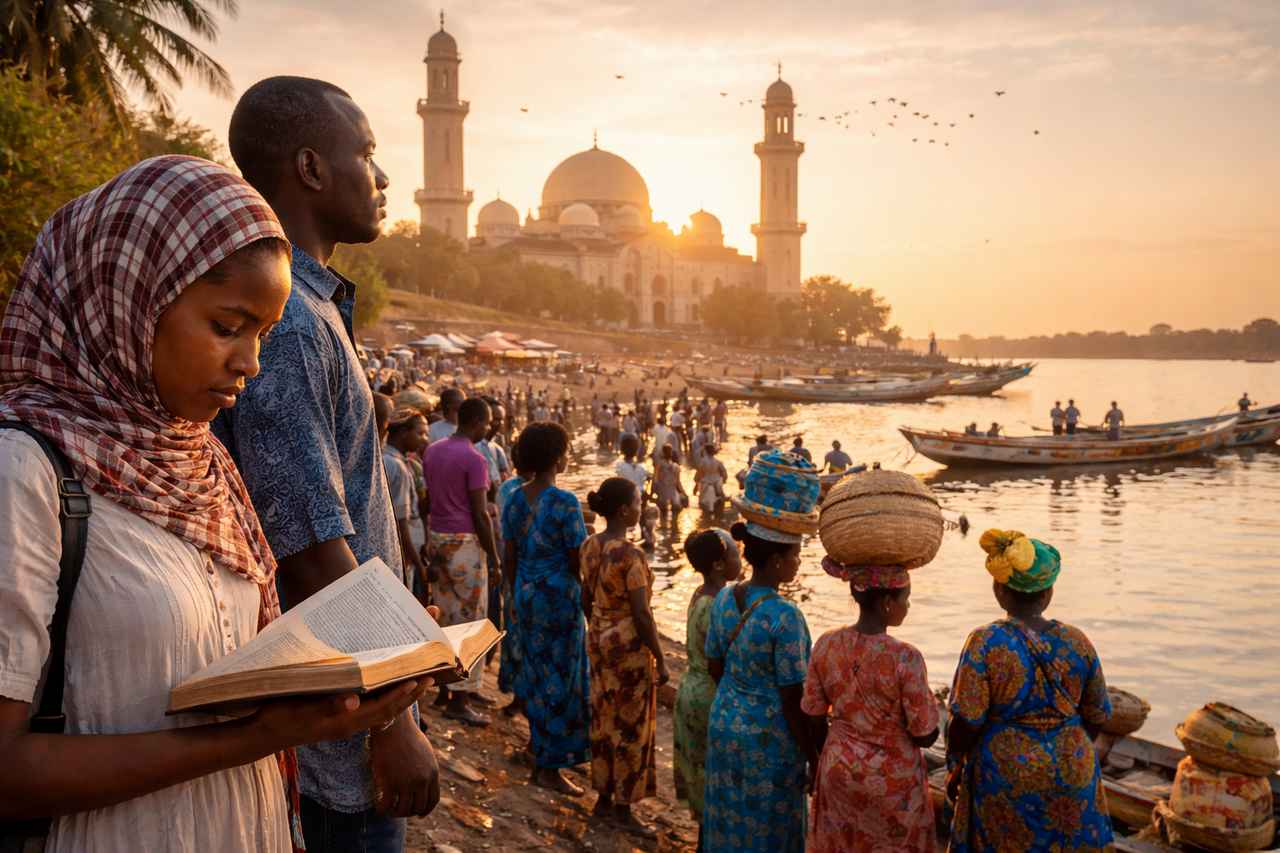
The Gambia does not often dominate international headlines, yet it deserves thoughtful Christian prayer. Christians there live as a small minority in a society where public coexistence often appears peaceful, but where following Christ can still bring costly pressure within families and communities. At the same time, the country continues to carry unfinished burdens in constitutional reform, public accountability after the Yahya Jammeh era, protection of the vulnerable, and economic fragility. All of this should move believers not to alarm, but to sober, compassionate, truth-governed prayer in the confidence that God remains sovereign over nations and over His church.
1. Why This Country Needs Prayer Now
The Gambia needs prayer now because its public life shows both mercy and strain. There are visible institutions and leaders who speak of peace and religious coexistence. Yet that outward calm sits beside unresolved constitutional questions, an unfinished reckoning with crimes from the Jammeh years, continuing concern for the protection of girls from female genital mutilation, and an economy that is recovering but still exposed to structural weakness and climate shocks.
These realities matter not only for public life in general, but also for the church’s witness within the nation. Christians should pray not only for believers to remain faithful, but also for justice, the restraint of evil, wise governance, and God’s preserving kindness over the country as a whole.
The present burden is not one-dimensional. This is not mainly a country defined by one dramatic nationwide crackdown on the church. Rather, it is a place where quieter pressures on Christian faithfulness are woven into broader national questions about law, truth, accountability, moral courage, and the health of public institutions. That combination makes prayer especially necessary.
2. Country Snapshot
The Gambia is a narrow West African country that follows the Gambia River, bordered by Senegal on three sides and opening to the Atlantic Ocean on the west. A preliminary 2024 census placed its population at about 2.4 million. As of April 2026, official government sources identify Adama Barrow as president and Muhammed B. S. Jallow as vice president, and describe the state as having executive, legislative, and judicial branches.
Muslims form the overwhelming majority of the population, while Christians are a small minority. Open Doors, a Christian ministry that tracks pressure on believers worldwide, estimated in its 2024 World Watch List country dossier that Christians make up about 4.5 percent of the population. That same background material notes that longstanding church communities are more established in parts of the west and south, while believers from Muslim backgrounds often face sharper pressure. Because this is background material rather than a live 2026 survey of every community, it should be read carefully and
3. Main Pressures Facing Christians
The main pressures facing Christians in The Gambia are often social and relational rather than spectacularly violent. According to the Open Doors background dossier, believers who turn to Christ from Muslim or traditional-religion backgrounds may face hostility from family members, pressure not to be baptized, difficulty in marriage, and resistance when they try to live openly as Christians.
That means the burden can be deeply personal. It is not always a raid, an arrest, or a public incident. Often it is the pain of rejection, shame, misunderstanding, or isolation from the people closest to them. For some believers, the hardest opposition may come not from the state, but from home.
Even here, the situation should be described carefully. The available sources do not justify painting the whole country in caricatured darkness. The Gambia still has visible public language of tolerance and coexistence, and there are longstanding Christian communities within the country. Yet it would also be naïve to assume that this outward calm means following Christ carries no cost. For converts especially, the cost may be quiet, but it can still be very real.
4. What Life Is Like for Christians in The Gambia
For many Christians, daily life includes ordinary worship, family life, work, and public presence within a society that is not uniformly hostile. Churches continue to gather. Believers continue to serve Christ. In many places, life does not look like constant emergency.
Yet for believers whose faith crosses inherited religious boundaries, life can become much more delicate. Discipleship may need to unfold quietly. Pastoral care may require unusual patience. A step of obedience that many Christians elsewhere might take for granted, such as public baptism or open identification with a local church, can carry consequences that outsiders may never see.
So faithfulness in The Gambia often looks less like headline-making defiance and more like steady perseverance. It looks like churches teaching Scripture carefully, believers bearing misunderstanding without bitterness, pastors helping converts count the cost, and Christians learning to witness with wisdom and love in communities where public peace and private pressure can exist side by side.
The same Open Doors background suggests that, even after the formal end of the old “Islamic Republic” language in 2017, the deeper social fabric remains conservative enough that pressure on converts is unlikely to disappear quickly. In practice, that means the church needs endurance, tenderness, courage, and wisdom more than dramatic rhetoric.
5. Recent Developments
A major recent development came in July 2025, when the National Assembly, the country’s parliament, rejected the Constitution (Promulgation) Bill 2024 at its second reading. ConstitutionNet, a constitutional-reform and democracy resource published by International IDEA, described this as a serious setback for constitutional reform, pointing to unresolved disputes over presidential term limits, weakened checks on executive power, and a lack of inclusive consultation. With the 1997 Constitution still in force, the country’s democratic transition remains unfinished.
The Gambia is also still wrestling with truth and accountability from the Yahya Jammeh era. In May 2025, protests over the government’s sale of Jammeh-linked assets led to the arrests of at least 27 demonstrators, while the government said the process was lawful and in the public interest. Then, in January 2026, a Gambian court opened the trial of Sanna Manjang, a former leader of the feared “Junglers” death squad, on murder charges dating back to 2006. Together, these developments show a nation still deciding whether truth and accountability will be handled with courage and integrity.
Another weighty development concerns the protection of women and girls. Reuters reported in 2026 that three women were charged after the death of a one-month-old girl following female genital mutilation. The report described it as the first such case since lawmakers had resisted efforts the previous year to overturn the ban. The case underscores how questions of law, custom, and human dignity remain urgent in the country’s public life.
Economically, the picture is mixed. The World Bank said real GDP growth reached 5.7 percent in 2024 and spoke of resilience and recovery, while also warning that structural challenges and external vulnerabilities continue to weigh on the country. The Ministry of Finance and Economic Affairs presented the 2026 budget in the language of stability, human-capital investment, and fiscal discipline. Even so, long-term fragility remains, and an International Monetary Fund climate diagnostic highlighted the country’s exposure to sea-level rise, drought, flooding, and other climate-related shocks. These pressures matter for households, churches, and communities across the country.
6. How to Pray
- Pray that the Lord would sustain the small Christian minority in The Gambia with steadfast faith, holy courage, and quiet joy in Christ, especially believers from Muslim backgrounds who may face family pressure, misunderstanding, or isolation for openly following Him.
- Pray for pastors, elders, and churches to teach God’s Word faithfully and care well for believers under pressure, so that converts are discipled patiently, churches remain united, and Christian witness grows in wisdom, love, and truth.
- Pray for truth, justice, and genuine repentance in the country’s unfinished reckoning with the Yahya Jammeh era, including matters of corruption, violence, and public accountability, so that the nation is not shaped by fear, denial, or political convenience.
- Pray for President Adama Barrow, Vice President Muhammed B. S. Jallow, judges, legislators, and other public officials, that God would restrain evil, grant wisdom, and incline them toward justice, honesty, and decisions that protect the vulnerable and serve the common good.
- Pray for the protection of girls and women, and for moral courage in families and communities, especially where harmful customs, social pressure, and fear still endanger the weak.
- Pray for economic mercy and wise provision across the country, especially for households facing hardship, and ask the Lord to preserve communities affected by debt, fragile livelihoods, and climate-related pressures such as flooding, drought, and coastal vulnerability.
- Pray that Christ would build His church in The Gambia through faithful preaching, prayer, discipleship, repentance, and loving witness, so that believers endure, mature, and bear fruit for the gospel.
7. Give Thanks
- Give thanks that the Lord has preserved a real Christian witness in The Gambia, including churches that continue to gather, worship, and confess Christ even as a small minority.
- Give thanks for signs of peaceful coexistence and public restraint which, though imperfect, are still gifts of God’s common grace and help preserve space for ordinary church life.
- Give thanks that truth and accountability have not been wholly abandoned, and that serious public wrongdoing from earlier years is still being examined rather than simply forgotten.
- Give thanks for modest signs of economic resilience and recovery, and for every evidence of God’s preserving mercy that helps households, churches, and communities endure.
8. Last Verified
Last updated: April 18, 2026.
Next review due: October 2026, or sooner if there is a major constitutional, church-freedom, accountability, or public-morality development.
Key Sources Consulted
- Government of The Gambia, “The Government of The Gambia” page, including current leadership listings for President Adama Barrow and Vice President Muhammed B. S. Jallow.
- United Nations Population Fund in The Gambia / Gambia Bureau of Statistics, “Preliminary Report of the 2024 Census in The Gambia.”
- World Bank, “The Gambia’s Economy Maintains Growth Momentum Amid Global Uncertainty” (September 2, 2025).
- Ministry of Finance and Economic Affairs of The Gambia, “The Gambia Presents 2026 Budget with Strong Emphasis on Stability, Human Capital & Fiscal Discipline.”
- ConstitutionNet / International IDEA, “Constitution Bill Rejected at Second Reading: Halting the Reform Process in The Gambia?” (July 8, 2025).
- AP News, “27 people arrested in a protest in Gambia over the sale of a former dictator’s assets” (May 9, 2025).
- AP News, “Trial opens in Gambia of leader of notorious death squad during Jammeh era” (January 15, 2026).
- AP News, “3 women in Gambia are charged in the death of one-month-old in female genital mutilation case” (August 14, 2025).
- Open Doors, “Full Country Dossier: Gambia 2024” from the World Watch List research materials.
- Gambia Supreme Islamic Council, “About Us.”