

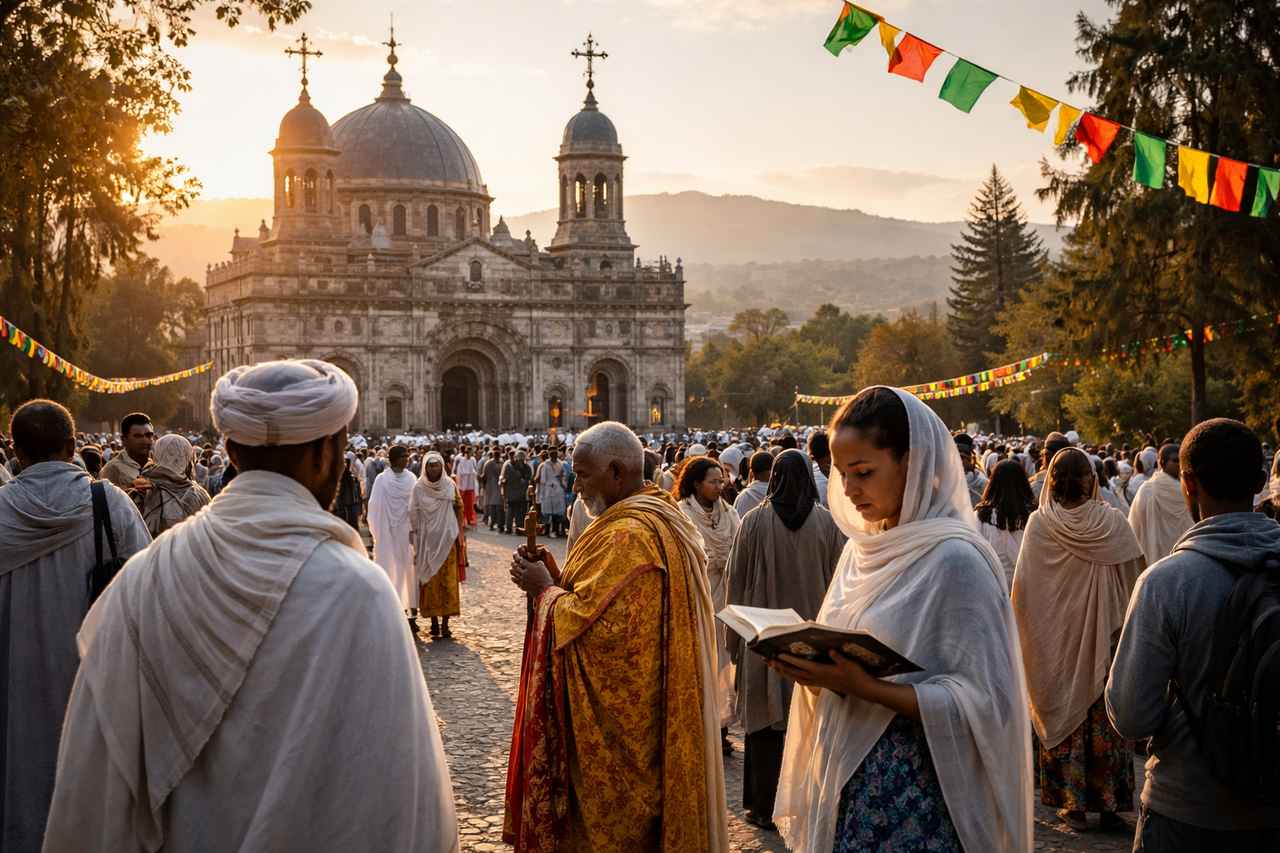
Ethiopia calls for urgent, informed prayer because its present burden is not just one thing. This is a country with ancient Christian roots, large Muslim communities, and a long public religious history. Yet it is also living under the strain of overlapping conflicts, humanitarian distress, and renewed regional tension. Christians there need prayer not only for protection, but for holiness, endurance, wisdom, and visible love in a season when fear, grievance, and political pressure could easily harden the heart.
1. Why This Country Needs Prayer Now
Ethiopia needs prayer now because several serious burdens are pressing at once. Armed conflict has continued in Amhara and parts of Oromia. Renewed fighting in Tigray early in 2026 also raised fears of a deeper crisis in the north. At the same time, tensions with Eritrea have sharpened, and humanitarian need remains severe across multiple regions. The church is therefore living not on the edge of one isolated problem, but within a wider national atmosphere of insecurity, displacement, and uncertainty.
The burden is sharpened further by Ethiopia’s approach to the June 1, 2026, general election. Human Rights Watch says the government intensified pressure on independent media and civil society ahead of the vote, while the National Election Board of Ethiopia has already set polling day and moved into preparations. In such a season, believers need grace to remain truthful, peaceable, and discerning rather than being pulled into partisan fear or anger.
2. Country Snapshot
Ethiopia is a federal republic in the Horn of Africa with a population of about 132.1 million, according to World Bank data for 2024. It is religiously diverse, with large Ethiopian Orthodox Tewahedo, Protestant, and Muslim communities. The constitution describes the state as secular, requires separation of religion and state, and forbids religious discrimination.
Public figures on religious composition should still be handled with care because many of the best-known breakdowns are old. The U.S. Department of State’s 2023 report on international religious freedom, drawing on the 2007 census, says 44 percent of the population followed the Ethiopian Orthodox Tewahedo Church, 34 percent were Sunni Muslim, and 19 percent belonged to evangelical and Pentecostal groups. The same report notes that many observers believe the Muslim and evangelical shares have grown since then. Even with dated figures, the main point is clear: religion remains deep, public, and highly significant in Ethiopian life.
3. Main Pressures Facing Christians
Pressure on Christians in Ethiopia is uneven. In some places it comes through direct hostility. Open Doors says converts from Islam can face family rejection, discrimination, mob violence, and church burnings in Muslim-majority areas. It also reports that some strongly conservative factions within the Ethiopian Orthodox world portray Protestant and Evangelical believers as foreign or unpatriotic, bringing stigma and pressure on those who leave Orthodoxy for other Christian traditions.
The strain is not only religious in a narrow sense. In 2025, Open Doors said armed groups in Oromia and parts of Amhara burned, demolished, or looted at least 25 churches, scattered congregations, and heightened the risk of kidnapping. Associated Press reporting from Oromia adds that ordinary people have been living with restricted movement, extortion, and fear, while rights monitors accuse both the Oromo Liberation Army and government forces of grave abuses. For Christians, that means worship, travel, discipleship, and family life can all be disrupted by violence that is wider than the church but still deeply shapes the church’s daily life.
At points, religious tension has also intersected directly with politics and security. The U.S. Department of State’s 2023 report records killings of Ethiopian Orthodox Tewahedo Church worshippers during the 2023 Oromia church schism crisis, mosque demolitions that sparked protest, and reports of attacks on churches by armed groups. These incidents should not be treated as the whole current picture, but they do show how quickly religious life in Ethiopia can become entangled with state action, local grievance, and communal unrest.
4. What Life Is Like for Christians in Ethiopia
For many believers, Christian life in Ethiopia is still public and deeply woven into family and community life. Yet it is not equally secure everywhere. In quieter areas, church life may continue in an open and ordinary way. In more volatile places, the realities are different. Roads become dangerous. Travel becomes uncertain. Congregations are scattered. Families may think twice before gathering, visiting relatives, or moving openly as Christians.
For converts from Islam, the cost may be especially personal. Open Doors says these believers can lose family acceptance and face harsh pressure from their communities. For Protestants in Orthodox-dominated settings, the pain may come less through formal state policy than through social suspicion, exclusion, or being treated as disloyal to the country’s heritage. In both cases, the burden is often intimate rather than dramatic: strained homes, damaged trust, and a daily need for courage in small acts of faithfulness.
Even so, Christians in Ethiopia are not present only as victims. Churches and faith leaders remain important actors in relief work, public health, and peacebuilding. In 2025, the World Health Organization’s Ethiopia office reported cooperation between religious leaders and health authorities in Amhara to strengthen water, sanitation, and health standards at religious institutions during the cholera response. That same year, a major interfaith gathering in Addis Ababa brought together Christian and Muslim leaders to speak about peacebuilding, human dignity, and religious freedom. These efforts do not erase Ethiopia’s wounds, but they do show that God has not left the country without witnesses working for the common good.
5. Recent Developments
Open Doors reports that in 2025 armed groups carried out widespread attacks in Oromia and parts of Amhara, damaging churches and increasing kidnappings, especially in rural Oromia and in border areas near Amhara. That matters for prayer because it means many believers are not facing abstract instability, but concrete threats to gathered worship, safe travel, and family security.
In early 2026, the north of the country grew more volatile again. The United Nations human rights office warned in February that renewed heavy fighting in Tigray could deepen the region’s already fragile humanitarian and human rights situation. It said clashes between the Ethiopian National Defence Forces and Tigray Security Forces intensified in late January, with drones, artillery, and other powerful weapons reportedly used. The same briefing also warned that tensions between Ethiopia and Eritrea could worsen the crisis.
That warning matched wider reporting. Reuters reported in January and February 2026 that Ethiopian authorities accused Eritrea of arming rebels in Amhara and of military aggression along parts of the shared border. Eritrea rejected those claims and accused Ethiopia’s leadership of seeking a pretext for war. Associated Press also reported in February that Prime Minister Abiy Ahmed publicly accused Eritrean troops of mass killings during the Tigray war, while Eritrean officials dismissed his remarks as false. These claims and denials should be handled carefully, but together they show a serious and dangerous deterioration in Ethiopia’s regional environment.
Meanwhile, Ethiopia’s humanitarian need remains immense. UNICEF says it aims to reach about 8.9 million people in Ethiopia in 2026, including 6.3 million children, because ongoing conflict, disease outbreaks, climate shocks, displacement, and refugee pressures continue to drive acute need. UNICEF also reports more than 1.9 million internally displaced people, 2.8 million returnees, and 1.1 million refugees inside Ethiopia. Human Rights Watch says more than nine million children were out of school because of conflict and natural disasters. All of this should shape how Christians pray: not only for safety, but for mercy, stability, and faithful witness in the middle of prolonged strain.
6. How to Pray
- Pray that God would keep His church in Ethiopia steadfast in Christ, especially in places where fear, insecurity, and public tension make ordinary faithfulness harder. Ask Him to preserve believers in truth, holiness, and brotherly love rather than bitterness, panic, or despair.
- Pray for Christians in Amhara, Oromia, and Tigray who live amid conflict, displacement, or disrupted community life. Ask the Lord to protect families, strengthen pastors and elders, comfort the traumatized, and provide safe ways for congregations to gather, worship, and care for one another.
- Pray for believers who face pressure because of their Christian witness, including converts from Muslim backgrounds and Christians who are treated with suspicion by relatives or neighbors. Ask God to grant them courage, wisdom, and gentleness, and to use their costly faithfulness to draw others to Christ.
- Pray that the Lord would restrain evil in Ethiopia. Ask Him to check the violence of armed groups, curb abuses by those who wield state power, expose lies and manipulation, and bring a more just and peaceful ordering of public life.
- Pray for Ethiopia’s leaders, judges, security officials, local authorities, and election administrators as the country moves through a tense political season. Ask God to give them wisdom, honesty, restraint, and a greater regard for truth and justice than for propaganda, fear, or self-protection.
- Pray for the many people suffering under displacement, hunger, disease, interrupted schooling, and fragile services. Ask the Lord to provide daily bread, medical help, shelter, and mercy for the vulnerable, and to raise up churches and neighbors who serve with compassion.
- Pray that the gospel would continue to bear fruit in Ethiopia. Ask God to strengthen faithful preaching, deepen discipleship, preserve unity among true believers across ethnic and denominational lines, and help the church remain visibly Christian in both conviction and love.
7. Give Thanks
- Give thanks that Ethiopia still has a large and visible Christian presence, and that in many parts of the country the name of Christ is publicly known, preached, and confessed.
- Give thanks for believers, pastors, and congregations who continue to worship, disciple others, and care for the suffering even under pressure. Their perseverance is a real mercy from God and a sign of His preserving grace.
- Give thanks for every sign of common grace that helps restrain deeper collapse, including efforts toward peacebuilding, practical cooperation for public health, and acts of service that protect human life and dignity.
- Give thanks that, even in a deeply troubled season, the Lord has not left Ethiopia without witnesses to His truth, mercy, and kingdom. Ask Him to make these signs of grace more visible and fruitful in the days ahead.
Last Updated
Last updated: April 18, 2026
Next review due: July 2026, or sooner if fighting in Tigray, Amhara, or Oromia escalates further, or if Ethiopia-Eritrea tensions sharpen again.
Key Sources Consulted
- Open Doors, Ethiopia country profile / World Watch List 2026
- U.S. Department of State, 2023 Report on International Religious Freedom: Ethiopia
- Reuters, Ethiopia accuses Eritrea of arming rebels in escalating war of words (January 15, 2026)
- Reuters, Ethiopia accuses Eritrea of military aggression, backing armed groups (February 8, 2026)
- Associated Press, “Executions, torture, abductions, rape”: Ethiopia’s hidden conflict (February 2026)
- Associated Press, Ethiopia’s prime minister accuses Eritrea of mass killings during Tigray war (February 2026)
- United Nations Office at Geneva / Office of the High Commissioner for Human Rights, Ethiopia: Türk fears new crisis in Tigray amid renewed fighting (February 10, 2026)
- Human Rights Watch, World Report 2026: Ethiopia
- UNICEF, Ethiopia Appeal 2026
- World Bank Data, Population, total – Ethiopia and related Ethiopia country data
- World Health Organization Ethiopia, Religious leaders, health authorities, and WHO meet to validate minimum WASH and health standards for religious institutions (October 28, 2025)
- Vatican News, Ethiopia hosts World Interfaith Harmony Week to promote unity through faith (May 17, 2025)
- Ethiopian News Agency, Ethiopian General Election to Be Held in June 2026 (December 9, 2025)