


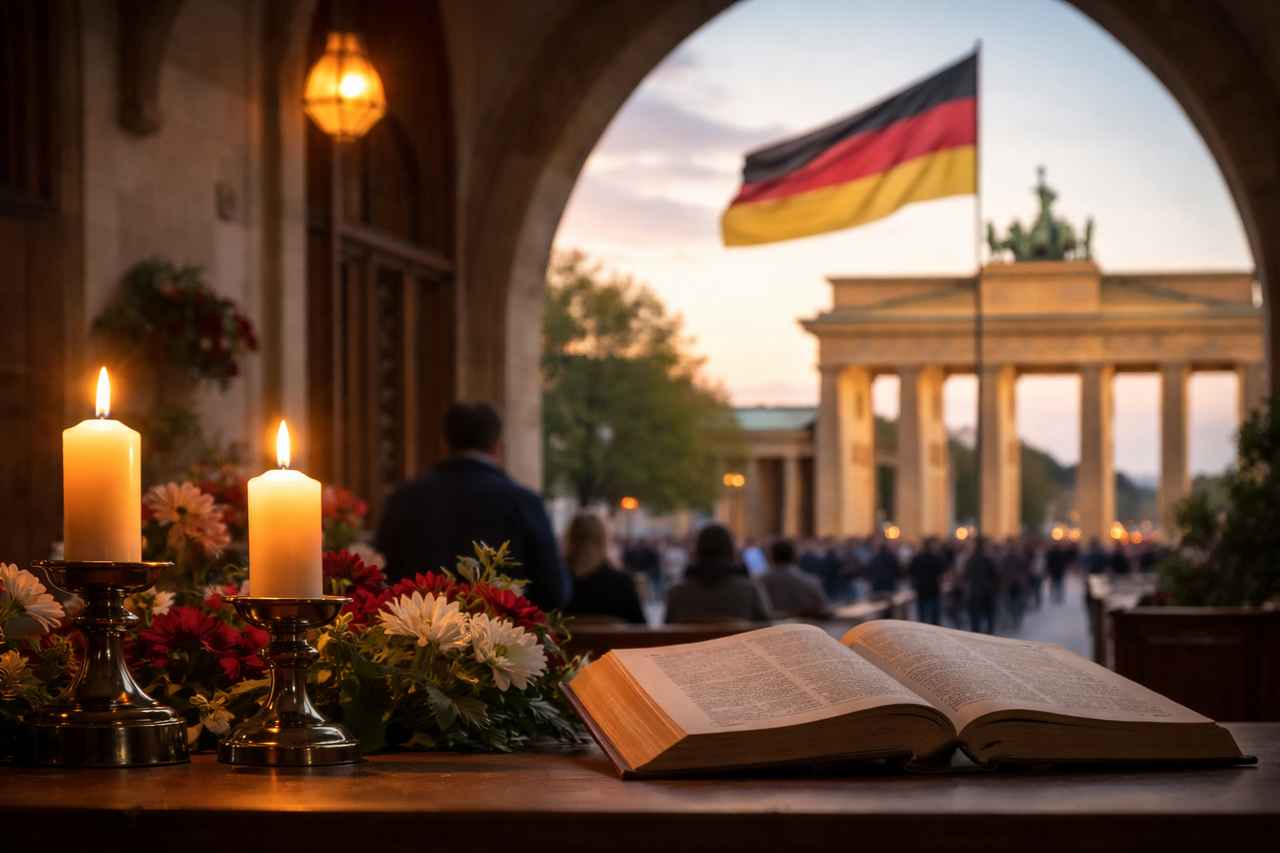
Germany remains a country of broad religious liberty, strong institutions, and deep Christian memory. Yet it still needs earnest prayer. The churches are shrinking, trust has been weakened, public life is strained by polarization, and Europe’s wider security crisis presses heavily on the nation. Even so, the Lord has not left Germany without witness. Congregations still gather. Christian service is still visible. Opportunities for mercy, evangelism, and renewal still remain.
1. Why This Country Needs Prayer Now
Germany matters far beyond its own borders. Under Chancellor Friedrich Merz, the federal government has emphasized defence, economic renewal, and what it calls an orderly migration policy. At the same time, Germany continues to carry major responsibility in Europe’s response to Russia’s war against Ukraine. The country is also trying to strengthen an economy that has faced difficult years and remains under pressure to reform.
For Christians, the main burden is not legal prohibition. Germany’s Basic Law, the country’s constitution, protects freedom of faith and the undisturbed practice of religion. The deeper struggle is spiritual and cultural. Secularization has thinned many people’s connection to historic Christianity. Institutional distrust has weakened confidence in the churches. Public debates over identity, migration, security, and national direction can easily harden the atmosphere and make patient truthfulness more difficult.
That burden has also been sharpened by a rise in antisemitic incidents and by a wider public mood in which fear, anger, and ideological certainty can crowd out humility and neighbor love. Germany therefore needs prayer not only for peace and stability, but for repentance, gospel clarity, renewed courage in the churches, and a public life marked more by truth, restraint, and mercy than by bitterness or suspicion.
2. Country Snapshot
Germany is a federal republic in the heart of Europe with a population of about 83.5 million. Friedrich Merz has served as federal chancellor since May 2025. The constitution protects freedom of faith and guarantees the undisturbed practice of religion.
Christianity still has a large public presence, but its hold has weakened. Official figures show that the Protestant Church in Germany, a communion of 20 regional Protestant churches, had about 17.4 million members at the end of 2025. The Roman Catholic Church reported about 19.2 million members, or 23 percent of the population. Statistics from the Protestant Church in Germany also indicate that Christians made up about 50.8 percent of Germany’s population in 2024 when other Christian traditions are included.
Germany is not a country without Christian roots. But it is increasingly a country where many people are only loosely connected to the church, and many others no longer have any meaningful connection at all.
3. Main Pressures Facing Christians
One major pressure is secularization. The churches are legally free, but many congregations serve in a culture where Christian belief is often treated as private, outdated, or morally suspect. The steady loss of members in both Protestant and Catholic life shows how deep this challenge has become.
A second pressure is weakened credibility. The churches continue to labor under long-term distrust shaped by abuse scandals, institutional failures, and contentious reform debates. In Roman Catholic life especially, current discussions about abuse, church reform, and interfaith questions show that the strain is not merely numerical. It is also moral, pastoral, and doctrinal.
A third pressure is the broader national atmosphere. Germany’s public life is being tested by economic pressure, security concerns, fierce migration debates, and the wider strain created by the war in Ukraine. Christians are therefore called to speak with truth and love in a setting where fear, resentment, or ideological certainty can easily crowd out patience and wisdom.
A fourth pressure is the hardening of social hostility. Recorded antisemitic incidents rose sharply in 2024. Even where Christians themselves are not the main target, this kind of hatred corrodes public life and makes faithful witness more difficult. The church must not answer this by retreating into self-protection. It must answer with truth, dignity, courage, and the peace of Christ.
4. What Life Is Like for Christians in Germany
Ordinary Christian life in Germany usually unfolds under freedom rather than formal repression. Churches can gather openly, operate institutions, and serve in public life. The Protestant Church in Germany notes that its churches continue to provide worship, pastoral care, and places of fellowship, while church-run care ministries remain active in kindergartens, schools, counseling, care for the sick, and support for people in hardship.
Yet freedom does not remove the burden of faithfulness. Many believers serve in aging congregations, in neighborhoods where churchgoing is no longer normal, or in settings where Christian convictions are misunderstood or quietly dismissed. Pastors and church leaders often need endurance more than public visibility. They need the patience to preach clearly, disciple steadily, and love neighbors who may be indifferent, suspicious, or spiritually restless.
There are also real openings. Germany remains home to broad networks of Christian schools, social ministries, ecumenical relationships, and international partnerships. Churches also have unusual opportunities to serve migrants and refugees. More than one million Ukrainian refugees have found protection in Germany since Russia’s full-scale invasion, creating both a humanitarian burden and a significant field for Christian mercy, friendship, and witness.
So life for Christians in Germany is mixed. It is freer than in many countries, yet spiritually demanding. The challenge is not mainly survival under persecution. It is faithful gospel witness in a wealthy, tired, morally contested, and often distracted society.
5. Recent Developments
Germany entered a new political chapter in 2025. Friedrich Merz was elected chancellor in May 2025 after an initial failed round of voting, and his government quickly signaled priorities in defence, economic growth, and migration policy. That change has helped shape the country’s present mood and direction.
Germany’s role in Europe’s security burden has also remained prominent. In February 2026, the federal government again emphasized its support for Ukraine, reporting major civilian and military assistance since Russia’s 2022 invasion. The government also noted that more than one million Ukrainian refugees have found protection in Germany.
The churches’ own March 2026 figures underscored the spiritual challenge inside the country. The Protestant Church in Germany reported about 17.4 million Protestant members at the end of 2025, while the Roman Catholic Church reported about 19.2 million members and said Catholics made up 23 percent of the population. These are not merely institutional statistics. They point to a nation where historic Christianity still matters, but where many ties to church life continue to thin.
At the same time, public hostility remains a serious concern. Reporting in 2025 noted that recorded antisemitic incidents in Germany had nearly doubled in 2024. That rise should concern Christians not only because of Germany’s history, but because hatred and fear deform the moral life of a nation and make truthful, humane public witness harder.
6. How to Pray
- Pray that God would bring true spiritual renewal in Germany: not mere religious tradition, but repentance, living faith in Christ, and fresh hunger for His Word in homes, churches, universities, and public life.
- Pray for pastors, elders, theologians, and faithful church members to stand firm with humility and courage as they preach the gospel in a society marked by secularization, moral confusion, and spiritual weariness.
- Pray for the Protestant Church in Germany, a major federation of regional Protestant churches, for the Roman Catholic Church, and for faithful evangelical congregations across the country: that the Lord would purify what is weak, strengthen what is sound, and raise up clear, holy, and Christ-centered shepherds.
- Pray for Germany’s rulers and public servants to exercise wisdom, restraint, and justice as they face economic pressure, migration debates, security concerns, and the wider burden created by the war in Ukraine. Ask God to curb fear, bitterness, and political extremism.
- Pray that Christians would be known for truth, love, hospitality, and steady witness toward neighbors, migrants, refugees, Jews, Muslims, and the socially isolated, especially in a time when public life can easily harden into suspicion or hostility.
- Pray that churches and mercy ministries would not only offer practical help, but also speak clearly of Christ, so that works of compassion would be joined to faithful evangelism, discipleship, and enduring hope.
7. Give Thanks
- Give thanks that Germany still has broad legal protection for freedom of religion and open space for churches to gather, teach, serve, and bear public witness.
- Give thanks for the Lord’s preserving grace in sustaining congregations, pastors, Christian schools, care ministries, counseling work, and other forms of ordinary church faithfulness even amid visible decline.
- Give thanks for opportunities to show Christian mercy through service to refugees, migrants, students, families, and the lonely, and for the doors these ministries can open for gospel witness.
- Give thanks that, despite secularization and institutional weakness, the Lord still preserves a real Christian presence in Germany and has not left Himself without witnesses there.
Last Verified
Last updated: April 18, 2026
Key sources consulted:
- Federal Government of Germany, The Federal Chancellor’s New Year Address 2026
- Federal Government of Germany, official Chancellor page for Friedrich Merz
- Federal Government of Germany, First Government Statement by Chancellor Friedrich Merz (14 May 2025)
- Federal Government of Germany, How Germany Is Supporting Ukraine
- Federal Government of Germany, Basic Law for the Federal Republic of Germany
- Destatis, German Federal Statistical Office, current population data for Germany
- Protestant Church in Germany, 2025 membership statistics
- Protestant Church in Germany, statistics on people of Christian faith in Germany
- German Bishops’ Conference, 2025 Catholic Church statistics
- Reuters, report on Friedrich Merz’s election as chancellor after the initial failed vote
- Reuters, report on Germany’s growth hopes and reform pressures
- Reuters, report on antisemitic incidents in Germany nearly doubling in 2024