


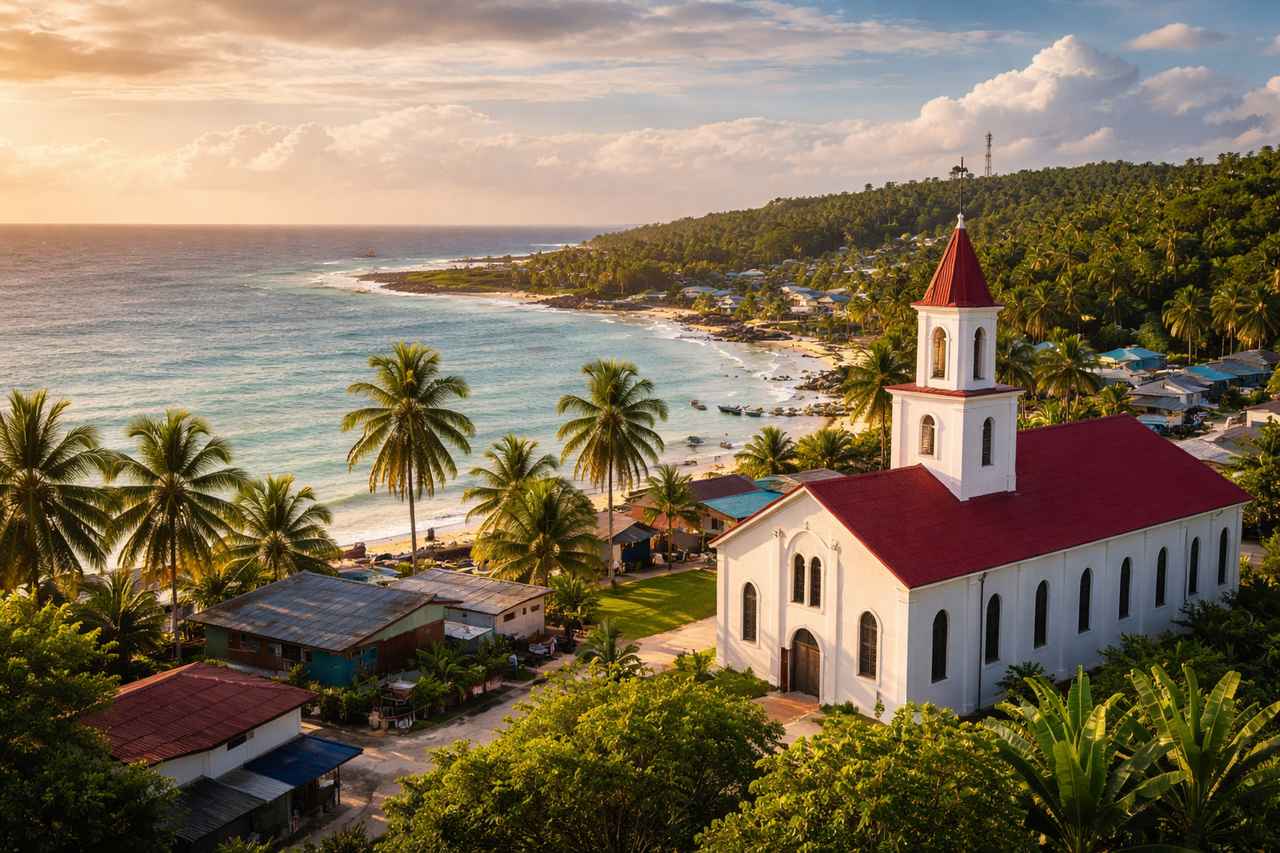
Nauru is tiny, but its burdens are not. This small Pacific republic faces pressures that reach far beyond its size: climate vulnerability, fragile economic dependence, serious public-health strain, and national decisions shaped heavily by stronger outside partners. Christians in Nauru do not face the kind of broad violent persecution seen in some countries, yet that does not make the nation spiritually easy. In a place where Christianity is widespread and public life is tightly interwoven, the need is for deep, faithful, gospel-rooted discipleship rather than mere religious familiarity. Nauru needs prayer for endurance, wisdom, integrity, and hope under the good providence of God.
1. Why This Country Needs Prayer Now
Nauru needs prayer now because national fragility is pressing in from several directions at once. The island remains highly exposed to climate-related risk, especially along the coast, while its economic resilience is still narrow and closely tied to outside support. In December 2024, Nauru and Australia signed a treaty aimed at strengthening banking access, fiscal stability, and security cooperation. Nauru’s Economic and Climate Resilience Citizenship Program is also being presented as a way to support climate resilience and long-term development. These are not small policy adjustments. They show a country trying to secure its future under real pressure.
That pressure is felt in daily life. The World Health Organization says Nauru faces a “triple burden” of communicable diseases, noncommunicable diseases, and climate- and environment-related health impacts. It also notes that obesity, diabetes, and hypertension are major causes of death, while water and food insecurity worsen health problems and limited health-system capacity makes the strain harder to bear. These are not merely technical concerns. They shape families, churches, schools, and the emotional climate of the whole nation.
2. Country Snapshot
Nauru is an independent republic in Micronesia. World Bank data lists its population at 11,947 in 2024, and the government’s ministries page lists David W. R. Adeang as president. Nauruan is the native language, and English is widely used in government and commerce.
Christianity is the dominant religion. The 2021 census religion tables show 34.3% identifying with the Nauruan Congregational Church, 33.9% as Catholic, and 11.7% as Assemblies of God, with smaller shares in other churches and only a small percentage reporting no religion. That means Nauru is not a place where the church is hidden from public life. The more searching question is whether the church is spiritually healthy, biblically grounded, and ready to bear faithful witness under pressure.
3. Main Pressures Facing Christians
The main pressure on Christians in Nauru is not broad state persecution, but spiritual shallowness in a country where Christianity is common and public. Where churches are numerous and faith is culturally familiar, believers can drift into inherited religion without deep repentance, doctrinal clarity, or costly obedience. That kind of pressure is quieter than open hostility, but it can still weaken the church.
A second pressure is national strain. In a country this small, climate risk, public-health burdens, dependence on imported goods, and economic uncertainty do not stay in the background. They press directly on congregations, marriages, youth, and church leaders. Pastors and lay believers are called to serve not in abstraction, but in communities where illness, cost of living, uncertainty, and outward dependence are real and persistent features of life.
A third pressure concerns the legal and institutional space available to smaller religious groups. Nauru’s constitution protects freedom of conscience, thought, and religion, including the freedom to manifest and propagate beliefs in public or private. At the same time, the U.S. State Department’s 2018 Report on International Religious Freedom: Nauru said smaller churches found a 750-member registration requirement difficult to meet, even though religious groups stated they could still carry out most normal functions without registration. Because this reporting is dated and more recent detailed reporting is limited, it should be handled cautiously. Still, it remains a reminder that even in a broadly Christian country, smaller fellowships may face practical administrative barriers.
4. What Life Is Like for Christians in Nauru
For many Christians in Nauru, church life is open and visible. The constitution protects religious freedom and says that no one attending a place of education can be required to receive religious instruction from another religion without consent. That is a mercy. Believers are not being pushed entirely out of public view. Yet visible religion is not the same as living faith. In a close-knit island society, where church, family, and public life overlap heavily, Christian witness can be strengthened by community ties, but it can also be dulled by familiarity, compromise, or fear of displeasing others.
Daily Christian faithfulness in Nauru is therefore likely to look ordinary rather than dramatic: pastors preaching Scripture plainly, parents teaching children to love Christ sincerely, churches caring for the sick, believers resisting cynicism, and congregations learning to pray not only for personal needs but also for the future of their island. In a country facing climate exposure, water and food strain, and chronic health burdens, the church’s calling includes steadfast hope, truthful speech, practical mercy, and patient endurance in Christ.
The situation also carries an outward-facing dimension. Nauru’s public life has long been shaped by external arrangements, especially with Australia. In August 2025, Australia and Nauru signed an agreement allowing some noncitizens without valid Australian visas to be deported or resettled there, with substantial Australian financial support attached. The Australian government presented the deal as part of maintaining a functioning visa system after court rulings prevented indefinite detention in some cases, while refugee and human-rights advocates strongly criticized it. Christians should not rush into slogan-level judgments here. But they should pray that every person on Nauru—citizen, worker, migrant, detainee, or transferee—would be treated with justice, truthfulness, and neighbor love as an image-bearer of God.
5. Recent Developments
One of the most important recent developments is Nauru’s attempt to confront climate vulnerability more directly. The Nauru Economic and Climate Resilience Citizenship Program presents itself as a way to support climate resilience, sustainable development, and infrastructure in a country on the frontlines of climate change. Whatever one thinks of the policy itself, it reflects how urgent the long-term survival question has become for the island. This is not merely an environmental headline. It is a whole-of-society burden that touches homes, land use, infrastructure, and the nation’s emotional horizon.
Another major development is the Nauru–Australia Treaty signed on 9 December 2024. Official Australian statements say the treaty is meant to strengthen Nauru’s long-term economic resilience and security, including ongoing access to banking services and fiscal support for future investment. For prayer, this means asking not only for stability, but for wise stewardship, integrity, and the kind of leadership that uses outside help without surrendering moral clarity or the good of ordinary people.
Migration-related arrangements tied to Australia have also remained part of Nauru’s recent story. Associated Press reported in August 2025 that Australia and Nauru signed an agreement allowing some formerly detained people without valid visas to be deported or resettled there. This remains one of the clearest ways Nauru’s public life is shaped by forces larger than itself. Christians should therefore pray for justice without caricature, compassion without naïveté, and policies that do not forget the dignity of those most vulnerable to state decisions.
Economically, the picture is mixed. The International Monetary Fund said in July 2025 that growth had picked up in FY2025, supported by donor backing and renewed activity in the Regional Processing Center, the island’s Australia-linked migrant processing facility, but it also stressed that Nauru remains highly vulnerable to external shocks. That combination—some improvement, yet continuing fragility—should keep Christians from both panic and complacency. It is a moment for sober hope, not shallow optimism.
6. How to Pray
- Pray that the churches of Nauru would not rest in cultural Christianity alone, but would be renewed in heartfelt repentance, living faith in Christ, reverent worship, and glad obedience to Scripture. In a country where Christian identity is common, pray for the Lord to deepen spiritual reality, not just preserve outward familiarity.
- Pray for pastors, elders, and other church leaders to preach God’s Word clearly, shepherd people patiently, and disciple the next generation with courage and tenderness. In a small and tightly connected society, faithful ministry can bear wide fruit, but compromise and spiritual drift can also spread quickly.
- Pray for President David Adeang and Nauru’s public leaders to govern with wisdom, integrity, humility, and a sincere regard for the common good as they make decisions about economic security, banking access, public services, climate resilience, and national stability.
- Pray for mercy in the face of Nauru’s serious health burdens. Ask the Lord to strengthen families, protect the vulnerable, sustain health workers, and help churches show practical love to the sick, the weary, and those caring for them.
- Pray that Nauru would be granted wisdom, honesty, and neighbor love as it faces climate pressure and long-term adaptation challenges. Ask God to restrain fear, expose folly, and lead the nation toward just and prudent stewardship of land, infrastructure, and public life.
- Pray for justice and compassion in all policies affecting people brought to Nauru through outside arrangements. Ask that every person on the island would be treated with dignity, and that Christians there would be marked by truthfulness, mercy, and moral clarity rather than indifference or slogan-driven judgment.
- Pray that the gospel would bear lasting fruit in Nauru through holy churches, faithful families, patient discipleship, and a humble dependence on God’s grace rather than on policy solutions alone.
7. Give Thanks
- Give thanks that the name of Christ is publicly known across much of Nauru, and that the island still has many visible churches and Christian communities.
- Give thanks that freedom of conscience and religion is protected in Nauru’s constitutional order, and that believers are not shut out of public life altogether.
- Give thanks that Nauru is not simply surrendering to its vulnerabilities, but is actively seeking ways to address climate resilience and long-term national sustainability.
- Give thanks for signs of practical provision and stabilizing support that may help ordinary people if used wisely, including efforts to maintain banking access and support public investment. These are not grounds for naïve optimism, but they are mercies worth acknowledging before God.
8. Last Verified
Last updated: April 18, 2026.
Next review due: October 2026, or sooner if there is a major legal, migration-policy, climate, or leadership development.
9. Key Sources Consulted
- Government of the Republic of Nauru, Ministries page, for current leadership listing.
- Government of the Republic of Nauru, Constitution of Nauru, for freedom of conscience and constitutional background.
- Nauru Bureau of Statistics / Pacific Data Hub, Population and Housing Census 2021 religion tables.
- World Bank, Nauru country data and population data for 2024.
- World Health Organization, Our work in Nauru, for current public-health pressures.
- International Monetary Fund, Republic of Nauru: Staff Concluding Statement of the 2025 Article IV Mission.
- Prime Minister of Australia and related Australian government materials on the Nauru–Australia Treaty, dated 9 December 2024.
- Associated Press reporting on the August 2025 Australia–Nauru transfer / resettlement arrangement.
- Official Nauru Economic and Climate Resilience Citizenship Program materials.
- U.S. Department of State, 2018 Report on International Religious Freedom: Nauru, used cautiously for dated background on religious-group registration.


