

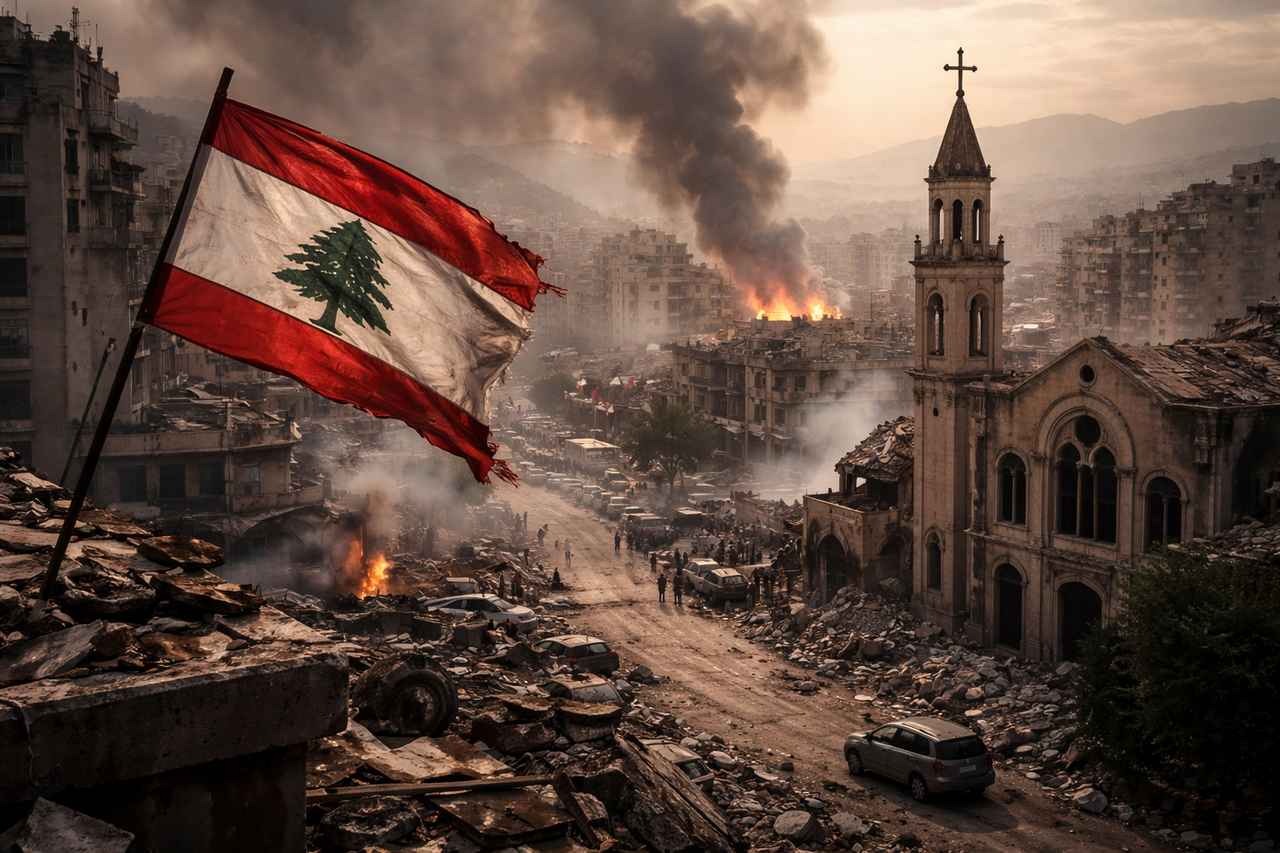
Lebanon calls for informed Christian prayer because the country’s long-running fragility has again been overtaken by war, displacement, and deep uncertainty. Since the renewed escalation in March 2026, civilians have faced repeated strikes, evacuation orders, damaged hospitals and schools, and a humanitarian burden that now reaches far beyond the front lines.
Even after the political reset of 2025, Lebanon remains a place where ordinary faithfulness must be lived out under pressure, grief, and exhaustion. This is why the country deserves more than passing concern. It calls for sober, informed, and compassionate prayer.
1. Why This Country Needs Prayer Now
Lebanon needs prayer now because several burdens are pressing on the country at once.
The most immediate is the renewed war. By early April 2026, UNICEF reported that more than 1.1 million people had been displaced since March 2, and that at least 1,318 people had been killed. Hospitals, schools, water systems, and emergency services were all under severe strain. The Office of the High Commissioner for Human Rights likewise warned in March that ground incursions, blanket displacement orders, and continued airstrikes were deepening the suffering of civilians already worn down by earlier conflict.
Yet the burden is not only military. Lebanon is still trying to govern, recover, and rebuild while carrying the effects of financial collapse, political paralysis, and damage from earlier fighting. The country did see a meaningful political breakthrough in early 2025, but the reform path remains fragile. The World Bank estimated reconstruction and recovery needs from the earlier conflict period at around 11 billion US dollars.
All of this matters for prayer because Lebanon’s churches do not live outside these realities. They live inside them. Christians are worshiping, serving, raising families, and bearing witness to Christ in a nation marked by fear, fatigue, and instability. Prayer, then, must be as wide as the burden itself: for protection, for perseverance, for truth, for peace, and for the church to remain faithful under the sovereign care of God.
2. Country Snapshot
Lebanon is a small Eastern Mediterranean nation centered on Beirut, with a society shaped by deep religious diversity and a political system built around sectarian power-sharing.
After more than two years of presidential deadlock, parliament elected Joseph Aoun as president in January 2025. Nawaf Salam was appointed prime minister soon after, formed a 24-member cabinet on February 8, and won a parliamentary confidence vote on February 26. That shift marked an important political turning point, even though Lebanon’s broader instability did not suddenly disappear.
The country’s religious makeup is difficult to state with precision because Lebanon has not held an official census for decades. Open Doors, drawing on World Christian Database statistics in its 2024 Lebanon dossier, reports that roughly 60 percent of the population is Muslim and 33.9 percent Christian. It also notes that estimates for Lebanese nationals commonly place Christians at around 30 to 35 percent. The U.S. State Department reports that Lebanon officially recognizes 18 religious communities and that political life and senior offices are distributed according to a “just and equitable balance” among major sects.
This means the church in Lebanon is not a hidden remnant. It is old, visible, and woven into the nation’s public life. Yet that visibility does not remove vulnerability. Christians still live within a fractured national order, and some believers, especially converts, bear much heavier and quieter risks than Lebanon’s public Christian presence might suggest.
3. Main Pressures Facing Christians
The first pressure is the country’s wider national crisis. In today’s Lebanon, war and displacement are not distant background issues. They are reshaping daily life. When homes, schools, clinics, roads, and water systems are disrupted, churches feel the strain as well. Ministry becomes harder. Movement becomes riskier. Many believers are pushed into survival mode.
A second pressure falls especially on converts to Christianity from communities where conversion is viewed as betrayal. Open Doors reports that although conversion is legally possible, converts from Sunni, Shia, Druze, and Alawite backgrounds may face rejection, threats, kidnapping, or intense family and community hostility. Many choose secrecy simply to remain safe.
A third pressure is structural. Lebanon’s system gives recognized religious communities a formal place in public life, but that same system can leave unrecognized groups exposed. The U.S. State Department has reported that some Baha’is and members of unrecognized Protestant communities continue to register themselves under recognized groups so that marriages and personal-status documents remain legally valid. Religious liberty in Lebanon is therefore real in some respects, but uneven in practice.
A fourth pressure is long-term exhaustion. Years of economic collapse, corruption, and stalled reform have weakened families, institutions, and hope. The IMF has continued to press for banking-sector restructuring and wider reforms, while the World Bank has described Lebanon’s outlook as tied to fragile stabilization and a narrow but urgent reform window. Churches minister in the middle of that weariness, not above it.
4. What Life Is Like for Christians in Lebanon
For many historic Christian communities in Lebanon, church life remains public and deeply rooted. Congregations can gather. Christian institutions remain visible. The country still has a Christian presence in national life that is unusual in much of the region. That is a real mercy, and it should not be overlooked.
But it would be misleading to stop there. Public presence is not the same thing as peace.
For many ordinary believers, life now carries layered strain. Some are first concerned with safety, shelter, medicine, and schooling because war has displaced families and disrupted essential services. Others carry the slower grief of watching Lebanon’s instability drain strength from churches, businesses, schools, and households. Even where worship continues, it does so in a nation where fear and fatigue can easily settle into the heart.
For converts, daily faithfulness can be even more costly. They may fear not only the nation’s instability, but also the reaction of parents, relatives, or neighbors if their allegiance to Christ becomes known. In practice, this often means guarded conversations, quiet discipleship, and a personal cost attached to open witness.
Still, Lebanon’s Christians are not called merely to endure. They are called to remain the church: to worship God, to love neighbor, to speak truth with wisdom, to care for the displaced and the poor, and to bear witness to Christ in a land where many people are desperate for both mercy and moral clarity. That witness may not always look dramatic, but it is deeply significant.
5. Recent Developments
Lebanon’s recent story has moved quickly.
In January and February 2025, the country emerged from a long political deadlock. Joseph Aoun was elected president, Nawaf Salam was designated prime minister, and a new government was formed and approved by parliament. That created fresh hope for reform after years of paralysis.
Even so, economic and reconstruction pressures remained severe. In March 2025, the World Bank estimated Lebanon’s recovery and reconstruction needs from the earlier conflict period at about 11 billion US dollars. In June 2025, it approved a 250 million US dollar project to support urgent repair and reconstruction in conflict-affected areas. During the same period, the IMF continued to stress the need for bank restructuring and broader reforms.
Then the situation worsened sharply again in 2026. UNICEF reported that hostilities escalated within a broader regional conflict from March 2, bringing mass displacement, school closures, damage to health infrastructure, and growing public-health risk. OHCHR said in March that blanket displacement orders and continued airstrikes were bringing even more misery to civilians already weary from earlier violence.
As of mid-April 2026, the conflict remained active even as diplomacy was being discussed. AP reported on April 13 that fighting continued in southern Lebanon while Lebanon and Israel were preparing for direct talks in Washington, the first such negotiations in decades. That makes this a particularly fluid moment. There are signs of possible diplomatic movement, but there is no settled peace.
6. How to Pray
- Pray that the Lord would restrain evil, protect civilians, and bring a just and durable peace to Lebanon—not merely a brief pause in violence, but a real easing of suffering and a merciful preservation of life.
- Pray for Lebanon’s churches to remain steady in worship, compassion, and gospel witness while so many families are displaced, grieving, or exhausted. Ask that congregations would not turn inward in fear, but serve wisely and sacrificially in Christ’s name.
- Pray especially for converts to Christ from Muslim, Druze, and other non-Christian backgrounds. Ask God to guard them from violence and coercion, sustain them where secrecy is necessary, and provide faithful fellowship and mature discipleship.
- Pray for Lebanon’s leaders to act with wisdom, integrity, courage, and restraint. Ask God to frustrate corruption, weaken sectarian cynicism, and grant policies that serve the common good rather than narrow power interests.
- Pray for relief and reconstruction to reach those who need it most. Ask the Lord to provide food, shelter, medical care, functioning schools, and honest stewardship as Lebanon faces both war damage and long-running economic weakness.
- Pray that Christ would preserve a clear, humble, and holy witness in Lebanon. Ask that suffering would not harden hearts against the gospel, but that the Lord would use even this dark season to draw many to repentance, faith, and living hope in Him.
7. Give Thanks
- Give thanks that Lebanon still has a substantial and historically rooted Christian presence, and that Christian worship and witness remain publicly visible in ways that are rare in much of the region.
- Give thanks that the long presidential deadlock was broken in early 2025 and that at least some reform and reconstruction steps have moved forward, even if the work remains incomplete and fragile.
- Give thanks for every sign of God’s preserving mercy that has kept churches, families, and ministries standing through years of collapse, conflict, and uncertainty.
8. Last Verified
Last updated: April 14, 2026
Next review due: May 2026, or sooner if the current fighting or reported talks shift significantly
Key Sources Consulted
- UNICEF, Lebanon Humanitarian Flash Update No. 6: Escalation of Hostilities (2 April 2026).
- OHCHR, Lebanon: Israeli blanket displacement orders bring more misery to civilians (6 March 2026).
- AP News reporting from April 2026 on ongoing fighting and reported Lebanon-Israel talks.
- International IDEA Democracy Tracker, Lebanon – January 2025.
- U.S. Department of State, 2023 Report on International Religious Freedom: Lebanon.
- Open Doors, Lebanon: Full Country Dossier (May 2024) and Lebanon Persecution Dynamics (March 2025).
- World Bank, Lebanon Economic Monitor, Spring 2025: Turning the Tide?; Lebanon’s Recovery and Reconstruction Needs Estimated at US$11 Billion (7 March 2025); Lebanon: New US$250 Million Project to Kickstart the Recovery and Reconstruction in Conflict-Affected Areas (25 June 2025).
- IMF, Staff Concludes Mission to Lebanon (5 June 2025) and related Lebanon country materials.


