


Libya’s prayer burden is carried in two shadows at once: a divided nation still struggling for public order, and a small Christian presence that often must live quietly under fear, suspicion, and danger. Believers there are not only affected by religious pressure, but also by fractured rule, armed groups, migration abuses, and weak legal protection. To pray for Libya well is to ask the Lord for more than outward stability; it is to plead for justice, mercy, repentance, faithful witness, and the preserving grace of Christ in a hard land.
Why Libya Needs Prayer Now
Libya’s political fragmentation, migrant suffering, and pressure on hidden believers all shape the country’s present prayer burden.
Libya remains politically fragmented. As of the latest checked reporting, the country is still divided between rival western and eastern authorities, with armed groups, institutional rivalry, and competition over resources continuing to weaken public life. In an April 2025 briefing reported by the Associated Press, the United Nations envoy to Libya warned that fragmented institutions, lack of a unified budget, foreign exchange pressure, inflation, currency depreciation, and armed mobilizations around Tripoli were all sharpening the country’s instability.
This instability matters deeply for prayer because weak rule of law leaves ordinary people exposed. It also makes Christian life more fragile. Converts from Islam, migrant believers, foreign Christians, asylum seekers, and refugees may face overlapping dangers: religious pressure, social rejection, detention risk, trafficking, extortion, forced labor, or violence from criminal networks and armed groups. Open Doors’ 2026 Libya profile ranks Libya ninth on its World Watch List and describes Christian life there as highly dangerous, especially for Libyan converts and migrant Christians.
Libya also remains a major migration corridor across the central Mediterranean. Recent reporting has kept this burden painfully visible: in May 2026, the Associated Press reported that armed vessels linked to the Libyan coast guard fired on a humanitarian rescue ship after it rescued about 90 migrants, while another AP report said a boat carrying Sudanese migrants capsized near Tobruk, leaving at least 17 dead and nine missing. These developments are not merely migration headlines; they deepen the present prayer burden for vulnerable people, including migrant believers and displaced families passing through Libya.
Country Snapshot
Compact background that helps readers locate Libya’s burden in its regional, political, and religious setting.
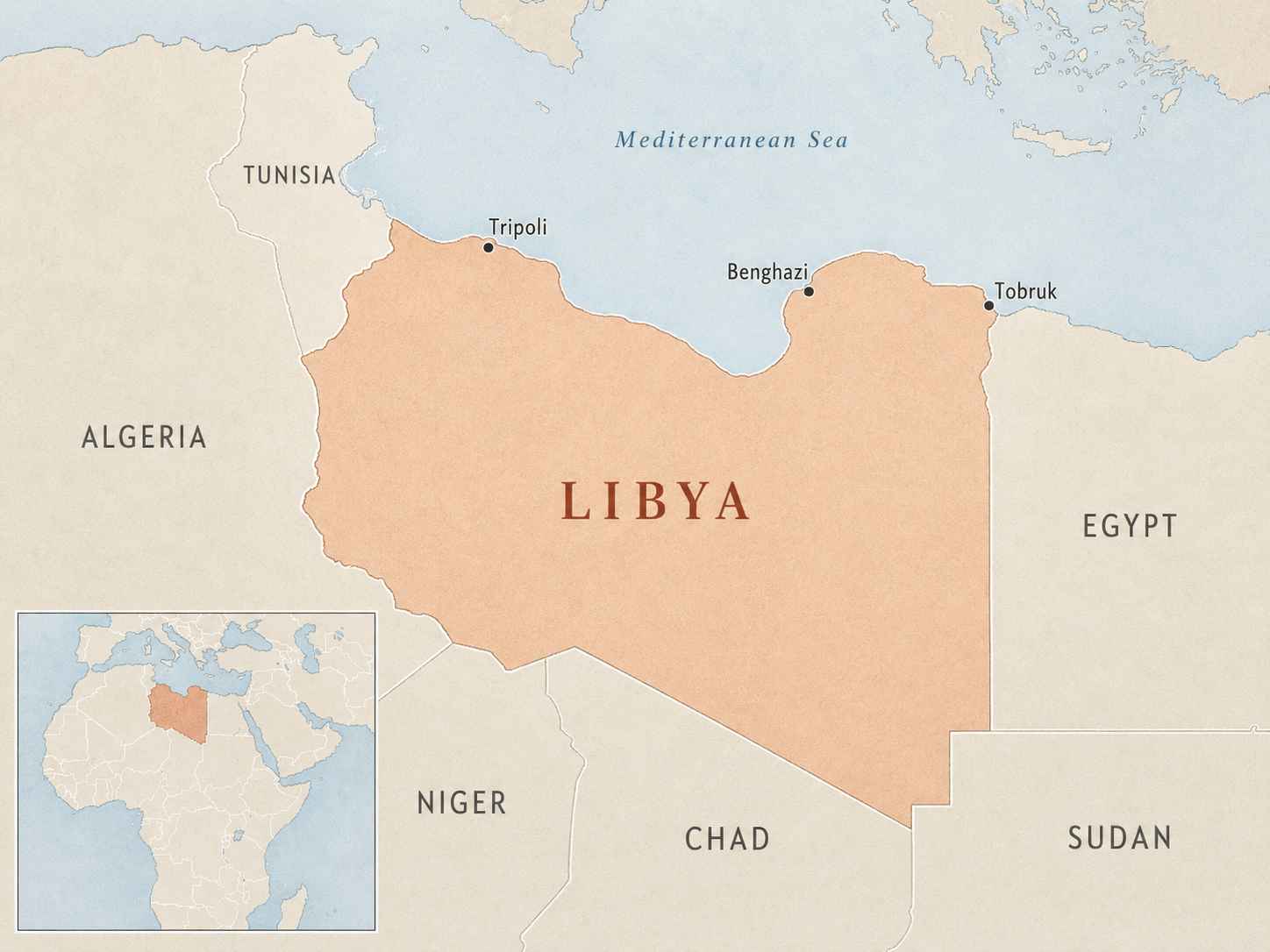
Libya is a large North African country on the Mediterranean Sea, sharing borders with Egypt, Sudan, Chad, Niger, Algeria, and Tunisia. Its location makes it both strategically important and deeply exposed to regional conflict, migration routes, and cross-border instability. AP reporting notes that Libya has been a main transit point for people fleeing war and poverty in Africa and the Middle East and seeking to cross the Mediterranean toward Europe.
Libya’s government remains in transition. Open Doors’ Libya profile lists the country’s government as “In transition” and identifies Prime Minister Abdul Hamid Dbeibeh as the leader in Tripoli. At the same time, the U.S. Commission on International Religious Freedom describes Libya as politically fragmented between the internationally recognized Government of National Unity in Tripoli and the rival Government of National Stability, an unrecognized eastern-based authority in Benghazi.
Religiously, Libya is overwhelmingly Muslim. The U.S. Commission on International Religious Freedom’s 2026 Libya chapter says roughly 97 percent of the population is Muslim, mostly Sunni, with a smaller Ibadi Muslim community largely concentrated among the Amazigh ethnic minority. Other religious communities are much smaller and include Christians, Baha’is, Hindus, Buddhists, and Ahmadiyya Muslims.
The Christian presence in Libya is small and varied. Many Christians are foreign residents, migrant workers, or refugees. Some are Egyptian Copts or believers from other parts of Africa. Libyan converts from Islam are especially vulnerable and often cannot practice their faith openly. Open Doors says Libyan Christians from a Muslim background face intense family and community pressure and that all practice their faith in secret.
Main Pressures Facing Christians
The pressures facing Christians in Libya are legal, social, security-related, and deeply affected by the country’s wider disorder.
Secrecy for Converts
For Libyans who turn from Islam to Christ, Christian faith is not usually treated as a private matter. It may be viewed by family, community, or authorities as betrayal, shame, or danger. Open Doors says converts from Islam are extremely vulnerable and are “forced into the shadows.”
Legal and Security Pressure
The U.S. Commission on International Religious Freedom reports that Libya’s political fragmentation has weakened protection for freedom of religion or belief. It says authorities affiliated with both the Tripoli-based Government of National Unity and the eastern Government of National Stability maintain restrictive environments for religious expression. It also reports that the Internal Security Agency, a state-affiliated security body in Tripoli, has carried out arrests, prolonged detention, interrogation, and torture of people suspected of apostasy from Islam or proselytizing.
Religion-Related Prosecution
In 2025, according to the U.S. Commission on International Religious Freedom, a Tripoli court convicted 10 Christians and one atheist on charges connected to their beliefs, sentencing them to prison terms of three to 15 years. Amnesty International also described the same case as a grossly unfair trial and said the convictions punished freedom of thought. The state and security lane is important here: Libyan authorities have used legal and security language in such cases, while outside monitors argue that peaceful belief, religious expression, and due process were violated.
Migrant Vulnerability
Open Doors reports that foreign Christians, many from other parts of Africa, can be targeted by extremist groups and organized criminal gangs through trafficking, kidnapping, ransom demands, and forced labor. Their Christian identity can make them even more vulnerable when discovered.
Broader Disorder
Weak institutions, militia influence, competing authorities, and social suspicion make safe worship, discipleship, Bible access, fellowship, and public witness difficult. For many believers in Libya, the question is not only whether they may gather, but whether anyone can know they follow Christ at all.
What Life Is Like for Christians in Libya
For many believers in Libya, ordinary faithfulness is quiet, costly, and dependent on God’s preserving grace.
For many Christians in Libya, faithfulness is quiet and costly. A Libyan convert may need to hide a Bible, guard online activity, avoid speaking openly about Christ with relatives, and live with the fear that discovery could bring rejection, interrogation, imprisonment, or violence. Open Doors notes that Christian activity online came under increased monitoring after arrests of Libyan Christians in 2023.
Foreign Christians and migrant believers may face a different but overlapping burden. Some may be able to worship more openly within migrant or expatriate communities, but many remain vulnerable because of ethnicity, legal status, poverty, or the dangers of movement through Libya. In detention settings, trafficking networks, or informal labor situations, Christian migrants may be targeted both as foreigners and as believers.
Not every Christian in Libya faces the same kind of pressure. An Egyptian Copt, a sub-Saharan African migrant worker, a foreign professional, and a Libyan convert from Islam may experience Christian life differently. Yet the recurring realities are similar: caution, fear of exposure, limited fellowship, difficulty finding trustworthy discipleship, and deep dependence on God’s preserving grace.
And still, the Lord has not left Libya without a witness. The church there may be small, hidden, and pressured, but Christ knows His people by name. Their endurance should move the wider church not to curiosity or dramatic storytelling, but to steady, informed, reverent intercession.
Recent Developments
Time-sensitive developments that materially shape how Christians should pray for Libya now.
-
April 2025
Political deadlock and economic pressure
Libya’s political deadlock continues to shape the country’s prayer burden. In April 2025, the United Nations envoy to Libya warned that political rivalry, fragmented institutions, lack of a unified budget, and economic pressure were deepening instability. She also said the unresolved dispute over presidential elections remained a major obstacle and urged rival parties to compromise.
-
2025
Religious-freedom concerns sharpened
Religious-freedom concerns sharpened in 2025. The U.S. Commission on International Religious Freedom’s 2026 Libya chapter says religious freedom conditions in Libya continued to deteriorate in 2025 and highlights convictions, coerced-confession allegations, and continued vulnerability for religious minorities. It also reports that a Christian remained imprisoned while awaiting review of a death sentence connected to a 2022 apostasy conviction.
-
August 2025
Religion-related convictions challenged by outside monitors
In August 2025, Amnesty International called for the convictions of 10 Libyans and one Pakistani man to be quashed, saying the trial was marred by serious due-process violations. This should be described carefully: Amnesty presents these convictions as punishment for freedom of thought, while Libyan authorities used criminal and religious-legal frameworks. For prayer, the central concern is clear without overstating what remains contested: people accused in religion-related cases need justice, truth, due process, humane treatment, and protection of conscience.
-
April 2025
Aid organizations ordered to suspend operations
Libya’s treatment of migrants and humanitarian groups has also remained a major concern. In April 2025, Libyan authorities ordered 10 international aid organizations to suspend operations, accusing them of violating local law by helping African migrants settle in the country. The Associated Press reported that the authorities framed the issue in terms of demographics, money laundering suspicions, and state security crimes, while aid and medical groups warned that migrants in Libya already faced violence, trafficking, abuse, and severe barriers to health care.
-
May 2026
Migrant-rescue danger and deaths near Tobruk
The migrant burden has continued into 2026. In May 2026, AP reported that armed vessels linked to the Libyan coast guard fired on the Sea-Watch 5, a humanitarian rescue ship, after it rescued about 90 migrants. AP also reported that a boat carrying Sudanese migrants capsized near Tobruk, leaving at least 17 dead and nine missing, and that the International Organization for Migration said 2026 had seen the deadliest start to a year for Mediterranean crossings since 2014.
These developments do not turn the prayer post into a migration report. They do, however, show why Libya’s present burden cannot be narrowed to church pressure alone. Political division, armed disorder, legal pressure, religious fear, migrant vulnerability, and weak public accountability all shape how Christians should pray for Libya now.
How to Pray
Specific prayers rooted in Libya’s church context, public disorder, and present burdens.
-
Pray that God would restrain militias, traffickers, abusive security actors, and all who profit from fear, detention, extortion, and disorder, and that He would grant Libya a more truthful, just, and accountable public order.
-
Pray for Libyan converts from Islam and other hidden believers, that the Lord Jesus would keep them steadfast in faith, holy in conduct, and wise in speech, and that He would provide safe fellowship, sound discipleship, and quiet access to His Word.
-
Pray for Christians who are imprisoned, prosecuted, or pressured in religion-related cases, that coerced confessions would be exposed, unjust sentences revisited, and officials restrained from punishing peaceful belief, worship, or witness.
-
Pray for migrant Christians, asylum seekers, and refugees in Libya, including many made more vulnerable by conflict and displacement from Sudan, that God would protect them from trafficking, detention abuse, sexual violence, ransom, and exploitation, and raise up timely help for the defenseless.
-
Pray for Libya’s divided political leaders, mediators, judges, and public institutions, that the Lord would humble the proud, check factional ambition, frustrate corruption, and grant wisdom for steps that would serve ordinary families with greater stability, justice, and peace.
-
Pray that amid secrecy, fear, and national fragmentation, Christ would build His church in Libya: strengthening weary believers, preserving faithful witness, raising up mature disciples, and bringing sinners to repentance and faith through the gospel.
Give Thanks
Measured thanksgiving for God’s preserving mercy, visible witness, and common grace.
- Give thanks that God has not left Libya without a witness. He continues to preserve believers there, including hidden disciples and vulnerable migrant Christians, even where faithfulness often must remain quiet and costly.
- Give thanks for every evidence of preserving grace in the church: endurance under pressure, guarded but real fellowship, and quiet faithfulness by which believers continue to hold fast to Christ in a hard land.
- Give thanks that grave abuses in Libya are not entirely hidden. Public reporting, international scrutiny, and continued advocacy have brought suffering, detention abuse, and religion-related injustice more clearly into the light.
- Give thanks for those who continue to serve vulnerable people in Libya and at sea, including humanitarian workers, rescue crews, medical workers, and local responders who seek to preserve life in dangerous and morally complicated conditions.
Last Verified
A compact update note for future review and responsible republication.
- Last updated
- May 16, 2026
- Next review due
- August 2026, or sooner if there is a major political breakthrough, renewed fighting in Tripoli or eastern Libya, a significant development in religion-related prosecutions, or a sharp escalation in migrant and refugee abuse.
Key Sources Consulted
Descriptive source documentation for later review, updating, and editorial transparency.
- U.S. Commission on International Religious Freedom. 2026 Annual Report: Libya. 2026. Used for religious-freedom conditions, religion-related prosecutions, legal background, and pressure on converts and minorities.
- Open Doors. Libya Country Profile and 2026 World Watch List Materials. 2026. Used for current Christian-pressure profile, Libya’s 2026 World Watch List ranking, conditions for converts, and migrant Christian vulnerability.
- Amnesty International. “Libya: Harsh Sentences Punishing Freedom of Thought Following Grossly Unfair Trial.” August 12, 2025. Used for due-process concerns and outside human-rights assessment of the 2025 religion-related convictions.
- Associated Press. “UN Envoy Underscores Libya’s Security Struggles amid Political Crisis.” April 2025. Used for political fragmentation, economic strain, election deadlock, armed-group concerns, and migrant-related public pressure.
- Associated Press. “Libyan Authorities Suspend 10 International Aid Groups Providing Crucial Assistance to Migrants.” April 2025. Used for the aid-group suspension, official Libyan rationale, and humanitarian concerns about migrant vulnerability.
- Associated Press. “Armed Vessels Linked to Libyan Coast Guard Attack Migrant Rescue Ship, Aid Group Says.” May 2026. Used for the May 2026 Sea-Watch 5 incident and continuing migrant-rescue tensions.
- Associated Press. “Boat Wreck off Libya Claims the Lives of at Least 17 Sudanese Migrants.” May 2026. Used for recent Sudanese migrant deaths near Tobruk and the current central Mediterranean migration burden.
A Closing Prayer for Libya
Gathering this prayer guide into one focused prayer before God.


