


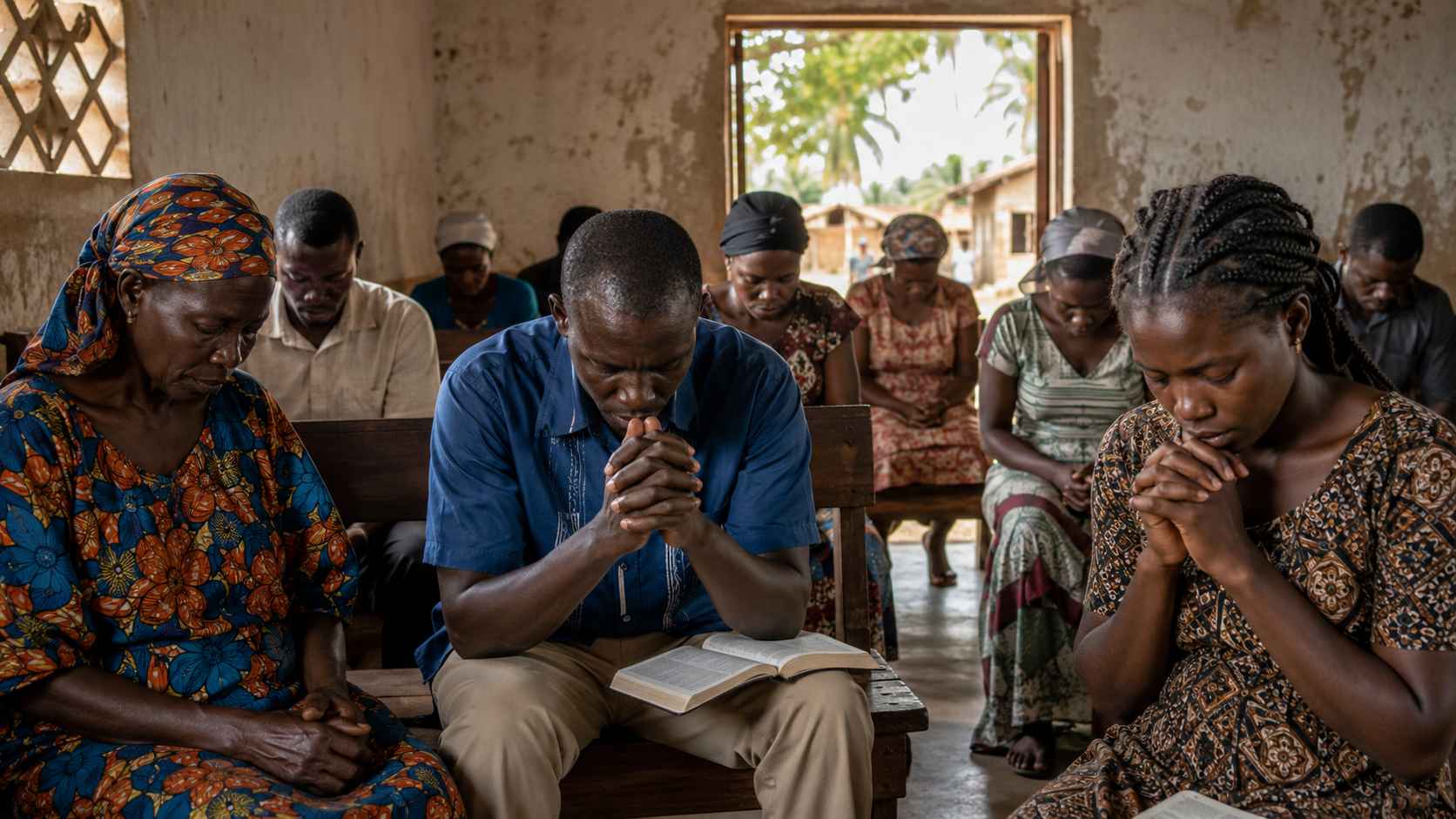
Guinea-Bissau is a small Atlantic nation in West Africa, but its public life has repeatedly been disrupted by disputed power, weak institutions, military intervention, and widespread poverty. After the 2025 military takeover interrupted a disputed electoral process, many families now face another uncertain transition and wonder whether the promised return to constitutional order will happen peacefully. Christians pray not only for public order, but also for churches to remain united, wise, courageous, and clear in their witness in a religiously mixed society where many communities live peaceably together, yet family and local expectations can still make open discipleship costly.
Prayer Burden at a Glance
Pray for Guinea-Bissau during its post-coup transition: for peaceful and lawful public order, for poor households affected by high prices and uncertain income, and for churches to worship, disciple believers, love their neighbors, and speak clearly of Christ.
Last verified: May 2026
Why Guinea-Bissau Needs Prayer Now
Guinea-Bissau needs prayer for peaceful public order, faithful churches, and the protection of vulnerable households during military transition and economic strain.
Guinea-Bissau needs prayer now because a disputed election process has again been interrupted by military rule. After the November 2025 presidential and legislative elections, the military seized power, halted the electoral process, and installed Gen. Horta Inta-A as head of a transitional military government. The African Union suspended Guinea-Bissau from its activities until constitutional order is restored, and the Economic Community of West African States, the regional bloc commonly known as ECOWAS, also suspended Guinea-Bissau from its decision-making bodies. Associated Press
The transition has a published election date, but that does not remove the uncertainty. In January 2026, Guinea-Bissau’s transitional authorities announced presidential and legislative elections for December 6, 2026. That date gives the country a public timetable, but Guinea-Bissau’s long history of coups, attempted coups, and interrupted constitutional order makes this a season when citizens need protection, leaders need restraint, and churches need wisdom. Associated Press
This instability comes alongside serious economic vulnerability. The World Bank’s April 2026 Macro Poverty Outlook says Guinea-Bissau’s growth is expected to soften in 2026 because of political instability, higher food and oil prices, lower international cashew prices, and external shocks. The same outlook notes that stronger cashew production and easing inflation supported growth in 2025 and reduced extreme poverty to 39.8 percent, but poverty remains a major national burden. World Bank
Christians therefore pray for Guinea-Bissau with more than one concern in view. They pray for peace in public life, justice in leadership, daily provision for the poor, protection from fear and manipulation, and the strengthening of churches that must witness patiently in a society facing military rule, poverty, and uncertainty about elections.
Country Snapshot
A brief orientation to Guinea-Bissau’s location, people, government context, and church setting.
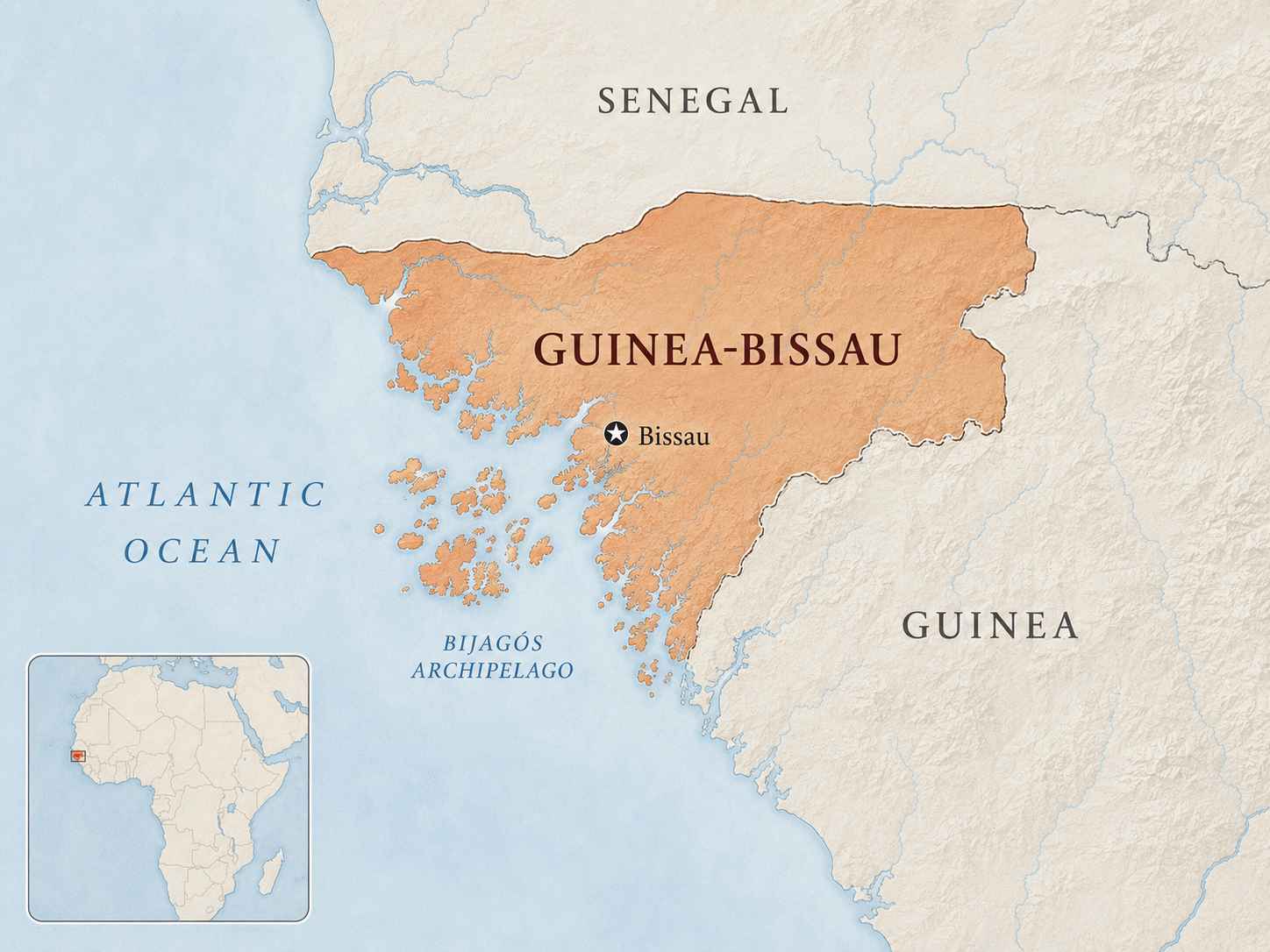
Guinea-Bissau sits on the Atlantic coast of West Africa, bordered by Senegal to the north and Guinea to the east and south, with the Bijagós Archipelago lying offshore. The body map below helps readers locate Guinea-Bissau within West Africa and see its regional setting before moving into the country’s church, political, and social context.
The country’s religious setting is mixed. Islam is the largest religious identity, Indigenous religious practices remain influential, and Christians are a significant minority, especially in Bissau and coastal areas. That mix often allows neighborly coexistence, but in some communities family expectations, local customs, or ancestral religious practices can also create tension for Christians and churches. U.S. State Department
Restrictions and Opposition Facing Christians and Churches
Christians in Guinea-Bissau have legal space to worship, yet family expectations, ancestral religious customs, political instability, and poverty can still make discipleship and church life difficult.
Legal protection with local opposition in some communities
Christians in Guinea-Bissau do not face a uniform national system of legal persecution. The constitution protects freedom of conscience and religion, affirms separation between the state and religious institutions, and recognizes the freedom of religious groups to teach their faith. That legal framework is an important mercy. U.S. State Department
Community tension around ancestral practices
At the same time, legal protection has not prevented every local restriction. The U.S. State Department reported that in January 2023, a community in Canchungo suspended the activities of a local evangelical Protestant church, accusing the church of failing to respect the community’s ancestral animist practices. The church and its school remained closed at the end of that reporting year. U.S. State Department
Instability and concern about extremist influence
Religious leaders told the State Department that different religious groups were mostly respectful and tolerant of one another, but some leaders also warned about extremist influence spreading in the east, especially where porous borders and poverty create vulnerability. U.S. State Department
Daily pastoral burdens under poverty and political fear
These burdens may not appear in national laws or headlines, but believers can still feel them in daily life: family unease when someone follows Christ openly, community suspicion toward a church that seems to reject ancestral customs, or pastoral burdens when poverty and political fear make people weary. Churches need wisdom to witness without needless provocation, courage when family or community opposition comes, and patience to love neighbors in a society where religious identity and community life are closely woven together.
Christian Life and Witness in Guinea-Bissau
Many Christians live peacefully beside Muslim neighbors and communities shaped by Indigenous religious practices, while still needing wisdom when family customs, village expectations, or poverty affect daily discipleship.
Many Christians in Guinea-Bissau live in daily contact with Muslim neighbors and communities shaped by Indigenous religious practices. Religious leaders have reported broad patterns of respect and tolerance among religious groups, and that should be received as evidence of God’s common grace. U.S. State Department
Yet peaceful coexistence does not mean discipleship is easy. A believer may freely attend church in Bissau and still face tension during family ceremonies, village expectations, or community customs. A pastor may preach freely and still shepherd people whose lives are strained by poverty, political uncertainty, and fear. A congregation may worship without police harassment and still need wisdom when ancestral expectations or local suspicion make open Christian witness difficult.
The church’s calling in Guinea-Bissau is deeply practical: to worship the Lord faithfully, teach Scripture clearly, serve poor and anxious communities, strengthen families, disciple the young, and keep proclaiming Christ without bitterness or fear.
Recent Developments
Guinea-Bissau’s post-coup transition, regional response, and planned elections give Christians clear reasons to pray for peace, lawful order, and protection for ordinary citizens.
-
February–September 2025
Dispute over the presidential mandate
A serious political dispute intensified in 2025 over the end of President Umaro Sissoco Embaló’s mandate. Opposition figures said his term ended in February 2025, while Guinea-Bissau’s Supreme Court ruled that it ended on September 4, 2025. The International Institute for Democracy and Electoral Assistance, commonly known as International IDEA, recorded this dispute as part of the country’s wider democratic and constitutional crisis. International IDEA
Prayer significance: Pray for public trust, restraint, truthfulness, and protection for ordinary communities where disputed authority increases fear and instability.
-
November 2025
Military takeover after disputed elections
The crisis worsened later that year. After disputed presidential and legislative elections in November 2025, the military took control, halted the electoral process, and installed Gen. Horta Inta-A as the transitional leader. Associated Press reported that both Embaló and opposition candidate Fernando Dias had claimed victory before the takeover. Associated Press
Prayer significance: Pray for restraint, lawful order, protection from intimidation, and wise pastoral leadership for churches ministering amid uncertainty.
-
November 2025
Regional response from the African Union and ECOWAS
Regional and international bodies condemned the military takeover and called for a return to constitutional order. The African Union Commission chairperson condemned the military takeover, and the African Union later suspended Guinea-Bissau from participation in its activities until constitutional order is restored. ECOWAS also suspended Guinea-Bissau from its decision-making bodies and called for the restoration of constitutional order. African Union; ECOWAS
Prayer significance: Pray for constitutional order, regional peacemaking, and leaders who pursue the good of the people rather than personal advantage.
-
January 2026
New elections announced for December 6, 2026
In January 2026, the transitional authorities announced that presidential and legislative elections would be held on December 6, 2026. That date gives a public timetable, but the prayer need remains clear: Guinea-Bissau needs restraint, lawful order, credible institutions, and leaders who seek the good of the people rather than personal advantage. Associated Press
Prayer significance: Pray that any path toward elections would be marked by peace, truthfulness, justice, and protection for ordinary citizens.
How to Pray
Use these prayer points to intercede for Guinea-Bissau with biblical hope, compassion, and clear attention to the country’s present burden.
-
Pray for the Lord to restrain disorder and establish peace. Ask God to hold back violence, intimidation, revenge, and fear during Guinea-Bissau’s political transition, and to grant the nation a peaceful path toward lawful public order.
-
Pray for just and honest leadership. Ask the Lord to expose corruption, restrain selfish ambition, and raise leaders who use authority to protect the vulnerable, serve the public good, and pursue truth.
-
Pray for churches to remain faithful under uncertainty. Ask God to strengthen pastors, elders, evangelists, and ordinary believers in Scripture, prayer, holiness, courage, humility, and perseverance.
-
Pray for believers facing family or community opposition. Pray especially for Christians whose faith brings tension with family expectations, ancestral practices, village customs, or suspicion toward evangelical churches. Ask the Lord to give them courage without harshness and love without compromise.
-
Pray for wise Christian witness in a religiously mixed society. Ask God to help believers speak clearly of Christ while showing patience, respect, and neighbor-love toward Muslims and those shaped by Indigenous religious traditions.
-
Pray for poor households and rural communities. Ask the Father to provide food, work, fair prices for cashew farmers, and daily protection for families affected by political instability, high prices, and uncertain income.
-
Pray for lasting gospel fruit. Ask the Lord Jesus Christ to build His church in Guinea-Bissau, bring sinners to repentance and faith, strengthen discipleship, and make local congregations known for truth, mercy, holiness, and hope.
Give Thanks
Even during political instability, there are real reasons to thank God for mercy and common grace in Guinea-Bissau.
-
Give thanks for the public space churches still have to worship and teach. Guinea-Bissau’s legal protections for freedom of conscience and religion are a real mercy during political instability.
-
Give thanks for patterns of interreligious coexistence. In many places, Muslims, Christians, and communities shaped by Indigenous religious traditions live alongside one another with meaningful respect. That peace should not be taken for granted.
-
Give thanks for believers and churches that continue to serve faithfully. Even amid poverty, uncertainty, and political instability, congregations continue to gather, disciple, pray, and bear witness to Christ.
-
Give thanks for every restraint of violence and every honest effort toward peace. In a country with a long history of coups and instability, every preserved life, peaceful community, and faithful act of public service is a gift of God’s common grace.
Last Verified / Update Note
This note helps readers understand when the guide was reviewed and which developments may affect future prayer use.
Review Status
Reviewed for current prayer use
This guide reflects a May 2026 review of Guinea-Bissau’s post-coup transition, current transitional leadership, planned December 6, 2026 elections, regional responses by the African Union and the Economic Community of West African States, religious-freedom context, reports of local opposition affecting churches, and major economic pressures affecting ordinary households.
Changes in the transition timetable, the planned December 6, 2026 elections, African Union or Economic Community of West African States decisions, new human-rights or religious-freedom reports, local opposition affecting churches, food prices, oil prices, or cashew income may affect how readers use this guide for prayer.
Key Sources Consulted
These sources informed the country context, recent developments, and prayer points in this Guinea-Bissau guide.
- Associated Press — “African Union suspends Guinea-Bissau after coup and former president flees to Republic of Congo.” Used for the November 2025 coup, African Union suspension, disputed election context, transitional leadership, ECOWAS suspension, and political-instability background.
- Associated Press — “Guinea-Bissau junta sets election date following last year’s coup.” Used for the January 2026 announcement of December 6, 2026 presidential and legislative elections and the one-year transition frame.
- International Institute for Democracy and Electoral Assistance — Guinea-Bissau, February 2025. Used for the mandate dispute involving former President Umaro Sissoco Embaló and the country’s wider democratic and constitutional crisis.
- African Union Commission — Chairperson statement condemning the military coup in Guinea-Bissau. Used for regional institutional response and constitutional-order framing.
- African Union Peace and Security Council — Communiqué on the emergency situation in Guinea-Bissau. Used for the African Union suspension and restoration-of-constitutional-order context.
- Economic Community of West African States — Final Communiqué of the Extraordinary Virtual Summit on Guinea-Bissau. Used for ECOWAS’s condemnation of the coup, suspension of Guinea-Bissau from decision-making bodies, and call for restoration of constitutional order.
- U.S. Central Intelligence Agency — World Leaders: Guinea-Bissau. Used for the transitional officeholder listing last updated January 14, 2026.
- World Bank — Guinea-Bissau Macro Poverty Outlook, April 2026. Used for growth, poverty, inflation, cashew-sector, and economic-risk context.
- U.S. Department of State — 2023 International Religious Freedom Report: Guinea-Bissau. Used for religious-demography estimates, constitutional religious-freedom protections, coexistence reporting, the Canchungo evangelical church closure, and concerns about extremist influence in the east.
Source Context
- Religious composition and local church opposition: These details rely mainly on the U.S. State Department’s 2023 religious-freedom reporting, which remains useful for structural background but is older than the 2025–2026 political transition.
- Economic outlook: The World Bank’s April 2026 outlook gives current economic context and includes projections that may change as political and market conditions shift.
- Political transition: Details about the transition remain time-sensitive because its legitimacy, durability, and outcome remain contested.
A Closing Prayer for Guinea-Bissau
A concise prayer gathering Guinea-Bissau’s present burden before the Lord.


