

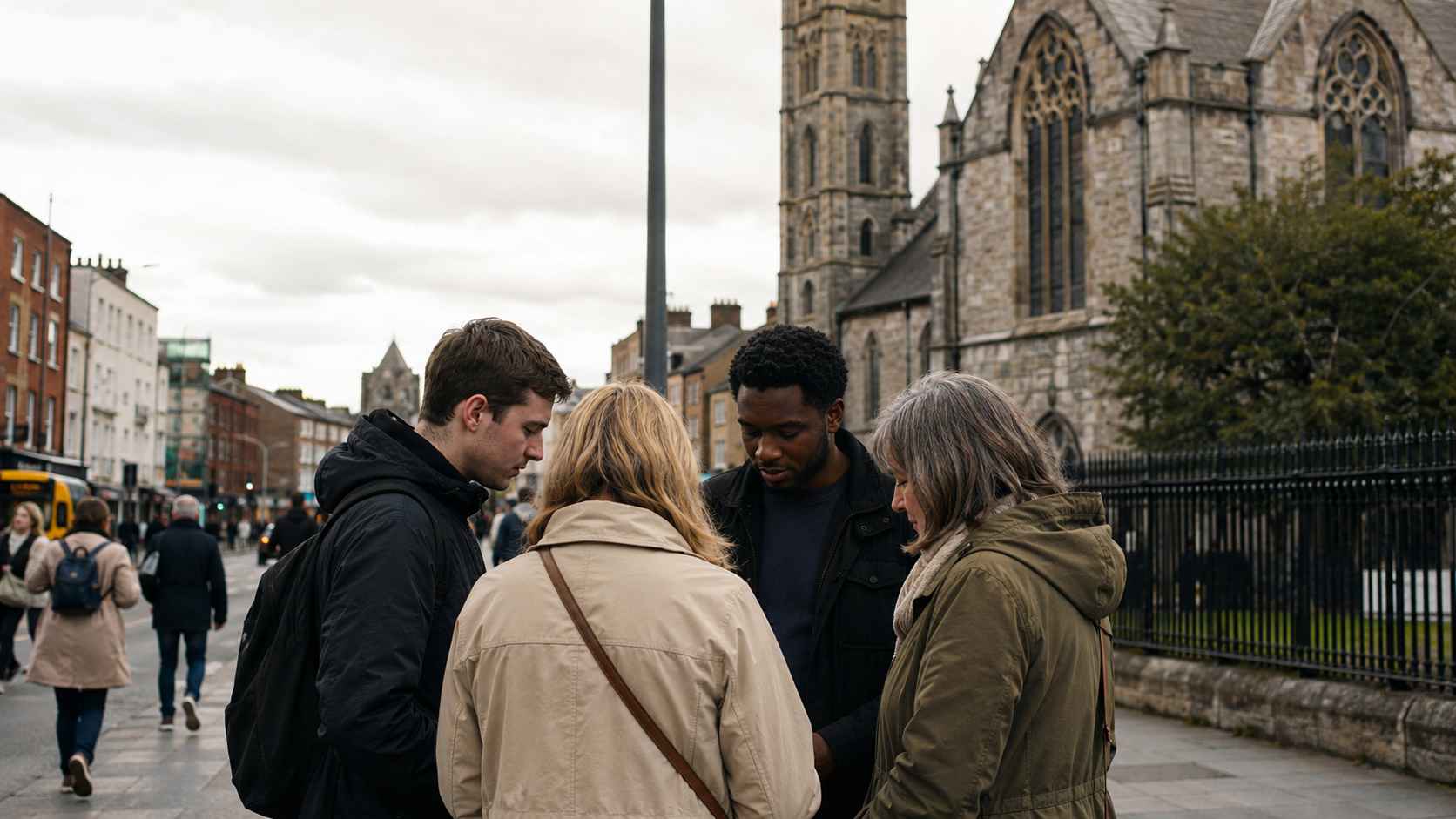
Ireland’s churches minister in a country where Christian signs are still easy to see: church buildings, school histories, public holidays, graveyards, place names, and family memories still remind many people of the faith that shaped much of Irish life. Yet many people now have little active connection to worship, Scripture, repentance, or local church discipleship, and some associate Christian institutions first with abuse, shame, or broken trust. Prayer for Ireland should therefore be grateful, honest, and hopeful: grateful for real freedom and Christian inheritance, honest about sin and spiritual distance, and hopeful that the Lord can renew churches, heal what has been damaged, and draw people to living faith in Jesus Christ.
Pray for believers and churches in Ireland to proclaim Christ with humility and courage in a society where Christian symbols remain familiar but active worship and discipleship are weakening for many. Ask God to bring repentance where religious institutions have sinned, healing for survivors of abuse, protection for children, wisdom for families and schools, mercy amid housing and migration burdens, and renewed confidence in Christ rather than in cultural religion.
Last verified: June 2026
Why Ireland Needs Prayer Now
Ireland needs prayer not because Christians lack basic legal freedom, but because familiar Christian signs do not guarantee active faith in Christ.
Ireland does not need to be made to sound like a high-persecution or armed-conflict country. Christians in Ireland generally have legal freedom to gather, preach, teach, publish, serve, and pray. The Constitution of Ireland guarantees freedom of conscience and the free profession and practice of religion, subject to public order and morality, and outside assessments such as Freedom House continue to describe Ireland as a highly free society where people are free to practice and express religious faith or nonbelief.
Ireland’s prayer burden is different. It is the burden of a country where Christian inheritance is still public, but active faith can no longer be assumed. The Central Statistics Office’s Census 2022 religion profile recorded more than 3.5 million people identifying as Roman Catholic, about 69% of the population, while 736,210 people reported having no religion, more than 14%. The figures do not tell the whole spiritual story, but they do show a country where inherited Christian identity, growing nonreligion, and wider religious diversity now exist side by side.
This creates a serious prayer need. Some people remain close to Christian language through family, school, public holidays, or local history, while having little active connection to worship, Scripture, repentance, or local church life. Others have turned away because they associate religious institutions with hypocrisy, abuse, control, shame, or disappointment. Some younger people know Christianity mainly as family background or public controversy rather than as the good news that sinners are reconciled to God through the crucified and risen Lord.
The church in Ireland therefore needs more than cultural respectability. It needs repentance, holiness, courage, patient discipleship, and clear preaching of Christ. Churches must speak of sin without cruelty, grace without softness, truth without defensiveness, and Christ without nostalgia. They must protect the vulnerable, disciple the young, serve neighbors under pressure, and show that Christianity is not merely part of Ireland’s past but the message of salvation, mercy, and new life in Christ.
Ireland also faces public burdens that shape ordinary life and Christian witness. Housing pressure has left many families and single adults insecure. Migration and asylum-accommodation tensions have exposed fear, anger, vulnerability, and the need for moral care in public speech. Education debates raise real questions about religious formation, conscience, pluralism, and parental trust. Life-ethics debates require churches to speak carefully about suffering, dignity, autonomy, and the value of human life.
These concerns do not make Ireland hopeless. They make Ireland a country where Christians should pray with sober love: asking the Lord to renew His church, heal what sin has wounded, protect children and vulnerable people, strengthen faithful witness, and bring many from inherited religion, secular indifference, or disillusionment into living faith in Christ.
Country Snapshot
A brief orientation to Ireland’s location, people, government, and religious-freedom context.
Ireland shares the island of Ireland with Northern Ireland, which is part of the United Kingdom. This guide focuses on the sovereign state of Ireland. Northern Ireland is mentioned only where it helps readers understand geography, island context, or wider Irish public life.
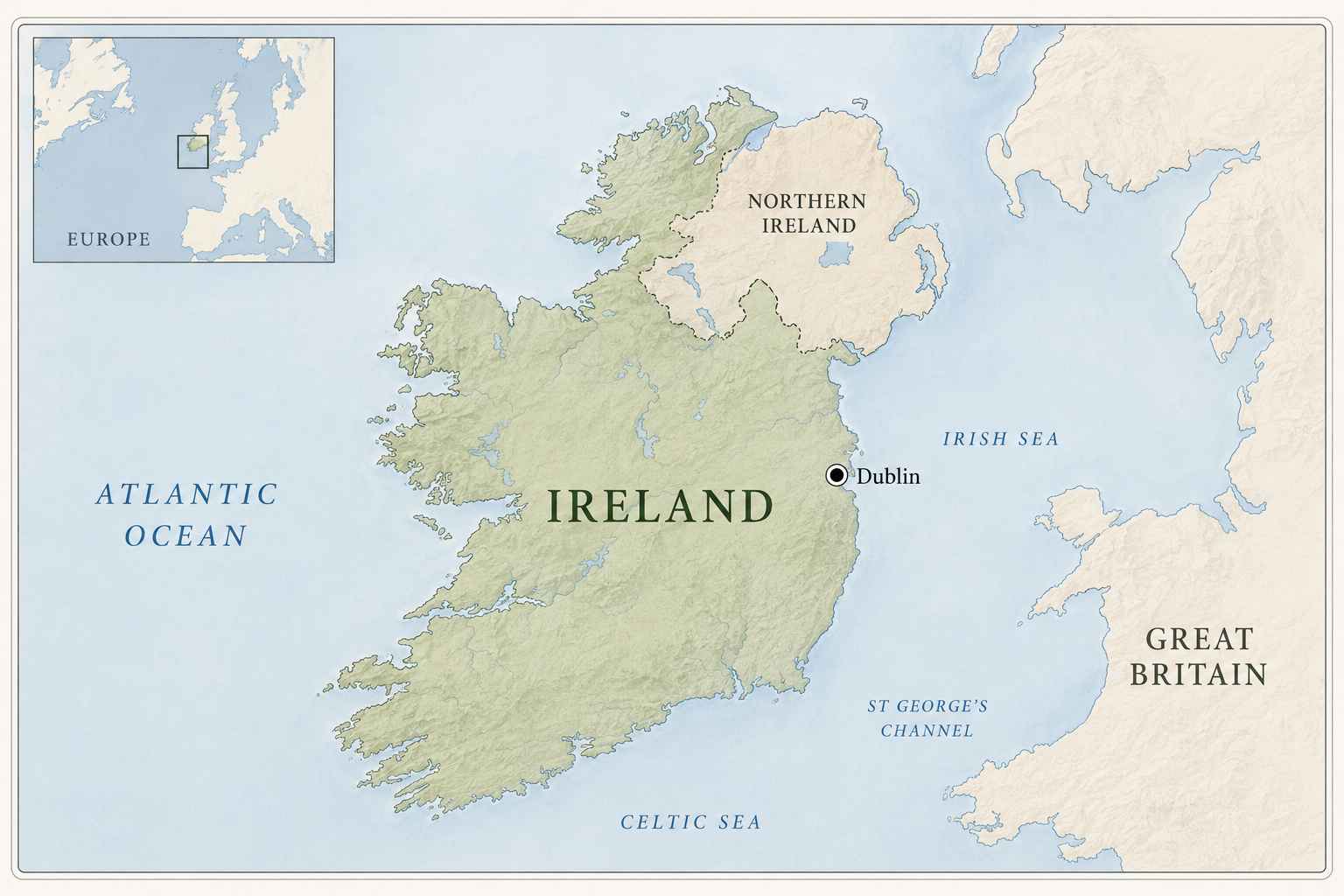
Ireland’s Christian inheritance is especially visible through Roman Catholic history, but the country also includes Church of Ireland, Presbyterian, Methodist, Orthodox, Pentecostal, evangelical, migrant, and other Christian communities. Recent migration has brought new Christian communities into Irish towns and cities, including believers from Africa, Eastern Europe, Asia, and other parts of the world. This can bring both blessing and pastoral complexity: churches have opportunities for cross-cultural fellowship, but they also need humility, patience, and love across ethnic, class, denominational, and generational lines.
Main Pressures Facing Christians
Ireland’s main pressures are not persecution by the state, but secularization, weakened trust, moral disagreement, and the need for credible Christian witness.
Secularization and inherited religion
Ireland’s Christian inheritance remains visible, but inheritance is not the same as faith. Some people still identify with Christianity because of family, school, national history, or sacramental background, while having little active connection to worship, Scripture, repentance, or discipleship. Others no longer identify with religion at all. Churches need grace to speak clearly to both groups: to those who think they already know Christianity and to those who assume they no longer need it.
This is not a call to despise Ireland’s Christian history. It is a call to pray that Christian inheritance would not become a substitute for conversion, obedience, and living fellowship with Christ.
Public-trust wounds from abuse and institutional failure
The wounds connected to abuse in religious and school settings remain a major burden for prayer. The Government of Ireland’s Commission of Investigation into the Handling of Historical Child Sexual Abuse in Schools was established to examine how concerns or allegations of child sexual abuse were handled in Irish day and boarding schools, including special schools, between 1927 and 2013.
This burden must be handled without denial, defensiveness, or vague religious language. Survivors need truth, care, justice, and protection from being retraumatized. Churches need repentance where sin was hidden, courage where truth was avoided, and serious safeguarding where trust must be rebuilt. Christian witness in Ireland will not be strengthened by protecting institutional reputation. It will be strengthened by truth, humility, holiness, and genuine care for those harmed.
Schools, conscience, and religious formation
School patronage remains one of Ireland’s important public questions. In Ireland, a denominational school is a school with a religious patron, and the Department of Education says the vast majority of primary schools remain under Catholic patronage. The same Department of Education patronage and ethos page distinguishes multi-denominational schools as schools under non-religious patrons where children learn about all faiths and belief systems through a multi-denominational programme.
This matters for prayer because schools shape children, families, conscience, religious memory, and public trust. Christian parents need wisdom to disciple their children without outsourcing faith to institutions. Teachers and school leaders need fairness, integrity, and care. Churches need humility as they engage questions of religious ethos, parental choice, pluralism, and the place of Christian formation in a changing society.
Migration, asylum, and local-community tension
Ireland’s population has grown through migration as well as natural increase. The Central Statistics Office estimated that 125,300 immigrants entered the State in the year to April 2025, while 65,600 people emigrated during the same period. Migration brings neighbors made in God’s image, practical needs, cultural complexity, church opportunities, and local pressures.
Recent unrest near asylum accommodation shows why Christians need moral care in speech and action. Associated Press reported that in October 2025 protesters clashed with police outside the CityWest Hotel near Dublin, which was housing asylum seekers, after reports of a sexual assault in the area; the report described thrown bricks, bottles, fireworks, a police van set on fire, arrests, and official warnings against politicizing crime to incite unrest. Christians should pray for justice for victims of crime, due process, public safety, protection of asylum seekers, restraint against violence, and churches that refuse both cruelty and naivety.
Housing pressure and homelessness
Housing pressure is one of Ireland’s most visible social burdens. The Government of Ireland’s Monthly Homelessness Report April 2026 recorded official emergency-accommodation figures for that month. Those official April 2026 figures record 17,548 people in emergency accommodation, including 5,604 children.
This is not only a policy issue. It affects children sleeping in temporary accommodation, parents under strain, single adults living with insecurity, older people facing fear, and churches trying to serve neighbors whose burdens may remain hidden. Pray for mercy, wise public action, honest local compassion, and churches that can notice people in need without turning them into slogans.
Moral discernment in public life
Ireland continues to debate questions touching the beginning and end of life, family, sexuality, autonomy, suffering, and medical care. The Houses of the Oireachtas, Ireland’s national parliament, page for the Voluntary Assisted Dying Bill 2024 described the bill as seeking to establish a legal framework for assisted dying in Ireland and listed it as before Dáil Éireann, the lower house of parliament, at Second Stage, a formal debate stage in the Irish legislative process. The page was last updated May 1, 2025.
Christians should not treat such matters as culture-war talking points. They should pray for public reasoning shaped by the dignity of every person, care for the suffering, protection of the vulnerable, and the biblical truth that human life belongs to God. Churches need courage to speak clearly and tenderness to walk with people facing pain, fear, disability, illness, grief, and death.
What Life Is Like for Christians in Ireland
Many Christians in Ireland live with public freedom, but also with social pressure, weakened trust, and the need to explain Christian faith beyond inherited religious identity.
For many Christians in Ireland, faith is legally free but increasingly countercultural. A believer may attend church openly, carry a Bible, speak of Christ, serve neighbors, or raise children in the faith without fear of state punishment. Yet the social cost can still be real. A young adult may feel embarrassed to admit that worship, Scripture, and prayer are central to life. A parent may feel alone trying to disciple children when Christian faith is treated as a private preference or an old family tradition. A pastor may preach to people who respect Christian history but resist Christian claims on repentance, holiness, and obedience.
Roman Catholic communities face the burden of renewal after long public dominance, serious scandal, and declining assumptions about religious authority. Faithful Catholics who love Christ and Scripture may long for deeper discipleship, stronger teaching, greater holiness, and genuine repentance where institutions failed. Protestant and evangelical churches often minister with smaller numbers and may need courage to preach the gospel clearly in communities where people think they already understand Christianity. Orthodox, Pentecostal, migrant, and independent churches may bring spiritual vitality, prayerfulness, and missionary energy, while also needing fellowship, stability, and wise integration into local Christian life.
Churches in Ireland must also learn to love across history and difference. Catholic-Protestant memory, class difference, migration, political identity, urban-rural divides, and debates about education and morality can all shape how people hear one another. The church needs humility, not merely strategy. It needs pastors and believers who can say true things in a trustworthy way, who protect the vulnerable, who confess sin, who do not confuse Irish identity with Christian faith, and who speak of Christ as Savior and Lord rather than as a symbol of the past.
The hope for Ireland is not that churches regain social control. The hope is that Christ would renew His people, gather sinners by grace, heal damaged trust, raise up faithful shepherds, strengthen ordinary believers, and make churches places of worship, repentance, mercy, truth, and welcome.
Recent Developments
Recent developments that materially shape prayer for Ireland without turning the guide into a news digest.
-
Census 2022 baseline
Census 2022 religion data continues to shape prayer for Ireland
The Central Statistics Office’s Census 2022 religion profile reported that Roman Catholic identification remained the largest religious category, while “no religion” rose to more than 14% of the population. These figures remain important because they show both the continuing public weight of Christian identity and the growing number of people outside religious affiliation.
Prayer significance: Pray for churches to speak to people who are culturally near Christianity but spiritually distant from Christ, and to people who have no active connection to church at all.
-
April 2025 estimate
Ireland’s population growth and migration remain important context
The April 2025 population and migration estimate placed Ireland’s population at about 5.46 million and recorded significant immigration and emigration during the previous year.
Prayer significance: Pray for churches to welcome neighbors wisely, disciple believers across cultures, serve communities under pressure, and receive the gifts of migrant Christians without treating them as outsiders.
-
November 2025
Catherine Connolly was inaugurated as president
The official President of Ireland inauguration page states that Catherine Connolly was inaugurated as Ireland’s tenth president on November 11, 2025.
Prayer significance: Pray for public leaders to act with justice, restraint, wisdom, humility, and concern for the common good.
-
2025–2026
The historical child sexual abuse commission remains a major public-trust matter
The Government of Ireland’s commission on historical child sexual abuse in schools concerns the handling of allegations and concerns in Irish schools across a long period. The commission’s work remains a major source of public attention and pain.
Prayer significance: Pray for survivors to be heard with dignity, for truth to be handled carefully, for churches and institutions to reject defensiveness, and for children and vulnerable people to be protected.
-
Current public guidance
School patronage and ethos continue to matter for families
The Department of Education’s patronage material shows the continuing predominance of Catholic patronage in primary schools, alongside multi-denominational provision and wider public discussion about parental choice and religious ethos.
Prayer significance: Pray for parents, teachers, churches, and public leaders as they navigate children’s formation, conscience, fairness, and religious freedom in a plural society.
-
October 2025
Asylum-accommodation unrest showed the danger of fear and violence
The October 2025 CityWest unrest near Dublin showed how crime allegations, asylum accommodation, public fear, anti-immigrant anger, and violence can combine in dangerous ways.
Prayer significance: Pray for justice where crimes occur, protection for children and vulnerable people, peace in local communities, truthful public speech, and churches that defend human dignity without ignoring real fears or public-safety concerns.
-
April 2026 reporting
Homelessness remained a serious social burden in 2026
Ireland’s April 2026 official homelessness reporting showed another month of severe emergency-accommodation need, including thousands of children.
Prayer significance: Pray for mercy, wise public action, family stability, and churches that notice and serve people living with housing insecurity.
-
Page last updated May 2025
Assisted-dying legislation remained a live moral concern
The Voluntary Assisted Dying Bill 2024 remained an important public-life issue. The Houses of the Oireachtas, Ireland’s national parliament, listed it as before Dáil Éireann, the lower house of parliament, at Second Stage, a formal debate stage in the Irish legislative process.
Prayer significance: Pray for lawmakers, doctors, families, pastors, and those facing serious illness or fear of suffering. Ask God to protect human life, comfort the suffering, and help churches speak with both courage and compassion.
How to Pray
Pray for churches, families, survivors, migrants, leaders, and ordinary believers to know Christ’s mercy and bear faithful witness.
-
Pray for clear preaching of Christ in a nation with deep Christian inheritance. Ask the Lord to help churches proclaim Christ Himself, not merely cultural religion, moral tradition, national memory, or institutional belonging. Pray that people who know Christian words from school, family, public holidays, or history would come to see their need for repentance, grace, and living faith in the crucified and risen Lord.
-
Pray for humility, repentance, justice, and healing where religious institutions have wounded people. Ask God to comfort survivors of abuse, strengthen honest investigation, protect children and vulnerable people, and make churches marked by truth rather than defensiveness. Pray that Christian leaders would respond to past and present failures with contrition, transparency, safeguarding, and a deeper fear of God.
-
Pray for pastors, elders, ministry workers, and ordinary believers to be faithful in a secularizing culture. Ask the Lord to give them courage without harshness, conviction without pride, and patience when gospel witness feels slow or misunderstood. Pray especially for believers who feel pressure to keep faith private, soften biblical truth, or treat Christianity as merely a private heritage rather than public allegiance to Christ.
-
Pray for children, students, parents, teachers, and schools. Ask God to give wisdom as Ireland navigates questions of school patronage, religious formation, pluralism, and conscience. Pray that Christian parents would disciple their children faithfully, that teachers would act with fairness and care, and that young people would encounter the truth of Scripture with clarity rather than confusion, pressure, or mere habit.
-
Pray for churches to show truthful compassion amid migration, asylum, and local-community tensions. Ask the Lord to protect asylum seekers, migrants, children, women, and local residents from fear, violence, exploitation, and injustice. Pray that churches would refuse both naivety and cruelty, speak carefully, serve practically, and bear witness to the dignity of every person made in God’s image.
-
Pray for mercy and wisdom amid housing pressure, homelessness, loneliness, and family strain. Ask God to strengthen churches to notice hidden burdens, serve neighbors under pressure, and support families, single people, children, and the elderly with practical love. Pray that public leaders and communities would pursue justice, stability, and wise care for those living with insecurity.
-
Pray for renewed churches that are holy, hospitable, and mission-minded. Ask the Lord to deepen prayer, Scripture, discipleship, evangelism, and unity among believers from Irish-born, migrant, Catholic, Protestant, evangelical, Orthodox, Pentecostal, and other Christian backgrounds. Pray that the church in Ireland would not be trapped by nostalgia or fear, but would shine with humility, holiness, mercy, and confidence in the gospel.
Give Thanks
Give thanks for real mercies without ignoring the need for repentance, healing, and renewal.
-
Give thanks for Ireland’s freedom for Christian worship and witness. Believers are generally able to gather, preach, teach, publish, serve, and pray openly. This liberty is a real mercy and a responsibility to steward faithfully.
-
Give thanks for every faithful church, pastor, family, and believer seeking renewal rather than mere religious habit. Even where public trust has been damaged and cultural Christianity has weakened, God continues to preserve people who love His Word, gather with His people, and desire gospel faithfulness.
-
Give thanks for truth-telling, safeguarding, and public accountability where harm has been exposed. Painful investigation and survivor testimony should not be treated lightly, but they can serve justice, protection, repentance, and the common good when handled truthfully and humbly.
-
Give thanks for the presence of believers from many nations and traditions. Migrant Christians and long-established Irish churches can strengthen one another in prayer, worship, hospitality, and witness, reminding the church that Christ is gathering His people from every tribe, tongue, people, and nation.
Last Verified / Update Note
This note helps readers understand when the guide was reviewed and which developments may affect future prayer use.
Review Status
Reviewed for current prayer use
This guide reflects a June 2026 review of Ireland’s religious-demographic context, population and migration estimates, religious-freedom setting, government and parliamentary context, historical abuse investigation, school patronage material, homelessness reporting, asylum-accommodation tensions, and selected public-life developments that materially affect prayer use.
Later developments in the historical child sexual abuse commission, homelessness and housing policy, asylum accommodation and migration policy, school patronage discussions, assisted-dying legislation, and newly released demographic or religious-practice data may affect how readers use this guide for prayer.
Key Sources Consulted
Sources that materially informed this guide’s demographic, religious-freedom, public-life, and prayer-burden context.
- Central Statistics Office. “Census of Population 2022 Profile 5 — Diversity, Migration, Ethnicity, Irish Travellers & Religion: Religion.” Central Statistics Office, Census 2022 / published October 26, 2023. Used for Ireland’s religious-demographic context, including Roman Catholic identification, the growth of “no religion,” and the wider religious-diversity setting.
- Central Statistics Office. “Population and Migration Estimates, April 2025.” Central Statistics Office, statistical release published August 26, 2025. Used for Ireland’s population estimate, immigration and emigration context, and demographic-change background.
- Constitution of Ireland. “Article 44.” Government / Constitution of Ireland, current constitutional text. Used for religious-freedom background, especially freedom of conscience and the free profession and practice of religion.
- Freedom House. “Ireland: Freedom in the World 2025 Country Report.” Freedom House, 2025. Used as outside religious-freedom and civil-liberties context, especially for public and private religious expression.
- President of Ireland. “Inauguration of President Catherine Connolly.” President of Ireland, November 11, 2025. Used for current head-of-state context.
- Government of Ireland. “Government Ministers.” Department of the Taoiseach, last updated June 2, 2026. Used for current government-leadership context.
- Government of Ireland. “Commission of Investigation into the Handling of Historical Child Sexual Abuse in Schools.” Government of Ireland, 2025–2026 commission material. Used for the historical child sexual abuse investigation, public-trust context, and safeguarding-related prayer burden.
- Department of Education and Youth. “Minister Naughton Announces the Appointment of Commissioners to the Commission of Investigation into the Handling of Historical Child Sexual Abuse in Schools.” Government of Ireland, April 21, 2026. Used for the current commission-development context.
- Department of Education. “Primary School Patronage and Ethos.” Government of Ireland, 2025 / current public guidance. Used for school patronage, Catholic patronage, denominational schools, and multi-denominational school context.
- Department of Housing, Local Government and Heritage. “Monthly Homelessness Report April 2026.” Government of Ireland, published May 29, 2026. Used for homelessness and emergency-accommodation context.
- Houses of the Oireachtas. “Voluntary Assisted Dying Bill 2024.” Houses of the Oireachtas, Bill No. 50 of 2024 / page last updated May 1, 2025. Used for current legislative context around assisted dying and related life-ethics prayer concerns.
- Associated Press. “6 Arrested After Protesters Clash with Police Outside Dublin Hotel Housing Asylum Seekers.” Associated Press, October 22, 2025. Used for the CityWest asylum-accommodation unrest, public-order concerns, and prayer framing around justice, safety, migrants, and local communities.
Source Context
- Religious composition: Ireland’s religious-demographic baseline comes mainly from Census 2022.
- Population and migration: Population and migration figures come from the April 2025 official estimate.
- Homelessness reporting: Homelessness figures are more time-sensitive and reflect the April 2026 official reporting cycle.
- Religious-freedom context: Religious-freedom sources are used to clarify that, in this guide, Ireland’s main prayer burden is not state restriction on worship but the need for renewed church credibility, active discipleship, survivor care, wise public witness, and gospel faithfulness in a secularizing society.
A Closing Prayer for Ireland
Gathering Ireland’s present burden before the Lord in grateful, honest, Christ-centered prayer.


