


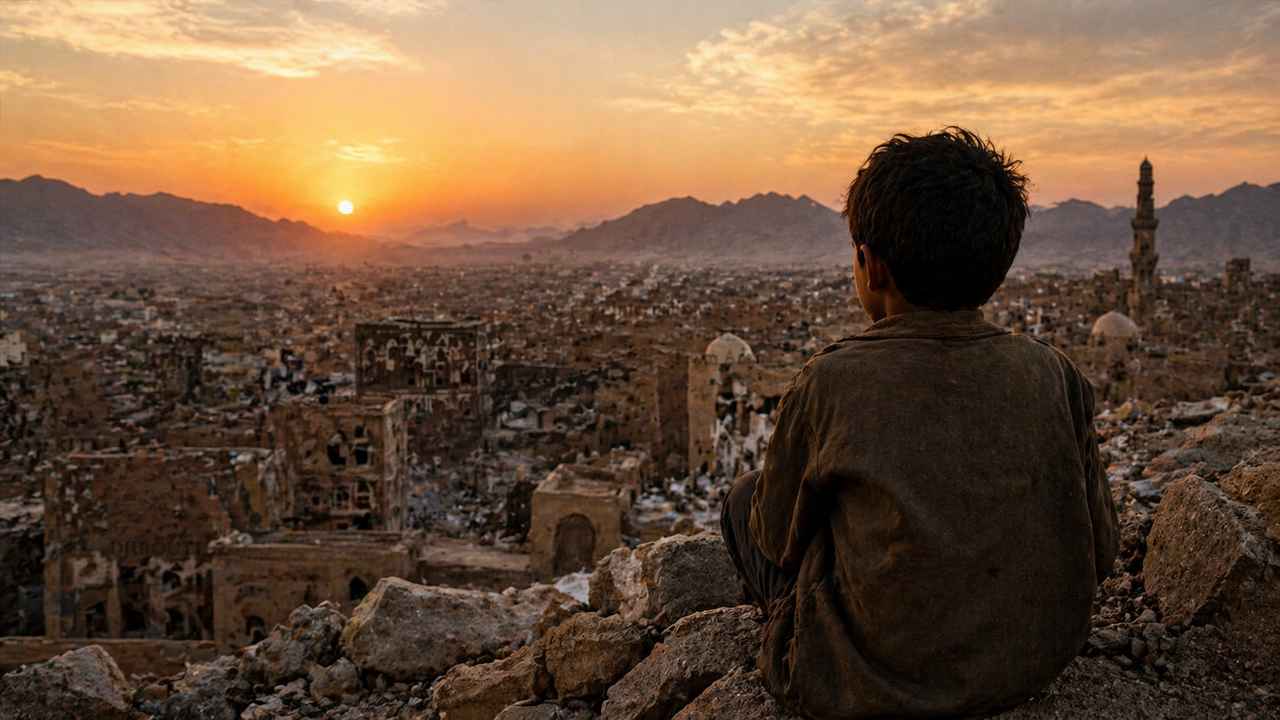
Yemen calls for informed Christian prayer because its people continue to live beneath overlapping burdens that have not lifted: prolonged conflict, deep hunger, economic collapse, fractured authority, fear, and an ever-narrowing space for ordinary life to recover. For the small and often hidden church, these are not distant national troubles but daily realities that shape worship, fellowship, witness, and endurance. Yemen therefore calls for prayer that is clear-eyed, compassionate, and full of dependence on the sovereign mercy of God—prayer that asks Him to preserve the suffering, restrain evil, sustain His people, and cause the light of Christ to shine even in a land so deeply worn by sorrow.
Why This Country Needs Prayer Now
Yemen needs prayer now because the country remains caught in a long and exhausting emergency that is both national in scale and deeply personal in its effects. Millions are living with hunger, displacement, failing services, and profound uncertainty, while families already worn down by years of war continue to carry grief, fatigue, and material loss. This is not merely a political crisis or a humanitarian headline. It is a setting in which the ordinary fabric of life has become fragile, and that makes wise, informed prayer especially necessary.
The burden is sharpened further by divided rule and competing claims about responsibility, order, and relief. The internationally recognized government based in Aden speaks of recovery, stabilization, and the restoration of state authority. The de facto authorities in Sana’a, by contrast, justify tighter control in the language of sovereignty, security, and resistance to outside interference. A careful prayer brief should hear those rival voices without treating any single narrative as morally self-authenticating. What remains plain is that Yemen’s fractured public life continues to deepen mistrust, slow relief, and leave ordinary people dangerously exposed.
For Christians, these broader realities make an already costly path of discipleship still harder. Yemen’s believers are few, and many must live their faith quietly because open Christian identity can bring danger from both the surrounding social environment and the country’s wider climate of fear. Yemen therefore needs prayer not only for peace and material relief, but also for steadfast endurance, wise courage, faithful witness, and the preserving grace of God toward His hidden people. The nation’s wider upheaval is not outside the prayer burden here. It is directly shaping how believers suffer, hope, and remain faithful now.
Country Snapshot

Yemen lies at the southern edge of the Arabian Peninsula, where the Red Sea and the Gulf of Aden meet some of the region’s most strategically contested waters. Its population is large, overwhelmingly Muslim, and deeply marked by years of conflict, economic decline, and humanitarian distress. The church is very small, and much of it remains hidden from public view.
Politically, Yemen cannot be described simply as one stable national state. The internationally recognized government operates mainly from Aden under the Presidential Leadership Council, the multi-member body serving as the country’s internationally recognized executive leadership. The Houthi movement, formally known as Ansar Allah, exercises de facto control over much of the northwest from Sana’a. That divided reality matters because public life, relief work, security, and ordinary freedom are shaped not by one settled national order, but by fractured authority and competing claims to legitimacy.
Yet Yemen should not be viewed only through the language of crisis. It is also a place where a small, often unseen church continues to endure, worship, and bear faithful witness under severe pressure. That quiet reality deserves to remain in view alongside the country’s broader distress.
Main Pressures Facing Christians
One major pressure is the cost of openly following Christ in a society where conversion from Islam can carry serious family and social consequences. For many Yemeni believers, especially converts, the danger is not abstract. Discovery may bring rejection at home, broken relationships, threats, isolation, or worse. As a result, Christian faithfulness in Yemen is often quiet, guarded, and costly.
A second pressure comes from the wider national collapse itself. Christians do not experience religious pressure in isolation from the rest of the country’s suffering. They are trying to endure amid hunger, displacement, fear, disrupted services, weakened institutions, and the accumulated weariness of years of war. For small hidden fellowships, these burdens make ordinary discipleship more difficult. Meeting safely, caring for one another, accessing help, and continuing in steady witness all become harder when the wider social fabric is frayed.
A third pressure is the narrowing of civic and religious space, especially in Houthi-controlled areas. Outside monitors describe intimidation, ideological pressure, and a climate of suspicion affecting Christians and other religious minorities. The authorities in Sana’a, however, defend tighter oversight of organizations and public life in terms of sovereignty, legality, and protection against foreign manipulation. A careful prayer guide should hear that official explanation, but it should also say plainly that, according to outside monitoring and wider reporting, the lived effect has been a more fearful and constricted environment for communities that were already vulnerable.
The pressure, then, is not confined to one dramatic form of persecution. It is the cumulative strain of secrecy, family risk, social vulnerability, conflict, deprivation, and tightening control. For ordinary believers, following Christ in Yemen often requires patience, wisdom, restraint, and endurance in conditions where both public life and private safety can feel fragile.
What Life Is Like for Christians in Yemen
For many Christians in Yemen, ordinary faithfulness is quiet and costly. Believers often worship in secret, speak carefully about their faith, and limit who knows their convictions. For converts from Islam in particular, following Christ can mean living with the fear of discovery, family rejection, social isolation, or worse. In practice, this makes Christian life in Yemen more hidden and far less public than in many other places.
That hiddenness affects nearly every part of discipleship. Fellowship is often small, cautious, and closely guarded. Encouraging another believer, finding trusted Christian friendship, or speaking openly about Scripture may require unusual care. What many Christians elsewhere would regard as ordinary church life can become difficult when believers must weigh every relationship and every conversation so carefully.
The burden is not only spiritual secrecy. It is also the strain of living as a small and vulnerable minority in a country already worn down by war, hunger, displacement, and fear. For ordinary believers, that often means trying to remain faithful while public life is unstable, help is uncertain, and the broader social atmosphere is tense. In such a setting, endurance is rarely dramatic. More often, it looks like quiet obedience, patient prayer, restrained speech, and steady trust in Christ under pressure.
Even so, the church in Yemen has not disappeared. Much of it remains hidden, but believers continue to pray, encourage one another, and hold fast to Christ. The lived reality of Christianity in Yemen is therefore not only danger. It is also perseverance—often fragile in appearance, yet unmistakably real.
Recent Developments
As of 2026, Yemen remains one of the world’s gravest humanitarian emergencies. Millions continue to face hunger, displacement, failing public services, and deep uncertainty after years of conflict and economic collapse. These are not merely background conditions. They continue to shape daily life across the country and intensify the burden carried by small and already vulnerable Christian communities.
The humanitarian picture has been made worse by growing strain around aid access and public trust. United Nations officials have continued to call for the release of detained personnel and to warn that restrictions and fear are damaging mercy work in a country where need is already immense. The internationally recognized government in Aden has presented these developments as evidence that Houthi rule is obstructing relief and worsening suffering. The authorities in Sana’a, by contrast, have defended tighter control in the language of sovereignty, legality, and protection against espionage or manipulation. A careful prayer brief should hear those rival explanations, but it should also say plainly that the practical result has been a more fearful and constricted environment for humanitarian work.
Developments in government-held areas have been more mixed. In early 2026, officials in Aden introduced a program focused on salaries, basic services, public finances, and economic stabilization. Those efforts should not be dismissed, since they represent a real attempt at institutional recovery. Yet the wider national situation remains extremely fragile, and the gap between stated goals and lived conditions is still large. Yemen’s burdens are too deep to be eased quickly by policy language alone.
Regional tensions have added another layer of danger. In late March 2026, missile fire from Yemen toward Israel heightened concern that the country could be drawn more deeply into wider regional conflict. United Nations Special Envoy for Yemen Hans Grundberg warned against allowing Yemen to be pulled further into that broader confrontation. For prayer, the significance is clear: a country already exhausted by prolonged suffering remains vulnerable to fresh instability generated beyond its own borders.
Christians have also faced a sharper direct burden in 2026. Recent reporting says that more than 50 believers and ministry workers were arrested or disappeared in an unusually severe crackdown earlier this year. That reporting should be handled carefully, but it fits the broader pattern of fear, secrecy, and shrinking space that already shapes Christian life in Yemen. The point is not to turn this section into a persecution digest, but to recognize that recent developments have made an already difficult path of discipleship still more costly.
How to Pray
- Pray that God would restrain further war in Yemen and keep the country from being drawn more deeply into wider regional conflict. Ask Him to overrule armed actors, humble violent men, and spare ordinary families from fresh devastation.
- Pray for the millions facing hunger, displacement, disease, and failing public services. Ask the Lord to provide daily bread, protect children and the weak, and show mercy to those whose strength has been worn down by years of conflict and deprivation.
- Pray for Yemeni believers who must follow Christ quietly, especially converts from Muslim backgrounds. Ask God to keep them steadfast in faith, wise in speech, holy in conduct, and courageous without recklessness.
- Pray for imprisoned believers, detained aid workers, and others held amid Yemen’s tightening climate of fear. Ask the Lord to sustain them in body and soul, guard them from abuse, and bring truth, justice, and lawful release where wrong has been done.
- Pray for pastors, small fellowships, and hidden Christian friendships in Yemen. Ask God to strengthen them through His Word, preserve them in sound doctrine and love, and make them faithful in discipleship, prayer, and witness even where public church life is severely constrained.
- Pray for Yemen’s rulers, commanders, and authorities, including the internationally recognized government in Aden and the de facto authorities in Sana’a. Ask God to grant wisdom, restrain cruelty, expose lies, and move those in power toward decisions that protect life, allow honest relief work, and reduce the country’s suffering.
- Pray that the gospel of Christ would continue to advance in Yemen with quiet but real fruit. Ask the Lord to draw sinners to repentance and faith, sustain weary believers, and cause His church to endure in purity, humility, and hope.
Give Thanks
- Give thanks that Christ has not left Himself without a witness in Yemen. Though the church is small, scattered, and often hidden, the Lord continues to preserve believers and keep the light of the gospel burning.
- Give thanks for every sign of faithful endurance among Yemeni Christians: quiet obedience, patient witness, guarded fellowship, and love that persists under pressure. These are not small things, but evidences of God’s preserving grace.
- Give thanks for every act of mercy that still reaches the suffering in Yemen, including the work of health staff, relief workers, local helpers, and others who continue to serve amid danger, fatigue, and scarcity. Such service is a real expression of common grace in a deeply afflicted land.
- Give thanks that, even amid political fracture and competing narratives, there are still efforts toward mediation, public order, and the easing of suffering. Ask God to use every truthful and restraining good for the protection of the vulnerable and the furtherance of peace.
- Give thanks that the Lord remains sovereign over Yemen’s wars, rulers, sorrows, and hidden acts of faithfulness. His providence has not failed, even where the country’s burdens remain severe.
Last Verified
Last verified: April 23, 2026.
The conflict, humanitarian, political, detention, and church-pressure references in this brief were checked against reporting, official Yemeni statements, humanitarian materials, and church-pressure sources available through April 23, 2026.
Key Sources Consulted
- Yemen 2026 Humanitarian Needs and Response Plan, for current national humanitarian conditions, displacement, food insecurity, and relief needs.
- World Health Organization, Yemen Health Emergency Appeal 2026, for current strain on the health system and disruption of medical services.
- World Food Programme Yemen country page and 2026 Yemen emergency updates, for food insecurity, displacement, and the broader humanitarian burden.
- United Nations statements and briefings by Special Envoy for Yemen Hans Grundberg on April 9, April 14, April 21, and April 22, 2026, for current diplomatic, security, detention-related, and regional-escalation developments affecting Yemen.
- Security Council Report, “Yemen: April 2026 Monthly Forecast,” for current political, humanitarian, and conflict-related developments.
- Ministry of Foreign Affairs and Expatriates of the internationally recognized Yemeni government, January 2026 statement on raids against UN offices and related April 2026 statements, for the government’s own framing of humanitarian obstruction, sovereignty, diplomacy, and current national pressures.
- Saba News Agency (Aden), March 2026 reporting on the 2026 government program, draft budget, salaries, services, and institutional priorities, for official government claims about economic stabilization and state authority.
- Saba reporting from Sana’a and related 2026 official statements from the de facto authorities, for their stated rationale on sovereignty, aid regulation, legality, and security concerns.
- Sana’a Center for Strategic Studies, 2026 analysis on Yemen’s economy, public finance, state capacity, and political fragmentation, for an inside-Yemen analytical perspective beyond official claims alone.
- U.S. Commission on International Religious Freedom, recent reporting on religious freedom in Houthi-controlled areas of Yemen, for current pressure on Christians and other religious minorities.
- Open Doors, Yemen country profile, 2026 World Watch List materials, and 2026 reporting on hidden church life and recent arrests of believers and ministry workers, for current church-pressure realities.
- Associated Press reports from February to March 2026 on Yemen’s government program, humanitarian restrictions, and regional-security escalation, for recent externally reported developments that materially shape Yemen’s present prayer burden.


