

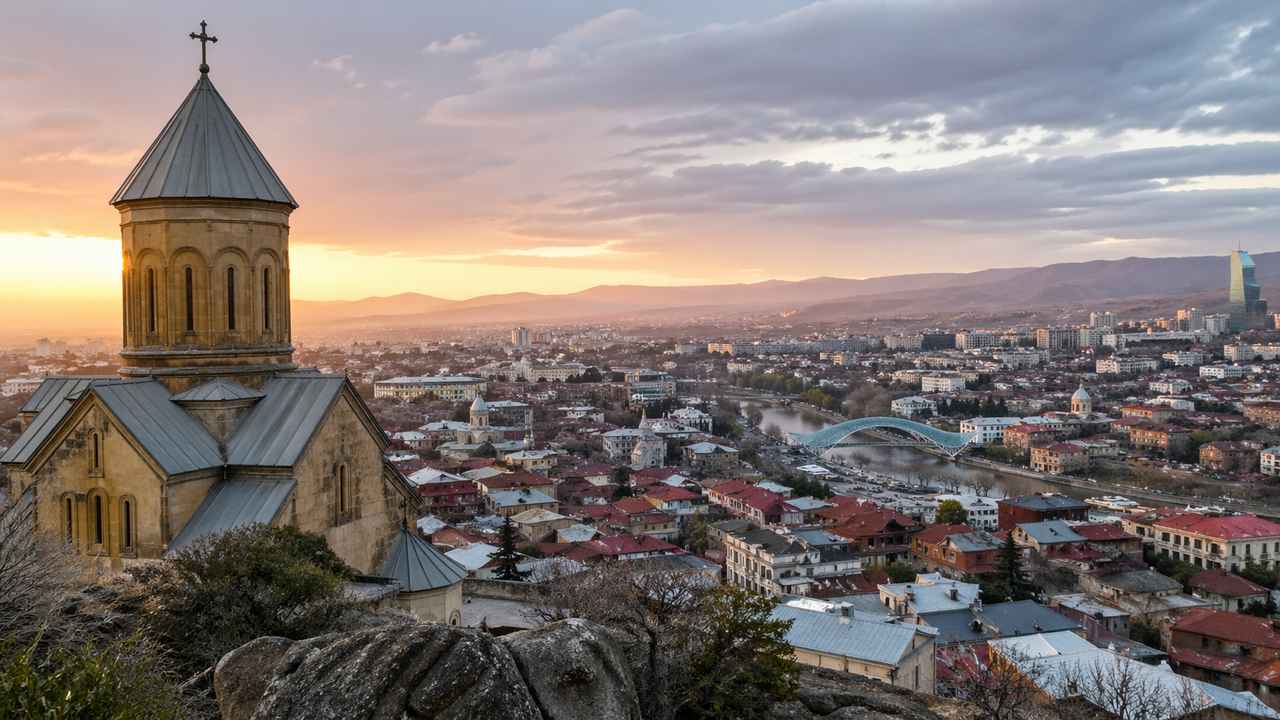
Georgia needs prayer not because Christian faith has vanished from public life, but because public life itself is under severe strain. This is a nation with deep Christian memory, visible churches, and a strong historical identity. Yet it is also passing through a season marked by sharp political division, tightening legal pressure, prolonged public protest, and a major transition in one of the country’s most influential churches. Christians should therefore pray for Georgia with sobriety and discernment: for truth without propaganda, courage without rage, faith without nationalism, and hope rooted in Christ rather than in any passing political camp.
Why This Country Needs Prayer Now
Since late 2024, Georgia has been shaken by mass protests, growing concerns about democratic backsliding, and a deepening crisis of legitimacy after the ruling Georgian Dream party halted the country’s European Union accession process and claimed victory in a disputed electoral cycle. Throughout 2025 and into 2026, parliament and government advanced further measures affecting grants, media, protest activity, and public speech. Critics argue that these steps have narrowed civic space, while government-backed explanations present them as necessary defenses of national sovereignty and independence.
A faithful prayer brief should not simply baptize one political narrative. At the same time, it should speak honestly: Georgia is passing through a season of hardened mistrust, public strain, and moral fatigue. Such an atmosphere is spiritually dangerous. It breeds fear, harshness, factionalism, and despair. It can also tempt Christians to confuse party loyalty with truth, or national identity with living faith.
There is another major reason Georgia needs prayer now. In March 2026, Patriarch Ilia II, who had led the Georgian Orthodox Church for nearly fifty years, died at the age of 93. Associated Press reported that Shio Mujiri temporarily assumed leadership while the church awaited the election of a new patriarch. Because the Georgian Orthodox Church, the country’s historic majority church, has long stood near the center of Georgia’s religious and public life, this is not a minor internal church matter. It is a national transition with wide spiritual and cultural implications.
Country Snapshot
Georgia is a South Caucasus nation whose capital is Tbilisi. According to Georgia’s 2014 General Population Census Results, which did not include Abkhazia and the Tskhinvali region/South Ossetia, most residents identified as Orthodox Christians, while Muslims formed the largest religious minority. Smaller religious communities also contribute to the country’s religious landscape. Georgia’s constitution protects freedom of belief, religion, and conscience, while also recognizing “the outstanding role” of the Apostolic Autocephalous Orthodox Church of Georgia in the nation’s history. This helps explain both Georgia’s strengths and its tensions: Christian faith is publicly visible and historically rooted, yet equal treatment can be strained when one church occupies such an honored and culturally dominant place.
Georgia’s wider national life is also burdened by unresolved territorial division. Abkhazia and the Tskhinvali region/South Ossetia are territories internationally recognized as part of Georgia but outside Tbilisi’s control. Freedom House assesses them separately and reports that both are heavily shaped by Russian power, though local conditions are not identical. Even when these territories are not daily headline news, they remain part of Georgia’s long grief and long-standing prayer burden.
Main Pressures Facing Christians
Georgia is not, in the ordinary sense, a country where most Christians must worship in secret. The pressures believers face are more subtle, but they are still serious. One major pressure is the confusion of faith with national identity. Where Christianity is deeply woven into a nation’s story, people can begin to rely on inherited symbolism instead of living faith, or on public reverence instead of repentance, holiness, and gospel clarity. A church may be culturally honored even where spiritual renewal is shallow.
A second pressure affects minority communities. The Tolerance and Diversity Institute, a Georgian rights organization, reports continuing structural problems facing minority religious groups, including unequal treatment, state interference, difficulties surrounding property and houses of worship, and bias within public institutions. In February 2024, the Tbilisi Court of Appeals found indirect religious discrimination in a case involving Seventh-day Adventist applicants and exam scheduling. These pressures are quieter than the headline-grabbing forms of persecution seen elsewhere, but they are real. They can leave believers weary, exposed, and feeling that some communities belong more fully than others.
A third pressure arises from the wider political climate. When public life becomes more fearful, polarized, and combative, Christians of every tradition can be drawn into the same spirit. Some may retreat into silence out of exhaustion. Others may become sharper, angrier, and more tribal. Georgia therefore needs prayer not only for religious freedom in a narrow legal sense, but also for spiritual discernment, truthfulness, self-control, courage, and endurance.
What Life Is Like for Christians in Georgia
For many Orthodox Christians in Georgia, church life is public, visible, and woven into ordinary life. Christian holy days are widely known. Churches are present in the landscape. The language of faith is not hidden. This is a real mercy. Yet public familiarity with Christianity is not the same thing as spiritual health. In a setting where the church is culturally strong, one danger is the thinning of discipleship: inherited religion without repentance, national reverence without gospel depth, and Christian symbolism without clear obedience to Christ.
For evangelical believers and other minority communities, daily life may feel different. They may worship openly, yet still face misunderstanding, unequal treatment, or the lingering sense that they do not share the same social legitimacy as the historic majority church. Their burden is often not dramatic prohibition, but patient endurance under structural inequality, local suspicion, or institutional imbalance. In such a context, faithful witness often depends less on dramatic heroism than on wise speech, resilient love, and steady discipleship.
For believers praying for the whole country, the unresolved realities of Abkhazia and the Tskhinvali region/South Ossetia add another layer of sorrow. The conditions in these territories differ and should not be flattened into slogans. Still, for prayer purposes, the point is clear: long division, foreign military power, displacement, and unresolved political status can harden a people over time. Georgia needs the Lord’s mercy in places where national wounds have remained open for years.
Recent Developments
Perhaps the most visible recent development has been the continuing erosion of civic and political trust. World Report 2026: Georgia says the country’s human rights record sharply deteriorated in 2025 as the ruling party adopted sweeping laws affecting civil society, media, protest, and public speech. Parliament’s own materials, by contrast, present the new grants framework and related changes as part of a sovereignty-protection effort aimed at resisting foreign political influence. A truthful account should neither ignore the government’s stated rationale nor accept it uncritically. For prayer purposes, what is unmistakable is that Georgia’s public square is now marked by greater strain, suspicion, and instability.
Georgia’s political crisis has also produced international consequences. In January 2025, the Council of the European Union suspended parts of the EU-Georgia visa facilitation agreement for certain Georgian diplomats and officials. In March 2026, Associated Press reported that the European Union suspended visa-free travel for Georgian diplomats and officials over democratic backsliding and the crackdown on protesters. These developments do not define the whole country, but they do show how serious the present strain has become and how far its consequences now reach beyond domestic politics alone.
Then came the death of Patriarch Ilia II in March 2026. After decades as one of the country’s most influential public figures, his death placed Georgia in a moment of unusual ecclesial vulnerability. Associated Press reported that Shio Mujiri temporarily assumed leadership pending the election of a new patriarch within two months. This is a time to pray that church leadership will be shaped by truth, humility, wisdom, and the fear of God rather than by ambition, image, or political usefulness.
How to Pray
- Pray that the Lord would rule over Georgia in mercy and truth, restraining falsehood, fear, and hardness of heart in public life, and granting rulers wisdom, justice, restraint, and accountability as the country passes through deep political strain.
- Pray that the churches of Georgia would love Christ more than party, tribe, image, or national prestige. Ask that believers would not confuse cultural Christianity with living faith, but would grow in repentance, holiness, faithful preaching, and humble obedience to God’s Word.
- Pray for the Georgian Orthodox Church during this season of transition following the March 2026 death of Patriarch Ilia II. Ask the Lord to raise up shepherds marked by truth, humility, courage, and spiritual maturity rather than ambition or political usefulness.
- Pray for evangelical believers and for minority communities, including Muslims, Armenian Apostolic Christians, Catholics, Jehovah’s Witnesses, and Seventh-day Adventists. Ask that they would know protection, equal treatment before the law, and steady courage to worship and bear witness without bitterness or fear.
- Pray for protesters, journalists, students, parents, and ordinary citizens living under pressure in a climate of mistrust. Ask that truth would not be crushed by propaganda or rage, and that Christians would be peacemakers without becoming silent about what is right.
- Pray for those affected by Georgia’s long unresolved territorial grief in Abkhazia and the Tskhinvali region/South Ossetia. Ask the Lord to restrain violence, preserve the vulnerable, and open a way for peace, justice, and truth without empty slogans or hardened hatred.
Give Thanks
- Give thanks that Georgia’s constitution still explicitly protects freedom of belief, religion, and conscience, and that Christian worship remains public rather than being driven underground. Ask the Lord to preserve and deepen that freedom in truth and fairness.
- Give thanks for every genuine sign of legal restraint and justice. In February 2024, the Tbilisi Court of Appeals recognized indirect religious discrimination against Seventh-day Adventist applicants, reminding us that minority believers are not entirely without recourse.
- Give thanks that Georgia has not yet fallen into total public silence. Georgia: Freedom in the World 2025 Country Report still describes the country as having lively media and civil society sectors, even though both are under mounting pressure. This is a form of common grace worth recognizing, and it should move Christians to pray that truth-telling, civic courage, and neighbor love would not be extinguished.
Last Verified
Last updated: April 20, 2026. The political, legal, ecclesial-transition, and territorial references in this brief were checked against reporting and official materials available through April 2026.
Key Sources Consulted
- Human Rights Watch, World Report 2026: Georgia.
- Associated Press, “EU suspends visa-free travel for Georgian diplomats and officials over democratic backsliding.”
- Associated Press, “Georgian Orthodox Patriarch Ilia II, hailed as an ‘epochal figure,’ dies at 93.”
- Parliament of Georgia, Constitution of Georgia.
- Parliament of Georgia, “Parliament Approved Amendments to the Law ‘On Grants’.”
- Parliament of Georgia, “Parliament Adopts Three Bills Amending the Law on Broadcasting.”
- National Statistics Office of Georgia, 2014 General Population Census Results.
- U.S. Department of State, 2023 Report on International Religious Freedom: Georgia.
- Tolerance and Diversity Institute, Freedom of Religion or Belief in Georgia: 2024 report.
- Tolerance and Diversity Institute, “The Court of Appeals has found discrimination based on religion in the case of Seventh-Day Adventists.”
- Freedom House, Georgia: Freedom in the World 2025 Country Report.
- Freedom House, Abkhazia: Freedom in the World 2025 Country Report.
- Freedom House, South Ossetia: Freedom in the World 2025 Country Report.