


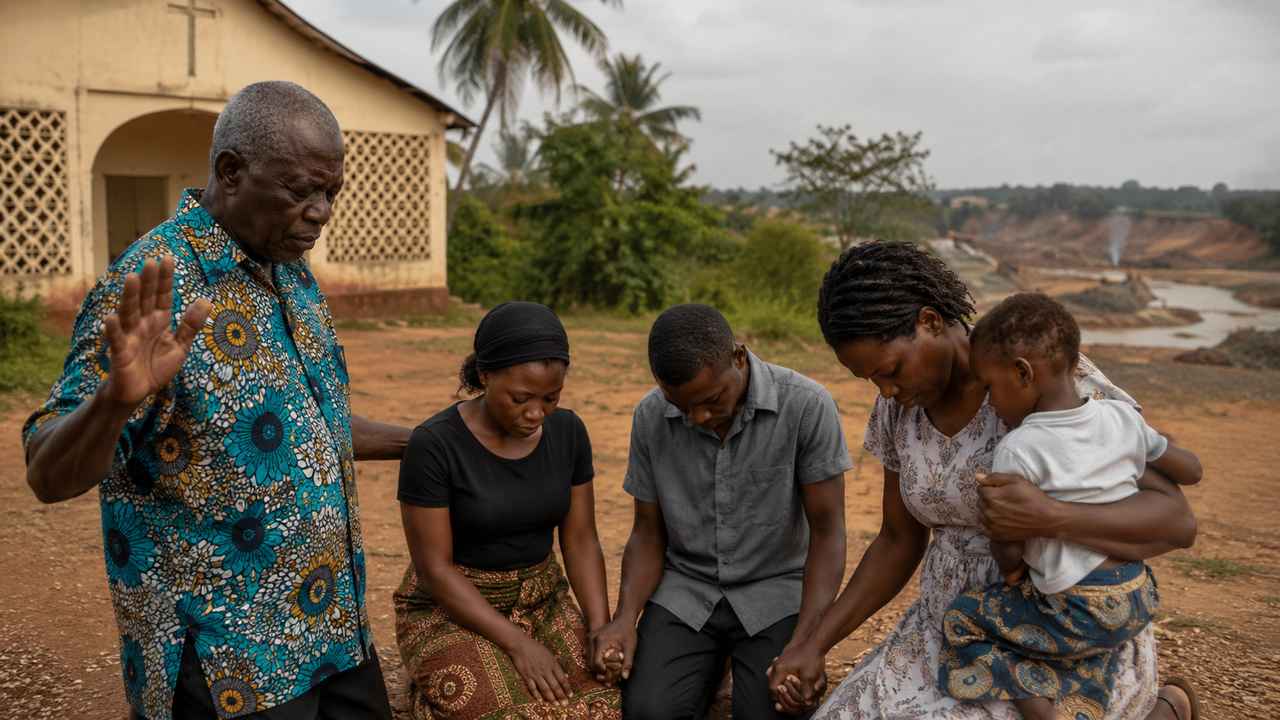
In Ghana, Christianity is not hidden in the margins. It is sung in churches, heard in public speech, woven into family life, and visible across much of the nation. Yet visible religion is not the same as deep gospel health. Ghana needs prayer not because the church is absent, but because the church is numerous, public, and called to bear faithful witness in a country carrying economic strain, environmental wounds, public moral conflict, and watchfulness along its northern frontier.
Pray for believers in Ghana to remain faithful where Christianity is public but discipleship must be deepened; for churches to serve families under economic pressure; for courage and mercy in public moral debates; and for gospel witness to stay clear, humble, and Christ-centered amid national change.
Last verified: May 2026.
Why Ghana Needs Prayer Now
Ghana’s present prayer burden sits at the meeting point of public Christian life, economic repair, moral debate, environmental harm, and regional watchfulness.
Ghana needs prayer now because it stands in a place of both strength and testing. The country remains one of West Africa’s more durable democracies, and the 2024 election brought John Dramani Mahama back to the presidency after a generally peaceful contest. Associated Press reported that Mahama was sworn in on January 7, 2025, after a campaign shaped by concerns over the economy, corruption, unemployment, and the need to “reset” national life. Associated Press
For the church, this matters because economic strain is never only economic. It enters kitchens, school-fee conversations, pastoral care, church benevolence, youth decisions, and daily temptations. When families are under pressure, quick money, corruption, resentment, despair, and false promises all become louder. Ghanaian churches need grace to preach Christ clearly and to serve wisely in places where hope can feel costly.
Ghana also needs prayer because public Christianity is influential there. That is a mercy, but it also brings responsibility. In a strongly religious society, churches can become socially powerful while still needing deeper repentance, stronger discipleship, doctrinal clarity, and humility before God. The danger is not only hostility from outside the church. It is also spiritual shallowness inside public religion.
Public moral debate is another present burden. Ghanaian lawmakers reintroduced the Human Sexual Rights and Family Values Bill after an earlier version had passed Parliament but was not enacted before the previous presidential term ended. Supporters present the bill as a defense of children, abuse victims, family values, and national moral order, while critics warn that it could deepen fear, restrict speech and association, and expose vulnerable people to harm. Christians should pray here with conviction, but not with cruelty; with biblical clarity, but not with self-righteousness. Associated Press
Ghana’s north also requires watchful prayer. Ghana is not in a domestic war, but violence in Burkina Faso and the wider Sahel region of West Africa has made the country’s northern frontier more sensitive. Reports in February 2026 said Ghanaian traders were killed in Burkina Faso by suspected jihadist militants. That kind of event does not make Ghana a conflict country, but it does sharpen the need to pray for protection, wise security, and steady churches near vulnerable routes.
Country Snapshot
A brief orientation to Ghana’s location, people, public life, and religious landscape.
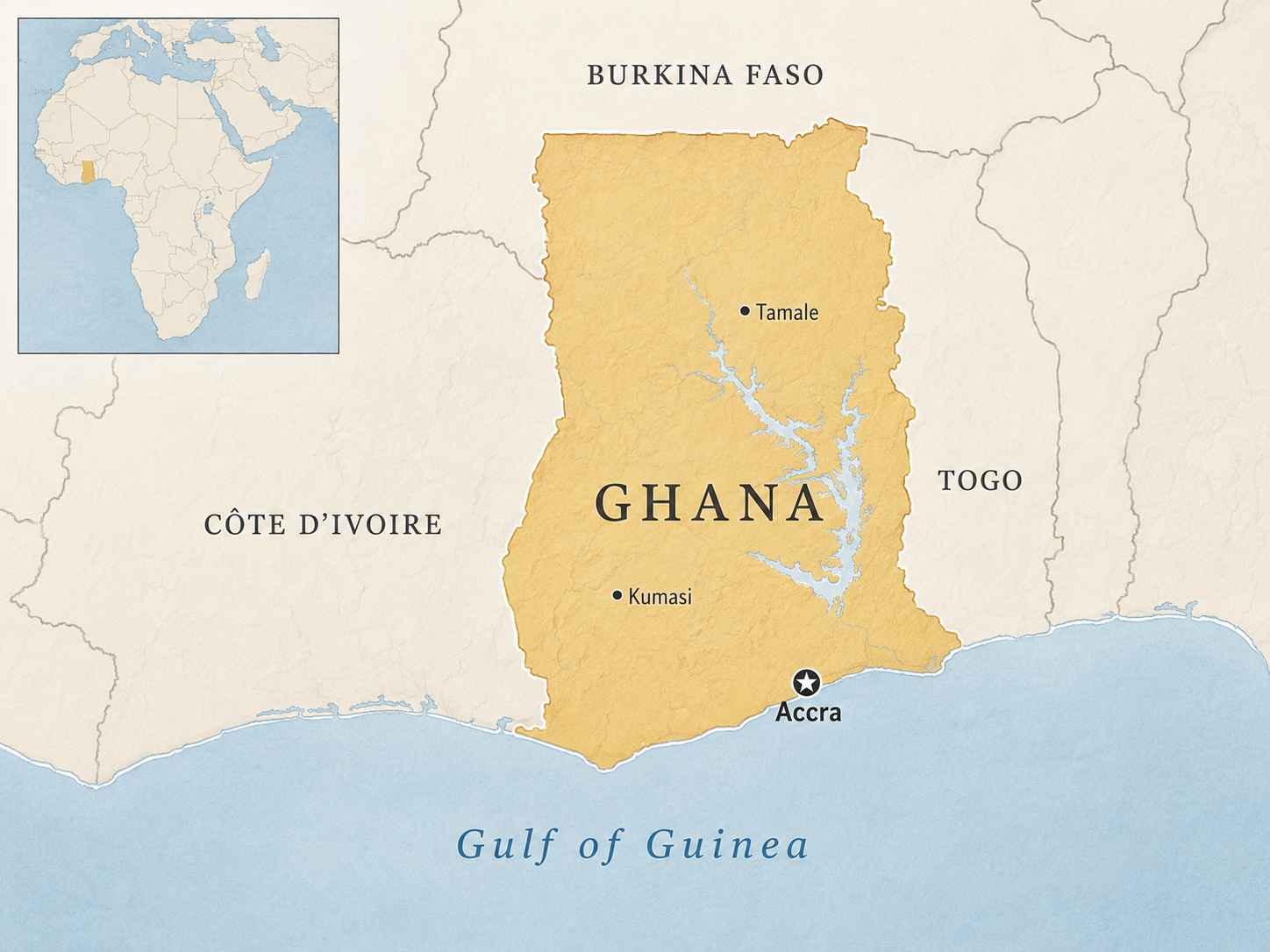
Ghana is a West African republic on the Gulf of Guinea, bordered by Côte d’Ivoire, Burkina Faso, and Togo. Its capital is Accra. The World Bank lists Ghana’s 2024 population at about 34.4 million. World Bank Data
Ghana’s religious life is public and active. Churches are numerous, and Christian language often appears in public life. Islam is especially significant in northern Ghana and in Muslim communities across the country. Ghana therefore needs prayer not as a place where Christianity is barely visible, but as a place where many people openly identify with religion and yet still need the renewing work of God through the gospel.
Main Pressures Facing Christians
The main pressures are not usually bans on worship, but the spiritual, moral, economic, and public-witness burdens facing churches in a highly religious society.
Public religion without deep discipleship
The first pressure facing Christians in Ghana is the pressure of public religion without deep discipleship. When Christianity is socially familiar, faith can become assumed rather than examined. A person may attend church, use Christian language, and still need true repentance, living faith, holiness, and a heart governed by Scripture. Churches in Ghana need prayer for faithful preaching, careful pastoral care, and discipleship that reaches beyond Sunday emotion into family life, work, speech, money, purity, and perseverance.
Economic strain
A second pressure is economic strain. Ghana’s recent economic crisis has left many households sensitive to prices, debt, jobs, wages, and uncertainty. World Bank data recorded Ghana’s 2024 inflation at 22.8%, while reporting around Ghana’s 2025 transition described a country still working through the aftermath of severe economic hardship and an International Monetary Fund (IMF)-supported recovery program. World Bank Data
Illegal mining and dishonest gain
A third pressure is corruption and dishonest gain. This is especially visible in the struggle against illegal gold mining, known locally as galamsey. The issue is not merely technical or environmental. It affects rivers, farms, livelihoods, local authority, youth employment, public trust, and moral courage. In 2025, Ghana created the Ghana Gold Board, commonly known as GoldBod, to regulate gold trading, while AP reported that illegal mining had polluted rivers and other parts of the environment despite government attempts to clamp down on the practice. Associated Press
Public moral debate
A fourth pressure is the public debate over sexuality, family, law, and human dignity. Many Christians in Ghana believe strongly that society must uphold biblical and traditional moral convictions. At the same time, Christians must guard their speech and conduct so that public conviction does not become contempt, intimidation, or political self-righteousness. The church’s witness is damaged when truth is separated from love, and love is weakened when it refuses to speak truth.
Regional insecurity near the northern frontier
A fifth pressure is regional insecurity. Ghana’s northern areas are not the same as Burkina Faso’s conflict zones, but the region is close enough that fear, trade disruption, border vigilance, and community anxiety can affect daily life. Churches in such places need steadiness, wisdom, and courage, especially where Christians and Muslims live together and where fear can be easily manipulated.
What Life Is Like for Christians in Ghana
Christian life is often open and public, yet ordinary faithfulness still requires courage, repentance, wisdom, and perseverance.
For many Christians in Ghana, church life is open, public, and active. Believers gather for worship without the kind of nationwide state repression seen in more restrictive countries. Churches preach, sing, evangelize, run schools and ministries, and participate visibly in public life. This openness is a real mercy and should be received with thanksgiving.
Yet ordinary Christian faithfulness in Ghana is still costly. A believer may not fear arrest for attending church, but he may still face pressure to compromise at work, join corrupt practices, pursue quick money, flatter powerful people, or treat church as a social identity rather than a call to follow Christ. The spiritual battle is not less real because it is ordinary.
Pastors and church leaders carry heavy burdens. They shepherd people facing unemployment, family strain, moral confusion, migration pressures, debt, disappointment, and the temptations that come when public religion is everywhere but biblical maturity is uneven. Churches need leaders who will not merely excite crowds, but feed Christ’s sheep with Scripture, prayer, discipline, tenderness, and courage.
Young believers especially need prayer. Ghana’s future will be shaped by students, workers, entrepreneurs, farmers, migrants, and young families trying to find their way in a changing economy. Some will be drawn toward prosperity promises, political anger, sexual temptation, cynicism, or despair. They need churches that can show them something better: the beauty of Christ, the fear of God, the dignity of honest work, and the hope of eternal life.
Recent Developments
These developments do not make Ghana a crisis country, but they do sharpen how Christians can pray with understanding now.
-
January 2025
Ghana’s 2024 election and 2025 transition
John Dramani Mahama won Ghana’s 2024 presidential election and was inaugurated in January 2025. Associated Press described the transition as an important democratic moment in West Africa, while also noting that Ghana’s economy, corruption concerns, and unemployment were major public burdens at the time. Associated Press
-
2024–2026
Economic recovery remains sensitive
Ghana’s economy has shown signs of recovery, but the country continues to live with the aftereffects of inflation, debt restructuring, and an International Monetary Fund (IMF)-supported recovery program. The World Bank recorded Ghana’s 2024 population at about 34.4 million and its 2024 inflation rate at 22.8%, both useful indicators for understanding the scale of household pressure and national repair still facing the country. World Bank Data
-
April 2025
Illegal mining remains a national burden
In 2025, Ghana moved to centralize and regulate gold trading through the Ghana Gold Board, commonly known as GoldBod. AP reported that the Ghana Gold Board law was signed by President Mahama on April 2, 2025, and that illegal gold mining, known locally as galamsey, had become a major national issue because of environmental damage, smuggling, and economic desperation. Associated Press
-
2025–2026
The family-values bill remains update-sensitive
The Human Sexual Rights and Family Values Bill remains a volatile public issue. AP reported in 2025 that lawmakers reintroduced the bill after an earlier version had passed Parliament but was not enacted before the previous president left office. The bill is therefore handled here as a proposed or reintroduced bill, not as settled enacted law. Associated Press
-
February 2026
Northern-border concern has increased
Reports on Burkina Faso’s 2026 violence included the killing of Ghanaian traders in Titao. Ghana itself should not be described as a war zone, but this event sharpens prayer for border communities, traders, security forces, and churches in northern areas.
How to Pray
Pray for gospel depth, faithful shepherding, honest work, public wisdom, and steady witness in Ghana’s present season.
-
For true gospel life in visible churches: Pray that Ghana’s many visible churches would be marked by true gospel life, not merely public religion — that pastors would preach Christ faithfully, congregations would grow in repentance and holiness, and nominal Christianity would give way to living faith.
-
For faithful pastors and ministry leaders: Pray for pastors, elders, evangelists, and ministry leaders to shepherd with courage, humility, doctrinal clarity, and tenderness, especially as they care for families under financial pressure, young people facing temptation, and believers weary from daily burdens.
-
For families under economic pressure: Pray for Ghanaian families affected by economic strain, unemployment, rising costs, and uncertainty, that the Lord would provide daily bread, strengthen honest work, protect households from despair, and keep believers from corruption or quick-money compromise.
-
For communities harmed by illegal mining: Pray for communities harmed by illegal small-scale gold mining, often called galamsey, that polluted rivers, damaged farmland, and distorted local economies would be met with justice, wise enforcement, repentance, and practical care for affected families.
-
For wise Christian witness in public moral debates: Pray for Christian witness in Ghana’s public moral debates, including the proposed Human Sexual Rights and Family Values Bill, that believers would hold biblical conviction together with humility, neighbor-love, restraint, and speech that reflects the grace and truth of Christ.
-
For peace and protection near vulnerable borders: Pray for peace and protection in northern Ghana and near the Burkina Faso border, where violence in the wider Sahel region of West Africa has increased fear and watchfulness. Ask the Lord to guard traders, families, security personnel, churches, and vulnerable communities.
-
For Ghana’s young people: Pray for Ghana’s young people, that they would not be captured by empty prosperity promises, sexual confusion, cynicism, or the pursuit of dishonest gain, but would be drawn to Christ, grounded in Scripture, and strengthened for faithful service.
Give Thanks
Give thanks for open worship, democratic resilience, ordinary faithfulness, and public concern for justice and stewardship.
- Give thanks that many Christians in Ghana can gather openly for worship, hear God’s Word preached, sing, serve, evangelize, and participate visibly in public life.
- Give thanks for Ghana’s record of peaceful electoral transfer and relative democratic stability in a region where many nations have faced coups, conflict, or severe political breakdown.
- Give thanks for pastors, churches, families, and ordinary believers who continue to serve Christ faithfully in homes, schools, workplaces, villages, cities, and local congregations.
- Give thanks for public concern over corruption, illegal mining, environmental harm, and national stewardship, and pray that such concern would mature into repentance, justice, wise reform, and care for neighbors made in the image of God.
Last Verified / Update Note
This guide reflects a May 2026 review. Later material changes in Ghana’s legal, economic, security, or religious-freedom situation may affect how readers use it for prayer.
Last verified: May 2026.
Freshness Note: This guide is especially time-sensitive through August 2026 because of Parliament’s handling of the Human Sexual Rights and Family Values Bill, security concerns near Ghana’s northern border, major economic shifts, and significant religious-freedom developments.
Most update-sensitive sections: Why Ghana Needs Prayer Now; Recent Developments; How to Pray; Last Verified / Update Note; Key Sources Consulted.
Developments to watch: Key items include the bill’s parliamentary status and final wording; security developments connected to Burkina Faso and Ghana’s northern border; inflation, debt, cocoa-sector, and International Monetary Fund-related economic developments; and major changes in illegal-mining enforcement, GoldBod policy, or environmental impact.
Key Sources Consulted
These sources materially informed the current version of this Ghana prayer guide.
- Associated Press — “Mahama sworn in as Ghana’s president for a third time against the backdrop of an economic crisis.” Used for Ghana’s 2025 presidential transition, democratic context, and the economic concerns shaping the Mahama administration’s return to power. Read source
- World Bank Data — Ghana country data page. Used for population, inflation, and stable economic indicators that help frame Ghana’s household and national economic pressures. Read source
- Associated Press — “Lawmakers in Ghana reintroduce an anti-LGBTQ+ bill that sparked criticism.” Used for the status, public controversy, and careful wording around the Human Sexual Rights and Family Values Bill. Read source
- Associated Press — “Ghana prohibits foreigners from trading gold in the country starting May 1.” Used for the Ghana Gold Board / GoldBod, illegal gold mining, galamsey, gold-smuggling concerns, and environmental-damage context. Read source
- Ghana 2021 Population and Housing Census reporting summaries. Used for the country’s religious-composition figures, especially the commonly reported 71.3% Christian and 19.9% Muslim share.
- Reuters-linked Burkina Faso 2026 reporting summaries. Used cautiously for the February 2026 report that Ghanaian traders were killed in Burkina Faso, shaping the article’s northern-border watchfulness language without describing Ghana itself as a war zone.
The Human Sexual Rights and Family Values Bill is highly update-sensitive. This guide does not state that the bill has become law. It treats the issue as an active or reintroduced legislative proposal and should be rechecked before publication if any significant time passes.
Ghana’s northern-border security concern is handled carefully. Ghana is not described as being in active armed conflict. The article refers to watchfulness and spillover concern connected to violence in Burkina Faso and the wider Sahel region.
The religious-composition figures are based on the 2021 census reporting commonly attributed to Ghana’s Population and Housing Census materials. They are stable enough for country-snapshot context, though newer official demographic releases may refine those figures.
A Closing Prayer for Ghana
A Scripture-shaped prayer asking the Lord to deepen His church, strengthen faithful witness, and show mercy to Ghana.


