


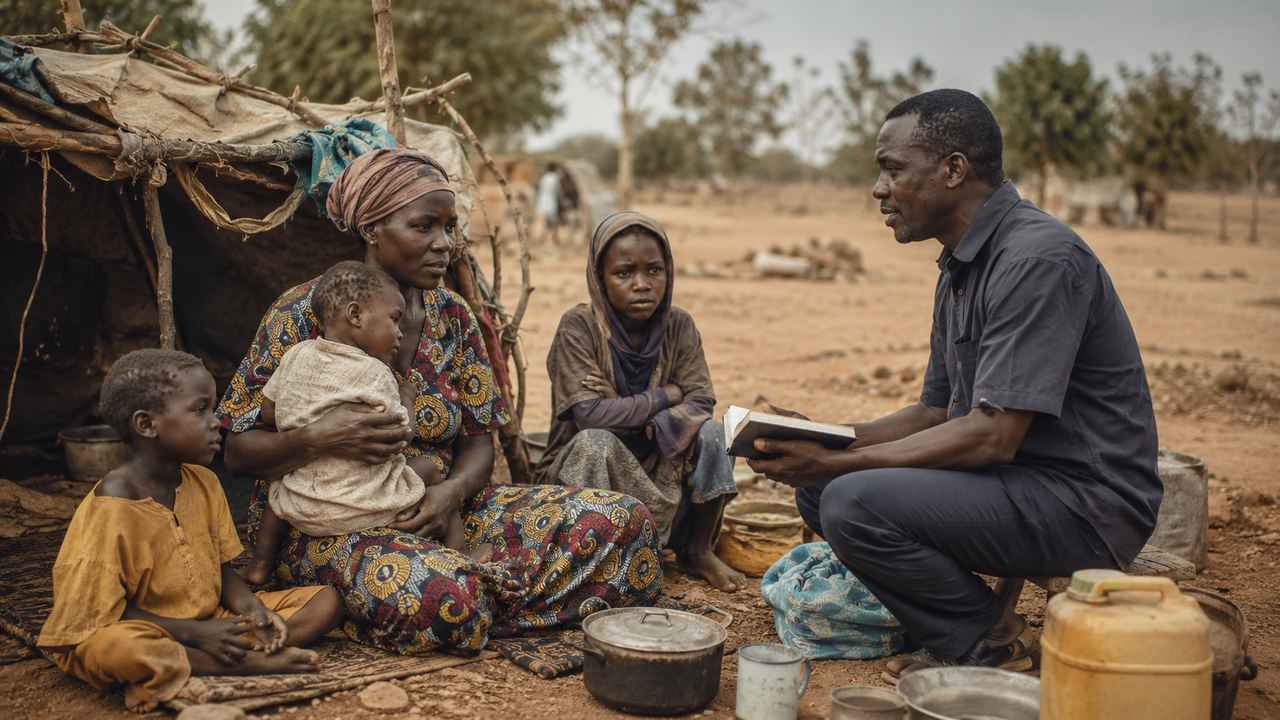
Burkina Faso needs prayer because armed violence, displacement, hunger, school closures, restrictions on public life, media, and civil society, and allegations of abuse during counterinsurgency operations have damaged daily life for many communities. Christians and churches need courage and protection where worshippers, pastors, catechists, converts, and congregations may face danger. The wider nation also needs mercy: peace for villages living under fear, food for hungry families, schooling for children, truth and justice, wise leadership, and room for worship, humanitarian care, and faithful Christian witness.
Prayer Burden at a Glance
Pray for Burkina Faso’s people to be protected from violence, hunger, displacement, fear, and injustice. Pray for churches to hold fast to Christ, for displaced families and children to receive care, and for leaders, security forces, and local authorities to protect civilians, tell the truth, restrain abuse, and seek the good of the vulnerable.
Last verified: June 2026
Why Burkina Faso Needs Prayer Now
Burkina Faso has endured years of national sorrow. Years of violence have disrupted village life, scattered families, closed schools, strained churches, and made ordinary routines uncertain in many communities.
The country’s suffering is not only political or military. It is felt in homes, churches, classrooms, farms, clinics, displaced families, and communities that do not know whether tomorrow will bring safety or fresh grief.
Christians are not the only people suffering in Burkina Faso. The country’s pain is shared by many Muslims, traditional-religion communities, teachers, health workers, farmers, traders, and displaced families who live with fear, hunger, loss, and uncertainty. Yet Christians and churches do face serious and specific dangers. In vulnerable areas, worship gatherings, pastors, catechists, converts, and church communities may face attack, intimidation, displacement, or fear that makes worship and public witness harder.
Burkina Faso therefore needs prayer for both the church and the whole nation. Pray for believers to remain faithful to Christ. Pray for churches to serve suffering neighbors with courage and compassion. Pray for communities harmed by violence, hunger, and displacement. Pray for leaders and security actors to protect civilians and be restrained from revenge, corruption, abuse, and falsehood. Pray that God would bring peace, justice, repentance, and hope to people carrying grief that cannot be captured by statistics alone.
Country Snapshot
Burkina Faso sits in West Africa’s Sahel, where insecurity, poverty, displacement, and disrupted public services affect daily life, church ministry, and the country’s future.
Geographic orientation: Burkina Faso sits in West Africa’s Sahel and borders Mali, Niger, Benin, Togo, Ghana, and Côte d’Ivoire.
Burkina Faso sits in the Sahel, where climate stress, poverty, weak public services, armed violence, and regional instability often reinforce one another. Its current crisis is not only a security problem. It affects family life, worship, education, agriculture, public trust, church ministry, and the ability of ordinary people to plan for the future.
Burkina Faso’s religious diversity calls for careful, compassionate prayer. Islam is the majority religion, Christianity is a significant minority presence, and traditional religious practices continue to shape many communities. Prayer for Burkina Faso should ask God for mercy, truth, protection, repentance, faithful Christian witness, and peace without feeding suspicion between communities.
Spiritual and Practical Challenges Affecting Christians and Churches
Christians in Burkina Faso face dangers that affect worship, family life, church leadership, discipleship, mercy ministry, and public witness, especially in areas where armed violence has disrupted normal life.
Worship and church life in dangerous areas
In areas affected by violence, gathering for worship may carry real risk. Pastors, catechists, church leaders, converts, and ordinary believers may have to make hard decisions about whether to remain, flee, meet quietly, continue ministry, or serve neighbors when resources are limited and danger is near.
Attacks affecting Christian worship and church workers
The killing of Catholic worshippers in Essakane in February 2024 is one painful example of how Christian worship can be exposed to deadly violence in conflict-affected regions. The attack does not mean every part of Burkina Faso is equally dangerous, but it does show the seriousness of the threat facing some Christian communities.
Displacement, poverty, and scattered congregations
Displacement can scatter congregations and separate pastors from their people. Poverty can limit what churches are able to share with those in need. Churches in vulnerable areas may carry grief, fear, and the cost and sorrow of continuing to confess Christ where armed groups kill, threaten, and intimidate civilians.
Fear, trauma, and witness among suffering neighbors
Trauma can leave families exhausted. Fear can tempt believers to withdraw from witness, speak harshly of others, or lose hope that God is still at work. In places where Christians live beside Muslim neighbors who are also suffering, churches need wisdom to love without partiality, speak truthfully of Christ without needless provocation, and resist any spirit of revenge.
Discernment amid contested public claims
Some reports about violence, military operations, disappearances, media restrictions, or human-rights abuses are contested. Christians must be careful not to spread rumors, excuse injustice, or make simplistic judgments. They need courage to pray for the truth to be known, for wrongdoing to be exposed, for civilians to be protected, and for genuine peace to come.
Christian Life and Witness in Burkina Faso
Christian life continues under uneven conditions, with some churches gathering openly while others face fear, displacement, restricted movement, or grief.
In safer areas, churches may gather openly, teach Scripture, disciple children and young people, care for displaced families, and encourage believers from affected regions. In more dangerous areas, congregations may face restricted movement, fear of attacks, loss of church buildings, scattered membership, or the grief of families who have lost loved ones.
The witness of the church is especially important because suffering has not fallen on one community alone. Churches have an opportunity to show the mercy of Christ to displaced families, hungry neighbors, grieving communities, widows, children, and those traumatized by violence. When believers serve people across religious or ethnic lines, they show that Christ’s compassion is not limited to their own group.
Pastors and church leaders need strength to preach Christ clearly without turning the pulpit into political anger or despair. They need courage to call believers to forgiveness, repentance, prayer, endurance, and mercy. They also need wisdom to protect their people, avoid unnecessary risk, and help congregations respond to trauma with truth and hope.
Families need prayer too. Some parents may be trying to raise children in displacement, poverty, or insecurity. Young people may have lost schooling, stability, or a sense of future. Some believers may be grieving relatives killed or displaced by violence. Others may be tempted to keep their faith hidden because identifying openly as Christian feels dangerous. In such conditions, ordinary discipleship matters deeply: gathering when possible, praying in families, teaching children, refusing revenge, serving neighbors, and holding fast to Christ.
Recent Developments
Several recent and ongoing developments should guide prayer for Burkina Faso, including military rule, insecurity, humanitarian need, restrictions on public life, media, and civil society, and danger to churches in affected areas.
-
2022–2024
Military transition extended
After the 2022 coup, Captain Ibrahim Traoré became transitional president, and the transition was later extended. This makes prayer for leadership, public trust, justice, accountability, and protection of ordinary citizens especially important.
Prayer significance: Pray for leaders to protect civilians, resist corruption, tell the truth, and govern with restraint and concern for the vulnerable.
-
Ongoing
Security crisis affecting national life
Armed groups have attacked civilians, communities, worshippers, security forces, and local institutions. The government describes its actions in terms of counterterrorism, sovereignty, and national survival. Outside observers, human-rights groups, and journalists have also raised concerns about abuses, disappearances, mass killings, media restrictions, and limits on public speech, political activity, and civil society.
Prayer significance: Pray for civilians to be protected, violence to be restrained, wrongdoing to be exposed, and peace to be restored.
-
Ongoing
Humanitarian need remains severe
Millions of people need assistance, displaced families continue to face hunger and limited services, and children are especially affected by school closures, malnutrition risk, disrupted health services, and trauma.
Prayer significance: Pray for food, shelter, safe humanitarian access, schooling, medical care, and protection for children and displaced families.
-
2025–2026
Public life and political activity tightened
The dissolution of political parties and election-related bodies, together with restrictions affecting media and civil society, raises serious prayer concerns about public trust, truthful speech, accountability, and people’s ability to speak, organize, vote, and hold leaders accountable.
Prayer significance: Pray for leaders who protect citizens, tell the truth, resist corruption, and do not rule through fear.
-
Ongoing
Churches continue ministry despite danger and displacement
Churches continue to minister where Christian communities in some areas face danger, displacement, and fear. Worshippers have been killed, church workers have been threatened, and congregations in insecure regions may be scattered or afraid. Yet churches also remain places of prayer, mercy, teaching, comfort, and witness.
Prayer significance: Pray for pastors, catechists, church leaders, converts, worshippers, and displaced congregations to remain faithful to Christ.
Conflict, Displacement, and the Need for Mercy
Burkina Faso’s crisis is lived in ordinary homes and villages, not only in political statements, military reports, or humanitarian figures.
It is seen when a family leaves land they can no longer safely farm, when children lose months or years of schooling, when a church receives displaced believers with little to offer except prayer and shared food, when a mother searches for water, when a pastor comforts the grieving, and when neighbors wonder whether tomorrow will bring safety or violence.
The country’s humanitarian crisis should move Christians toward compassionate prayer. Millions need food, protection, water, health care, schooling, and safe access to services. Many host communities are also under pressure as they receive displaced families while already facing poverty and limited resources.
This is also a spiritual crisis. Conflict can harden hearts. It can teach children to expect violence. It can deepen ethnic suspicion, religious fear, and political bitterness. It can tempt people with power to justify cruelty in the name of security. It can tempt victims to despair or revenge. Burkina Faso needs God’s mercy not only to stop violence, but to heal what violence has done to trust, families, churches, communities, and consciences.
For Christians, the call is not to pray from a distance with detached analysis. It is to bring Burkina Faso before the Lord with honesty, grief, faith, and hope. Christ is not indifferent to displaced children, grieving worshippers, hungry families, fearful pastors, or communities caught between armed groups and alleged abuses committed in the name of security. He is Lord over the nations, Judge of all injustice, Shepherd of His people, and refuge for the afflicted.
How to Pray
Use these prayer points to intercede for Burkina Faso’s people, churches, leaders, displaced families, children, and communities affected by violence.
Pray for God to restrain violence by jihadist armed groups and protect civilians. Ask Him to bring peace to villages, towns, roads, farms, churches, schools, and displaced communities affected by fear.
Pray for Burkina Faso’s leaders and security actors. Ask God to help military authorities, security forces, and local defense volunteers protect ordinary people, resist corruption and revenge, tell the truth, and act with restraint.
Pray for Christians in insecure areas to remain faithful to Christ. Ask God to keep them steady in prayer, wise in danger, and courageous in witness without hatred or revenge.
Pray for pastors, catechists, elders, evangelists, and ministry workers. Ask God to protect and strengthen them as they comfort the grieving, teach Scripture, and serve scattered congregations.
Pray for churches to show the mercy of Christ. Ask God to help believers serve displaced families, hungry neighbors, widows, orphans, traumatized children, and people from every religious or ethnic community.
Pray for displaced families to receive what they need. Ask God to provide food, shelter, water, medical care, safety, and the possibility of returning home only when it is truly safe.
Pray for children whose schooling has been disrupted. Ask God to protect them from violence, recruitment, exploitation, bitterness, and despair.
Pray for those serving vulnerable communities. Ask God to help humanitarian workers, local churches, community leaders, teachers, health workers, and aid agencies reach people safely and distribute help honestly.
Pray for truth where killings, disappearances, abuses, or false accusations are alleged. Ask God to expose evil, restrain lies, protect witnesses, and bring justice without revenge.
Pray for communities to resist hatred and fear. Ask God to help Muslims, Christians, and people shaped by traditional religious practices live with restraint and for the gospel of Christ to be seen in humble, courageous, merciful Christian witness.
Give Thanks
Even amid deep suffering, Christians still have reasons to thank God for faithful believers in Burkina Faso, courageous service, acts of mercy, and every restraint of violence.
Give thanks for churches and believers who continue to worship, pray, serve, and bear witness to Christ. Their perseverance is a real mercy in a country marked by fear, displacement, grief, and uncertainty.
Give thanks for pastors, catechists, ministry workers, and ordinary Christians who care for the suffering. Praise God for those who comfort the grieving, teach Scripture, care for displaced families, and encourage believers not to lose hope.
Give thanks for those who continue serving vulnerable people. Thank God for humanitarian workers, teachers, health workers, local leaders, and community volunteers who serve despite insecurity and limited resources.
Give thanks for every sign of protection and provision. Praise God for every child who is able to continue learning, every displaced family that finds shelter, every hungry household that receives food, and every community where violence is restrained.
Give thanks for families and communities that continue to care for one another. Thank God for people who continue to work, pray, care for children, host displaced neighbors, and seek peace in a time of severe hardship.
Give thanks that the Lord sees Burkina Faso fully. No village, church, displaced camp, grieving family, hungry child, or frightened believer is hidden from Him.
Last Verified / Update Note
This note helps readers understand when the guide was reviewed and which developments may affect prayer needs in the months ahead.
Review Status
Reviewed for current prayer use
This guide reflects a June 2026 review of current political leadership and transition context, conflict and displacement conditions, humanitarian needs, school closures, religious and church-life context, attacks affecting Christian worshippers, restrictions on public life, media, and civil society, and contested human-rights claims.
The main prayer burdens are protection from armed violence, mercy for displaced and hungry families, care for children whose schooling has been disrupted, faithful churches under danger, pastors and catechists needing courage, truth and justice where abuses are alleged, wise leadership, and gospel witness across religious and ethnic lines.
Developments to watch include changes in the security situation, displacement figures, humanitarian access, school reopening or closure data, political-transition announcements, civil-society and media restrictions, allegations of abuses by armed groups or security forces, and further attacks affecting churches, worshippers, pastors, catechists, converts, or other vulnerable communities.
Burkina Faso’s conflict and humanitarian situation can be difficult to verify fully because insecurity, restricted access, political pressure, and media limits affect reporting. This guide uses cautious wording where figures vary or claims are contested, especially for displacement, civilian harm, church-life disruption, and responsibility for specific abuses.
Help keep this guide accurate and current
If you noticed a possible correction, broken link, or significant country update, please contact the Nations Prayer Directory so we can review it carefully.
Key Sources Consulted
Sources that materially informed this Burkina Faso prayer guide, including country context, humanitarian background, church-life concerns, recent developments, and notes on source limits.
Government, transition, and country context
- World Bank — Burkina Faso Overview. Used for current country context, political transition background, security and economic conditions, displacement context, and regional alignment.
Humanitarian need, hunger, displacement, and children
- World Food Programme — Burkina Faso. Used for acute hunger, conflict-related displacement, poverty, food access, livelihoods, humanitarian constraints, and WFP response activity.
- UNICEF — Burkina Faso Humanitarian Action for Children 2026. Used for children’s humanitarian needs, education disruption, nutrition, health, WASH, child protection, hard-to-reach areas, and school-closure data.
- UNHCR Operational Data Portal — Burkina Faso. Used for refugee and displacement reference points, with caution that some internally displaced person figures rely on older government data.
Christian life, persecution, and church burden
- Open Doors — Burkina Faso Country Profile. Used for church-life vulnerability, threats to Christians in extremist-controlled areas, church closures or attacks, displacement, convert pressure, and prayer concerns for persecuted believers.
- Open Doors UK — Burkina Faso World Watch List Profile. Used as a supporting church-life and persecution source, especially for Christian population estimates, vulnerability of converts, targeted attacks, displacement, and pastoral prayer concerns.
- Aid to the Church in Need — Burkina Faso: Living with terror in the “land of people of integrity”. Used for Catholic church context, the Essakane attack, local bishop testimony, parish disruption, school closures in affected dioceses, and examples of church mercy to displaced people.
- Aid to the Church in Need — Catechist kidnapped and killed in Burkina Faso. Used for church-worker vulnerability and the killing of catechist Edouard Yougbare.
Recent developments, public restrictions, media limits, and contested claims
- Associated Press — At least 15 Catholic worshippers killed in northern Burkina Faso. Used for the February 2024 Essakane worship attack and its church-confirmed details.
- Associated Press — Burkina Faso ruling junta dissolves independent electoral commission. Used for the dissolution of the electoral commission and the government’s stated rationale concerning cost, sovereignty, and foreign influence.
- Associated Press — Burkina Faso’s junta dissolves all political parties. Used for the January 2026 dissolution of political parties and the government’s stated rationale concerning division and social cohesion.
- Associated Press — Burkina Faso suspends BBC and Voice of America after coverage of HRW report. Used for media-restriction context and the government response to reporting on contested army-abuse allegations.
- Human Rights Watch — Burkina Faso: Army Massacres 223 Villagers. Used for attributed human-rights allegations concerning Nondin and Soro. This guide treats those claims as Human Rights Watch findings and uses cautious attribution where responsibility for specific abuses is contested.
- Associated Press — Burkina Faso forces killed twice as many civilians as jihadists, rights group says. Used for reporting on Human Rights Watch’s broader 2026 assessment of civilian harm, allegations against both government forces and jihadist groups, and the restricted information environment.
Source Context
How to read the sources behind this guide in a conflict-affected setting involving humanitarian need, church-life concerns, public restrictions, and contested claims.
Source Context
- Source mix. This guide draws on humanitarian sources, displacement data, church-life and religious-freedom reporting, reputable current news reporting, and human-rights reporting. The goal is to help readers pray with current understanding, not to provide an exhaustive conflict or political analysis.
- Conflict and access limits. Burkina Faso’s situation is difficult to summarize with complete precision because armed conflict, displacement, restricted access, security operations, political restrictions, and media limitations affect what can be verified.
- Humanitarian figures. Humanitarian figures may vary by source and date, especially for displacement and return movements. Humanitarian numbers should be read in light of the guide’s review date and the difficulty of gathering current information in insecure areas.
- Church-life reporting. Church-life reporting is uneven because some of the most affected areas are dangerous or difficult to access. Because reporting is uneven, the guide describes church danger with caution and does not claim that all churches nationwide face the same level of danger.
- Official explanations and outside criticism. Official explanations are included where available through reputable reporting, especially on political-party dissolution, electoral changes, media restrictions, and counterterrorism policy. Outside criticism and human-rights allegations are attributed rather than treated as settled beyond the sources named.
- Whole-nation prayer. Christians and churches face serious dangers in some areas, but Muslims, people shaped by traditional religious practices, displaced families, teachers, health workers, farmers, and other civilians are also deeply affected by violence, hunger, fear, and insecurity. The sources are used to help readers pray with truth, compassion, restraint, and care for the whole nation.
A Closing Prayer for Burkina Faso
A concise prayer gathering Burkina Faso’s present burden before the Lord.