


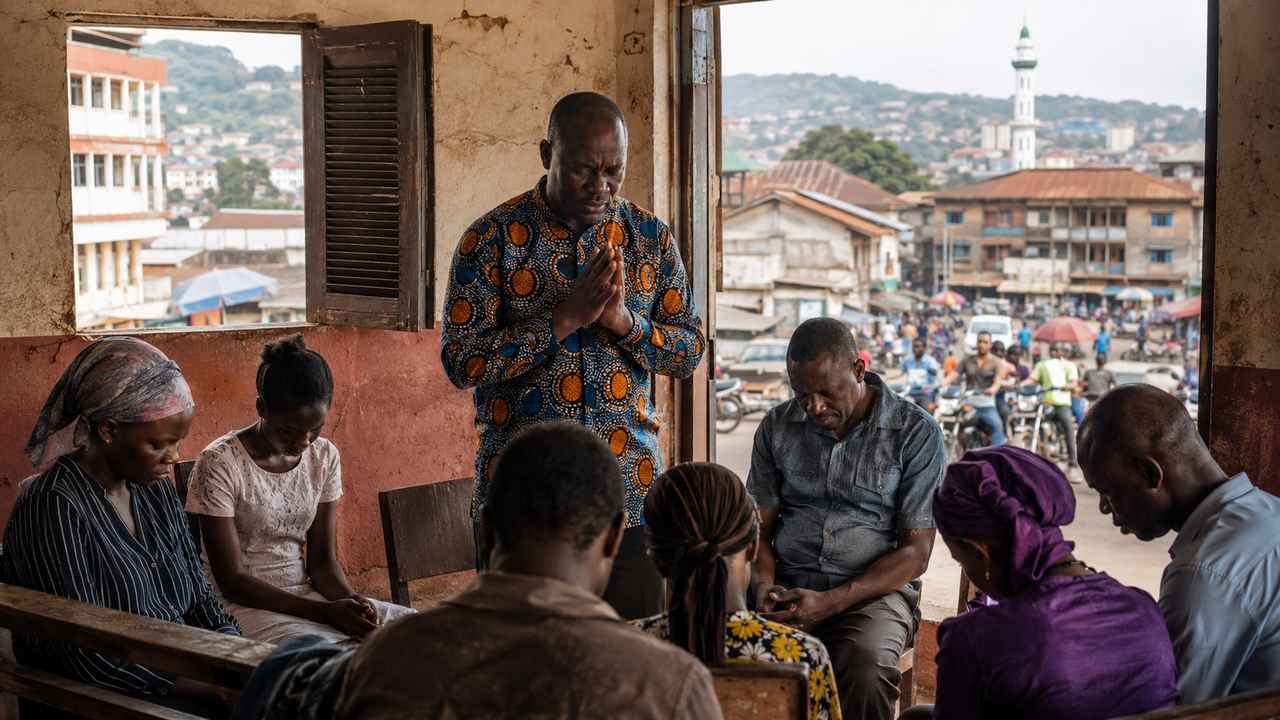
Guinea stands at a difficult crossroads: outwardly moving into a new constitutional era, yet still carrying deep questions about public trust, freedom of speech, justice, and whether the country’s great mineral wealth will truly serve ordinary people. For Christians, the burden is not only national instability. It is the quieter cost of faithful witness in a majority-Muslim society where churches often worship openly, yet converts and interfaith families may still feel strong family and community pressure. Mamady Doumbouya, who first came to power after the 2021 coup, was confirmed president-elect in January 2026 after Guinea’s December 2025 election.
Pray for believers in Guinea to remain steadfast in Christ amid political uncertainty, social pressure on converts, and the moral strain of public fear. Pray for churches to be strengthened in discipleship, courage, mercy, and faithful gospel witness.
Last verified: May 2026
Why Guinea Needs Prayer Now
Guinea’s formal political transition has not removed the deeper need for truth, justice, public trust, and faithful Christian witness.
Guinea has formally moved out of its post-2021 military-transition period, but the path has been deeply contested. Mamady Doumbouya, who took power in a 2021 coup, was confirmed by Guinea’s Supreme Court as president-elect in January 2026 after winning 86.7 percent of the vote in the December 2025 election. That election followed a new constitution that allowed military leaders to run and extended the presidential mandate from five years to seven years.
That formal transition has not resolved the country’s deeper tensions. In March 2026, the government dissolved 40 political parties, including major opposition parties. Associated Press reported that the order stripped affected parties of legal status and banned political activity using their names, logos, and symbols.
Media freedom has also become a serious concern. Reporters Without Borders ranked Guinea 111th out of 180 countries in its 2026 World Press Freedom Index, down from 103rd in 2025. The organization says the years following the 2021 coup have brought censorship of critical outlets, arrests, threats, exile, and the unresolved disappearance of journalist Habib Marouane Camara.
These national realities matter for prayer because churches do not live outside public life. When fear grows, truth is costly, leaders become difficult to challenge, and ordinary people carry poverty, uncertainty, and political exhaustion, believers need grace to live as salt and light without retreating into silence, bitterness, or despair.
Country Snapshot
Guinea’s geography, religious landscape, and mineral wealth all shape the setting in which believers live, worship, and witness.
Guinea is a West African country on the Atlantic coast, bordered by Guinea-Bissau, Senegal, Mali, Côte d’Ivoire, Liberia, and Sierra Leone. Its capital is Conakry. The World Bank lists Guinea’s 2024 population at 14,754,785.
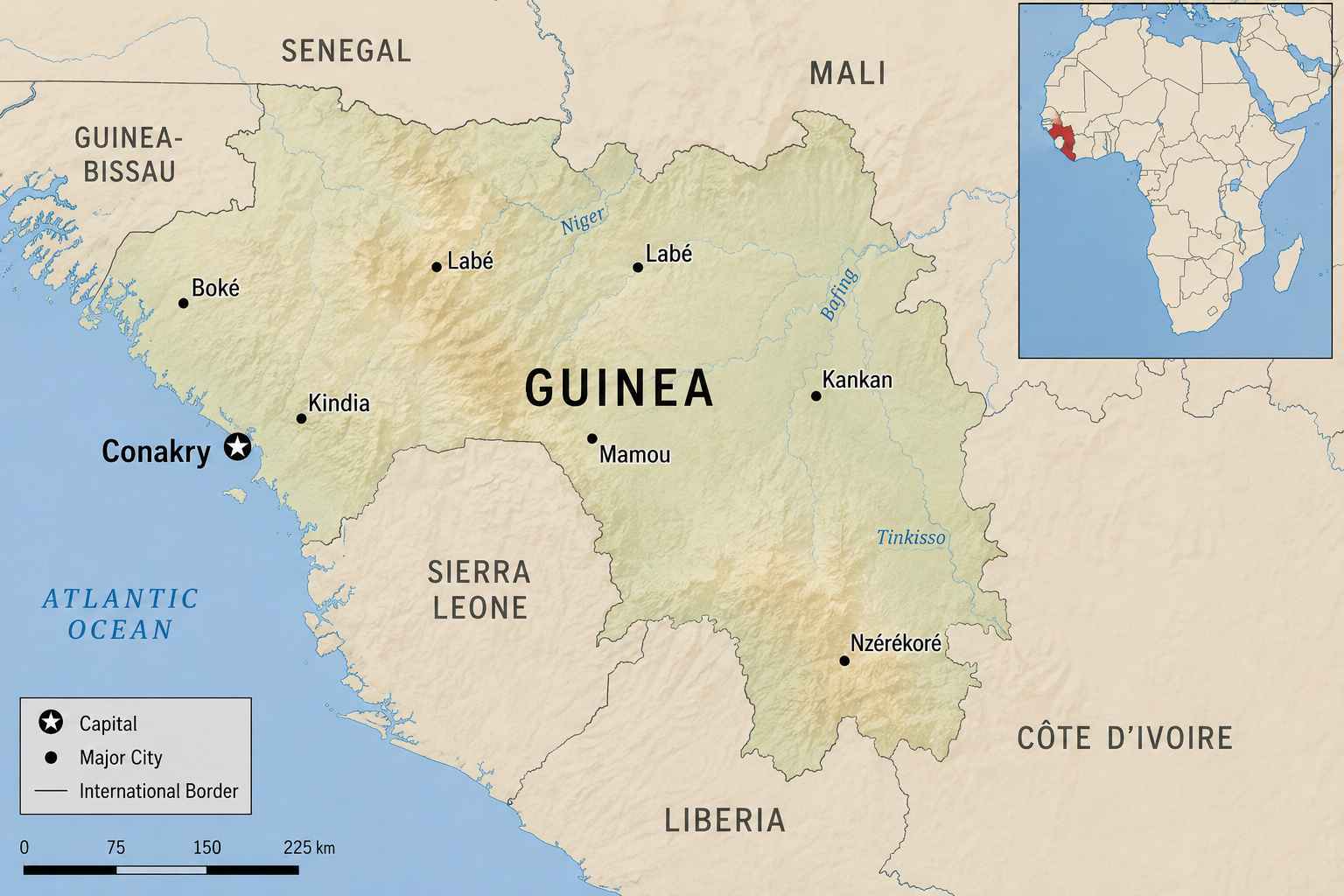
Religiously, Guinea is majority Muslim with a smaller Christian minority. The U.S. Department of State’s 2023 religious-freedom report, citing Guinea’s Secretariat General of Religious Affairs, estimated the population at about 84 percent Muslim, 11 percent Christian, and 5 percent indigenous religious or other beliefs. The same report noted that many Muslims and Christians incorporate indigenous rituals into religious practice.
Christians are especially concentrated in Conakry, southern coastal areas, and the eastern Forest Region. Christian groups include Roman Catholics, Anglicans, Baptists, Seventh-day Adventists, Jehovah’s Witnesses, and several evangelical groups.
Economically, Guinea is rich in natural resources, especially bauxite and iron ore. The World Bank says Guinea’s overall economic growth accelerated in 2024 and that the Simandou iron ore project could boost growth, but it also warns that mining-led growth may deepen inclusive-growth challenges unless sound public-finance measures and reforms are carried out.
Main Pressures Facing Christians
Christian pressure in Guinea is often social, local, and administrative rather than one simple nationwide pattern.
The main pressures on Christians in Guinea are not best described as a uniform nationwide campaign against the church. The picture is more layered. Churches often operate openly, Christian schools continue in large cities, and public Christian worship is possible in many places. Yet converts from Islam may face strong pressure from family and community, especially in the middle and upper regions of the country.
The U.S. religious-freedom report says familial, communal, cultural, social, and economic pressure can discourage conversion from Islam. It also notes that interfaith marriages, especially between Muslim women and Christian men or men of other faiths, may be conditioned on the man converting to Islam in order to gain the woman’s family approval.
There is also a state-management dimension to religious life. Guinea’s Secretariat General of Religious Affairs, the cabinet-level body overseeing religious affairs, issues weekly themes for mosque and church sermons. Its inspectors are present in every region and are responsible for helping ensure sermons align with official directives. Religious groups must receive state approval, and unregistered groups may be shut down.
Local disputes can also burden Christian communities. A long-running land dispute involving Susu Muslim villagers and the Catholic Saint-Jean monastery in Kendoumaya remained unresolved in the latest religious-freedom report reviewed for this article. A separate older case involving an evangelical church in the Forest Region also remained pending.
The broader civic climate adds another layer. When journalists disappear, opposition leaders are exiled, and media outlets are censored, Christians may feel pressure to avoid public truth-telling, careful moral speech, or visible concern for justice. The church needs wisdom to remain peaceful and respectful while not becoming timid, compromised, or indifferent.
What Life Is Like for Christians in Guinea
Many believers experience both meaningful freedom and quieter forms of pressure in ordinary family and community life.
For many Christians in Guinea, ordinary life includes real freedom and real caution at the same time. A believer may attend church, send children to a Christian school, and live peaceably with Muslim neighbors, while another believer—especially a convert—may feel the cost of following Christ most strongly around the family table, in marriage negotiations, at funerals, or in the quiet fear of being treated as disloyal to one’s people.
That kind of pressure is often difficult for outside readers to see. It may not appear as prison bars or dramatic headlines. It may come as a father’s disappointment, a marriage delayed, a community’s suspicion, a business opportunity lost, or a young believer quietly wondering whether obedience to Christ will cost too much.
Still, Guinea also shows signs of common grace. The government has subsidized both Muslim and Christian pilgrimages; Christian schools continue to operate; religious broadcasting has been permitted; and religious leaders have publicly spoken about tolerance and social cohesion.
This means Christians need prayer that is neither exaggerated nor shallow. They need courage for pressure, humility for coexistence, endurance in uncertainty, and pastors who can teach believers to follow Christ with both conviction and gentleness.
Recent Developments
Recent political, civic, media, economic, and security developments sharpen Guinea’s present prayer burden.
-
January 2026
Doumbouya confirmed and sworn in after Guinea’s first presidential vote since the 2021 coup
Mamady Doumbouya was confirmed president-elect by Guinea’s Supreme Court in January 2026 after winning the December 2025 election, and he was sworn in on January 17. Associated Press reported that the election took place under a constitution that allowed military leaders to run and extended the presidential term from five to seven years. Associated Press
Prayer significance: Guinea’s formal transition has not removed the need for truth, justice, public trust, and wise restraint in the use of power.
-
January 2026
Regional sanctions lifted while concerns over the transition remained
The African Union lifted sanctions in January 2026, citing the organization of the December 2025 presidential election. Africanews / Agence France-Presse also noted that civil-society and opposition voices criticized the process as irregular or exclusionary. Agence France-Presse, often abbreviated AFP, is an international news agency. Africanews / AFP
Prayer significance: Guinea has been regionally normalized, yet serious questions remain about political openness, accountability, and public trust.
-
March 2026
Authorities dissolved 40 political parties
Authorities dissolved 40 political parties, including the main opposition party Union of Democratic Forces of Guinea, the party of former president Alpha Condé, and the Union of Republican Forces. Associated Press reported that several major opposition figures were already in exile and that major opposition leaders had been barred from the December election. Associated Press
Prayer significance: This sharpens prayer for justice, honest civic life, and courage for believers who must live faithfully in a tense political environment.
-
2025–2026
Press freedom remained under serious pressure
Reporters Without Borders says Guinea’s private press has faced censorship, bans, economic damage, threats, exile, and violence. It also says journalist Habib Marouane Camara remains missing after being abducted in December 2024. Reporters Without Borders
Prayer significance: Pray that truth would not be crushed by fear, and that Christians would speak and live with both wisdom and courage.
-
May 2026
Reported disappearances added to civic-space concerns
Africanews / Agence France-Presse reported the kidnapping of an opposition vlogger’s son and an opposition-linked figure, while noting official silence and broader allegations of disappearances connected to critics. Because some details are contested or attributed, this guide treats them as serious reported concerns rather than as fully adjudicated legal findings. Africanews / AFP
Prayer significance: This strengthens the need to pray for protection, truth, lawful accountability, and restraint from every abuse of power.
-
2025–2026 economic outlook
Mining growth could bring opportunity, but also deepen inequality
The World Bank says Simandou iron ore exports could boost growth, but it also warns that mining-led growth may deepen existing inclusive-growth challenges unless reforms are carried out. World Bank
Prayer significance: In a country with great natural wealth and widespread need, pray that public wealth would serve the common good rather than corruption, narrow interests, or inequality.
-
March 2026
Authorities reported arrests linked to suspected extremist networks
Africanews reported that Guinean authorities announced arrests linked to suspected networks of the Group for the Support of Islam and Muslims, often abbreviated GSIM, a jihadist coalition active in parts of the Sahel. Africanews
Prayer significance: This does not mean Guinea should be framed as a major active-war country, but it does add to the need for prayer for wise security, justice, restraint, and protection of civilians.
How to Pray
Pray for Christ’s church in Guinea to be strengthened in faithfulness, courage, love, and gospel witness.
-
Pray for steadfast believers. Ask the Lord to strengthen Christians in Guinea to remain faithful to Christ with courage, humility, and love, especially where family expectations, community pressure, or fear of social loss make obedience costly.
-
Pray for converts from Islam. Ask God to uphold them in faith, protect them from isolation, and surround them with wise, patient churches that can disciple them with tenderness, biblical clarity, and perseverance.
-
Pray for pastors and church leaders. Ask the Lord to help them preach Scripture faithfully, shepherd the flock with courage, and teach believers to resist both fear and bitterness in a tense national season.
-
Pray for rulers, courts, and public officials. Ask God to grant justice, restraint, honesty, and the fear of the Lord, especially where political power, opposition activity, and public trust are under strain.
-
Pray for truth and accountability. Ask the Lord to protect journalists, civil-society voices, and ordinary citizens who seek truth from intimidation, disappearance, false accusation, and violence.
-
Pray for just stewardship of Guinea’s resources. Ask that the country’s mineral wealth would not deepen corruption or inequality, but would serve the poor, create just opportunity, and support the common good.
-
Pray for peace and gospel witness. Ask the Lord to preserve peace between Muslim, Christian, and communities shaped by indigenous religious traditions, and to open doors for gracious witness, genuine repentance, and lasting hope in Christ.
Give Thanks
Even amid serious concerns, Guinea’s Christians and communities show signs of preserved mercy and common grace.
-
Give thanks that many Christians in Guinea are still able to gather for worship, teach, serve, and maintain a visible church presence in their communities.
-
Give thanks for places where Muslims and Christians continue to live peaceably as neighbors, and for every public or local effort that encourages religious tolerance rather than suspicion.
-
Give thanks for pastors, churches, Christian schools, and ordinary believers who continue to serve Christ quietly and faithfully, even where pressure is more social than public.
-
Give thanks for every evidence of God’s common grace in Guinea: preserved peace in many communities, continued space for Christian witness, and opportunities for truth, mercy, and gospel service.
Last Verified / Update Note
This guide should be reviewed again if Guinea’s political, civic, religious-freedom, or security conditions change materially.
This prayer guide reflects a May 2026 review. The most time-sensitive areas are Guinea’s political and electoral developments, the legal status of opposition parties, reported disappearances or abductions, media restrictions, religious-affairs regulation, and security-related claims.
Religious-demography and religious-freedom details are drawn mainly from the U.S. Department of State’s 2023 religious-freedom report, published in 2024 and accessed through ecoi.net during this review. Later official or independent reports may refine those details.
Key Sources Consulted
These sources materially informed the current version of this prayer guide.
- Associated Press — Guinea’s junta leader is confirmed president-elect after first vote since a 2021 coup. Used for the January 2026 confirmation of Doumbouya’s election victory, the vote percentage, and the constitutional context.
- Associated Press — Guinea’s main opposition leader warns of a “party-state” after 40 political parties dissolved. Used for the March 2026 opposition-party dissolution and civic-space concerns.
- Africanews / Agence France-Presse — Guinea: African Union lifts sanctions. Used for regional normalization after the December 2025 election and the contested-transition framing.
- Reporters Without Borders — Guinea country profile and World Press Freedom Index. Used for Guinea’s 2026 press-freedom ranking, media restrictions, censorship concerns, and the Habib Marouane Camara case.
- U.S. Department of State — 2023 Report on International Religious Freedom: Guinea, accessed through ecoi.net. Used for religious demography, the Secretariat General of Religious Affairs, sermon guidance, registration requirements, Christian-school context, convert pressure, interfaith marriage pressure, religious coexistence, and unresolved local church-related disputes.
- World Bank — Guinea Data. Used for Guinea’s 2024 population figure and basic economic indicators.
- World Bank — Guinea Economic Update 2025. Used for economic growth, Simandou iron ore outlook, and inclusive-growth concerns.
- Human Rights Watch — World Report 2025: Guinea. Used for background on political repression, excessive force concerns, media pressure, accountability, and mining-community issues.
- Africanews / Agence France-Presse — Opposition-linked kidnapping reports and social-media restrictions. Used cautiously for recent civic-space and disappearance concerns.
- Africanews — Guinea cracks down on suspected GSIM networks. Used as a light security-context source, not as the main frame for the country.
A Closing Prayer for Guinea
Bring Guinea’s burdens before the Lord with sober hope in Christ.


