

Across Mauritania’s deserts, border towns, and crowded capital, the public face of the nation is almost entirely Islamic. For many Mauritanians, leaving Islam is not merely a private religious decision but a rupture with family, clan, legal identity, and social survival. That is why prayer for Mauritania must be tender and alert: the church is small, converts often remain hidden, and public Christian witness can carry severe consequences.
Prayer Burden at a Glance
Pray for hidden believers from Muslim backgrounds, for foreign and migrant Christians worshiping under restriction, and for gospel witness to endure with wisdom, courage, and love amid legal danger, family pressure, refugee strain, and national vulnerability.
Last verified: May 2026
Why Mauritania Needs Prayer Now
Mauritania’s prayer burden is shaped by hidden Christian faith, legal and family pressure, refugee strain, and the need for wise gospel witness.
Mauritania needs prayer because following Christ can cost a person nearly everything that ordinarily gives life stability: family belonging, community protection, marriage prospects, work, safety, and legal standing. Open Doors ranks Mauritania No. 21 on the World Watch List 2026 and reports that converts from Islam face severe opposition from family and society, while public expressions of faith by non-Mauritanian Christians can be viewed as proselytizing Muslims and may lead to imprisonment or deportation.
The legal shadow is especially heavy. Open Doors’ 2026 Mauritania dossier says the government has indicated it will enforce strict apostasy laws and that, since 2018, those laws include the death penalty without leniency based on repentance for Muslims convicted of leaving Islam or committing blasphemy. The article does not treat this as evidence of recent executions; the burden is that the legal threat itself reinforces fear and constrains Christian life.
Prayer is also needed because the church’s burden sits inside a wider national strain. Mauritania is hosting a large Malian refugee population amid continuing insecurity across the border. The United Nations High Commissioner for Refugees, commonly known as UNHCR, reported in its April 2026 Mauritania listing that the country continued to receive Malian refugees in 2025 and that the number of refugees and asylum seekers had surpassed 300,000. Such pressure weighs on host communities, aid systems, vulnerable migrants, and churches that must worship quietly while many neighbors are also carrying hardship.
Country Snapshot
A brief orientation to Mauritania’s location, people, government, and church context.
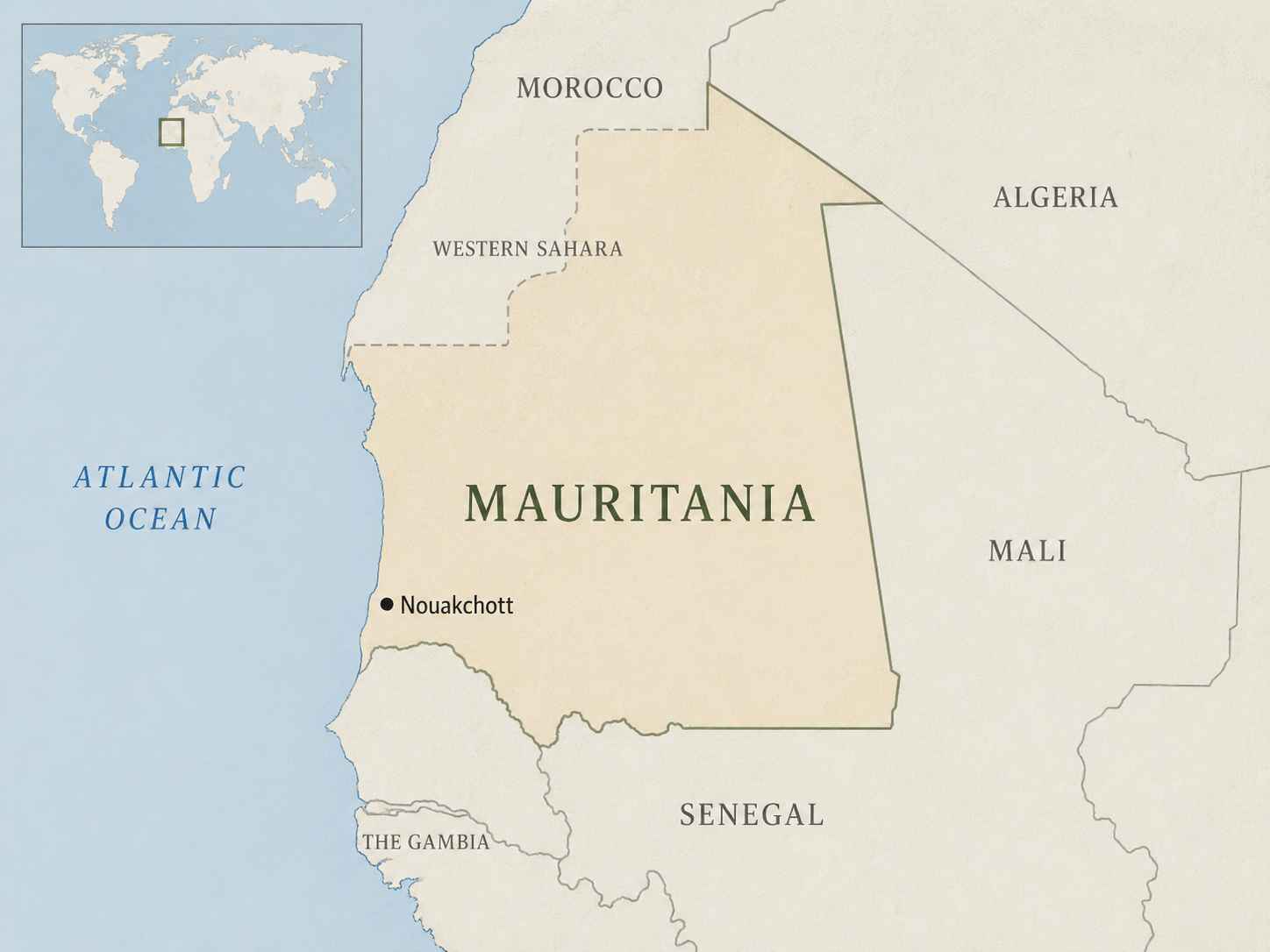
Mauritania lies where the Arab-Berber world of North Africa meets Sub-Saharan West Africa. Its geography matters for prayer: it faces the Atlantic, borders Mali and Senegal, and sits near conflict-affected Sahel routes used by refugees, migrants, traders, security forces, and armed groups.
The country has retained more state continuity than some neighbors in the Sahel, but it remains marked by poverty, social hierarchy, ethnic tension, and the long shadow of slavery. Amnesty International’s 2025/26 Mauritania material points to continuing concerns around discrimination, gender-based violence, detention, freedom of expression, and descent-based slavery.
Main Pressures Facing Christians
Believers face legal pressure, family pressure, restricted church life, and wider social vulnerability.
Legal pressure over conversion and public witness
Mauritania’s legal environment is one of the heaviest burdens for believers. Open Doors says apostasy and blasphemy are punishable by death and that public expression of any faith other than Islam is severely restricted. This does not mean every believer is constantly before a court. The deeper daily effect is fear. A convert may hesitate before baptism, before speaking to a trusted relative, before meeting another believer, or before letting a child ask too many questions. Law becomes more than text on paper; it becomes pressure inside ordinary decisions.
Family, clan, and community pressure
For Mauritanian converts from Islam, pressure often begins closest to home. Open Doors says converts are highly vulnerable to pressure and violence from extended family, Islamist groups, and the wider community, and that most try to hide their faith because conversion becoming public can mean losing status and survival support.
This is especially weighty in a society where communal interdependence matters. A believer may not simply lose approval; he may lose shelter, work, marriage prospects, or the relationships that make daily life possible. Faithfulness may mean living with a quiet Bible, whispered prayers, and few safe people to trust.
Pressure on women and men in different ways
Open Doors reports that female converts may face food deprivation, bullying, house arrest, forced marriage, divorce, loss of means to survive, and legal barriers around marriage to Christian men. Male converts and leaders may face detention, surveillance, death threats, expulsion from home, physical violence, job loss, business boycotts, or pressure to flee.
These details should shape prayer. The burden is not abstract “persecution.” It is a daughter pressured by her household, a husband afraid of losing work, a young believer wondering whether baptism will endanger others, a church leader carrying the weight of secrecy and shepherding at the same time.
Restricted church life for foreign and migrant Christians
Most Christians in Mauritania are foreigners, including Sub-Saharan African migrants and Roman Catholics. Open Doors says foreign-born Christians may worship in specific places but are not permitted to share their faith; its dossier also says the Roman Catholic Church has legal status and that expatriate churches are not allowed to welcome Muslims into church buildings or integrate converts from Islam.
This creates a painful tension. There is visible Christian presence, but only within narrow boundaries. There is worship, but not free witness. There are churches, but not broad liberty to disciple Mauritanians who come to Christ.
Broader vulnerability for migrants, refugees, and marginalized communities
Many Christians in Mauritania are migrants or foreign workers, so humanitarian and migration pressures matter for church life. Human Rights Watch reported in August 2025 serious abuses against migrants and asylum seekers between 2020 and early 2025. Because these claims are serious and politically sensitive, they should be handled carefully. They are not a reason to flatten Mauritania into a single dark story, but they do give Christians strong reason to pray for justice, humane enforcement, restraint, and protection for vulnerable people.
What Life Is Like for Christians in Mauritania
For many believers, faithfulness is quiet, costly, and often hidden from public view.
For a Mauritanian believer from a Muslim background, the Christian life may be quiet almost everywhere except before God. The public world says, “You are Muslim.” The family may assume it. The school may enforce it. The law may threaten anyone who says otherwise. A convert may carry the gospel as a hidden treasure, rejoicing in Christ while still walking carefully through family expectations, community suspicion, and real danger.
Open Doors’ 2026 dossier describes recent incidents that shook the small Christian community, including continuing social hostility after a baptism video and the exhumation of a Christian convert’s body in April 2025. It also says baptisms can only be carried out in secret, and many converts hesitate because discovery may bring apostasy charges.
Foreign and migrant Christians face a different kind of narrowness. Some can gather, but within designated or tolerated spaces. They may worship Christ while knowing they cannot freely speak of Him to Mauritanian neighbors. Some also face racial or social discrimination as Sub-Saharan Africans, making Christian identity one more vulnerability in an already precarious life.
Yet Christ has not forgotten Mauritania. The church is small, but not imaginary. Hidden believers are not hidden from the Lord. Restricted churches are not restricted from His presence. The gospel may be whispered, but the risen Christ reigns openly.
Recent Developments
Recent developments sharpen the prayer burden without turning the guide into a news digest.
-
2026 reporting period
Religious pressure remains severe
Open Doors’ World Watch List 2026, its annual ranking of countries where Christians face severe pressure or persecution, places Mauritania at No. 21. Its current materials describe high pressure across private life, family life, community life, national life, and church life, with converts from Islam especially vulnerable.
Prayer significance: Pray for hidden believers to endure with wisdom, courage, and safe fellowship under legal and social pressure.
-
April 2026 data listing
Refugee pressure from Mali has grown sharply
Mauritania continues to receive people fleeing violence and insecurity in Mali. UNHCR’s April 2026 Mauritania listing says that after around 50,000 new arrivals in 2025, the number of refugees and asylum seekers in Mauritania had surpassed 300,000.
Prayer significance: Pray for refugees, host communities, and churches serving quietly amid strain on food, shelter, protection, and local resources.
-
2024–2025
Migration control has become a contested rights issue
Mauritania’s location on Atlantic and Saharan migration routes has made it a focus of European migration policy. Associated Press reporting in 2024 described European Union support connected to migration control, humanitarian aid, job creation, and security cooperation.
Human Rights Watch later reported serious migration-control abuses against migrants and asylum seekers, while also describing recent steps that could improve protection if implemented with integrity.
Prayer significance: Pray for humane enforcement, truthful public administration, protection for vulnerable migrants, and justice without caricature or political simplification.
-
April 2026
Economic stability remains fragile but not hopeless
The International Monetary Fund, or IMF, said in April 2026 that Mauritania’s 2025 growth was about 4.0% and projected 2026 growth at 4.8%, while also noting that non-extractive growth was expected to slow. The IMF also welcomed cash transfers to more than 124,000 vulnerable households and emphasized fiscal, governance, and anti-corruption reforms.
Prayer significance: Pray for vulnerable households, honest stewardship, and believers whose material security may be tied closely to family and community acceptance.
-
June 2024 and 2026 public-rights context
Political continuity has not removed deeper rights concerns
President Mohamed Ould Cheikh el Ghazouani won re-election in June 2024, but the aftermath included opposition protests and reported deaths after arrests, according to contemporary reporting. Freedom House’s 2026 Mauritania score page lists the country as Partly Free, showing that political continuity and civic constraint both belong in the country picture.
Prayer significance: Pray for rulers, judges, and local officials to act with truth, restraint, justice, and mercy.
How to Pray
Turn Mauritania’s present burden into specific, Christ-centered intercession.
-
Pray for Mauritanians who have come to Christ from Islam. Ask the Lord to strengthen hidden believers with courage, wisdom, and joy in Christ, especially where following Him may mean family rejection, loss of livelihood, or danger from the wider community.
-
Pray for safe and faithful discipleship. Ask Christ, the Head of the church, to provide mature believers, trustworthy fellowship, sound teaching, and access to Scripture for those who cannot gather openly or ask public questions about the faith.
-
Pray for women, young believers, and isolated converts under household pressure. Ask God to protect those who may face coercion, forced marriage, confinement, intimidation, or emotional pressure, and to give them perseverance without despair.
-
Pray for foreign and migrant Christians worshiping under restriction. Ask the Lord to help believers from other countries walk wisely, worship faithfully, love their neighbors, and bear quiet witness without fear, bitterness, or careless risk.
-
Pray for rulers, judges, police, and local authorities. Ask God to give them justice, restraint, truthfulness, and mercy, especially in matters involving conscience, religious identity, migrants, refugees, prisoners, and vulnerable minorities.
-
Pray for Malian refugees, vulnerable migrants, and Mauritanian host communities. Ask the Father of mercies to provide food, shelter, protection, lawful treatment, and peace, and to make His people compassionate without becoming overwhelmed.
-
Pray for gospel fruit in a spiritually difficult place. Ask the Lord to open hearts to Christ, preserve His small church, raise up faithful leaders, and build His kingdom in Mauritania in ways that no law, fear, or social pressure can finally prevent.
Give Thanks
Give thanks for credible signs of mercy, endurance, and common grace without minimizing the weight of the burden.
-
Give thanks that Christ is preserving His church in Mauritania. The church is small and often quiet, but the Lord sees His people, sustains their faith, and keeps His promise to gather His own.
-
Give thanks for believers who endure costly faithfulness. Every hidden prayer, secret act of obedience, careful conversation, and quiet refusal to deny Christ matters before God.
-
Give thanks for every measure of hospitality shown to refugees and vulnerable strangers. Mauritania’s reception of many people fleeing insecurity in Mali is a real mercy, even where resources are strained and needs remain great.
-
Give thanks for any just restraint and reform in public life. Where authorities take steps that may better protect migrants, refugees, or vulnerable communities, Christians can receive that as common grace while continuing to pray for deeper justice.
-
Give thanks for practical help reaching vulnerable households. Economic support, food assistance, and community cooperation cannot replace the gospel, but they can restrain suffering and open space for mercy, stability, and neighborly love.
Last Verified / Update Note
This note helps readers understand the guide’s freshness and update sensitivity.
- Last verified
- May 2026.
- Freshness window
- This guide reflects a May 2026 review. The church-pressure, refugee, migration-control, and economic sections are time-sensitive because new reports, policy changes, or updated humanitarian figures may affect how readers use the guide for prayer.
- Developments to watch
- Developments that may affect future prayer use include new reports involving converts or church leaders, changes in apostasy or blasphemy enforcement, refugee and asylum-seeker figures from Mali-related displacement, migration-control policy, and major political, economic, or humanitarian shifts.
Key Sources Consulted
These sources materially informed the current version of this prayer guide.
- Open Doors Australia, “Mauritania,” World Watch List 2026 country profile. Used for ranking, Christian population estimate, main persecution pressures, and prayer-facing church context.
- Open Doors, “World Watch List 2026: Mauritania — Profile of Religious Freedom for Christians.” Used for detailed analysis of convert pressure, church restrictions, gendered pressure, recent incidents, legal context, and Christian-life texture.
- Human Rights Watch, “Mauritania: Mandatory Death Penalty for Blasphemy.” Used for background on the 2018 legal change concerning blasphemy and apostasy-related crimes.
- UNHCR Operational Data Portal, “Country — Mauritania.” Used for refugee and asylum-seeker totals and the 2025 Malian refugee influx, including the February 2026 country factsheet listing published in April 2026.
- International Monetary Fund, “Mauritania: IMF Reaches Staff-Level Agreement…” April 10, 2026. Used for current economic context, growth projections, external-shock language, financing needs, and cash-transfer information.
- Human Rights Watch, “Mauritania: Years of Migration Control Abuses.” August 27, 2025. Used for contested migration-control abuse claims, government-reform context, and vulnerability of migrants and asylum seekers.
- Amnesty International, “Mauritania 2023,” in The State of the World’s Human Rights 2025/26. Used for broader rights context, including freedom of expression, discrimination, slavery, and gender-based violence concerns.
- Freedom House, “Mauritania: Freedom in the World 2026.” Used for public-rights context and the “Partly Free” assessment.
- The Guardian, “Three people die in custody after arrests at election protests in Mauritania.” July 3, 2024. Used for post-election context and rights-related background.
- Associated Press, “The EU is giving Mauritania millions to curb migration. Rights activists worry about what it means for migrants.” March 7, 2024. Used for migration-policy context and external-partnership background.
A Closing Prayer for Mauritania
Gathering this prayer guide into one focused prayer before God.


