

Islam is central to Morocco’s public life and is the religion of the state. Morocco also has strong Arab and Amazigh heritage, close family ties, and close links with both Africa and Europe through the Atlantic Ocean and the Mediterranean Sea. The Constitution guarantees the free exercise of worship.
Recognised churches serving foreign residents can gather publicly, and migrant congregations provide fellowship for Christians from many countries. Moroccan citizens who leave Islam to follow Christ may face rejection within the family, social isolation, difficulties at work, or uncertainty about where they can worship safely.
They need protection from hostility, Scripture, faithful teaching, mature Christian friendship, and churches that will care for them patiently. Pray that they will keep following Christ and respond wisely when relatives oppose them.
Morocco also needs prayer for young people seeking steady work and for families trying to help them build a secure future. In late July 2026, the movement of large numbers of people from Fnideq toward Ceuta showed how quickly attempts to reach Europe can put lives at risk. Pray also for migrants and refugees living far from home, communities recovering from floods and earthquake damage, families affected by water scarcity, and leaders carrying public responsibility. These hardships are not the whole story of Morocco, but they are real needs Christians should bring before God.
Prayer Burden at a Glance
Remember Moroccan believers who may have few mature Christians nearby or limited access to a church. Pray that they will grow in their knowledge of Scripture, trust in Christ, and obedience to Him, endure family and social opposition, and speak about Christ with courage and gentleness.
Pray for recognised churches and migrant congregations to teach Scripture faithfully, train dependable leaders, welcome vulnerable people, and work together without setting aside the truth of the gospel.
Bring Morocco’s wider needs before the Lord: freedom of conscience, honest government, dignified work and real opportunities for young people, protection of life on dangerous migration routes, humane care for migrants and refugees, wise cooperation with Spain over border safety, recovery after floods and earthquake damage, careful use of scarce water, and a just and peaceful settlement concerning Western Sahara.
Last verified: August 15, 2026
Why Morocco Needs Prayer Now
Morocco’s constitutional protection for worship is important, but many converts still need safe fellowship, pastoral care, freedom of conscience, and strength to follow Christ when family expectations and social opposition make open Christian faith costly.
Morocco’s Constitution identifies Islam as the religion of the state and guarantees the free exercise of worship. Recognised churches serving foreign residents and migrants can hold public services. These freedoms matter, but Moroccan converts do not always experience the same freedom to discuss their faith openly or gather with other believers.
Moroccan law does not expressly make conversion from Islam to Christianity a crime. However, laws restricting attempts to persuade Muslims to change religion, together with strong family and social expectations, can make it difficult to speak openly about Christ.
Some converts fear losing family support, damaging close relationships, facing problems at work, or being pressured over whom they marry or how their children are raised. Others may worry that openly meeting with Christians will draw unwanted attention from relatives, neighbours, or authorities.
The experience is not the same for everyone. Some believers may have greater freedom than others. Even so, many must think carefully about whom they can trust, where they can meet, and when it is wise to speak openly.
As a result, some converts first encounter the gospel through a phone or computer but have no mature Christian nearby. A new believer may have no pastor to help with questions about family life, marriage, work, Islamic festivals, church membership, or public witness.
Without a church that teaches Scripture and provides pastoral care, believers may become discouraged or depend heavily on teachers they have never met. They may also struggle to recognise false teaching or learn how Christians worship, serve one another, and receive correction within a local church.
These religious and family difficulties sit alongside wider social and economic pressures. Many young Moroccans struggle to find stable work or move successfully from education into employment. Official Moroccan statistics show that many people aged 15–29 are outside employment, education, or training. Rural families may face fewer opportunities alongside drought, agricultural losses, and unequal access to services. Frustration over employment, education, healthcare, corruption, and public spending also contributed to youth-led protests during 2025.
The late-July 2026 events at Fnideq and Ceuta showed how serious the risks can become when large numbers of people try to reach Europe through dangerous routes. Tens of thousands of people crossed or attempted to cross into Ceuta by land or sea, and people died during the journeys. Moroccan and Spanish authorities reported different totals, so exact figures remain uncertain. The people involved should not be treated as though they all had the same reason for going. Even so, the crisis gives Christians clear reasons to pray for young people who feel uncertain about their future, for families fearful that loved ones may risk their lives, and for truthful information that does not encourage dangerous decisions.
Morocco and Spain also faced the practical question of how to protect life, manage the border, and deal humanely with people who had crossed. Different explanations of the crisis remain in public debate, but the clearest prayer needs are not difficult to see: protection of life, truthful information, humane treatment, responsible leadership, and wise cooperation between neighbouring countries.
Floods in February 2026 damaged homes, farms, businesses, roads, and water infrastructure. Communities in the High Atlas still live with the effects of the September 2023 earthquake. Severe heat and long-term water scarcity place further pressure on households, farmers, and public services. Migrants and refugees in Morocco may also face unstable work, inadequate documentation, discrimination, trafficking, or exploitation. Churches can welcome vulnerable people, meet practical needs, provide Christian fellowship, and explain the hope found in Christ without using material assistance to pressure anyone into professing faith.
Country Snapshot
A brief orientation to Morocco’s location, people, government, languages, religious setting, and the circumstances in which Christians live and serve.
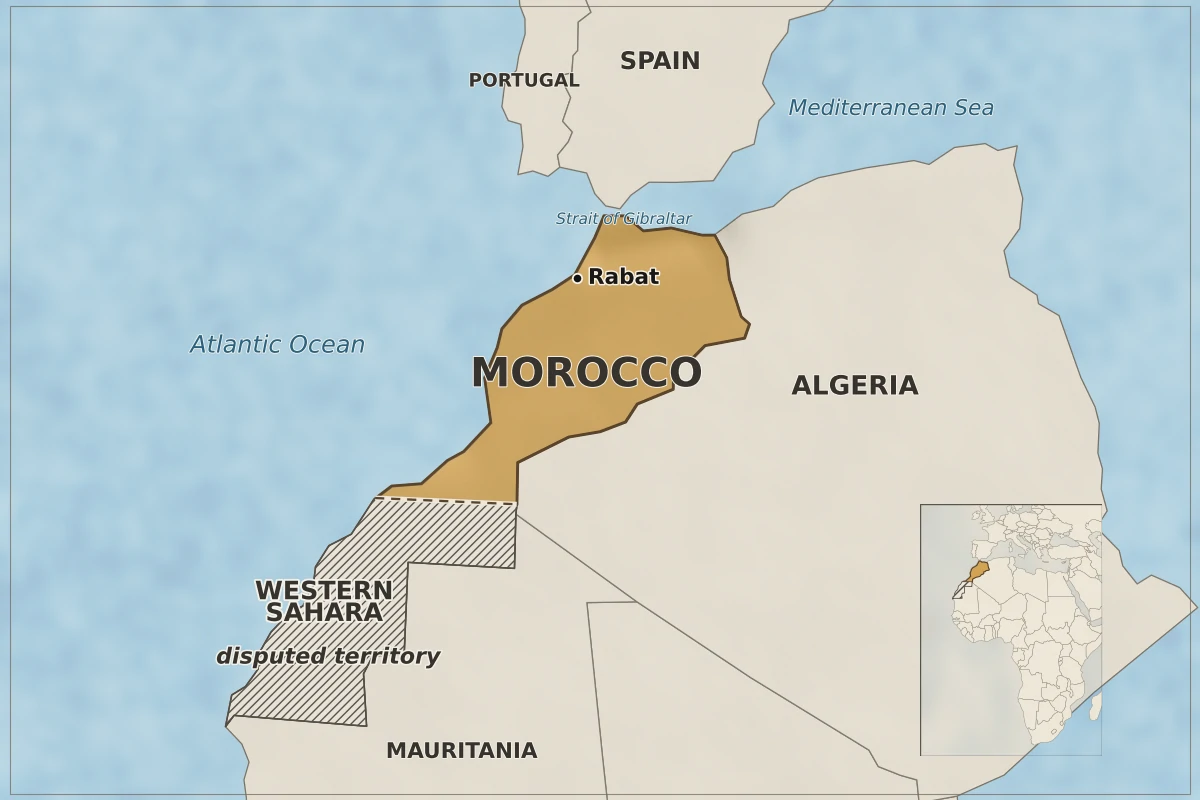
Morocco lies at the northwestern edge of Africa, separated from Spain by the Strait of Gibraltar. Its location connects the country with trade, migration routes, international relations, and security concerns on both sides of the Mediterranean.
The population includes Arab and Amazigh communities, alongside Sahrawi, sub-Saharan African, European, and other groups. Arabic and Tamazight are official languages. French is widely used in education, government, commerce, and public life, while Hassani Arabic is especially important in southern areas.
The monarchy has both political and religious significance. The King holds the title Commander of the Faithful and is constitutionally entrusted with protecting Islam and guaranteeing the free exercise of religious worship.
The state presents this arrangement as a foundation for moderation, stability, and peaceful coexistence. The constitutional guarantee of worship is significant, but it does not fully describe the difficulties Moroccan converts may face within their families and communities.
Morocco administers most of Western Sahara and regards the territory as part of the Kingdom. The Polisario Front seeks self-determination for the Sahrawi people, including the possibility of independence. The United Nations continues to list Western Sahara as a Non-Self-Governing Territory, and its final political status remains unresolved.
Spiritual and Practical Challenges Affecting Christians and Churches
Moroccan believers and churches may face family opposition, difficulty finding Christian fellowship, limits on public evangelism, insecure work, migration-related needs, water shortages, and long-term recovery after floods and earthquakes.
Following Christ within the family
For many Moroccan converts, the first and most painful opposition comes from people they love. Relatives may understand faith in Christ as a rejection of family, community, history, and national identity rather than as a personal conviction.
Parents may fear shame or social consequences. A husband or wife may feel betrayed. Relatives may urge the believer to hide the conversion, return to Islamic practice, or stop meeting with Christians.
A believer in this situation must learn how to honour family members without denying Christ. This may involve answering questions patiently, refusing contemptuous speech, continuing to care for relatives, and enduring misunderstanding without retaliation.
Finding faithful Christian fellowship
Some Moroccan believers have difficulty finding a church that teaches Scripture faithfully and provides pastoral care. A phone or computer can bring sermons and Bible teaching into a home, but it cannot replace a local congregation.
Believers cannot easily receive preaching, prayer, pastoral oversight, mutual encouragement, baptism, the Lord’s Supper, correction, and opportunities to serve one another when they are scattered or afraid to meet.
Small, discreet fellowships can provide vital support. They can also be vulnerable to poor teaching, betrayal, manipulation, or dependence upon one strong personality.
Morocco needs pastors, elders, Bible teachers, evangelists, and mature believers who will serve patiently and without seeking attention for themselves.
Freedom of conscience and public witness
Recognised churches serving foreign residents can worship openly, but Moroccan Christian groups have faced difficulties obtaining formal recognition. Restrictions on efforts to persuade Muslims to change religion also create uncertainty around evangelism, Christian literature, and public discussion of conversion.
A believer may remain silent when a genuine opportunity to speak about Christ arises. Another may speak in a way that exposes fellow Christians or family members unnecessarily.
Moroccan Christians need courage to confess Christ and wisdom to avoid reckless exposure. They should be free to answer sincere questions, read and share Scripture responsibly, and gather peacefully with other believers.
Work, opportunity, and vulnerable households
Unemployment, underemployment, and the difficulty of moving from education into stable work place serious pressure on many Moroccan families, especially young adults, graduates, women, and rural households. Official statistics also show that many young people are outside employment, education, or training.
For some young people, migration may seem like a way toward a better future when opportunities at home feel limited. False or misleading online claims, traffickers, and unrealistic promises can make those decisions more dangerous. Families need wisdom as they try to guide young adults who are frustrated about their prospects.
A convert may become especially vulnerable if housing, employment, or financial security depends upon relatives who oppose the Christian faith. Churches can help people facing hardship through food, temporary shelter, employment guidance, emergency care, or contact with trustworthy services. Such help should respect people’s dignity and encourage stability rather than dependence.
Migrants, refugees, and congregational care
Morocco is a country of origin, destination, and transit on migration routes linking Africa and Europe. Moroccans trying to reach Europe, refugees and asylum seekers living in Morocco, and migrants from sub-Saharan Africa and elsewhere do not all face the same circumstances and should not be spoken about as one group.
Dangerous journeys by land or sea can expose people to death, trafficking, exploitation, separation from family, and uncertain immigration procedures. The events near Ceuta underline these risks without defining the experience of every migrant or refugee.
Some migrants and refugees in Morocco are Christians, while others follow different religions. Migrant congregations can offer worship, friendship, pastoral care, and practical support to people far from home. Recognised churches and other Christian communities have opportunities to welcome strangers and care for vulnerable people without using material assistance as leverage for religious profession.
Water scarcity and disaster recovery
Morocco has invested in irrigation, desalination, water infrastructure, and drought response, but long-term water scarcity remains serious. Heatwaves, irregular rainfall, agricultural losses, and competition for water affect poorer households and rural communities most sharply.
Rebuilding a house is only one part of recovery. Schools, clinics, roads, jobs, farms, and community networks may also need repair or restoration.
Remember those whose losses continue after public attention has moved elsewhere. Pray for sufficient rain, fair access to water, wise planning, restored livelihoods, and continued support until homes, services, and livelihoods are secure again.
Christian Life and Witness in Morocco
Christian life in Morocco includes recognised churches serving foreign residents, migrant congregations, and Moroccan converts whose legal position, visibility, and daily experience are not the same.
Recognised churches serving foreign residents
Recognised Catholic and Protestant institutions serve expatriates, students, migrants, and refugees. Some provide public worship, education, theological training, pastoral care, or practical assistance.
Their public presence allows many Christians to worship openly and receive organised pastoral care. The same freedom is not always available to Moroccan converts.
Recognised church institutions serve many people, but attendance, denominational identity, church membership, baptism, or participation in religious ceremonies does not by itself show that a person has been born again. Salvation is by grace alone through faith in Christ alone.
Christians can thank God for congregations that preach the gospel clearly, teach Scripture faithfully, call people to repentance and faith, and care for those in need.
Migrant congregations
Believers from sub-Saharan Africa and other regions may gather in Arabic, French, English, or African languages. These congregations can provide community for people facing poverty, discrimination, unstable employment, or uncertain legal status.
Their membership may change frequently as people move or continue their journeys. Some congregations have few trained leaders, limited resources, or difficulty finding a stable place to meet.
They need pastors and teachers who can explain Scripture clearly, guard the church from exploitation and false doctrine, and care for people facing frequent moves, insecure work, or separation from family.
Moroccan converts
Moroccan converts often practise their faith more privately and may have fewer public places where they can worship. Some attend recognised churches where circumstances permit. Others meet quietly with a few believers or receive pastoral care privately.
Their limited public visibility does not mean that Christ has no people in Morocco. Reliable national figures are limited, and the available information does not establish the existence of a large public Christian movement.
Moroccan believers may honour Christ in daily life by refusing corruption at work, forgiving relatives who reject them, caring for people in need, answering friends’ questions about Christ, and continuing to read and obey Scripture when fellowship is difficult.
These actions do not replace speaking about the gospel. They show how the gospel changes conduct, relationships, and care for others.
Serving together without compromising truth
Recognised churches, migrant congregations, and Moroccan believers may be able to share training, pastoral care, practical resources, or ministries to vulnerable people.
Working together can be valuable, but Christian unity cannot be built by treating doctrine as unimportant. Cooperation should not require a church or believer to hide the truth of the gospel or approve teaching that contradicts Scripture.
Pray that these relationships will be honest, charitable, and faithful to Christ.
Leadership for the Moroccan church
Resources and teachers from outside Morocco can be helpful, but churches need mature Moroccan leaders to be taught, shepherded, and protected over time.
Moroccan believers need teaching that is faithful to Scripture and able to address their own languages, family structures, history, and daily questions. They need men qualified to shepherd churches, women who can disciple other women, and Christian households ready to welcome isolated believers.
The church’s future does not depend upon favourable statistics, political influence, foreign protection, or public recognition. Christ gathers and preserves His people through His Word and Spirit.
This gives Christians reason to pray with confidence: for the gospel to bear fruit, for believers to endure, and for God’s kingdom to come in Morocco.
Recent Developments
Several developments during 2025 and 2026 matter for prayer. They do not tell the whole story of Morocco or replace the need to pray for conversion, discipleship, and church life.
-
July 30–August 15, 2026
Ceuta/Fnideq migration crisis and renewed crossing calls
In late July, tens of thousands of people crossed or attempted to cross from the Fnideq area into Ceuta by land and sea. The sudden movement overwhelmed normal border arrangements, and people died during dangerous crossings. Moroccan and Spanish authorities later gave different estimates of the numbers involved and the deaths associated with the crisis, so exact totals remain uncertain.
After the crisis, Morocco and Spain strengthened cooperation over border management and the return of people who had crossed. Moroccan authorities said misleading digital information, trafficking networks, and confusion surrounding Spanish legal or administrative developments contributed to the crisis. Independent reporting also described economic frustration, hopes of reaching Europe, and the pressures facing young people in northern Morocco. More than one factor may have been at work, and the same explanation should not be applied to everyone involved.
Ahead of August 15, Moroccan and Spanish authorities reinforced security around Ceuta and Fnideq after new social-media calls for another mass crossing and misleading claims that the border would be open. In the early hours of August 15, the outcome of those calls remained unsettled.
Prayer significance: Pray for protection of life, truthful information, grieving and anxious families, real opportunities for young people, protection from trafficking and exploitation, humane treatment of migrants, and wise cooperation between Moroccan and Spanish authorities.
-
2025–September 2026
Youth protests and the parliamentary election
Youth-led protests during 2025 expressed frustration over unemployment, education, healthcare, corruption, public spending, and unequal opportunity. Some demonstrations became violent. People were killed, and many were arrested or prosecuted.
The Moroccan government said it was listening to young people’s concerns, supported constructive dialogue, and was pursuing reforms. Human-rights organisations questioned the use of force and the treatment of peaceful protesters.
Morocco is scheduled to hold elections for the House of Representatives on September 23, 2026. As of July 28, 2026, Aziz Akhannouch remained Head of Government. The election had not yet taken place, so its result and any subsequent government formation were unknown.
Prayer significance: Pray for peaceful participation, protection of life, fair legal processes, responsible campaigning, and practical action to improve education, healthcare, employment, and public services.
-
February 2026 and continuing
Flood recovery and earthquake reconstruction
Heavy rainfall and flooding in February 2026 damaged homes, farms, businesses, roads, and water infrastructure in northern and western provinces. The government announced a major programme of assistance and reconstruction.
Nearly 188,000 people were displaced during the February emergency. Some residents later began returning, but the number of households still needing temporary housing or other assistance was not clear when this guide was reviewed in July 2026. Recovery needs include restored livelihoods, safe homes, repaired infrastructure, and better protection from future flooding.
The September 2023 Al Haouz earthquake killed nearly 3,000 people and devastated mountain communities. Tens of thousands of homes and many public facilities had been completed or repaired. Independent reporting also found that some households remained in temporary or unfinished accommodation, while work on roads, health facilities, schools, and heritage sites continued into 2026.
Prayer significance: Remember communities whose needs continue long after a disaster has disappeared from international attention. Pray for fair assistance, safe homes, restored services, and lasting recovery.
-
2026
Severe heat and continuing water scarcity
Morocco experienced repeated periods of severe heat during 2026 while continuing to face long-term water scarcity.
One rainy season cannot solve long-term shortages affecting reservoirs, farms, rural livelihoods, growing cities, tourism, and household water supplies.
Prayer significance: Pray that leaders plan carefully, communities use water responsibly, and poor or rural families do not suffer the greatest loss of water, income, or crops.
-
October 31, 2025–2026
Western Sahara and the pursuit of peace
The political status of Western Sahara remains unresolved. Morocco promotes an autonomy proposal under Moroccan sovereignty. The Polisario Front continues to seek Sahrawi self-determination, while the United Nations remains involved in the political process.
Security Council Resolution 2797, adopted on October 31, 2025, extended the UN mission’s mandate through October 31, 2026 and placed Morocco’s autonomy proposal at the centre of the current negotiating framework. Morocco presents autonomy under its sovereignty as the appropriate settlement. The United Nations still lists Western Sahara as a Non-Self-Governing Territory, and no final status accepted by all parties has been reached.
Prayer significance: Pray for honest negotiations, protection of civilians, restraint, respect for human dignity, and a just and peaceful outcome. Remember both Moroccan and Sahrawi people without contempt for either.
Faith, Family, and Christian Discipleship in Morocco
Following Christ may affect a Moroccan convert’s family relationships, marriage, religious participation, public identity, personal safety, and access to Christian fellowship.
For a Moroccan convert, following Christ may affect almost every part of life. Religion is closely connected to family honour, communal belonging, marriage, morality, and national identity. A profession of Christian faith may therefore be heard as a rejection of one’s people rather than as trust in Christ.
Following Christ does not require contempt for Moroccan culture or unnecessary offence toward Muslim relatives. Believers remain called to honour their parents, care for family members, speak respectfully, work honestly, and seek the good of their communities.
Yet family loyalty and cultural belonging cannot take the place of obedience to Christ. When relatives, custom, or government require what Christ forbids—or forbid what Christ commands—believers must obey God rather than men.
This creates difficult practical questions:
- When should a new believer tell relatives about faith in Christ?
- How should a Christian respond to family expectations concerning marriage?
- How should believing parents teach their children?
- When would participation in Islamic prayers, festivals, or ceremonies violate Christian conscience?
- How can a believer preserve family relationships without pretending to hold beliefs no longer accepted?
- What should a Christian do when relatives threaten rejection, divorce, or loss of financial support?
No simple rule removes every danger. Believers need Scripture, prayer, pastoral counsel, and help applying God’s Word to these decisions.
Christians outside Morocco should pray with humility. They should not urge local believers to act publicly while remaining untouched by the consequences. Nor should they assume that discretion always shows cowardice. Caution may protect a family, a fellowship, or another believer.
At the same time, caution must not become a permanent denial of Christ. Believers need strength to confess Him when obedience to Christ requires them to speak, trusting that their lives are in God’s hands.
Religious liberty is good and should be sought, but freedom by itself cannot give spiritual life. God must grant repentance, open hearts to the gospel, preserve believers under opposition, and build churches that worship Him in spirit and truth.
Christian visibility is not the final goal. Pray for Moroccans to know Christ, for Scripture to be understood, for false teaching to be rejected, for sinners to turn to Christ in repentance and faith, and for believers to live in holiness and hope as they wait for His appearing.
How to Pray
Use these prayer points to intercede for Moroccan believers, churches, families, vulnerable communities, public leaders, and lasting gospel fruit.
-
Moroccan believers and their families. Bring before God those who have few mature Christians nearby or limited access to a church. Ask Him to strengthen their faith, protect family relationships where possible, and help them keep following Christ when relatives oppose them.
-
Safe fellowship and mature leadership. Remember believers who have no healthy church nearby. Ask the Lord to provide trustworthy congregations and to raise Moroccan pastors, elders, Bible teachers, evangelists, women who disciple women, and Christian families ready to receive isolated believers.
-
Recognised churches and migrant congregations. Pray for clear gospel preaching, faithful teaching, wise pastoral care, and protection from false doctrine or exploitation. May churches work together where they can do so without compromising biblical truth.
-
Freedom of conscience and faithful witness. Ask that peaceful worship and Christian fellowship will be protected. Pray that fear will not silence Moroccan Christians and that they will not expose themselves or others carelessly.
-
Young people, work, and hope for the future. Pray for young adults struggling to find stable work or move from education into employment. Ask God to provide useful education, honest employment, fair opportunities, and wise policies that address the barriers young people face. Pray for wisdom for those considering migration, especially when disappointment or misleading information may draw them toward dangerous choices.
-
Migration, protection, and humane cooperation. Pray for people making dangerous journeys, for grieving or anxious families, and for migrants and refugees living in Morocco. Ask God to protect people from trafficking and exploitation, give officials wisdom as they protect life and enforce the law, and strengthen just and humane cooperation between Morocco and Spain.
-
Water and disaster-affected communities. Ask for sufficient rain, wise management of water, protection during severe heat, restored livelihoods after flooding, and lasting recovery in communities affected by the Al Haouz earthquake.
-
National leaders and the September 2026 election. Pray that corruption and violence will be restrained. Ask God to give wisdom to those in authority and to lead public officials toward justice, peace, truthful administration, and concern for ordinary people.
-
Peace concerning Western Sahara. Remember both Moroccan and Sahrawi communities. Pray for honest negotiations, protection of civilians, restraint among all parties, and a settlement that upholds justice and human dignity.
-
Lasting gospel fruit. Ask God to bring Moroccans to repentance and faith in Christ, build churches governed by His Word, preserve believers in holiness and hope, and fulfil His saving purposes as His kingdom comes.
Give Thanks
Give thanks for Moroccan believers who continue to follow Christ, churches that teach Scripture, recognised congregations able to worship publicly, migrant fellowships, and practical care for people in need.
-
Moroccan believers who continue to trust and obey Christ despite isolation, family pressure, or uncertainty.
-
Pastors, teachers, congregations, and ministries that preach the gospel clearly, teach Scripture faithfully, disciple believers, and care for people in hardship.
-
The ability of recognised churches to gather publicly and provide worship, pastoral care, training, and practical assistance.
-
Migrant congregations that offer Christian fellowship and support to people living far from home.
-
Practical cooperation that has helped refugees and asylum seekers gain access to education, healthcare, employment, and protection.
-
Those who rebuild homes, restore livelihoods, care for disaster-affected families, and continue serving remote communities after immediate public attention has passed.
-
Believers who continue to read and obey Scripture, care for neighbours, refuse corruption, and speak about Christ with courage and gentleness.
Last Verified / Update Note
A brief record of what was reviewed, the guide’s present prayer concerns, and developments that may affect prayer in the months ahead.
Review Status
Reviewed and updated for current prayer use
What was reviewed
This guide was checked against current Moroccan constitutional, government, statistical, humanitarian, religious-freedom, church-life, and international sources. The August review also examined the late-July Ceuta/Fnideq migration crisis, Morocco–Spain cooperation and returns, renewed social-media calls for another crossing on August 15, and current evidence concerning the opportunities and pressures facing Moroccan young people.
Current Prayer Burdens
Moroccan converts need faithful discipleship and Christian fellowship; freedom of conscience; wisdom and courage to speak about Christ graciously; and mature church leaders who teach Scripture faithfully. Wider needs include stable work and real opportunities for young people, protection of life on dangerous migration routes, truthful information, humane care for migrants and refugees, wise cooperation between Morocco and Spain, continued recovery after floods and earthquake damage, and relief for communities affected by heat and water scarcity.
Developments to Watch
In the early hours of August 15, the outcome of renewed online calls for another mass crossing at Ceuta/Fnideq remained unsettled after Morocco and Spain reinforced security. Parliamentary elections are scheduled for September 23, 2026, and their outcome may change the country’s political setting. Flood recovery, Al Haouz reconstruction, water conditions, refugee needs, religious freedom, and developments concerning Western Sahara may also affect prayer for Morocco.
Source Note
Government and statistical sources are useful for laws, official positions, public policy, and economic or demographic data, while local, international, church, religious-freedom, and human-rights sources help show how these realities are experienced. Reporting on the late-July Ceuta/Fnideq crisis differs substantially over the number of people involved and the number who died. This guide therefore describes the scale of the crisis without presenting one disputed total as final and distinguishes Morocco’s stated position from Spanish, local, and independent assessments.
Help keep this guide accurate and current
Country conditions change, and direct information about Christian life can be difficult to obtain. Readers with reliable corrections or important updates may contact the Nations Prayer Directory.
Key Sources Consulted
These principal sources informed the constitutional, demographic, political, humanitarian, church-life, religious-freedom, economic, environmental, and territorial context presented in this guide.
Moroccan Constitution, Government, and National Statistics
- Moroccan Constitution — General Provisions, including Article 3 — constitutional wording on Islam as the religion of the state and the guarantee of free religious worship.
- Moroccan Constitution — Article 41 — the King’s constitutional role as Commander of the Faithful and guarantor of the free exercise of worship.
- Government of Morocco — Government Composition — current Head of Government and ministerial structure.
- Government of Morocco — September 23, 2026 Parliamentary Election Date — official election and campaign dates.
- Government of Morocco — Response to Youth Demands and Protests — the government’s stated response to the 2025 youth protests.
- Government of Morocco — February 2026 Flood Assistance Programme — official flood impact figures and the announced recovery programme.
- Government of Morocco — Al Haouz Earthquake Reconstruction Update — official information on homes and public infrastructure restored after the 2023 earthquake.
- High Commission for Planning — 2024 Legal Population Census Results — official population figures.
- High Commission for Planning — Employment and Unemployment in 2025 — national, youth, graduate, and women’s unemployment data.
- High Commission for Planning — Young NEETs in Morocco: Statistical Profiling for Public Action — official evidence on young people aged 15–29 who are outside employment, education, or training.
- Moroccan Ministry of Foreign Affairs — Statement Supporting Morocco’s Western Sahara Position — an official Morocco-aligned statement supporting autonomy under Moroccan sovereignty.
United Nations and International Institutions
- United Nations — Western Sahara as a Non-Self-Governing Territory — the territory’s continuing status within the UN decolonization framework.
- United Nations Security Council — Resolution 2797 — extension of the MINURSO mandate through October 31, 2026, and the current diplomatic framework.
- UNHCR Morocco — refugee and asylum-seeker information, including the first-quarter 2026 factsheet.
- World Bank — Morocco — economic opportunity, climate resilience, employment, water security, and development context.
- International Monetary Fund — 2026 Article IV Consultation with Morocco — economic growth, employment pressures, and reform priorities.
Religious Freedom and Christian Life
- U.S. Department of State — 2023 Report on International Religious Freedom: Morocco — laws affecting religious expression, recognised foreign churches, minority registration, and reported experiences of Moroccan Christians.
- Open Doors — Morocco, World Watch List 2026 — current specialist assessment of family, community, church, and public pressures affecting converts.
- La Relève — Statement from the Coordination of Moroccan Christians — a reported Moroccan Christian perspective concerning home worship, civil rights, and hostile public rhetoric.
- Al Mowafaqa Ecumenical Institute of Theology — theological training for churches and leaders serving Morocco’s international and migrant Christian communities.
Ceuta/Fnideq Migration and Morocco–Spain Cooperation
- EFE — Spain and Morocco Agree Measures for People Who Entered Ceuta Irregularly — bilateral coordination and return arrangements, including attributable Moroccan and Spanish official positions.
- Le360 — Morocco Reiterates Support for Legal, Orderly, and Safe Migration after the Ceuta Crisis — a Moroccan reporting lane carrying the Moroccan ambassador’s stated position on returns and bilateral cooperation.
- Associated Press — Morocco Reinforces Ceuta and Melilla Borders after Renewed Online Crossing Calls — August security measures, renewed social-media mobilisation, and warnings about false open-border claims.
- Spanish Ministry of the Interior — Entry Requirements for Moroccan Nationals at Ceuta and Melilla — official legal context for border entry.
- Le Monde — Northern Morocco Mourns People Who Died Trying to Reach Ceuta — reporting on grieving families, youth pressures, and differing casualty estimates.
Independent Reporting and Human-Rights Assessment
- Human Rights Watch — World Report 2026: Morocco and Western Sahara — outside assessment of protests, freedom of expression, migration, Western Sahara, and human-rights concerns.
- Le Monde — Morocco’s 2026 Heatwaves and Water Pressures — current reporting on extreme heat and structural water scarcity.
Source Context
These notes explain how to understand the guide’s source mix, disputed matters, dated figures, Christian-population estimates, and limits in public reporting.
Source Context
- Source mix. This guide uses Moroccan official and statistical sources alongside UN material, international institutions, local reporting, church and religious-freedom sources, and independent human-rights assessments. Government sources document Morocco’s laws, statistics, policies, and official positions; they do not by themselves settle disputed claims or describe every person’s experience.
- Religious freedom and lived experience. Morocco’s Constitution guarantees the free exercise of worship, and recognised churches serving foreign residents can gather publicly. These facts do not fully describe the circumstances of Moroccan converts, who may face different family, social, legal, or practical pressures.
- Christian population estimates. Morocco does not publish a definitive census count of Moroccan converts to Christianity. Estimates from church and religious-freedom organisations vary according to definitions, methods, and the difficulty of identifying people who practise their faith discreetly. This guide therefore avoids presenting one estimate as an exact national total.
- Direct reporting about believers. Public firsthand reporting from Moroccan converts is limited. Open identification may affect family relationships, employment, personal security, or the safety of Christian fellowship. Limited public testimony does not prove that few believers exist; at the same time, unverified reports cannot support confident claims about their number or circumstances.
- Different Christian settings. Recognised churches serving foreign residents, migrant-led congregations, and Moroccan converts do not share the same legal status, visibility, or daily experience. References to one group should not automatically be applied to the others.
- Western Sahara. Morocco administers most of Western Sahara, regards it as part of the Kingdom, and promotes autonomy under Moroccan sovereignty. The United Nations continues to list Western Sahara as a Non-Self-Governing Territory, and its final status remains unresolved. Human-rights and self-determination assessments may differ sharply from Morocco’s official position, so the guide distinguishes these perspectives rather than treating one as universally accepted.
- Refugee figures. UNHCR recorded 23,365 refugees and asylum seekers in Morocco as of March 31, 2026. This is a dated registration figure rather than a permanent population total and may change as people arrive, leave, receive recognition, or continue their journeys.
- Disaster recovery. Official updates show substantial progress in rebuilding homes and public infrastructure after the Al Haouz earthquake. Independent reporting has also documented households and community needs that remained unresolved. Together, the sources show that reconstruction has progressed, but some households still lacked secure housing and some public facilities still required repair.
- Ceuta/Fnideq migration figures. Moroccan, Spanish, local, and international sources have reported substantially different totals for the number of people involved in the late-July crossings and for deaths associated with them. The guide therefore describes a mass movement involving tens of thousands of people and acknowledges deaths without presenting one disputed figure as a settled final total.
- Morocco and Spain. Moroccan and Spanish authorities both described cooperation over returns and border management, while public explanations of how the crisis developed have differed. The guide distinguishes official positions from independent reporting and does not assign a single motive to everyone who crossed or attempted to cross.
- August 15 crossing calls. Authorities on both sides reinforced security after renewed online calls for another mass crossing and false claims that the border would be open. In the early hours of August 15, the outcome of those calls remained unsettled. Time-sensitive wording in this guide is therefore dated rather than presented as permanent.
- Current conditions. Election, disaster-recovery, migration, heat, water, and diplomatic information can change quickly. Time-sensitive details are dated so readers can see when they were current.
A Closing Prayer for Morocco
A prayer for Moroccan believers, churches, families, vulnerable communities, public leaders, peace, and lasting gospel fruit.


