



Ecuador needs prayer for God to restrain violence, protect communities, strengthen churches, give authorities wisdom and accountability, guard children and families, and help believers witness to Christ with courage, mercy, and truth in a climate of public fear and uncertainty.
Organized-crime violence has deeply affected Ecuador’s public life. Families in several provinces have lived with curfews, military and police deployments, extortion, killings, and uncertainty. The government has presented emergency measures as necessary to confront criminal groups, while Human Rights Watch and supporting reporting have raised serious concerns about abuse, accountability, and the repeated use of exceptional powers. Christians should pray humbly against lawless violence, corruption, and abuse, and for justice that protects the innocent while refusing cruelty, revenge, and corruption.
Ecuador is not chiefly a country where Christians are legally forbidden to worship. Ecuador’s main present prayer burden is not formal persecution, but churches serving amid violence, grief, poverty, youth vulnerability, and public distrust. Believers need courage to speak of Christ, wisdom to serve neighbors, and steadfast love for families and communities living under daily pressure.
Prayer Burden at a Glance
Pray for God to restrain organized-crime violence in Ecuador, protect families and young people, give wisdom and accountability to authorities, comfort grieving communities, and strengthen churches to serve, disciple, and witness to Christ with courage, mercy, truth, and hope.
Last verified: June 2026
Why Ecuador Needs Prayer Now
Ecuador needs prayer as organized-crime violence, emergency security measures, public fear, and questions of justice shape the setting in which churches serve and witness.
Ecuador needs prayer now because organized-crime violence and emergency security measures now affect daily public life in the country. In recent years, criminal groups linked to drug trafficking, extortion, prison violence, and control of coastal routes have brought severe insecurity to many communities. Associated Press and El País reporting in 2026 described major deployments of soldiers and police, curfews in violence-hit provinces, and repeated states of exception as the government tried to confront criminal groups.
This matters for Christian prayer because violence does not remain in statistics. It enters homes, schools, churches, markets, bus routes, neighborhoods, and family decisions. Parents worry about their children. Young people may be exposed to recruitment, fear, revenge, or despair. Pastors and church leaders must care for people who are grieving, anxious, threatened, or exhausted. Churches must continue to gather, disciple, serve, and speak truthfully in a country where many people feel unsafe.
Ecuador also needs prayer because the response to crime raises serious moral questions. The government’s security measures are presented as a way to restore order and protect citizens. At the same time, Human Rights Watch and supporting reporting have raised concerns about alleged abuses, disappearances, prison conditions, arbitrary detention, and weak accountability. Christians should not pray as if the only issue were public order or as if the only issue were criticism of the state. Ecuador needs both: the restraint of evil and the protection of human dignity.
In this setting, churches and believers have a serious calling. Believers must pray for rulers and authorities, but also for the poor, the frightened, the falsely accused, the grieving, the young, the tempted, and the forgotten. They must ask God for justice that is not corrupt, courage that is not reckless, mercy that is not naive, and witness that remains centered on Christ.
Country Snapshot
A brief orientation to Ecuador’s location, public setting, religious context, and prayer burden.
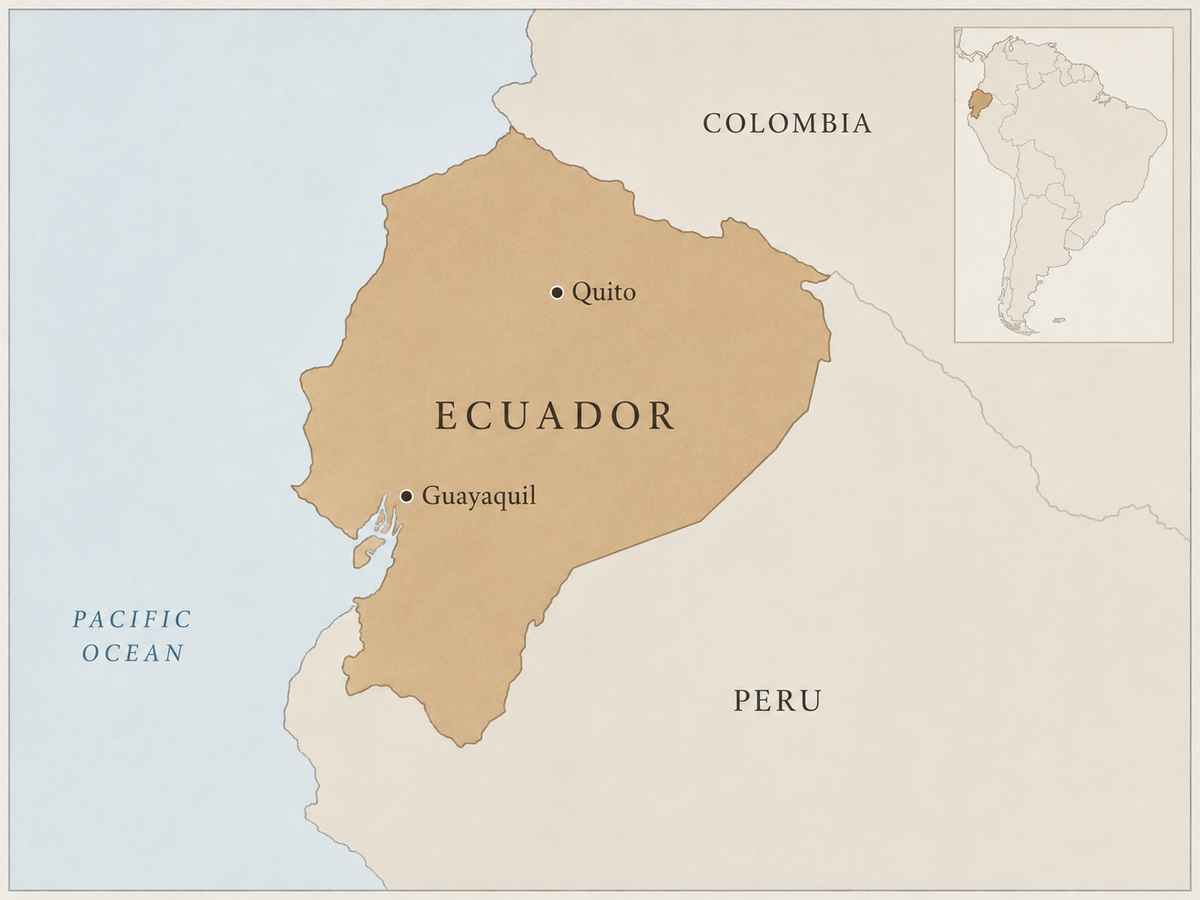
Ecuador is a South American country on the Pacific coast, bordered by Colombia to the north and Peru to the east and south. It includes the Andean highlands, Amazon regions, coastal provinces, major urban centers such as Quito and Guayaquil, and the Galápagos Islands. Its location between major cocaine-producing countries has made ports, coastal routes, prisons, and criminal networks especially significant in the country’s security crisis.
Christianity remains publicly significant in Ecuador. Catholic identity has historically shaped much of the country’s religious life, while evangelical and Protestant churches are also present. Background religious data consistently points to Ecuador as a majority-Christian country, though exact percentages vary by source and year. Ecuador is not a country where Christian worship is broadly banned, and state persecution of Christians is not the main national prayer burden.
Ecuador’s current public setting is shaped by violence, institutional strain, economic pressure, and repeated emergency measures. President Daniel Noboa’s government has used a military-and-police security approach against organized-crime groups, including curfews, deployments, and states of exception. That context should shape prayer without turning the guide into a political judgment on one leader or party.
For readers praying for Ecuador, the main burden is clear: Ecuador has religious freedom and visible Christian presence, but churches are serving in a country where violence, poverty, and public distrust make ordinary faithfulness more demanding.
Spiritual and Practical Challenges Affecting Christians and Churches
Ecuador’s churches need wisdom, courage, and mercy as violence, fear, youth vulnerability, poverty, and public distrust shape daily ministry.
One major challenge for Christians and churches in Ecuador is fear. Where violence, extortion, killings, and criminal control affect daily life, fear can change ordinary ministry decisions. People may avoid evening gatherings, limit travel, distrust public spaces, or carry grief that is not easily seen. Churches may need wisdom about when to gather, how to visit families, how to protect children and youth, and how to serve communities without drawing reckless attention.
A second challenge is the danger facing young people. Human-rights reporting has warned that children and adolescents have been affected by Ecuador’s violence, including homicide and recruitment by criminal groups. Churches therefore need more than vague concern for young people. They need prayer for patient discipleship, faithful families, protective communities, wise pastors, and gospel hope strong enough to confront the false promises of money, power, revenge, and belonging offered by criminal networks.
A third challenge is the moral confusion created by violence and emergency power. When people are afraid, they may welcome any force that promises order. When abuses are alleged, others may lose trust in authorities altogether. Christians need wisdom to avoid both extremes. They should pray for real justice, not vengeance; for lawful restraint, not lawlessness; for authorities who punish evil, not civilians; and for churches that speak truth without becoming partisan.
A fourth challenge is poverty and economic strain. When households are already struggling, insecurity makes life heavier. Curfews can affect work, transport, commerce, and family routines. Informal workers, small businesses, and vulnerable families may bear costs that are difficult to measure. Churches serving such communities need compassion, endurance, generosity, and practical wisdom.
A fifth challenge is the need for clear discipleship where Christianity remains publicly visible. Because Ecuador has a strong Christian presence, churches should not assume that religious identity by itself means repentance, living faith in Christ, or faithful discipleship. In a fearful national moment, churches need to preach Christ clearly, call people to repentance and faith, and show mercy that flows from the gospel rather than from cultural habit alone.
Christian Life and Witness in Ecuador
Christian witness in Ecuador can remain public and active, yet churches need grace to serve faithfully where many communities live with fear, grief, and daily pressure.
Christian life in Ecuador includes open worship, visible churches, Christian communities, and public religious identity. Many believers can gather, pray, preach, serve, and raise their children in the faith without the kind of formal restrictions faced by Christians in more hostile settings. This is a real mercy and should not be ignored.
Yet open worship does not mean easy witness. In communities affected by violence, Christian faithfulness may look like a pastor visiting a grieving family, a church helping children stay away from criminal influence, believers praying with neighbors who are afraid to leave home, or families choosing honesty and patience where corruption and intimidation feel normal. These are not small acts. They are ordinary forms of courage.
The church’s witness in Ecuador should be both clear and tender. It should not offer vague comfort that ignores suffering. It should not speak harshly as if fear were weakness. It should help people bring grief, anger, danger, and uncertainty before the Lord. Churches can serve their neighbors by praying publicly and privately, teaching Scripture faithfully, caring for the vulnerable, and reminding people that Christ is Lord even when violence makes life feel unstable.
Believers also need prayer to resist despair. When killings continue, emergency measures repeat, and public trust weakens, people may become numb. The church must not become numb. It must continue to believe that God sees the oppressed, judges evil, hears prayer, saves sinners, and strengthens His people to do good even in dark times.
Recent Developments
Recent developments point to severe organized-crime violence, repeated emergency measures, and public concern about both security and accountability.
-
March 2026
Nighttime curfew and major security deployment
In March 2026, Ecuador imposed a nighttime curfew in four violence-hit provinces as part of a major security operation. Associated Press and El País reporting described the deployment of tens of thousands of soldiers and police to Guayas, El Oro, Los Ríos, and Santo Domingo de los Tsáchilas, with the government presenting the measure as part of its effort to confront organized crime.
Prayer significance: Pray for protection for communities, wisdom for authorities, and restraint against both criminal violence and unjust use of force.
-
May 2026
Curfew measures expand amid public and economic concern
In May 2026, El País reporting described another curfew measure affecting nine provinces and several cities. The measure was presented as a response to violence, while business sectors and analysts raised concerns about economic effects and the uncertain effectiveness of repeated curfews.
Prayer significance: Pray for public safety, wise policy, protection for workers and families, and mercy for communities affected by repeated emergency measures.
-
2026 review
Human-rights concerns shape how Christians should pray
Human Rights Watch’s 2026 Ecuador assessment described the country as facing high levels of violence driven by organized crime and also raised concerns about human-rights violations connected to the state’s security response. This matters for prayer because Ecuador’s crisis cannot be reduced to only one side of the story. Criminal violence is real and destructive. So are the dangers of abuse, weak accountability, and public fear when emergency powers become routine.
Prayer significance: Pray for justice that protects the innocent, accountability where abuse is alleged, and public order that does not abandon human dignity.
-
2025
Homicide levels remain a severe national burden
El País analysis cited in the source list described Ecuador’s 2025 homicide level as historically severe. Exact figures should be handled with attribution, but the overall burden is clear: Ecuador’s violence remains a major national crisis and should shape Christian prayer.
Prayer significance: Pray for grieving families, threatened neighborhoods, protection for children and young people, and the restraint of organized-crime violence.
-
Ongoing
Churches serve amid grief, uncertainty, and fear
Beyond any single incident, violence now affects national life far beyond the places where attacks occur, and churches must serve in a society where many people are living with grief, uncertainty, and fear.
Prayer significance: Pray for churches to comfort the grieving, disciple the vulnerable, serve neighbors wisely, and witness to Christ with courage and hope.
How to Pray
Use these prayer points to intercede for Ecuador with clarity, compassion, and hope in Christ.
Pray for the restraint of violence. Ask God to restrain organized-crime violence, extortion, trafficking, intimidation, prison violence, and murder, and to protect families, neighborhoods, schools, churches, and vulnerable communities.
Pray for wisdom and accountability in public leadership. Pray for President Daniel Noboa, government officials, judges, police, soldiers, prison authorities, and local leaders to act with wisdom, honesty, restraint, courage, and accountability as they confront violent crime.
Pray for justice that protects the innocent. Ask that justice in Ecuador would be firm against evil, careful with truth, protective of the innocent, accountable before the law, and free from corruption, cruelty, revenge, or abuse.
Pray for churches serving in violence-affected communities. Pray for pastors, elders, evangelists, youth workers, and ordinary believers, that they would be courageous without being reckless, compassionate without being naive, and faithful to Christ amid daily pressure.
Pray for children and young people. Pray especially for those exposed to fear, grief, criminal recruitment, broken family life, or the attraction of quick money and power. Ask God to protect them and make churches places of patient discipleship and refuge.
Pray for the grieving and forgotten. Pray for grieving families, threatened households, victims of extortion, prisoners, the falsely accused, and all who feel forgotten. Ask the Lord to comfort the afflicted, expose hidden evil, and bring many to Himself.
Pray for faithful gospel witness. Ask that Ecuador’s churches would use their religious freedom well, preaching Christ clearly, calling people to repentance and faith, serving neighbors practically, and showing a hope stronger than fear.
Give Thanks
Give thanks for signs of God’s mercy and for opportunities for faithful Christian witness in Ecuador.
Give thanks that Christianity remains publicly present in Ecuador and that many churches can gather, worship, teach Scripture, and serve their communities openly.
Give thanks for pastors, church leaders, families, and believers who continue to serve even when public life is strained by violence and economic pressure.
Give thanks for acts of justice, mercy, repentance, protection, truth-telling, and neighbor-love wherever they appear in churches, families, public service, and ordinary community life.
Give thanks that the Lord sees Ecuador’s suffering. He sees the frightened, the grieving, the poor, the young, the tempted, and the vulnerable, and He is able to preserve His people and draw sinners to Christ.
Review Status / Update Note
This note helps readers understand what was reviewed and how to read the guide’s current prayer burden with care.
Review Status
Reviewed for current prayer use
This guide reflects a June 2026 review of Ecuador’s organized-crime violence, 2025 homicide surge, 2026 curfews and military-police deployments, repeated emergency measures, human-rights concerns, child vulnerability, economic strain, religious-background limits, and the ministry concerns facing churches that serve communities affected by fear and instability.
The main prayer burdens are the restraint of organized-crime violence, protection of families and communities, justice with accountability, courage and mercy for churches, protection of children and young people, comfort for grieving households, and faithful Christian witness in a fearful national setting.
Future prayer use may be affected by active curfews or states of exception, homicide, extortion, kidnapping, and prison-violence trends, official Ecuadorian security data, credible church-life reporting, and whether reported human-rights concerns receive credible investigation or legal resolution.
Ecuador’s situation is fast-moving, and some claims about security measures, human-rights allegations, religious composition, and official policy require careful attribution. This guide uses linked reporting and human-rights assessment for current security and human-rights claims, while speaking cautiously about religious composition and church life where public source coverage is limited.
Have a correction or important update?
If you notice a possible correction, broken link, or significant country update, please contact the Nations Prayer Directory so it can be reviewed carefully.
Key Sources Consulted
Sources that materially informed this Ecuador prayer guide, including current reporting, human-rights assessment, security-policy context, and concerns affecting families and communities.
Security, violence, and recent developments
- Associated Press reporting on Ecuador’s March 2026 security offensive and U.S. logistical support. Used for the government’s stated security rationale, the March 2026 curfew context, affected provinces, and the guide’s careful prayer emphasis on protection, lawful order, and accountability.
- El País reporting on Ecuador’s March 2026 curfew in four provinces. Used for the March 2026 curfew, military deployment context, affected provinces, public-security rationale, and concerns about transparency and public pressure.
- El País reporting on the May 2026 curfew in nine provinces and several cities. Used for the guide’s treatment of repeated curfews, business-sector concern, public-life disruption, and the need to pray for both security and ordinary households affected by restrictions.
- El País analysis of Ecuador’s security model and 2025 homicide figure. Used cautiously for the reported 2025 homicide figure, the broader security-model debate, and the need to avoid presenting contested policy judgments as settled fact.
Human-rights concerns, public pressure, and vulnerable groups
- Human Rights Watch, World Report 2026: Ecuador. Used for organized-crime violence, human-rights concerns, prison conditions, poverty and informal work, child vulnerability, internal displacement, and the guide’s caution about the government’s “internal armed conflict” framing.
- The Guardian reporting on alleged forced disappearances, torture, killings, and accountability concerns connected to Ecuador’s drug-war response. Used as supporting reporting for alleged abuses and the need to pray for justice, truth, protection of the innocent, and accountability.
Government-position context
The government’s stated rationale for security measures is represented through the Associated Press and El País reporting listed above. Direct official-government pages were limited in this source set, so contested claims are handled with attribution rather than presented as settled fact.
Source Context
How to read the sources behind this guide with care in a fast-moving and politically sensitive setting.
Source Context
- Fast-moving security context. Ecuador’s situation is politically sensitive and changes quickly. Reports about violence, curfews, military operations, prison conditions, disappearances, and human-rights allegations should be handled with restraint and clear attribution.
- Different kinds of sources. Government explanations, independent reporting, rights-group findings, media analysis, and local testimony do not carry the same kind of authority. This guide uses each source according to what it can responsibly support.
- Official-position note. This guide states the government’s rationale through reputable reporting that describes official explanations. Where a direct official page is not available in this source set, contested claims are handled cautiously and attributed through reputable reporting rather than presented as settled fact.
- Religious-composition caution. Ecuador is clearly a country where Christianity remains socially visible, but exact percentages vary by source and year. This guide therefore avoids exact religious-composition figures and speaks only in broad, cautious terms about Christian presence.
- Church-life source note. Public church-life reporting is limited, so this guide avoids broad claims about nationwide church conditions and focuses on ministry concerns that follow from documented violence, poverty, fear, and youth vulnerability.
- Main prayer burden. Readers do not need every disputed claim settled in order to pray responsibly: Ecuador is facing severe violence linked to organized crime, and emergency security measures have raised both hopes for public safety and serious accountability concerns.
A Closing Prayer for Ecuador
A prayer asking the Lord to protect communities, restrain evil, strengthen churches, and make Christ known in Ecuador.


