


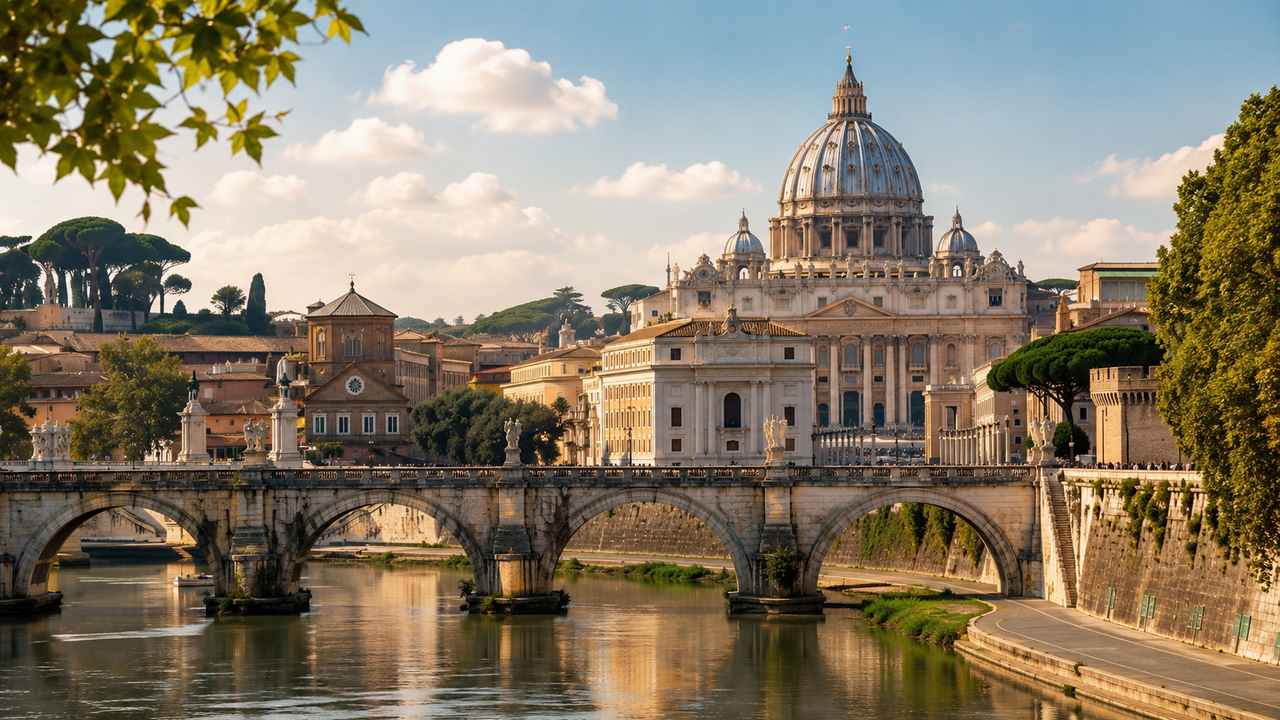
Italy is lined with churches, basilicas, shrines, village chapels, Christian art, and public reminders of the faith. Yet one of its deepest prayer burdens is that Christian forms remain visible while many people remain distant from repentance, regular worship, active discipleship, and personal trust in Christ. Italy needs prayer not only for public stability and mercy toward vulnerable people, but for churches to preach Christ clearly and for many who inherit religious identity to follow Him in living faith.
Prayer Burden at a Glance
Pray that many in Italy would move beyond inherited or cultural Christianity to repentance, regular worship, living faith in Christ, and active discipleship. Pray for churches to preach Christ clearly, for believers to witness with humility and courage, and for Christian mercy to be visible amid migration debates, economic strain, demographic decline, and public mistrust.
Last verified: May 2026
Why Italy Needs Prayer Now
Italy does not lack Christian symbols, church history, or public reminders of the faith. Its deeper need is for many people to move beyond inherited religious identity to repentance, active faith in Christ, regular worship, and faithful discipleship in everyday life.
Italy needs prayer because its most visible Christian heritage does not mean its people are spiritually secure. Associated Press reporting has described a deep gap between Catholic identity and church practice: many Italians still identify as Catholic, but only 19% attend services at least weekly, while 31% never attend. That is not merely a statistic about attendance; it points to a deeper pastoral burden. Millions may live close to Christian symbols while remaining distant from the gospel’s claims upon the heart.
Italy also faces current pressures that affect family life, public trust, and the church’s setting for witness. Voters rejected the government’s judicial-reform referendum in March 2026 after a polarizing campaign that raised questions about judicial independence, public confidence, and the stability of Prime Minister Giorgia Meloni’s coalition. The referendum result should not be made to carry the whole story of Italy, but it does show strain in public life and distrust around major institutional reform.
Migration remains one of the country’s heaviest moral and practical burdens. In February 2026, the Italian government approved a migration bill that would allow authorities, under certain conditions, to impose a “naval blockade” on migrant ships entering Italian territorial waters; public reporting noted that the measure still required parliamentary approval and had drawn strong humanitarian criticism. At the same time, the International Organization for Migration said in April 2026 that Mediterranean deaths and disappearances were nearing 1,000 for the year, including around 765 in the Central Mediterranean alone.
Italy’s churches must therefore witness in a setting shaped by weakening church practice, aging communities, economic anxiety, migration debate, and contested national identity. This does not make Italy hopeless. It makes Italy a place where Christians should pray with gratitude for real freedoms, grief over real spiritual need, and confidence that Christ can renew churches, families, and ordinary believers through His Word and Spirit.
Country Snapshot
A brief orientation to Italy’s location, people, government, and church context.
Italy sits in Southern Europe, extending into the central Mediterranean. Its geography has long made it a bridge between Europe, North Africa, and the wider Mediterranean world, and that setting remains important for understanding migration, public life, and the ministry context of churches.
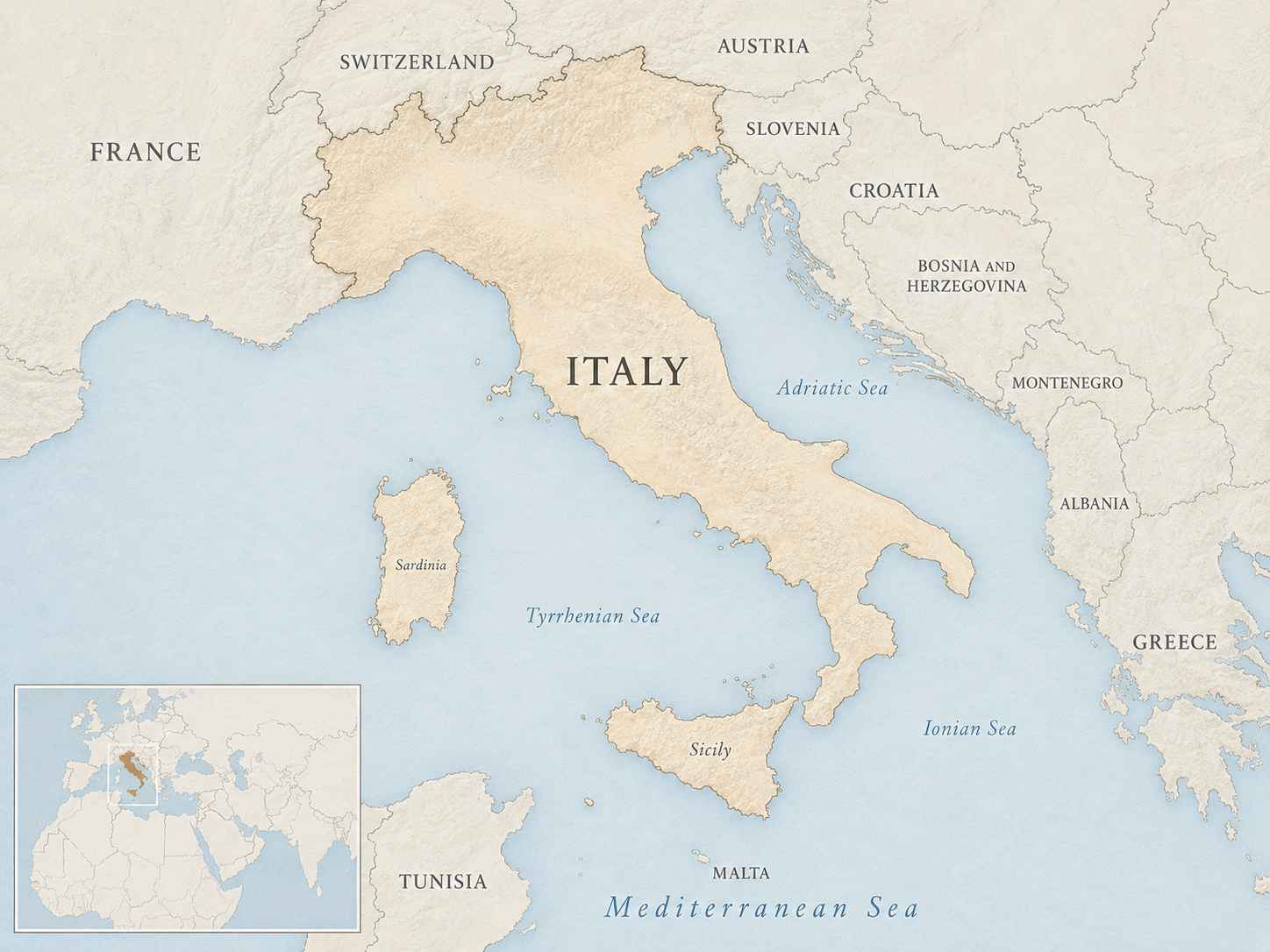
ISTAT, Italy’s national statistics institute, reported that as of January 1, 2026, Italy’s resident population stood at about 58.943 million. ISTAT’s longer-term projections also expect the resident population to decline to 54.7 million by 2050, making demographic decline and aging part of Italy’s long-term national burden.
Italy has no official state religion, but the Roman Catholic Church has a unique historical and legal place. The U.S. Department of State’s 2023 International Religious Freedom report says Italy’s constitution protects freedom of religion and the right of religious communities to establish their own institutions. It also notes that the state and the Roman Catholic Church are independent, with relations governed by treaty, and that thirteen other religious groups have accords granting many similar benefits.
Religiously, Italy remains strongly marked by Catholic identity while also becoming more secular and religiously diverse. A 2021 estimate cited by the State Department placed Catholics at 74.5% of the population, atheists or agnostics at 15.3%, non-Catholic Christians at 4.1%, Muslims at 3.7%, and followers of other religions at 2.2%.
Spiritual and Practical Challenges Affecting Christians and Churches
The main challenges affecting Christian life and church ministry in Italy are not usually open persecution, but secularization, inherited religion without active discipleship, public mistrust, demographic strain, migration pressure, and spiritual indifference.
Secularization beneath Christian memory
The main pressure facing Christians in Italy is not usually open persecution. It is the quieter pressure of secularization, nominal religion, and spiritual indifference. In many places, the church is not forbidden; it is overlooked. The gospel is not illegal; it is often treated as one more inherited custom, useful for baptisms, weddings, funerals, feast days, and family memory, but not necessarily as the living word of God calling sinners to repentance and faith.
Religious familiarity without living discipleship
Many Italians know Christian buildings, holidays, language, and family customs, but that familiarity can make serious faith seem unnecessary. A person may assume Christianity has already been understood because it has always been nearby. This creates a pastoral burden: churches must speak of Christ plainly in a culture that may honor Christian memory while resisting Christian obedience.
Pressure on pastors, churches, and ordinary witness
Associated Press reporting has noted that clergy are struggling with a significant drop in vocations, leaving many priests stretched across several communities. For evangelical and other non-Catholic churches, the challenge is often patient witness in a culture that may assume it already understands Christianity because it knows Catholic symbols and traditions. Believers need humility to avoid contempt, clarity to speak plainly of Christ, and warmth to serve neighbors with visible love.
Public strain, migration anxiety, and social distrust
Italy’s churches also minister in a society shaped by migration pressure, aging communities, economic anxiety, and public distrust. These realities are not separate from Christian witness. They affect families, neighborhoods, churches, migrants, young adults, and elderly people who may feel spiritually or socially forgotten.
Religious minorities and public hostility
Minority religious communities generally have legal space, but the broader climate still matters. Rising antisemitism, public distrust, political strain, and migration anxiety can all make public life harsher. Christians should desire both gospel faithfulness and public justice: a society where conscience is not coerced and where churches can witness without depending on privilege.
Christian Life and Witness in Italy
Many Christians in Italy worship freely, yet faithful witness still requires patient discipleship, clear gospel preaching, mercy toward neighbors, and courage to live as active followers of Christ in a culture that often treats faith as inherited identity or private tradition.
For many Christians in Italy, daily life is outwardly free. They can gather for worship, publish Christian material, teach children, serve neighbors, and speak of Christ openly. That freedom is a mercy. It should lead readers not to assume Italy is spiritually healthy, but to give thanks that churches have space to labor.
The harder reality is that many believers live among neighbors, relatives, and friends who may respect Christianity as culture while resisting it as truth. A young Italian Christian may face not imprisonment, but dismissal: “Why take church so seriously?” “Isn’t religion just personal?” “Why not keep the beautiful traditions and leave doctrine alone?” In such a setting, faithfulness often looks ordinary and costly: attending worship when others drift away, teaching children Scripture when peers see faith as irrelevant, speaking of Christ without sounding proud, and showing hospitality to migrants, secular neighbors, elderly relatives, and spiritually weary friends.
Italy’s active believers are not all the same. Some are faithful Roman Catholics seeking deeper discipleship within their own tradition. Some belong to evangelical churches that prize biblical preaching and local-church community. Some are migrants who bring Christian faith from Africa, Eastern Europe, Latin America, or Asia. Some are young Italians who have come to faith against the grain of family expectation or cultural indifference. Together, they need prayer for sound doctrine, holiness, humility, endurance, and gospel courage.
Recent Developments
Political strain, migration pressure, economic fragility, demographic decline, and rising antisemitism all shape how Christians can pray for Italy now.
-
March 2026
Judicial-reform referendum rejected
Italian voters rejected the government-backed judicial reform referendum. Supporters had framed the reform as a modernization of Italy’s slow judicial system, while opponents warned it could weaken checks and balances and judicial independence. Associated Press reporting described the result as a political setback for Prime Minister Giorgia Meloni.
Prayer significance: Pray for humility, public trust, restraint, and justice in Italy’s institutions and political life.
-
February 2026
Migration bill approved by the government
Italy’s government approved a migration bill that included powers to impose a “naval blockade” on migrant ships trying to enter Italian territorial waters under certain public-order or national-security conditions. Associated Press reporting said the measure still needed approval in both chambers of parliament and had drawn humanitarian concern.
Prayer significance: Pray for leaders to act with truth, wisdom, justice, and mercy, and for churches serving migrants, refugees, and strained local communities.
-
February–May 2026
Mediterranean migration remains dangerous and continues to change
UNHCR, the United Nations refugee agency, reported that 3,967 refugees and migrants arrived in Italy by sea in the first two months of 2026, down 42% from the same period in 2025. UNHCR’s Europe sea-arrivals portal also showed an Italy weekly sea-arrivals update dated May 25, 2026, confirming that the situation remains active and may change as new data is released. Yet the International Organization for Migration reported in April 2026 that deaths and disappearances in the Mediterranean were nearing 1,000 for the year, with around 765 deaths in the Central Mediterranean.
Prayer significance: Pray for the protection of vulnerable people, for wise and humane policy, and for churches to show compassion without losing discernment.
-
April–May 2026
Economic outlook remains fragile
The European Commission’s May 2026 forecast projected real gross domestic product — the total value of goods and services produced — to grow by only 0.5% in 2026 and 0.6% in 2027, with inflation rising to 3.2% in 2026 and public debt rising toward 139.2% of gross domestic product in 2027. Banca d’Italia, Italy’s central bank, likewise described the outlook as weakened and uncertain in light of conflict in the Middle East, energy-price pressure, and inflation risk.
Prayer significance: Pray for families, young adults, churches, and public leaders facing economic pressure and long-term demographic strain.
-
2025 reporting, used in 2026 review
Antisemitism sharply increased
The Foundation Jewish Contemporary Documentation Center in Italy, known by its Italian acronym CDEC, reported that from 1,492 reports received in 2025, its observatory selected 963 antisemitic episodes, including 643 online incidents and 320 incidents classified as occurring outside online settings.
Prayer significance: Pray for the protection of Jewish communities, for the restraint of hatred, and for Christians to answer public hostility with truth and neighbor-love.
Christian Heritage and Living Faith in Practice
Italy’s Christian heritage is real, but inherited religious identity is not the same as repentance and faith in Christ.
Italy’s spiritual condition cannot be understood only by counting churches or naming religious heritage. A country can have Christian art on its walls, Christian vocabulary in its holidays, and Christian ceremonies in its family life, while still needing renewed repentance, active worship, and deeper discipleship.
That makes Italy a serious prayer field. The danger is not only unbelief that rejects Christianity openly. It is also cultural familiarity that makes people feel they have already understood Christianity without truly hearing Christ’s call to repent, believe, take up the cross, and follow Him. This is one reason Italy needs clear preaching, patient discipleship, and churches marked by both doctrinal seriousness and visible love.
There is also opportunity. In a society weary of institutions, young adults may still ask honest questions about meaning, guilt, death, loneliness, family breakdown, and hope. Migrant communities may bring spiritual vitality, practical needs, and new mission opportunities into Italian cities. Aging towns may need churches that stay, serve, teach Scripture, and care for people others overlook. In all of this, the Lord is not limited by cultural decline. He is able to make the living voice of Christ heard again through faithful churches and ordinary believers.
How to Pray
Pray for renewed faith, faithful churches, public mercy, and gospel witness in Italy.
-
Pray for many Italians to move beyond inherited religion to living faith in Christ. Ask the Lord to awaken those who know Christian language, festivals, buildings, and family customs, but have not yet come to repentance, saving faith, worship, and joyful obedience to Jesus Christ.
-
Pray for churches to preach Christ with clarity, humility, and courage. Pray for pastors, elders, Bible teachers, missionaries, and faithful congregations to hold fast to Scripture, resist empty formalism, and disciple believers in truth, holiness, prayer, and love.
-
Pray for young Italians growing up in a secular and spiritually distracted age. Ask God to open hearts among students, young workers, and young families who may see Christianity as old, cultural, or irrelevant, and to draw them to Christ as the living Savior rather than a distant tradition.
-
Pray for ordinary believers to witness faithfully in daily life. Pray that Christians in Italy would speak of Christ wisely in homes, workplaces, universities, neighborhoods, and villages, bearing witness without pride, fear, bitterness, or compromise.
-
Pray for mercy, justice, and wisdom amid migration pressure. Ask the Lord to protect vulnerable people crossing the Mediterranean, guide leaders toward truthful and humane decisions, and strengthen churches serving migrants, refugees, and strained local communities with both compassion and discernment.
-
Pray for leaders and public institutions under political and economic strain. Pray for honesty, restraint, humility, and concern for the common good as Italy faces public mistrust, slow growth, high debt, aging communities, and pressure on families and young adults.
-
Pray for peace, dignity, and neighbor-love in public life. Ask God to restrain antisemitism, hatred, contempt, and scapegoating; protect Jewish communities and other vulnerable minorities; and help Christians answer public hostility with courage, truthfulness, repentance, and love of neighbor.
Give Thanks
Italy’s needs are real, but so are the mercies God has preserved there.
-
Give thanks for Italy’s continued freedom for public worship and Christian witness. Churches and Christian communities can gather, teach, publish, serve, and speak openly, which remains a real mercy and a serious stewardship.
-
Give thanks for faithful believers who continue to follow Christ by conviction rather than custom. In a country where religious identity is often inherited or cultural rather than actively practiced, praise God for Christians who worship, repent, serve, disciple, and persevere with sincere faith.
-
Give thanks for churches and ministries serving people under pressure. Praise God for Christian care shown to migrants, the elderly, families, students, the poor, and spiritually weary neighbors, especially where patient local service makes the gospel visible.
-
Give thanks that Italy’s Christian heritage can still open gospel conversations. Even where cultural Christianity is not saving faith, Scripture, worship, Christian art, church buildings, and family traditions can still become points of contact for renewed teaching, repentance, and hope in Christ.
Last Verified / Update Note
This note helps readers understand when the guide was reviewed and which developments may affect how they use it for prayer.
Review Status
Reviewed for current prayer use
This guide reflects a May 2026 review of official government information, demographic and migration data, religious-freedom reporting, church-life context, economic analysis, and recent public developments affecting Italian society. The review considered Italy’s Christian heritage, weakening regular religious practice, public freedom for worship and witness, migration pressures in the central Mediterranean, demographic decline, economic strain, family-life concerns, public trust, and current opportunities for faithful Christian witness.
The main prayer burdens are renewed personal trust in Christ beyond inherited Christian identity, churches that teach Scripture and disciple faithfully, wise public leadership, mercy and wisdom in responding to migration, care for families under economic and demographic strain, gospel clarity in a secularizing society, and faithful Christian witness in public life without fear, pride, or cultural nostalgia.
Developments to watch include updated migration data and policy changes, new demographic releases, economic forecasts affecting households and young people, major church-life developments, religious-freedom or antisemitism reporting, public debates about family and social life, and any political or legal developments that may affect public trust, migration response, religious communities, or Christian witness.
Italy has abundant public information, but source categories must be read carefully. Religious-affiliation data does not always show worship attendance, personal faith, active discipleship, or confidence in church teaching. Migration data can change quickly, and economic projections should be treated as time-sensitive. This guide therefore uses broad, prayer-serving language rather than overstating exact levels of faith, church vitality, migration pressure, or future economic conditions.
Help keep this guide accurate and current
If you noticed a possible correction, broken link, or significant country update, please contact the Nations Prayer Directory so we can review it carefully.
Key Sources Consulted
Sources that materially informed this Italy prayer guide, including official government materials, demographic background, religious-freedom context, church-practice reporting, migration data, economic forecasts, and public-life concerns.
Official Italian government and demographic sources
- Italian Government. “The President of the Council of Ministers.” Used for current head-of-government context and the official title of Giorgia Meloni.
- Presidency of the Italian Republic. “The President Sergio Mattarella — Biography.” Used for current head-of-state context.
- ISTAT. “Population Projections” and “Demographic Indicators — Year 2025.” Used for Italy’s January 1, 2026 population figure and long-term population-decline context.
Religious freedom, Catholic identity, and church-practice sources
- U.S. Department of State. “2023 Report on International Religious Freedom: Italy.” Used for constitutional religious-freedom context, Catholic Church treaty status, and religious-group accord background.
- Associated Press. “Nearly 80% of Italians say they are Catholic. But few regularly go to church.” Used for Catholic identity, church-attendance data, secularization, and clergy-life context.
Current public-life and political developments
- Associated Press. “Italian voters reject judicial reform in a setback for Premier Giorgia Meloni.” Used for the March 2026 referendum result, public-trust concerns, and political-context framing.
Migration and Mediterranean humanitarian context
- Associated Press. “Italy approves new migration bill including powers to impose ‘naval blockades’ on migrant ships.” Used for the February 2026 migration-policy development and contested public-order / humanitarian framing.
- UNHCR Operational Data Portal. “Europe Sea Arrivals.” Used for current Italy sea-arrivals monitoring and May 2026 migration-context review.
- UNHCR. “Italy Sea Arrivals Dashboard February 2026.” Used for the first-two-months 2026 Italy sea-arrivals figure and year-over-year comparison.
- International Organization for Migration. “Over 180 Feared Dead as Mediterranean Death Toll Nears 1,000 in 2026.” Used for Mediterranean deaths and disappearances, especially Central Mediterranean context.
Economic outlook and public-pressure sources
- European Commission. “Economic Forecast for Italy.” Used for May 2026 gross domestic product, inflation, deficit, and debt projections.
- Banca d’Italia. “Economic Bulletin No. 2 — 2026.” Used for Italy-specific economic outlook, inflation risk, and uncertainty tied to the Middle East conflict and energy prices.
- Banca d’Italia. “Macroeconomic Projections for Italy — April 2026.” Used for Italy’s 2026–28 macroeconomic projection context.
Public hostility and antisemitism source
- Foundation Jewish Contemporary Documentation Center in Italy. “Rapporto annuale sull’antisemitismo in Italia 2025.” Used for 2025 antisemitism incident data and public-life concern.
Source Context
How to read the sources behind this guide in a current, migration-sensitive, religious-freedom-aware, and forecast-dependent setting.
Source Context
- Source mix. This guide uses a mix of Italian official sources, demographic data, religious-freedom reporting, current news reporting, migration monitoring, economic forecasts, and public-life concern sources. These sources were used to help readers pray with current understanding, not to provide an exhaustive academic bibliography.
- Religious composition. The religious-composition figures are based on a 2021 estimate cited in the U.S. Department of State’s religious-freedom reporting. They are best read as broad religious-background information, not as a current measure of active church practice. Claims about church attendance, secularization, and Catholic identity are therefore drawn separately from reporting that cites practice-related data.
- Migration data. Migration figures are especially time-sensitive. United Nations sea-arrival dashboards describe arrivals by sea and do not represent every migration pathway into Italy. International Organization for Migration death and disappearance data reflect known or reported Mediterranean incidents and may be refined as new information emerges.
- Economic projections. Economic forecasts are sensitive to energy prices, borrowing costs, the Middle East conflict, wider European conditions, and later policy or market changes. This guide uses European Commission and Banca d’Italia forecasts as current prayer-context information, not as fixed predictions.
- Public-life reporting. Current reporting is used for developments such as migration policy, public-trust concerns, church-practice discussion, antisemitism reporting, and economic pressure. Readers should understand these claims in light of the guide’s review date, especially if major legal, economic, migration, church-life, or public-policy developments occur after publication.
A Closing Prayer for Italy
A concise prayer gathering Italy’s present burden before the Lord.


