



New Zealand is often seen as peaceful, beautiful, and far removed from many of the world’s most visible crises. Yet its churches still need serious prayer. Christian faith is no longer assumed by much of the population, public trust in religious and public institutions has been damaged by abuse and failures of care, and believers must learn to speak about Christ plainly, humbly, and courageously in a society where many people now live with little thought of God.
Pray for believers in New Zealand to speak about Christ plainly, walk humbly, and remain faithful as many people move away from active Christian belief, as the country enters an election year, and as public trust in churches and other institutions remains damaged. Pray for churches to repent where they have failed, show courage where faith is unpopular, and place their confidence in Christ rather than in the memory of a more Christian past.
Last verified: May 2026
Why New Zealand Needs Prayer Now
New Zealand’s prayer burden is not mainly legal persecution, but faithful Christian witness in a free society where religious practice is declining and trust in institutions has been badly tested.
New Zealand needs prayer not because Christians are usually prevented from worshiping, but because religious freedom can exist alongside deep spiritual indifference. The country’s law protects freedom of thought, conscience, religion, and belief, including the public or private manifestation of religion through worship, observance, practice, or teaching. That freedom is a mercy. Yet the deeper prayer burden is that the church must live faithfully in a society where Christian identity is shrinking, religious indifference is normal, and public trust in institutions, including religious institutions, has been badly tested. New Zealand Bill of Rights Act 1990
The 2023 census showed that 51.6% of New Zealanders identified with no religion, while 32.3% identified as Christian. Christianity remains the largest single religious grouping, but it is no longer the assumed center of national life. That means churches need prayer not only to survive, but to preach Christ plainly, disciple believers patiently, call people to repentance, love their neighbors well, and trust that Christ builds His church even when cultural support weakens. Stats NZ 2023 Census data
New Zealand also enters a politically sensitive season. Prime Minister Christopher Luxon announced that the 2026 general election will be held on Saturday, 7 November 2026. Election years can expose fear, resentment, pride, and distrust. Christians should pray for truthful speech, sober judgment, peaceable citizenship, and leaders who govern with justice rather than mere advantage. New Zealand Government election announcement
Country Snapshot
A brief orientation to New Zealand’s setting, public life, and Christian witness context.
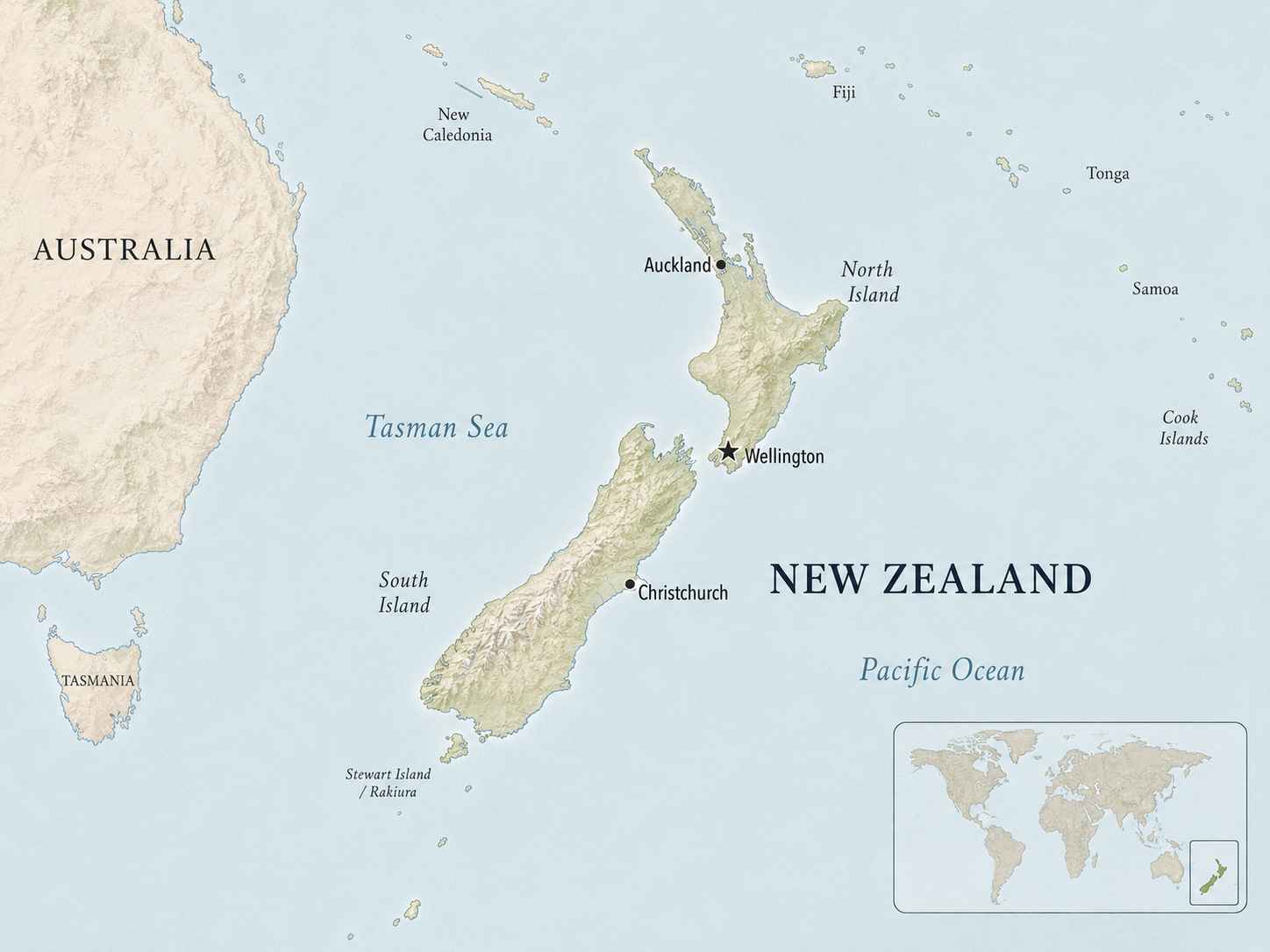
New Zealand sits southeast of Australia, across the Tasman Sea, and is made up principally of the North Island and South Island, with many smaller islands. Its distance from many global conflict zones can make its spiritual needs less visible in world news, but churches still need prayer for faithful witness in ordinary neighborhoods, schools, workplaces, universities, homes, and public life.
Main Challenges Facing Christians and Churches
The main challenges facing believers are mostly cultural, spiritual, credibility-related, and economic rather than formal legal persecution.
The first major challenge is secularization. In many parts of New Zealand, Christianity is no longer viewed as the default moral or cultural reference point. This does not mean New Zealanders are unreachable or hostile by definition. It does mean that many people may see Christian belief as unnecessary, outdated, private, or strange. The challenge for believers is often subtle: not “stop believing,” but “keep faith vague, quiet, and harmless.”
The second challenge is credibility. The Abuse in Care Royal Commission examined abuse and neglect of children, young people, and vulnerable adults in state and faith-based institutions, mainly between 1950 and 1999, and heard nearly 3,000 survivor accounts. For churches, this is not merely a public-relations problem. It is a call to repentance, safeguarding, truthfulness, and costly pastoral care for survivors and others who have been harmed. New Zealand Ministry of Justice, Crown response to the Abuse in Care Inquiry
A third challenge is national identity and treaty-related debate. Debates over Te Tiriti o Waitangi / the Treaty of Waitangi—New Zealand’s founding treaty between Māori chiefs and the British Crown—continue to shape national identity, law, and public trust. The Treaty Principles Bill was introduced in 2024 and rejected in Parliament in April 2025, but the debate showed that questions about historical responsibility, justice, equality, and national belonging remain unsettled in public life. New Zealand Ministry of Justice, A Treaty Principles Bill
A fourth challenge is economic strain. Treasury described subdued economic activity in 2025, higher unemployment, and a delayed recovery, while Associated Press reported planned public-sector job cuts in May 2026. Economic strain can weaken households, increase requests for help from churches, heighten political anxiety, and make mercy ministry more necessary. New Zealand Treasury, Half Year Economic and Fiscal Update 2025
Christian Life and Witness in New Zealand
Christian discipleship in New Zealand is often lived openly, but with growing cultural distance from historic Christian belief.
For many Christians in New Zealand, daily discipleship is lived in freedom, but not always with cultural acceptance. A believer may attend church openly on Sunday, yet spend the rest of the week among classmates, colleagues, neighbors, or family members who regard historic Christian faith as irrelevant or implausible. That can make witness feel less like public confrontation and more like quiet courage over many years.
Churches can gather, preach, baptize, celebrate the Lord’s Supper, evangelize, publish, and serve without needing to hide. This is a great blessing. But freedom can become spiritually dangerous if it teaches believers to expect comfort more than faithfulness. The church in New Zealand needs prayer to resist the slow dulling of conviction—the kind that comes not through prison doors, but through respectability, distraction, busyness, and the fear of seeming strange.
Pastors and elders also carry a serious burden. They must shepherd congregations in a society where biblical doctrine, Christian sexual ethics, repentance, judgment, grace, and the exclusivity of Christ may sound foreign or offensive to many ears. At the same time, they must lead with humility and integrity in a public environment where religious authority can be distrusted because of real institutional failures.
For Christian families, the challenge is often ordinary and persistent: teaching children the faith when the wider culture teaches them different assumptions about truth, identity, morality, and God, showing hospitality without compromise, speaking truth without harshness, and living with visible love in a plural society. New Zealand’s churches need renewal that is not built on longing for a more Christian past. They need the Word of God, prayer, repentance, discipleship, courage, and joy in Christ.
Recent Developments
These developments help explain how Christians can pray for New Zealand now without treating the country as a crisis zone.
-
2026 election year
New Zealand is in an election year.
Prime Minister Christopher Luxon announced that the 2026 general election will be held on Saturday, 7 November 2026. That makes 2026 a year for Christians to pray for honest public speech, wise voting, peaceable disagreement, and leaders who govern with justice. New Zealand Government election announcement
-
November 2024–April 2025
The Treaty Principles Bill debate revealed continuing national tension.
The Ministry of Justice records that the bill was introduced on 7 November 2024, received its first reading on 14 November 2024, went through select committee consideration, and was rejected by 112 votes to 11 at its second reading on 10 April 2025. The bill’s defeat did not remove the deeper public question of how New Zealand should reckon with its founding treaty, Māori-Crown relations, equality, and historic obligation. New Zealand Ministry of Justice, A Treaty Principles Bill
-
2024–2025
The Abuse in Care response remains important for repentance, safeguarding, and public trust.
The Royal Commission’s final report was made public in July 2024 and examined abuse in state and faith-based care. The Ministry of Justice records that the Prime Minister delivered a public apology in Parliament on behalf of the Crown on 12 November 2024, and that further Crown response actions followed in 2025. For churches, this remains a call to humility, truthful confession, care for survivors, and vigilance against spiritual authority being used to harm the vulnerable. New Zealand Ministry of Justice, Crown response to the Abuse in Care Inquiry
-
2025
Recent Gloriavale reporting raised further safeguarding and credibility concerns.
In 2025, Associated Press reported that Howard Temple, leader of the isolated Gloriavale Christian Community, pleaded guilty to indecency and assault charges involving women and girls in the community. The Gloriavale case does not represent all Christians in New Zealand, but it shows why churches must pray for truth, safeguarding, repentance, and protection from authoritarian or abusive religious cultures. Associated Press report on Gloriavale
-
Late 2025–May 2026
Economic strain continues to affect households and public trust.
Treasury described a slow and uneven recovery, with unemployment expected to peak at 5.5% in late 2025 and early 2026 before easing. In May 2026, Associated Press reported that the government planned to cut nearly 9,000 public-sector jobs by mid-2029 as part of a spending-reduction effort. These pressures matter for prayer because economic strain often reaches dinner tables, churches, schools, charities, and public confidence. New Zealand Treasury, Half Year Economic and Fiscal Update 2025
How to Pray
Use these prayer points to pray for faithful witness, church renewal, public life, and clear preaching of Christ in New Zealand.
-
Pray for spiritual awakening in a secularizing nation. Ask God to open the eyes of many New Zealanders who now live with little thought of Him, and to bring them from religious indifference to repentance, faith, and living hope in Jesus Christ.
-
Pray for churches to be faithful in freedom. Ask the Lord to keep congregations from settling for cultural comfort, religious language without repentance, or fear of public disapproval. Pray for clear preaching, serious discipleship, joyful worship, and humble confidence in the authority of Scripture.
-
Pray for repentance, justice, and healing where the vulnerable have been harmed. Ask God to comfort survivors of abuse in state and faith-based care, expose hidden sin, strengthen safeguarding, and make churches places of truth, protection, humility, and pastoral tenderness.
-
Pray for pastors, elders, and ministry leaders. Ask the Lord to give them courage without harshness, compassion without compromise, and wisdom to shepherd believers in a society where historic Christian belief is often misunderstood, dismissed, or treated as outdated.
-
Pray for Christian families, young believers, and students. Ask God to strengthen those following Christ in homes, schools, universities, and workplaces where faith may feel socially costly. Pray that they would not be ashamed of Christ, and that their lives would show both conviction and love.
-
Pray for wisdom, restraint, and truthfulness in public life during the 2026 election year. Ask God to restrain fear, pride, bitterness, and manipulation, and to grant New Zealand leaders justice, humility, concern for the vulnerable, and a sober sense of accountability before Him.
-
Pray for peace and honesty in national-identity tensions, including debates around Te Tiriti o Waitangi / the Treaty of Waitangi. Ask the Lord to help New Zealanders speak about history, justice, equality, and belonging with truth rather than contempt, and to help Christians seek reconciliation without sacrificing righteousness.
Give Thanks
These thanksgiving points recognize real mercies without minimizing the burdens named in this guide.
-
Give thanks for New Zealand’s religious freedom. Christians can gather, worship, preach, disciple, publish, serve, and bear witness to Christ openly.
-
Give thanks that churches remain present across the country. Even as Christian identification declines, there are still congregations, pastors, families, ministries, and believers seeking to make Christ known in ordinary New Zealand life.
-
Give thanks when abuse and institutional failure are exposed rather than hidden. Painful truth is not easy to face, but exposure can become a mercy when it leads to repentance, justice, protection, and reform.
-
Give thanks for peaceful civic space. New Zealand still has democratic processes, public debate, lawful participation, and room for Christians to pray, speak, vote, serve, and seek the good of their neighbors.
Last Verified / Update Note
This note helps readers understand when the guide was reviewed and which developments may affect future prayer use.
Review Status
Reviewed for current prayer use
This guide reflects a May 2026 review of New Zealand’s religious-demographic context, legal freedom, election-year setting, Treaty Principles Bill developments, Abuse in Care response, recent church-credibility concerns, and economic pressures affecting households and public trust.
Future prayer use may be affected by the 2026 general election campaign, new census or religious-affiliation data, further Abuse in Care response measures, church safeguarding developments, major Treaty-related policy debates, and material changes in unemployment, public-sector restructuring, or household economic pressure.
Key Sources Consulted
These sources materially informed the prayer burden, public-context summary, recent developments, and notes on how the data should be read.
- Beehive.govt.nz, “General Election to be held on 7 November.” Used to confirm the official date of New Zealand’s 2026 general election and related election-year context.
- Stats NZ, 2023 Census data. Used for the broad religious-demographic context showing no religion as the largest response and Christianity as the largest religious grouping but no longer a majority identity.
- New Zealand Bill of Rights Act 1990. Used for legal background on freedom of thought, conscience, religion, belief, and the public or private manifestation of religion through worship, observance, practice, or teaching.
- New Zealand Ministry of Justice, “A Treaty Principles Bill.” Used for the official timeline, purpose statement, select committee process, and second-reading defeat of the Treaty Principles Bill.
- New Zealand Ministry of Justice, “Crown response to the Abuse in Care Inquiry.” Used for the Abuse in Care inquiry scope, survivor-account context, Crown apology, and response timeline.
- New Zealand Treasury, “Half Year Economic and Fiscal Update 2025.” Used for current economic background, unemployment expectations, and recovery context.
- Associated Press, “New Zealand’s government plans to cut 14% of public sector jobs to slash spending.” Used for recent public-sector job-cut and fiscal-tightening context.
- Associated Press, “The leader of a secretive New Zealand commune admits abusing young church members.” Used for recent church-credibility and safeguarding context, handled narrowly and without caricaturing the whole church.
Source Context
- Religious-affiliation figures: The religion data are based on 2023 census identity responses and should be read as religious-affiliation data, not as a direct measure of church attendance, discipleship, or saving faith.
- Economic figures: Treasury’s unemployment and recovery figures are forecasts and planning context, not fixed outcomes.
- Abuse-in-care material: The inquiry is pastorally relevant to church credibility, safeguarding, and repentance, while not defining the whole of Christian life in New Zealand.
- Religious-freedom framing: This guide treats New Zealand as a country where Christians generally have strong legal freedom. The main concerns identified here are secularization, damaged public trust, church repentance, faithful witness, and clear preaching of Christ, not state persecution.


