


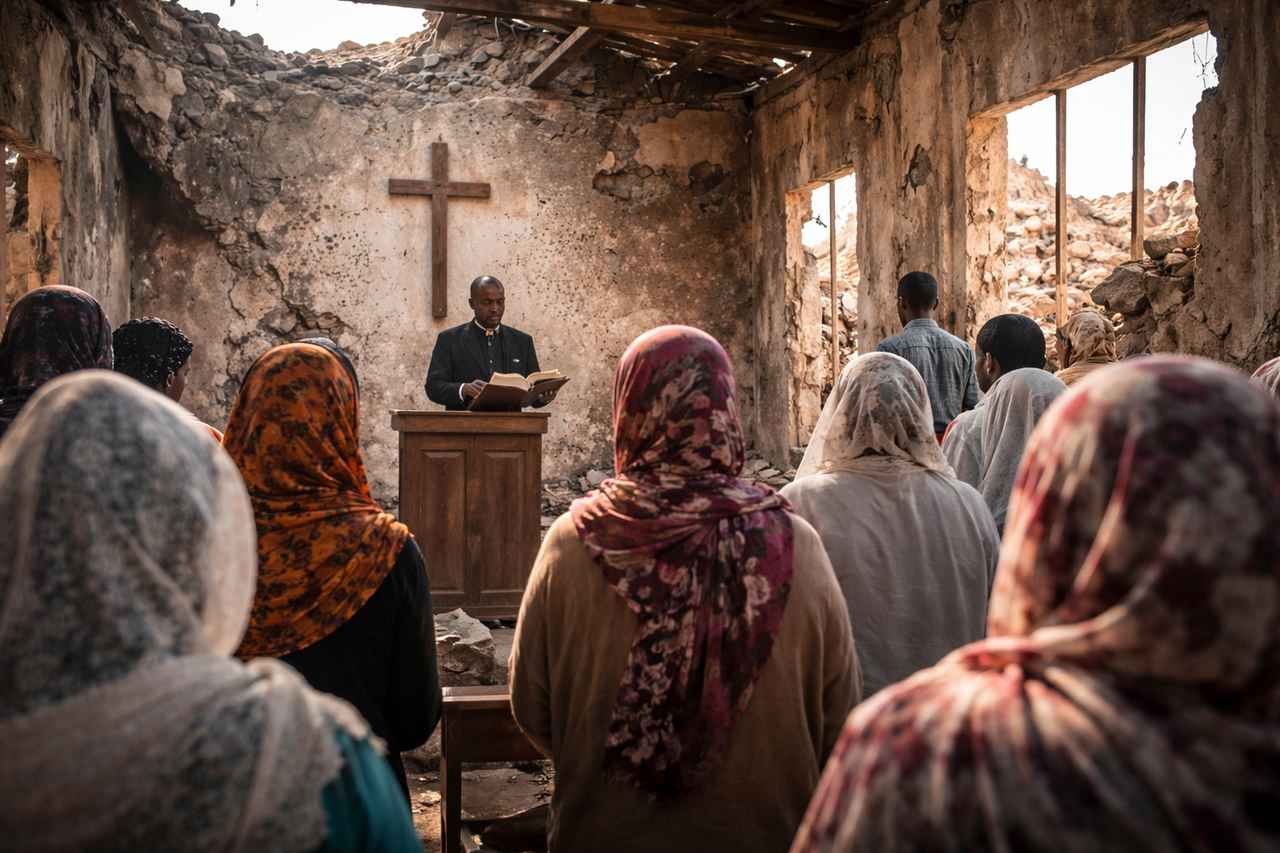
By May 2026, Sudan is no longer suffering through a temporary emergency. It is living under a long war that has become the landscape of daily life: families fleeing with little more than what they can carry, children growing hungry and afraid, churches gathering under pressure, and believers trying to remain faithful when fear, grief, and displacement have become ordinary burdens. Sudan needs prayer that is urgent, compassionate, informed, and anchored in the mercy of God.
Pray for the Lord to restrain violence in Sudan, protect civilians, provide daily bread for the hungry, sustain displaced families, and strengthen Christians to remain faithful in worship, witness, and love amid war, fear, and pressure.
Why Sudan Needs Prayer Now
Sudan’s present burden is severe and immediate. The war that began in April 2023 between the Sudanese Armed Forces and the Rapid Support Forces has devastated homes, markets, hospitals, schools, farms, roads, and places of worship. Associated Press reporting in May 2026 says at least 59,000 people have been killed, about 13 million displaced, and more than 30 million people need humanitarian assistance.
The country’s hunger crisis is also deepening. The Integrated Food Security Phase Classification, a global system used to measure food-insecurity severity, reported in May 2026 that nearly 19.5 million people in Sudan face high levels of acute food insecurity. It also warned that conditions are expected to worsen during the June–September lean season, when food stocks often run low before new harvests.
Children are carrying an especially heavy burden. UNICEF, the United Nations children’s agency, reported on April 14, 2026, that at least 245 children were killed or maimed in Sudan in the first 90 days of 2026, with the highest casualties in Darfur and Kordofan. UNICEF also said more than five million children have been displaced since the war began, and at least eight million children are out of school.
For Christians, this national suffering is not separate from church life. Believers are enduring the same hunger, displacement, trauma, and insecurity as their neighbors, while also facing the particular vulnerabilities of being a small religious minority in a violent and unstable setting. The prayer burden, therefore, is not only “pray for persecuted Christians,” though that is necessary. It is also “pray for a shattered nation, and for Christ’s people to bear faithful witness within it.”
Country Snapshot
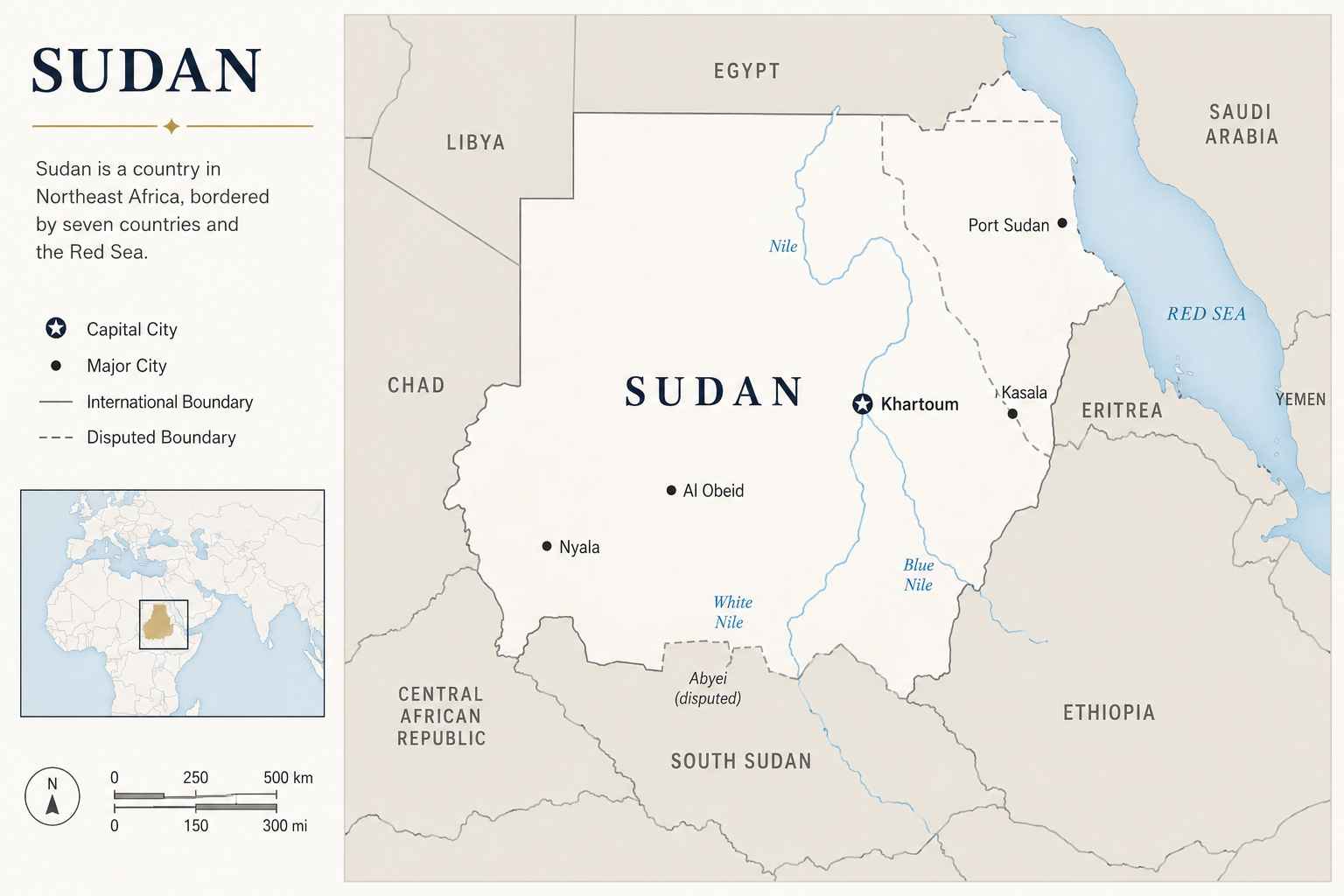
Sudan is a large country in northeastern Africa, bordering the Red Sea and neighboring Egypt, Libya, Chad, the Central African Republic, South Sudan, Ethiopia, and Eritrea. The World Bank lists Sudan’s 2024 population at about 50 million.
Sudan’s population is overwhelmingly Muslim, while Christians form a small minority made up of historic communities, Protestant and evangelical believers, converts from Islam, and expatriate Christians. Open Doors, a Christian organization that monitors pressure on Christians worldwide, lists Sudan at number 4 on its 2026 World Watch List and identifies Islam as the country’s main religion.
Politically, Sudan remains fractured by war rather than governed by settled national order. The Sudanese Armed Forces, often called the army, and the Rapid Support Forces, a powerful paramilitary force, continue to fight for control. Because territory, authority, and access can shift quickly, this guide avoids overconfident claims about who controls every area and instead focuses on the realities most relevant for prayer: violence, displacement, hunger, fear, church vulnerability, and the need for lasting peace.
Main Pressures Facing Christians
War, hunger, and displacement
Christians in Sudan face pressure from several directions at once. First, they suffer the national catastrophe of war: hunger, displacement, trauma, insecurity, closed schools, damaged health systems, and the loss of homes and livelihoods. Second, as a small religious minority, they face added vulnerability in places where law has weakened, armed actors operate with impunity, and suspicion toward Christians can deepen under nationalist or religious pressure.
Religious-freedom pressure
The U.S. Commission on International Religious Freedom, an independent U.S. government advisory body that monitors religious freedom worldwide, says Sudan’s current war has brought renewed religious-freedom concerns, including reports of attacks on places of worship, arbitrary detention of members of religious minorities, blocked humanitarian aid, and a pervasive climate of fear for those communities.
Church buildings and converts under strain
Open Doors reports that many church buildings have been bombed, taken over, or used by armed groups, and that Christians face discrimination in settings such as courts, workplaces, and schools. It also identifies converts from Islam as especially vulnerable because they may face pressure from family, community, armed groups, and the wider climate of fear created by war.
Fragile public worship
There are also quieter but still serious pressures on church life. Christian Solidarity Worldwide, a religious-freedom advocacy organization, reported in February 2026 that a local authority in Sudan’s Northern State halted reconstruction and worship at a Coptic church. That kind of incident does not carry the same scale as famine or mass displacement, but it matters because it shows how ordinary Christian worship can remain fragile even apart from direct battlefield violence.
What Life Is Like for Christians in Sudan
For many Sudanese Christians, faithfulness now means endurance under exhaustion. Worship may continue, but often with scattered members, damaged buildings, uncertainty about movement, and the emotional weight of grief. Some believers have fled. Others remain because they cannot leave, because family ties hold them in place, or because they believe they must continue serving where God has placed them.
Open Doors describes Christians in Sudan as living through severe crisis and displacement, with converts from Islam especially exposed to rejection, threats, and violence. The same source also notes that church leaders and expatriate believers can face arbitrary arrest or detention because of the conflict environment.
And yet the church has not disappeared. There are still pastors shepherding frightened people, families praying in uncertainty, believers trying to care for one another, and congregations seeking to be salt and light in a country torn by war. That does not minimize the suffering. It reminds us that Christ continues to preserve His people, often quietly, in places where human strength is spent.
Recent Developments
-
May 2026
Acute hunger continues to deepen.
The most urgent recent developments are the spread of acute hunger and the escalation of drone warfare. In May 2026, Associated Press reported that more than 40 percent of Sudan’s population faces high levels of acute food insecurity, while 14 areas in North Darfur, South Darfur, and South Kordofan are at risk of famine if conflict, displacement, weak sanitation, and poor access to care worsen.
-
January–April 2026
Drone warfare has become a deadly civilian threat.
Drone warfare has become an especially deadly feature of the current war. Associated Press reported in May 2026 that drones killed at least 880 civilians between January and April 2026 and have become the leading cause of conflict-related civilian deaths. Drones have struck or threatened civilian infrastructure including hospitals, dams, schools, markets, and displacement camps.
-
May 2026
Contested responsibility requires careful wording.
A May 2026 strike on a crowded market in Ghubaysh, West Kordofan, illustrates why contested claims must be handled carefully. A local rights group accused the army of targeting the market, while army sources denied targeting civilians and said the strike hit Rapid Support Forces vehicles nearby. This guide therefore treats the incident as a serious reported civilian-harm event with contested responsibility, not as a settled claim beyond the available evidence.
-
April–May 2026
Children face lasting harm.
For children, the damage is both immediate and long-term. UNICEF says homes, schools, hospitals, and markets continue to come under attack; nearly half of school buildings are either closed, being used as shelters, or occupied by parties to the conflict; and at least eight million children are out of school.
-
Current prayer burden
Church pressure remains severe.
For Christians, the recent picture remains sobering. Religious-freedom monitors continue to report damaged church buildings, fear among converts, restrictions on worship, and an environment in which Christian communities can be pressured by both war conditions and older patterns of discrimination.
How to Pray
-
Pray for violence to be restrained. Pray that the Lord would restrain evil, end the fighting, and protect civilians across Sudan, especially in Darfur, Kordofan, Khartoum, and other places where families are trapped by violence, hunger, displacement, or fear.
-
Pray for those in power and those bearing arms. Pray for the leaders and commanders of the Sudanese Armed Forces and the Rapid Support Forces, the two main warring forces, asking God to restrain cruelty, expose falsehood, humble the proud, and turn hearts toward justice, mercy, and peace.
-
Pray for displaced families. Pray for displaced families who have lost homes, land, income, schools, churches, and familiar community life. Ask the Lord to provide shelter, food, medicine, safety, and trustworthy help.
-
Pray for the hungry and vulnerable. Pray for hungry children, widows, orphans, the elderly, and the sick, asking God to preserve life, open safe routes for aid, and strengthen those providing relief under dangerous conditions.
-
Pray for steadfast Christians. Pray for Sudanese Christians to remain steadfast in Christ under fear, grief, uncertainty, and exhaustion, and to be guarded from despair, bitterness, compromise, and spiritual weariness.
-
Pray for church leaders. Pray for pastors, elders, and church leaders as they shepherd scattered and traumatized believers. Ask the Lord to give them wisdom, courage, tenderness, sound doctrine, and endurance.
-
Pray for converts and vulnerable believers. Pray for converts from Islam and other especially vulnerable believers who may face family rejection, social pressure, threats, or violence because they follow Christ.
-
Pray for worship, discipleship, and witness. Pray that churches would be able to gather, worship, teach Scripture, make disciples, care for the weak, and bear witness even where buildings are damaged, occupied, restricted, or unsafe.
-
Pray for visible Christian love. Pray that Christians in Sudan would love their neighbors visibly and wisely, showing mercy across ethnic, religious, and regional lines without losing courage, truth, or faithfulness to Christ.
-
Pray for gospel fruit. Pray that the gospel would continue to bear fruit in Sudan, and that the Lord would preserve a humble, courageous, and truthful witness through His church in the midst of war.
Give Thanks
-
Give thanks that the church in Sudan has not been extinguished, and that Christ continues to preserve a people for Himself even through war, hunger, displacement, and fear.
-
Give thanks for Sudanese believers who continue to worship, pray, endure, and quietly serve others under severe strain.
-
Give thanks for pastors, church leaders, families, and congregations who continue to care for the weak, teach Scripture, encourage the weary, and bear witness to Christ in hardship.
-
Give thanks for every act of mercy shown by neighbors, churches, medical workers, humanitarian responders, and local helpers who continue serving despite danger and limited resources.
-
Give thanks for every life protected, every child fed, every displaced family sheltered, every believer strengthened, and every path of help opened by God’s providence.
-
Give thanks for signs of common grace in Sudan: courage, compassion, patient endurance, truth-telling, relief work, and the continued desire for peace among ordinary people.
-
Give thanks that the Lord is not absent from Sudan’s suffering, and that His preserving grace is still at work even where the visible situation remains painful and unresolved.
Last Verified / Update Note
Last verified: May 21, 2026.
This guide reflects major developments known at the time of writing, especially Sudan’s continuing war, acute food insecurity, May 2026 drone-war concerns, child casualties and displacement, and current religious-freedom pressures affecting churches and converts. Because Sudan’s situation is highly volatile, recheck this post before publication if there are new major developments in Darfur, Kordofan, Khartoum, Blue Nile, church-property restrictions, drone attacks, famine classification, or religious-freedom reporting.
Key Sources Consulted
Associated Press. “Over 40% of Sudan’s population face high levels of acute food insecurity, monitoring group warns.” AP News, May 2026.
Used for current food-security conditions, displacement, death estimates, humanitarian-need scale, famine-risk areas, and the June–September lean-season warning.
Associated Press. “Drones are making Sudan’s war even deadlier for civilians.” AP News, May 2026.
Used for current drone-warfare context, civilian-death figures, infrastructure targeting, and the role of drone attacks in civilian harm.
Associated Press. “28 killed in a drone strike on a market in Sudan’s West Kordofan, rights group says.” AP News, May 2026.
Used for a recent contested civilian-harm example and for evidence-lane discipline around accusation and official denial.
UNICEF. “At least 245 child casualties in Sudan in the first 90 days of 2026.” UNICEF press release, April 14, 2026.
Used for child-casualty figures, displacement of children, school disruption, malnutrition concerns, and child-focused humanitarian needs.
U.S. Commission on International Religious Freedom. “Sudan Issue Update.” USCIRF, 2025.
Used for religious-freedom concerns connected to the war, including attacks on places of worship, arbitrary detention, blocked aid, and fear among religious minorities.
Open Doors. “Sudan.” World Watch List 2026 country profile.
Used for current Christian-pressure context, World Watch List ranking, church-building concerns, convert vulnerability, and prayer needs for the Sudanese church.
Christian Solidarity Worldwide. “Local authority halts reconstruction and worship in Coptic church.” CSW, February 17, 2026.
Used for a recent church-property and worship-restriction example in Northern State.
World Bank Data. “Sudan.” World Bank country data page.
Used for current population background.
Source note: This guide relies most heavily on 2026 sources for current war, food-security, drone-war, and child-impact claims. Religious-freedom and church-pressure claims are grounded in the U.S. Commission on International Religious Freedom, Open Doors, and Christian Solidarity Worldwide because those sources are more directly focused on the pressures facing Christian communities. Exact death totals, battlefield control, and responsibility for some recent attacks remain contested or difficult to verify, so the article avoids overconfident wording where sources differ or where access is limited.


