


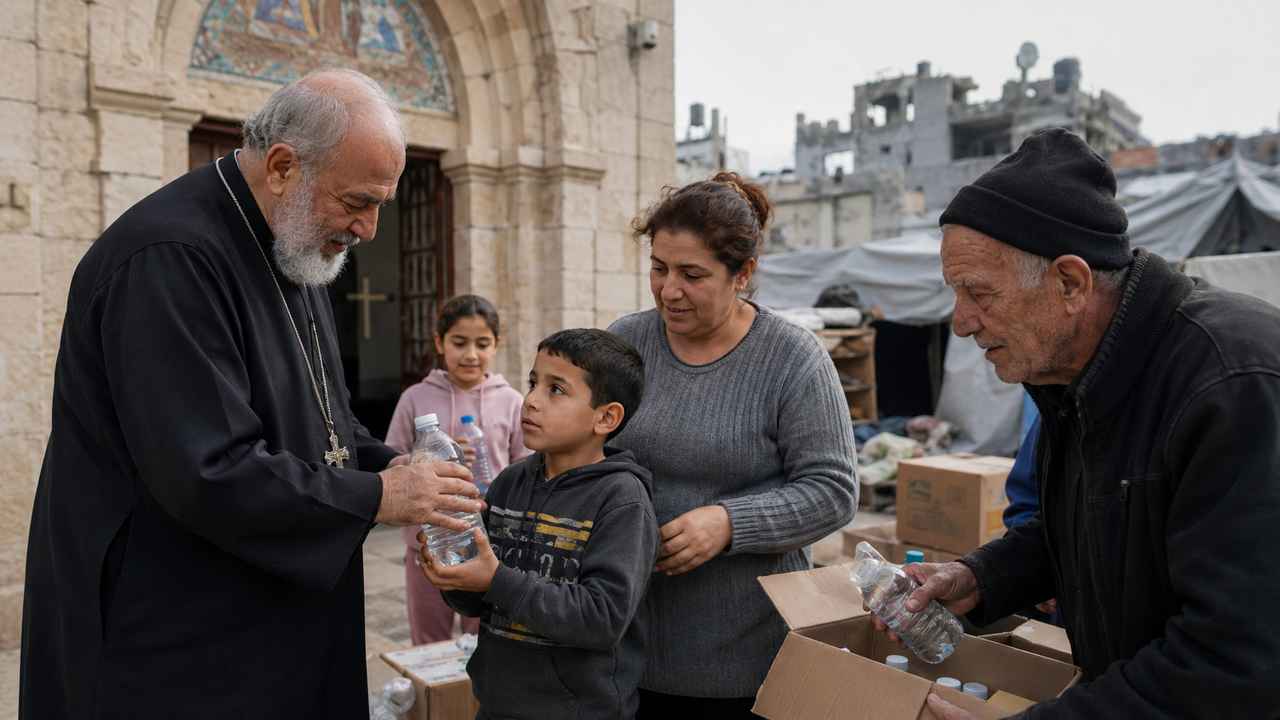
The State of Palestine calls for prayer because people in Gaza and the West Bank are suffering severely, and because small Christian communities are trying to remain faithful amid war, displacement, restricted movement, economic strain, and fear. In Gaza, many families are living with damaged services, limited safe water, hunger, and grief. In the West Bank, including East Jerusalem, many Palestinians face military operations, movement restrictions, demolitions, settler violence, and pressure on land and livelihoods. Palestinian Christians also need prayer to keep worshipping Christ, caring for their families, serving neighbours, and resisting despair while the future remains deeply uncertain.
On 31 July 2026, a roadmap was published proposing a phased transfer of Gaza’s civilian government, the decommissioning of Hamas weapons, Israeli military withdrawal, international monitoring, new policing arrangements, and reconstruction. Hamas said it had accepted the roadmap, but Israel had not formally accepted it. Israeli strikes continued after the announcement, showing that the proposal had not halted military action or taken effect. It remained an important but unsettled proposal, not a peace agreement in force.
Prayer Burden at a Glance
Pray for civilians in Gaza and the West Bank who are living with displacement, hunger, damaged services, restricted movement, fear, bereavement, and uncertainty. Pray for dependable humanitarian access, truthful and restrained leadership, justice without revenge, the protection of hostages, detainees, prisoners, and missing people, and every genuine path towards disarmament, military withdrawal, honest civilian government, reconstruction, and lasting peace. Pray especially for historic Palestinian Christian communities to remain steadfast in Christ and faithful in gospel witness.
Last verified: 1 August 2026
Why the State of Palestine Needs Prayer Now
War, displacement, restrictions, and economic hardship have disrupted daily life in Gaza and the West Bank, while small Christian communities struggle to remain and serve.
The State of Palestine needs prayer because daily life in Gaza and the West Bank has been disrupted by immediate suffering and long-running instability. In Gaza, about 1.9 million of 2.1 million people had experienced displacement by mid-July 2026. Essential services remained badly damaged, many families lacked dependable access to safe water and adequate shelter, and health, sanitation, education, and protection systems were under severe strain. These are not abstract humanitarian categories. They affect where families sleep, how parents feed and protect children, whether wounded and disabled people receive care, and whether communities can begin rebuilding ordinary life.
Food assistance increased during parts of 2026 and brought some improvement, but that progress remained fragile. On 24 July, United Nations agencies reported that about 1.4 million people still faced crisis-level or worse food insecurity, including approximately 212,000 in emergency conditions. Damaged livelihoods and public services had not recovered, and humanitarian access remained constrained.
The West Bank also needs sustained prayer. More than 33,000 Palestine refugees remained displaced from Jenin, Tulkarm, Nur Shams, and surrounding areas in late-July reporting. Military operations, demolitions, settler attacks, settlement expansion, and travel restrictions continued to affect homes, livelihoods, schools, health care, worship, and access to land. These pressures reach into daily life and family decisions far beyond the immediate sites of violence.
Direct anti-Christian persecution does not explain the whole situation. Palestinian Christians suffer alongside their Muslim neighbours under war, insecurity, economic strain, and movement restrictions. Because their communities are small, each death, departure, lost livelihood, and exhausted church leader can have lasting consequences. They need prayer to gather for worship, remain in their communities, teach their children, serve their neighbours, and speak about Christ without giving way to fear or despair.
Christians should therefore pray with grief and hope together: grief for the wounded, displaced, hungry, bereaved, detained, and afraid; hope because Christ remains Lord over rulers, wars, borders, churches, and families, and He is able to preserve His people and draw sinners to Himself even in a land marked by sorrow.
Country Snapshot
A brief orientation to the territory, communities, leadership, and divided systems of government that affect life in Gaza, the West Bank, and historic Palestinian Christian communities.
At the United Nations, the State of Palestine has non-member observer-state status, a status short of full UN membership. It is generally understood to refer to the West Bank, including East Jerusalem, and the Gaza Strip, though questions of control, sovereignty, borders, and final political status remain disputed. For clarity, this guide names Gaza, the West Bank, East Jerusalem, and individual towns when a specific place is meant.
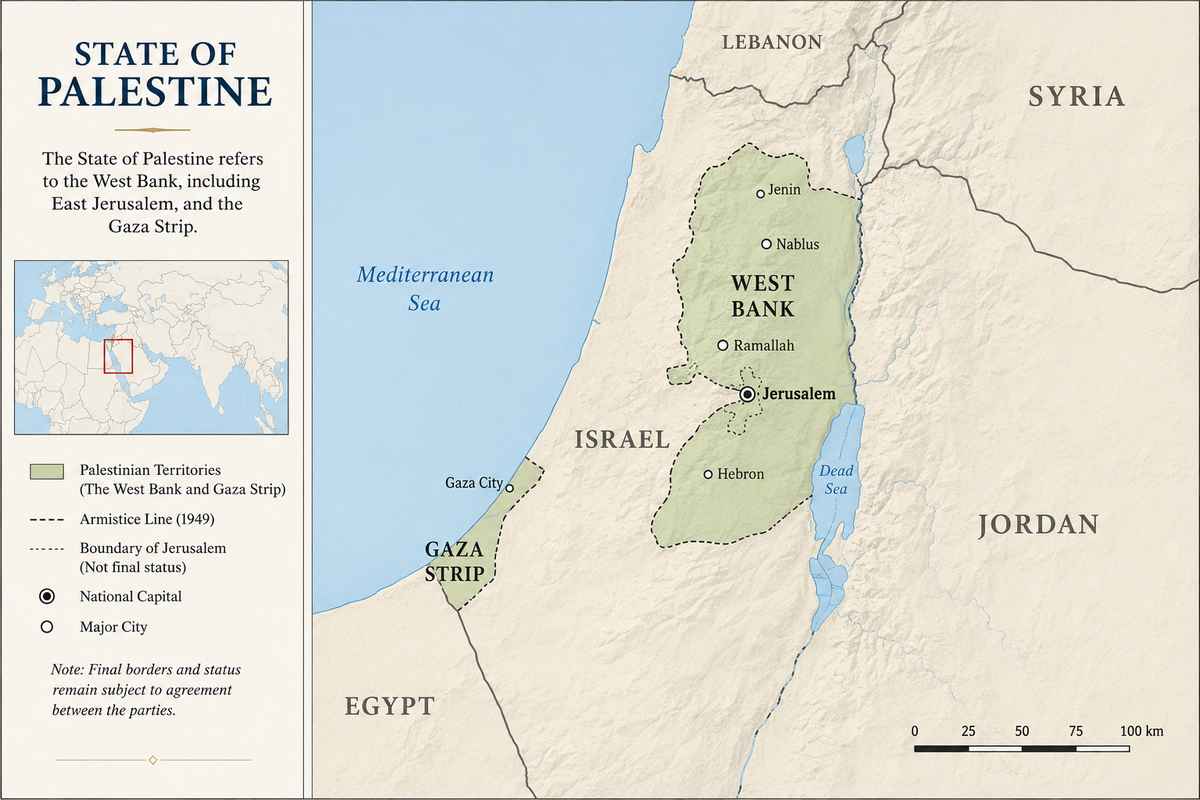
The population is overwhelmingly Muslim, while Christians form a small minority with deep historical roots. Christian Palestinians are concentrated mainly in places such as Bethlehem, Beit Jala, Beit Sahour, Ramallah, Taybeh, East Jerusalem, and Gaza City. Older census and demographic estimates should be treated carefully because war, displacement, and emigration can change small communities quickly.
Government and control are fragmented. The Palestinian Authority exercises limited civil authority in parts of the West Bank under earlier arrangements, while Israeli authorities retain extensive security, movement-control, and administrative powers in many areas. Gaza’s governance remained contested after years of Hamas-linked de facto rule, war, ceasefire efforts, and proposals for new civilian administration.
In Gaza, Hamas announced on 6 July that it had dissolved its emergency governmental committee and was prepared to help transfer civilian administration to a Palestinian technocratic body. The announcement did not complete that transfer. Ministries and technical staff were expected to continue working, while Hamas-linked security and policing remained in place until another governing body actually assumed those responsibilities.
Spiritual and Practical Challenges Affecting Christians and Churches
Christians suffer alongside their neighbours, but their small numbers make movement restrictions, threats to land and livelihoods, emigration, trauma, and family or social difficulties around Christian witness and conversion especially serious for the future of local churches.
Direct anti-Christian persecution does not explain the whole situation facing Christians in the State of Palestine. They suffer many of the same dangers, restrictions, and economic hardships as their Muslim neighbours. Because Christian communities are small, these wider pressures can quickly weaken congregations, schools, ministries, and family networks.
Movement, worship, and pastoral care
Movement restrictions can affect worship, family life, employment, pilgrimage, pastoral care, and access to Jerusalem-area holy sites. When roads are blocked, permits are denied, or travel becomes unsafe or costly, congregations may struggle to gather, pastors may be unable to reach members, and families can lose access to one another, school, work, and business.
Threats to land and local livelihoods
Settler intimidation, attacks, and restrictions on access to land affect communities across the West Bank, including Christian towns. Taybeh has faced reported attacks, property damage, and restricted access to agricultural land. People in Beit Sahour and nearby communities have also expressed concern that settlement expansion will reduce access to open land. These conditions threaten income, family continuity, local institutions, and the ability of small communities to remain.
Gaza’s exceptionally vulnerable Christian community
In Gaza, the Christian community is very small. War, displacement, damaged infrastructure, shortages, trauma, and fear affect everyone, but the death or departure of only a few families or elderly believers can alter the future of local congregations.
Emigration, trauma, and faithful witness
Economic collapse, grief, insecurity, and uncertainty can intensify pressure to leave. Believers may also face family or social difficulty when speaking openly about Christ, living in interfaith families, or dealing with questions of conversion. These difficulties vary and should not be used to caricature Palestinian society. Christians and Muslims often share neighbourhood ties, grief, poverty, and national suffering, while believers still need courage, humility, protection, and love as they seek to live openly and faithfully as Christians.
Christian Life and Witness in the State of Palestine
Palestinian Christians seek to worship, teach their children, serve neighbours, and remain faithful to Christ while conflict, movement restrictions, grief, and economic hardship disrupt ordinary life.
For many Palestinian Christians, faithfulness looks like ordinary obedience under extraordinary strain. A family may try to attend worship while checkpoints, insecurity, or transport costs make movement difficult. A pastor or priest may preach to people who have lost homes, relatives, income, or hope. A teacher may try to keep children learning while parents wonder whether they should stay or leave. A young believer may love the land and the church, yet feel that emigration is the only path to safety, work, or a future family life.
In Gaza, Christian life is exceptionally fragile. Churches and Christian institutions have served as places of worship, shelter, pastoral care, and practical help. Christians also need prayer for families to remain, children to be taught, elderly and disabled people to receive care, and believers to continue loving their neighbours when so much of ordinary life has been damaged.
In the West Bank, Christian life is tied to land, family, schools, churches, holy sites, small businesses, and pilgrimage. Around Bethlehem, Beit Jala, Beit Sahour, Ramallah, Taybeh, East Jerusalem, and nearby communities, the Christian presence is historic and visible, but not secure. When pilgrims are absent, movement is restricted, olive groves are hard to reach, nearby settlements expand, or young families leave, families lose income, schools and churches lose support, and more people must decide whether they can remain in communities where Christians have worshipped for generations.
Even where public life is marked by grief and fear, the Lord has preserved worship, pastoral care, Christian schools, works of mercy, and ordinary believers who continue serving suffering neighbours in the name of Christ.
Recent Developments
These dated developments directly affect civilian safety, church life, civilian administration, aid access, displacement, justice, and peace.
-
31 July–1 August 2026
A Gaza roadmap was announced, but military attacks continued
The roadmap proposed an end to military action, the decommissioning of Hamas weapons, phased Israeli withdrawal, the transfer of civilian government and policing, international monitoring, humanitarian access, and reconstruction.
Hamas said it had accepted the roadmap subject to Israeli withdrawal and an end to hostilities. Israel had not formally accepted it. The agreement required approval by all parties before a detailed timetable could be prepared and before the proposed Gaza administrative committee could enter and assume its responsibilities.
Israeli strikes continued overnight after the roadmap was announced, killing at least two people and injuring dozens according to local health officials cited by the Associated Press. There was no confirmed evidence that any of the roadmap’s main steps concerning governance, weapons, withdrawal, or international monitoring had begun.
Prayer significance: Pray that announcements would be followed by truthful action. Ask God to restrain further attacks, protect civilians, and prevent political ambition, revenge, or deception from destroying a genuine path towards disarmament, withdrawal, just government, reconstruction, and peace.
-
24 July 2026
Food insecurity remained severe despite fragile gains
United Nations agencies reported that increased humanitarian assistance and commercial traffic had brought some improvement, but about 1.4 million people still faced crisis-level or worse food insecurity, including approximately 212,000 in emergency conditions. The agencies warned that the improvement could be lost because livelihoods, public services, and food systems had not recovered, and families had little ability to withstand further shortages.
Prayer significance: Pray for dependable food access, protection for children and pregnant and breastfeeding women, restored livelihoods, honest distribution, and sustained help for families who remain at risk of hunger and malnutrition.
-
24 July 2026
Kerem Shalom remained the only reported goods crossing
UNICEF reported that Kerem Shalom, also known as Abu Salem, was the only open crossing for goods entering Gaza at that time. Food, fuel, medicine, shelter materials, spare parts, and repair equipment were still delayed or limited by inspection, transport, security, and distribution problems. Because crossing arrangements can change quickly, this is a dated account rather than a permanent description.
Prayer significance: Pray for safe, dependable, and sufficient entry and distribution of essential supplies, for protection of aid workers and civilians, and for those controlling access to act with truthfulness, restraint, and regard for human life.
-
Late July 2026
Displacement and pressure continued in the West Bank
More than 33,000 Palestine refugees remained displaced from Jenin, Tulkarm, Nur Shams, and surrounding areas. Military operations, demolitions, settler attacks, settlement expansion, and movement restrictions continued to affect homes, livelihoods, schools, health care, worship, and access to land. An earlier military order affecting Tulkarm and Nur Shams ran through 31 July, but its post-expiry status had not been confirmed when this guide was reviewed.
Prayer significance: Pray for protection and practical help for displaced families, restraint by armed and political actors, truthful investigation of violence, and justice that does not become revenge.
-
June–July 2026
Christian communities continued worship and pastoral service under pressure
Church leaders and Christian organisations continued to draw attention to the vulnerability of Christian communities in Gaza and the West Bank, including Taybeh. Worship, pastoral care, education, shelter, medical service, and neighbour care continued despite insecurity, displacement, land pressure, economic hardship, and grief.
Prayer significance: Give thanks for faithful service. Pray that churches would be protected and purified, that believers would be grounded in Scripture and courageous in speaking about Christ, and that they would care for suffering neighbours without giving way to fear or bitterness.
How to Pray
Use these prayer points to pray specifically for civilians, displaced families, vulnerable Christian communities, leaders, churches, and all who need mercy, truth, justice, and peace.
-
Pray for civilians and families in Gaza. Ask the Lord to protect those who are bereaved, wounded, displaced, disabled, elderly, pregnant, or deeply traumatised. Pray for dependable access to food, clean water, shelter, sanitation, medicine, fuel, and other needed help.
-
Pray for displaced families and communities facing violence and restrictions in the West Bank. Pray for people affected by military operations, settler violence, demolitions, settlement expansion, movement restrictions, and pressure on land and livelihoods. Ask God to comfort uprooted families, restrain those who use fear or force, and bring justice without revenge.
-
Pray for hostages, detainees, prisoners, and missing people. Ask God to protect them and their families, expose abuse and deception, uphold humane treatment and due process, and bring truth, justice, and clear answers where people remain captive, detained, imprisoned, or missing.
-
Pray for leaders, negotiators, armed movements, and security authorities. Ask God to grant repentance, truthfulness, wisdom, justice, and restraint to Palestinian and Israeli leaders and to everyone whose decisions affect civilian life. Pray that God would restrain political ambition, cruelty, revenge, and corruption, and turn people away from blaming whole communities for the actions of some.
-
Pray for every genuine path towards disarmament, withdrawal, just government, and reconstruction. Ask that proposals would not remain empty words, that implementation would be transparent and verifiable, and that civilians would not be used as bargaining tools. Pray for a lasting peace grounded in truth, justice, mercy, and protection of life.
-
Pray for small historic Christian communities. Pray for believers and churches in Gaza, Bethlehem, Beit Jala, Beit Sahour, Ramallah, Taybeh, East Jerusalem, and elsewhere. Ask the Lord to strengthen them to remain faithful through grief, isolation, fear, economic strain, and pressure to leave.
-
Pray for pastors, teachers, parents, health workers, and ordinary believers. Ask God to give them holiness, courage, tenderness, wisdom, and endurance as they proclaim the gospel, obey Scripture, teach children, comfort the grieving, serve the displaced, care for the sick, and resist fear and bitterness.
-
Pray for repentance, reconciliation, and gospel fruit. Ask the Lord to lead Palestinians and Israelis away from hatred, contempt, deception, and revenge. Pray that He would preserve and purify His church, bring those who bear the Christian name but do not know Christ to saving faith, and cause the gospel to bear fruit throughout the region.
Give Thanks
Even amid severe sorrow, thank God for continued worship, practical service, acts of mercy and restraint, and believers who remain faithful to Christ.
-
Continued worship and Christian presence. Give thanks that Christian worship and pastoral care have continued in Gaza and the West Bank despite war, restriction, displacement, fear, and uncertainty.
-
Faithful service to suffering neighbours. Give thanks for churches, Christian institutions, schools, health workers, clergy, parents, teachers, and ordinary believers who continue caring for children, the elderly, the displaced, the wounded, and the grieving.
-
Humanitarian workers and local helpers. Give thanks for those who continue bringing food, water, medical care, shelter, sanitation, protection, and practical help despite danger, obstruction, shortage, and exhaustion.
-
Every truthful effort towards restraint and peace. Give thanks for negotiations that protect civilians, the release and humane treatment of captives and detainees, acts of restraint, truthful public witness, and efforts towards reconciliation. Pray that stated commitments would lead to just and verifiable action.
-
God’s preserving and restraining mercy. Give thanks for every act of neighbour love, protection of life, courage, mercy, and integrity shown by anyone in the land. These acts are reasons to thank God even while the deeper causes of suffering remain.
Last Verified / Update Note
This note explains when the guide was reviewed, what was checked, and which fast-moving developments readers should continue to watch.
Review Status
Reviewed for current prayer use
We reviewed Gaza’s military and humanitarian conditions; the 31 July roadmap and whether any of its main steps had begun; Gaza governance and policing; proposed weapons decommissioning, Israeli withdrawal, and international monitoring; crossings and aid access; food security, displacement, and health-service strain; and West Bank operations, demolitions, settler violence, settlement expansion, movement restrictions, and displacement. We also reviewed conditions affecting Palestinian Christian communities and compared Palestinian and Israeli official statements, statements from Hamas, Egyptian regional reporting, United Nations reporting, and Christian-community sources.
Civilian protection in Gaza and the West Bank; dependable food, water, shelter, sanitation, medicine, and humanitarian access; care for displaced and traumatised people; protection and humane treatment of hostages, detainees, prisoners, and missing people; restraint and truthful leadership; just government and reconstruction; and faithful Christian witness amid fear, grief, and emigration pressure.
Whether Israel formally accepts, rejects, or proposes changes to the 31 July roadmap; whether all necessary parties approve it and an implementation timetable begins; whether Hamas weapons are decommissioned; whether Israeli military withdrawal begins; whether civilian government and policing transfer in Gaza; whether international monitoring or security arrangements become operational; whether further military attacks weaken or end the existing ceasefire framework; changes affecting Gaza’s crossings and delivery of aid; and the status of restrictions affecting Tulkarm and Nur Shams after 31 July.
The roadmap published on 31 July had not entered into force at the time of this review. Hamas said it had accepted the proposal, while Israel had not formally accepted it. Israeli attacks continued after the announcement. Its proposed steps should not be confused with actions that had actually begun. This guide reflects information available through 1 August 2026.
Key Sources Consulted
These sources provided the main humanitarian, political, church, and legal information used in this guide.
Humanitarian conditions, displacement, food security, and health
-
United Nations Office for the Coordination of Humanitarian Affairs. “Humanitarian Situation Report | 23 July 2026.” Used for Gaza and West Bank humanitarian conditions, displacement, military operations, demolitions, settler violence, movement restrictions, and civilian-protection concerns.
-
UNICEF State of Palestine. “Humanitarian Situation Update — Analysis of the Response to the Needs of Children at Mid-year 2026.” Used for the estimate that 1.9 million of Gaza’s 2.1 million people had experienced displacement and for current water, sanitation, health, infrastructure, access, and child-protection conditions.
-
FAO, UNICEF, and WFP. “Food security and child nutrition crises persist in Gaza despite fragile gains due to increased humanitarian assistance and commercial traffic,” 24 July 2026. Used for current food-security conditions, the approximately 1.4 million people facing crisis-level or worse food insecurity, the approximately 212,000 in emergency conditions, and the fragility of recent gains.
-
World Health Organization. “HeRAMS occupied Palestinian territory: Gaza infographics, June 2026.” Used for the condition and functionality of health services and facilities.
Roadmap, governance, and official positions
-
Associated Press. Full text and reporting on the 31 July Gaza roadmap. Used for the roadmap’s proposed sequence concerning cessation of military action, weapons, Israeli withdrawal, civilian administration, policing, international monitoring, humanitarian access, and reconstruction.
-
Associated Press. Reporting on Hamas’s stated acceptance, Israel’s lack of formal acceptance, and practical obstacles to implementation, 1 August 2026.
-
Associated Press. Middle East developments report, 1 August 2026. Used only for the report that Israeli strikes continued in Gaza after the roadmap announcement, causing deaths and injuries according to local health officials.
-
Reuters Connect. “Hamas dissolves Gaza government, presses for progress on stalled peace plan,” 6 July 2026. Used for Hamas’s announcement concerning its emergency governmental committee and the limits of the proposed administrative transfer.
-
Office of the President of the State of Palestine. “President Abbas urges international action to halt Israeli attacks and colonist violence,” 26 July 2026. Used for the Palestinian official position on West Bank attacks, settlements, protection, and peace.
-
Office of the President of the State of Palestine. Official report dated 15 July 2026. Used to confirm Mahmoud Abbas as president and Hussein al-Sheikh as vice president.
-
Government of Israel. “Joint Statement from PM Netanyahu and Defense Minister Katz — 24 July 2026.” Used as an Israeli official statement concerning security policy and West Bank military measures.
-
Israel Defense Forces. Official statement on humanitarian aid and security restrictions in Gaza. Used to represent the Israeli military’s stated security rationale alongside independent humanitarian reporting.
-
Egypt State Information Service. Official regional reporting on Gaza talks, Israeli withdrawal, and the proposed roadmap, 4 July 2026.
-
Egypt State Information Service. Official report on Egypt’s support for the Palestinian Authority and Prime Minister Mohammad Mustafa, 4 July 2026.
Christian communities and church witness
-
Vatican News. Reporting on Taybeh and the pressures affecting its Christian community, 7 July 2026.
-
World Council of Churches. Statement on Christian presence, witness, and freedom of worship in the Holy Land, 12 June 2026.
-
World Council of Churches. Report on the pastoral visit of Patriarch Theophilos III and Cardinal Pizzaballa to Gaza, 23 June 2026.
Legal and territorial status
-
United Nations General Assembly. Resolution A/RES/67/19, “Status of Palestine in the United Nations,” 29 November 2012. Used for the State of Palestine’s non-member observer-state status.
Source Context
These notes explain how to read the sources behind this guide, especially where facts are fast-moving, disputed, or difficult to measure.
Source Context
- Fast-moving Gaza developments. The roadmap published on 31 July could not take effect without further agreement and action by the parties. Military attacks continued after its announcement. Questions concerning Israeli acceptance, weapons, military withdrawal, international monitoring, policing, civilian government, and reconstruction had not been resolved when this guide was reviewed.
- Humanitarian figures. Figures on displacement, food security, the condition of essential services, and aid access are dated estimates rather than permanent totals. The figures included here are those most helpful for understanding the scale of need, and each is tied to a stated reporting period.
- Official positions. Palestinian, Israeli, Hamas, Egyptian, and other official statements are used to show the position of the speaker or institution. They are not treated as independent proof merely because they are official.
- Humanitarian access. Crossing status, inspection arrangements, convoy movement, aid volume, and distribution conditions can change quickly. The statement that Kerem Shalom was the only open goods crossing is explicitly tied to UNICEF’s 24 July reporting.
- Christian-community reporting. Christian sources and testimony help explain conditions affecting worship, pastoral care, access to land, emigration, and the ability of small communities to continue. Reporting is stronger for some locations, including Taybeh and Gaza, than for every Christian locality.
- Christian identity. References to Christian communities describe people and groups publicly connected with churches or Christian heritage. They do not imply that every person who bears the Christian name has saving faith in Christ.
- Demographic caution. Exact current Christian-population totals are difficult to establish because war, displacement, migration, differing geographic definitions, and the small size of the communities can change estimates quickly.
- Source mix. The guide draws on Palestinian official sources, Hamas and de facto-authority statements reported by reputable agencies, Israeli official sources, United Nations humanitarian sources, Egyptian regional sources, international reporting, and Christian-community sources. Direct local reporting from Gaza and reporting from some independent Palestinian and Israeli outlets were not consistently available.
A Closing Prayer for the State of Palestine
Use this prayer to bring the needs described in this guide before God.


