


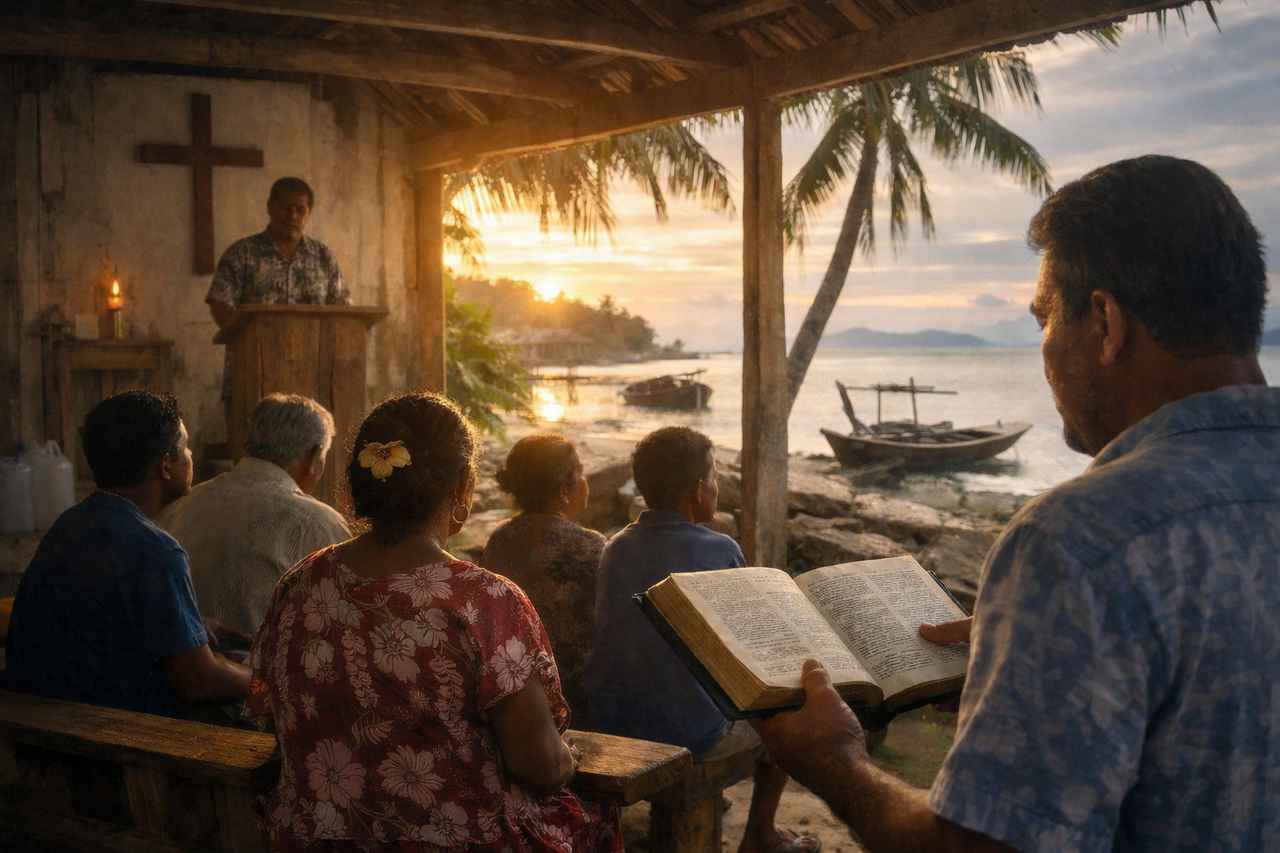
Micronesia may look quiet from a distance, but it deserves informed Christian prayer. The Federated States of Micronesia is a scattered island nation with constitutional protection for religious freedom, yet its people live under the steady strain of remoteness, climate vulnerability, infrastructure weakness, and outward migration. In a country where many already identify as Christian, the urgent burden is not only freedom to worship, but depth of discipleship, resilient churches, and faithful gospel witness across islands that are far apart and often hard to reach.
1. Why This Country Needs Prayer Now
Micronesia needs prayer now because daily life is becoming harder in ways that touch families, churches, and whole communities. Recent reporting points to a fragile national setting shaped by remoteness, a dispersed population, aging infrastructure, climate exposure, and sharp disparities between main islands and outer islands. In 2024, severe drought affected thousands, and by 2025 public health reporting was warning that rising temperatures, saltwater intrusion, and stressed water systems were increasing climate-sensitive disease risks.
At the same time, Micronesia stands in a season of opportunity as well as pressure. The 2024 COFA amendments extended U.S. financial provisions for another twenty years, and 2025–2026 reporting points to Compact-funded investment, governance reform, and major energy and public-finance projects. That means Christians can pray not only about hardship, but also about whether new resources will truly strengthen ordinary life, serve remote communities well, and make space for more stable, fruitful ministry.
2. Country Snapshot
The Federated States of Micronesia is a Pacific island nation in Oceania made up of four states—Yap, Chuuk, Pohnpei, and Kosrae. World Bank data puts the population at about 113,160 in 2024. It is a federal republic in free association with the United States, and its constitution explicitly protects freedom of religion.
Micronesia is overwhelmingly Christian by self-identification. Older CIA material lists the population as roughly 54.7% Roman Catholic and 41.1% Protestant; mission data likewise estimates 94.9% Christian adherent and 22.8% evangelical, while also identifying 2 unreached people groups totaling about 1,400 people. Those figures should be read carefully—they come from different years and methodologies—but together they suggest a country where the church is highly visible, while the need for gospel depth and ongoing mission work remains real.
3. Main Pressures Facing Christians
For Christians in Micronesia, the main pressure is not best described as nationwide state persecution. The constitution protects free exercise of religion, and Christian identity is widespread. The deeper challenge is that widespread Christian profession does not automatically mean mature discipleship, clear gospel understanding, or strong churches in every place. Mission estimates showing a large gap between overall Christian adherence and evangelical presence, alongside the existence of still-unreached groups, suggest the need for renewal, biblical clarity, and sustained evangelistic faithfulness.
A second pressure is geography. Churches are stretched across distant islands, and national reporting keeps returning to the same realities: remoteness, aging infrastructure, wide service gaps in outer islands, and emigration that drains skills and stability. When families move away, when transport is costly or irregular, and when local services are weak, ministry can easily become thinner, more isolated, and harder to sustain.
A third pressure is climate stress. Drought, saltwater intrusion, storms, and power weakness do not affect only economics or health; they affect the ordinary rhythms of church life as well. Congregations in fragile places may be pulled toward immediate survival concerns—water, food, repairs, transport, electricity—while pastors and church leaders try to keep worship, discipleship, and practical care moving forward at the same time.
4. What Life Is Like for Christians in Micronesia
Most believers in Micronesia can worship openly, teach their children the faith, and gather as churches without the kind of heavy formal restriction seen in some other countries. But open worship does not mean easy ministry. In practice, Christian life unfolds across scattered islands where communities may be small, travel can be difficult, utilities can be fragile, and outer-island households may already be carrying the burden of water insecurity, weak services, or climate disruption.
For many churches, faithfulness likely looks ordinary rather than dramatic: preaching Christ clearly in communities that already assume they are Christian, discipling young people who may be tempted to leave, caring for families under economic pressure, and keeping fellowship alive across large distances. In that setting, the burden is not only for freedom, but for seriousness, endurance, sound teaching, and churches that remain spiritually awake in a nation where Christianity is familiar.
5. Recent Developments
Several developments since 2024 help explain Micronesia’s present prayer burden. In March 2024, U.S. law extended the financial provisions of the Compact of Free Association for another twenty years. That same month, severe drought conditions prompted a national emergency response, with large numbers of people affected and outer communities facing acute water and food stress. These two facts sit side by side: long-term financial support on one hand, and acute environmental vulnerability on the other.
In March 2025, Micronesia held its regular congressional elections, and in May 2025 the 24th Congress was organized. Notably, the new Congress left climate and environmental issues visible enough that discussion of leadership for the Special Committee on Climate Change and Environmental Issues was specifically noted during reorganization. That is a reminder that climate stress is not a background theme for Micronesia; it is part of the country’s live national agenda.
Also in 2025, the World Bank approved a US$13 million public financial management project to strengthen spending and service delivery, and a US$42 million energy project to improve reliability and extend electricity access in remote outer islands. Then in July 2025, a US$17.9 million climate-and-health resilience programme was announced to address rising climate-sensitive disease risks. These are encouraging developments, but they also underline how serious the structural challenges are.
By January 2026, the IMF was still warning that Micronesia’s growth outlook depended on whether climate-resilient investment could actually be implemented well, and whether delays would worsen emigration and skills shortages. That same month, the country came under review in the UN Universal Periodic Review process. So Micronesia is not in dramatic upheaval, but it is in a significant season: political continuity after election, new funding streams, continued institutional scrutiny, and persistent vulnerability that will shape the life of churches as much as the life of the state.
6. How to Pray
These prayer points flow from Micronesia’s present realities: a largely Christian nation with constitutional freedom, yet one facing outer-island disparities, climate stress, migration pressure, and the need for deeper gospel maturity.
- Pray that the churches of Micronesia would not rely on Christian familiarity, but would grow in biblical depth, repentance, and joyful faith in Christ.
- Pray for pastors, elders, and ministry workers serving scattered and remote communities, that they would have wisdom, stamina, and practical support.
- Pray for outer-island believers and families facing drought, weak infrastructure, power instability, and other climate-related pressures.
- Pray that young people would not simply drift away through migration, discouragement, or nominal religion, but would be discipled well and strengthened in the faith.
- Pray that public resources, Compact-related funding, and development projects would be administered honestly and would genuinely serve ordinary people.
- Pray for gospel witness among communities and groups that remain weakly reached, and for renewed missionary vision in a nation that many assume is already fully Christian.
7. Give Thanks
There are real mercies to thank God for in Micronesia, even amid fragility. The country has constitutional protection for religious freedom, visible opportunities for worship and ministry, and a strong Christian presence. There are also meaningful efforts underway to improve service delivery, expand electricity access, strengthen climate-health resilience, and build more durable national systems.
- Give thanks for the open legal space for Christian worship and public faith.
- Give thanks for believers, pastors, and churches who continue serving across dispersed islands and difficult conditions.
- Give thanks for practical help now in motion through governance, energy, and climate-resilience initiatives that could relieve burdens on families and communities.
8. Last Verified
Last updated: April 12, 2026
Next review due: October 2026, or sooner if a major climate emergency, political disruption, or church-related development materially changes the prayer burden.
4. Last Updated note
Last updated: April 12, 2026.
5. Key Sources Consulted
- FSM Government, Executive Branch page, confirming current national executive leadership and current cabinet structure.
- Constitution of the Federated States of Micronesia, especially Article IV, Section 2 on religion.
- IMF, “IMF Staff Completes 2026 Article IV Mission to the Federated States of Micronesia” (January 30, 2026).
- U.S. Department of the Interior, “The Compacts of Free Association and Living in the United States”, noting the March 9, 2024 COFA amendments.
- World Bank data portal, Micronesia, Fed. Sts. population and migration indicators.
- World Bank, “World Bank Supports Federated States of Micronesia in Strengthening Public Financial Management and Service Delivery” (March 5, 2025).
- World Bank, “Thousands in Federated States of Micronesia to Gain Access to Clean, Reliable Electricity Through New World Bank Project” (May 28, 2025).
- Pacific Community (SPC), “The Federated States of Micronesia is tackling rising climate-related diseases with a major health resilience programme…” (July 3, 2025).
- UNICEF Pacific, “This World Water Day, thousands still affected by severe drought in the Federated States of Micronesia” (March 22, 2024), plus the March 2024 humanitarian situation material.
- FSM Congress, “Congress Organizes 24th Body and Maintains Most of its Leadership” (May 11, 2025), and Yap State Government election confirmation (March 10, 2025).
- OHCHR, UPR notice for the Federated States of Micronesia (January 14, 2026).
- CIA World Factbook archived country summary / profile material for background religious and government context, used carefully as dated background rather than as proof of unchanged current conditions.
- Joshua Project, Micronesia country profile, used as mission-context material for Christian-adherent, evangelical, and unreached-group estimates.


