


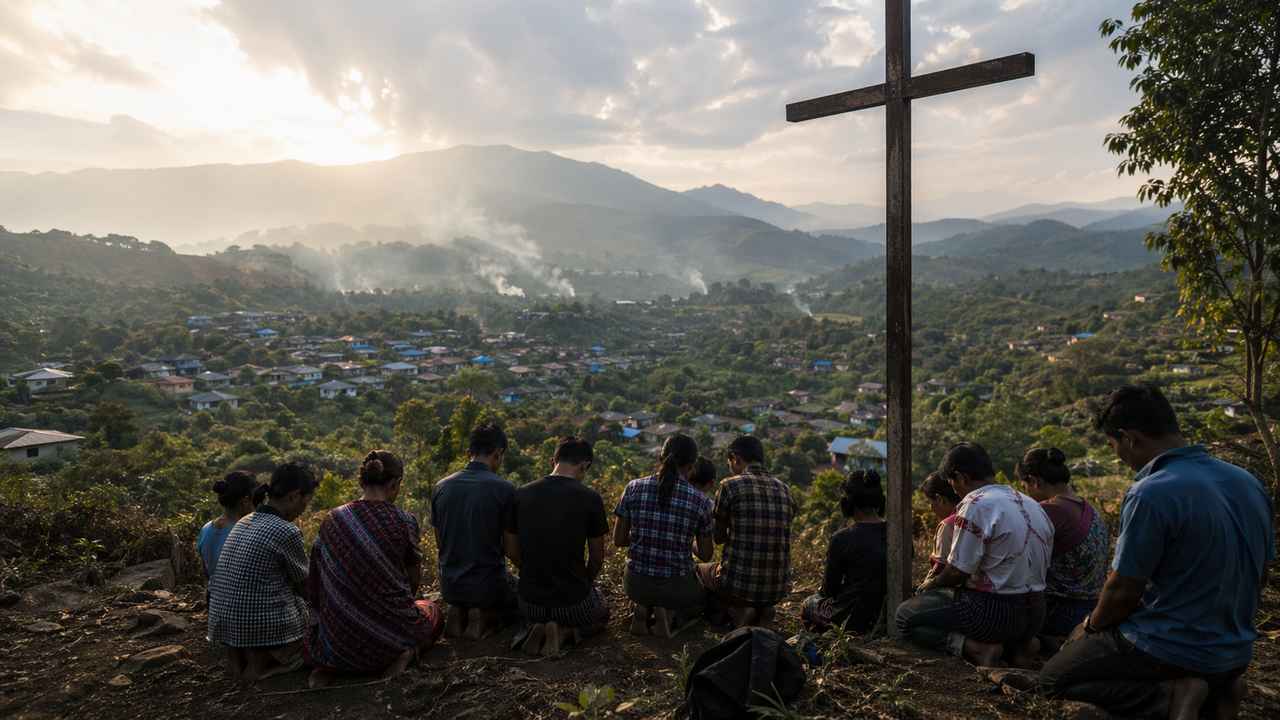
Myanmar’s hills, river valleys, borderlands, villages, and cities now carry the weight of a war that has entered ordinary life. The country’s suffering is not a passing emergency but a prolonged national crisis: families have been uprooted, communities have been split by fear, and many places of worship have become vulnerable in a conflict that has drawn civilians, ethnic minorities, and religious communities into danger. For Christians, faithfulness often means serving scattered people, gathering under uncertainty, and bearing witness to Christ where grief, fear, and endurance meet.
Pray for Myanmar amid civil war, mass displacement, political uncertainty, and heavy pressure on churches in conflict-affected areas. Ask God to protect His people, sustain displaced families, restrain violence, strengthen pastors and congregations, and preserve faithful gospel witness where fear and exhaustion have become part of daily life.
Last verified: May 2026
Why Myanmar Needs Prayer Now
Myanmar’s political transition has not brought clear relief from civil war, displacement, and pressure on vulnerable Christian communities.
Myanmar needs prayer now because the April 2026 political transition has not brought clear relief from the country’s deeper crisis. Parliament elected Min Aung Hlaing president on April 3, and he was sworn in on April 10 after elections that opposition groups and outside observers widely rejected as neither free nor fair. Associated Press reporting described the move as a nominal return to elected government while the military remained effectively dominant. The conflict that followed the 2021 coup still shapes national life more deeply than this formal change in government structure does.
The burden is not only political. The United Nations in Myanmar’s Humanitarian Needs and Response Plan 2026 says 16.2 million people need humanitarian assistance, more than 4 million people have been displaced, and the March 2025 earthquake compounded an already severe crisis. The March 2026 humanitarian update adds that conflict, airstrikes, underfunding, access restrictions, and economic decline continue to drive civilian suffering.
For Christians, especially in conflict-affected ethnic minority areas, the national crisis deepens older religious and social vulnerabilities. The Open Doors World Watch List 2026 Myanmar Country Dossier ranks Myanmar No. 14 and describes high pressure on Christians through violence, family pressure, community hostility, surveillance, legal barriers, and suspicion toward churches. Myanmar therefore calls for prayer that is sober, specific, compassionate, and confident in God’s preserving mercy.
Country Snapshot
A brief orientation to Myanmar’s location, people, government context, and church pressure.
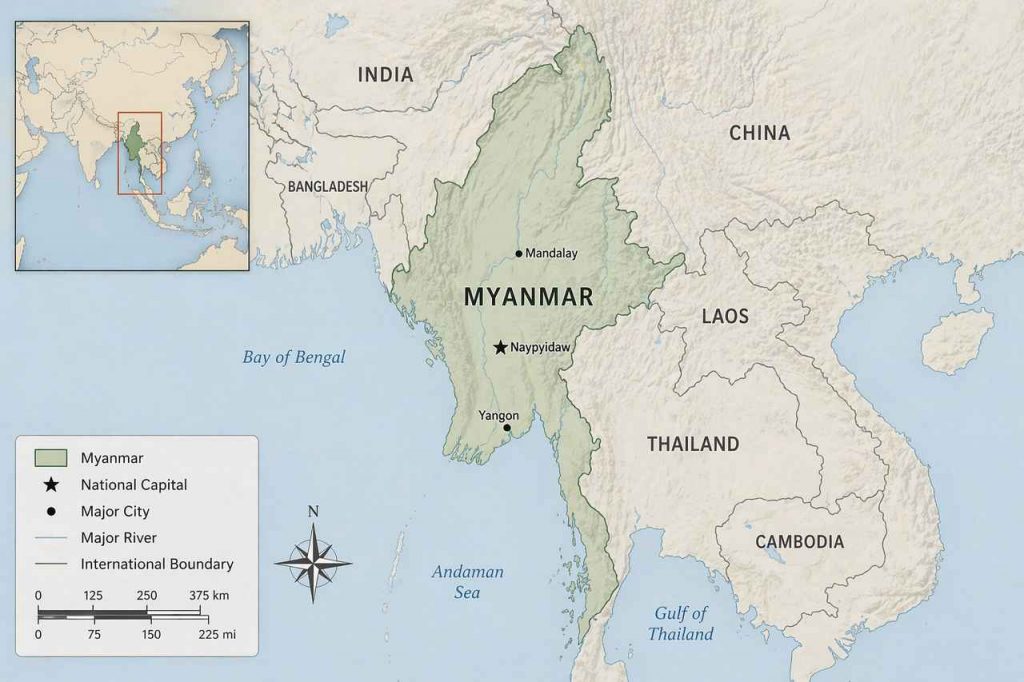
Myanmar sits between South Asia, China, and mainland Southeast Asia, with long borderlands where ethnic identity, conflict, trade routes, and religious life often overlap. That geography matters for prayer. Many of the country’s Christian communities are not evenly spread across the nation but are concentrated among ethnic minority peoples in areas such as Chin, Kachin, Karen, Kayah/Karenni, and parts of Shan and Sagaing, where conflict and displacement have often hit especially hard.
The 2008 constitution gives Buddhism a “special position,” and Buddhist identity is often closely tied to national and ethnic belonging. This does not mean every Buddhist person is hostile to Christians, and the article should not imply that. But it does mean Christians live as a clear minority within a national setting where religious identity, political power, ethnicity, and public belonging can be tightly intertwined, especially around the Bamar people, Myanmar’s largest ethnic group.
Main Pressures Facing Christians
The church in Myanmar faces conflict, displacement, social pressure, suspicion, and the moral strain of prolonged war.
War and civilian danger
One of the greatest pressures facing Christians in Myanmar is the war itself. The military, known as the Tatmadaw, has relied heavily on airstrikes and artillery during the civil war, and civilians, schools, homes, religious sites, and villages have repeatedly been caught in the violence. For many believers, danger does not arise only from private anti-Christian hostility. It also comes from living in places where church life has become exposed to the violence of a wider national conflict.
Displacement and material strain
A second pressure is displacement, exhaustion, and material strain. Millions of people have been uprooted, and many displaced families live with inadequate shelter, food insecurity, limited health care, and disrupted schooling. Churches in affected areas often carry spiritual and practical burdens at the same time: worshiping, discipling, sheltering, feeding, comforting, and helping scattered people survive.
Religion, ethnicity, and conflict
A third pressure is the overlap of religion, ethnicity, and conflict. In some communities, to be truly Burmese is still assumed to mean being Buddhist, especially for people from the Bamar majority. Christians from Buddhist backgrounds may be treated as betraying family, community, or national identity. Open Doors reports that converts may face hostility from relatives and communities, and that churches in rural or non-traditional settings can face harassment, threats, monitoring, and pressure to stop their activities.
Suspicion toward churches and leaders
A fourth pressure is suspicion toward churches and Christian leaders. In conflict zones, pastors, aid workers, and churches may be accused of supporting resistance forces, especially where Christian communities are located in ethnic minority areas affected by war. That makes ordinary ministry unusually difficult. A pastor may be trying to comfort the grieving, care for displaced families, and preach Christ clearly while also navigating suspicion from armed actors, local authorities, or frightened neighbors.
Moral confusion after years of war
A fifth pressure is the moral confusion that prolonged war creates. The strongest available reporting points to grave military responsibility for much of the country’s destruction and civilian harm, yet a shattered public life can also produce retaliation, fear, local abuses, and distorted judgment in many directions. Christians therefore need prayer not only for safety, but for truthfulness, restraint, forgiveness, courage, and faithful witness in a land where violence can harden hearts.
What Life Is Like for Christians in Myanmar
Many believers continue ordinary Christian faithfulness under instability, displacement, and social pressure.
For many Christians in Myanmar, ordinary faithfulness now means living under instability rather than within simple categories such as free or forbidden. Believers may still gather for worship, but they often do so while carrying the burdens of displacement, grief, interrupted schooling, food insecurity, and fear that a road, church, village, or town could become unsafe with little warning.
In places such as Chin, Kachin, Kayah/Karenni, Sagaing, and parts of Shan, church life is often inseparable from the realities of war. Pastors may shepherd people who have lost homes, relatives, livelihoods, or access to schools and clinics. Families may be separated by flight, conscription fears, checkpoints, or poverty. Young people may grow up treating uncertainty as part of everyday life.
That pressure is not only military. Converts from Buddhism may face family rejection, community exclusion, or pressure to return to inherited religious practice. Some churches struggle to function openly or register properly. Rural congregations may face monitoring or local hostility, especially when they are associated with evangelism or with ethnic communities viewed suspiciously by authorities.
Even so, Myanmar’s church is not only a picture of suffering. It is also a picture of endurance. Believers continue to gather, pray, teach children, care for displaced families, and bear witness to Christ in hard places. Their faithfulness is often quiet rather than public, costly rather than celebrated, and sustained not by outward safety but by the mercy of God.
Recent Developments
Recent developments show political continuity, continuing humanitarian strain, contested gestures toward reconciliation, and renewed battlefield pressure.
-
April 3–10, 2026
Min Aung Hlaing becomes president
Myanmar’s parliament elected Min Aung Hlaing president on April 3, and he was sworn in on April 10. State-backed authorities presented the transition as a constitutional step into a new phase of government. However, Associated Press reporting noted that opponents and independent observers regarded the elections as neither free nor fair and as designed to maintain military control.
Prayer significance: Pray with clear eyes. Myanmar’s political structure has changed in form, but the deeper burdens of war, fear, displacement, and military dominance remain.
-
April 2026
A cabinet with strong continuity from the previous military-led administration
Soon after the presidential transition, Myanmar’s parliament approved a new cabinet made up largely of former generals, current or former military officers, military-backed party figures, and holdovers from the prior military-led government, according to Associated Press reporting.
Prayer significance: Pray for those who govern and command, asking God to restrain evil, humble the proud, and open paths toward justice and protection for ordinary people.
-
April 17 and April 30, 2026
Prisoner amnesties and Aung San Suu Kyi moved to house arrest
In mid-April, the new government announced a broad prisoner amnesty that included former president Win Myint. At the end of April, former leader Aung San Suu Kyi was moved from prison to house arrest and her sentence was reduced as part of another amnesty. Associated Press reporting noted that the United Nations welcomed the move as a meaningful step toward conditions for a credible political process while also calling for the release of all political prisoners and genuine dialogue. Critics warned that the moves could be public-relations gestures rather than real reform.
Prayer significance: Pray for prisoners, detainees, families, and political leaders, asking God for truth, justice, mercy, and genuine peace rather than cosmetic change.
-
April 2026
New peace-talk offer rejected by major opposition actors
On April 22, Min Aung Hlaing proposed fresh peace talks with armed resistance groups as part of a 100-day program focused on peace, stability, and development. Associated Press reporting said the National Unity Government, the main opposition body coordinating resistance to military rule, rejected the offer as insincere and aimed at prolonging military dominance.
Prayer significance: Pray that any real opening toward peace would not be wasted, and that false peace would not be used to deepen control or prolong suffering.
-
April–May 2026
Signs of renewed military battlefield momentum
At the end of April, AP reported that the Tatmadaw appeared to have regained the strategic initiative after mid-2025, helped by conscription, opposition divisions, and China-mediated ceasefires with some armed groups. In May, Myanmar’s military-backed government said it had recaptured Tonzang near the Indian border and Mawtaung near the Thai border. Associated Press reporting noted that independent confirmation of such battlefield claims is difficult because reporting is restricted, though the claims had not been immediately challenged.
Prayer significance: Pray for civilians in contested areas, especially believers and churches in ethnic minority regions, as renewed offensives can bring fresh displacement, fear, and pressure.
How to Pray
Pray for protection, endurance, justice, mercy, gospel witness, and Christ’s preserving care over His church.
Pray that God would restrain evil in Myanmar, protect civilians from airstrikes, artillery, landmines, forced recruitment, and other violence, and open a path toward a just peace that is more than a change of political language.
Pray for pastors, elders, evangelists, and ordinary believers in conflict-affected places such as Chin, Kachin, Kayah/Karenni, Sagaing, Shan, Karen, and elsewhere, that the Lord would keep them faithful to Christ, wise under pressure, courageous in witness, and tender toward frightened and scattered people.
Pray for displaced families, widows, children, the elderly, and those with limited access to shelter, food, schooling, and health care. Ask God to provide daily mercies through churches, neighbors, aid workers, and every fitting channel of help.
Pray for believers from Buddhist and other non-Christian backgrounds who may face family rejection, community suspicion, legal difficulty, or pressure to hide their faith. Ask the Lord to strengthen them in the gospel, protect them from fear, and place them within faithful Christian fellowship.
Pray for churches to remain prayerful, truthful, and merciful in a land where violence can make people bitter, suspicious, or numb. Ask God not to let suffering silence gospel witness, and to make His people patient, forgiving, and steadfast in hope.
Pray for rulers, commanders, resistance leaders, local authorities, and all who wield power in Myanmar, that God would humble the proud, expose lies, restrain cruelty, grant repentance where there is guilt, and move hearts toward decisions that protect life rather than destroy it.
Pray that the gospel would bear fruit among all peoples of Myanmar, including the Bamar majority, ethnic minorities, Buddhists, Muslims, Hindus, traditional-religion communities, soldiers, prisoners, displaced families, and weary citizens longing for peace. Ask Christ to gather, preserve, and purify His church for His glory.
Give Thanks
Even in a heavy national crisis, there are real mercies for which Christians can give thanks.
Give thanks that Christ has not abandoned His church in Myanmar. Even amid war, displacement, fear, and pressure, believers continue to gather, pray, serve, disciple, and bear witness to Him.
Give thanks for every real act of mercy that still reaches those in need. Even under insecurity, access barriers, and severe underfunding, humanitarian workers, churches, neighbors, and local helpers continue to serve vulnerable people.
Give thanks for pastors, congregations, and ordinary Christians who continue to care for displaced families, teach children, comfort the grieving, and encourage weary believers when public strength is limited and quiet endurance is costly.
Give thanks for every limited sign that human life still matters in public concern: prisoners noticed, suffering documented, abuses named, aid delivered, and calls for dialogue kept before the country and the world. Ask God to turn even small mercies into deeper repentance, justice, and peace.
Last Verified / Update Note
This note helps readers understand when the guide was reviewed and which developments may affect future prayer use.
Review Status
Reviewed for current prayer use
This guide reflects a May 2026 review of Myanmar’s April 2026 presidential transition, cabinet formation, prisoner amnesties, Aung San Suu Kyi’s move to house arrest, peace-talk offer, renewed battlefield developments, humanitarian conditions, Christian-pressure reporting, and population context.
Future prayer use may be affected by changes in conflict intensity, the July 31 peace-talk window, political-prisoner releases or renewed arrests, humanitarian access and funding, battlefield changes in Chin, Kachin, Sagaing, Rakhine, Karen, Kayah/Karenni, Shan, and border areas, and new religious-freedom or persecution reporting.
Key Sources Consulted
These sources materially informed the article’s political, humanitarian, religious-freedom, and population context.
Associated Press, “Myanmar’s parliament elects ruling general as president, keeping the army in charge” — used for the April 3, 2026 presidential election, election criticism, military-control context, civil-war framing, and political-prisoner background.
Associated Press, “Myanmar’s parliament approves cabinet mostly of former generals and holdovers” — used for cabinet composition and evidence of continuity between the new government and the prior military-led administration.
Associated Press, “Former President Win Myint freed in broad Myanmar prisoner amnesty” — used for the April 2026 amnesty involving Win Myint, United Nations reaction, and political-prisoner context.
Associated Press, “Former leader Aung San Suu Kyi moved from prison to house arrest in Myanmar” — used for Aung San Suu Kyi’s house-arrest transfer, sentence reduction, United Nations response, and criticism of the move as image management rather than reform.
Associated Press, “The head of Myanmar’s army-backed government proposes new peace talks with armed resistance groups” — used for the April 2026 peace-talk offer, the 100-day program framing, and the opposition response.
Associated Press, “Myanmar army shifts to offense as resistance weakens in bloody civil war” — used for May 2026 conflict-momentum analysis, Tatmadaw battlefield position, resistance weakness, and the continuing civil-war burden.
Associated Press, “Myanmar military recaptures 2 strategic border towns from ethnic militias” — used for the May 2026 reported recapture of Tonzang and Mawtaung and the caution that battlefield reporting is difficult to verify independently.
United Nations in Myanmar / United Nations Office for the Coordination of Humanitarian Affairs, “Myanmar Humanitarian Needs and Response Plan 2026” — used for the 16.2 million people needing humanitarian assistance, more than 4 million displaced, and the broad 2026 humanitarian context.
United Nations in Myanmar / United Nations Office for the Coordination of Humanitarian Affairs, “Myanmar Humanitarian Update No. 51” — used for March 2026 updates on conflict, airstrikes, civilian harm, underfunding, access challenges, economic decline, and aid reach in 2025.
U.S. Commission on International Religious Freedom, “Burma Annual Report Chapters and Translations” — used as the stable public listing page for the 2026 Annual Report Burma chapter and religious-freedom source lane.
Open Doors, “World Watch List 2026: Myanmar Country Dossier” — used for Myanmar’s World Watch List 2026 rank, Christian-pressure patterns, convert pressure, church-life pressure, and conflict-related vulnerability of Christians.
World Bank, “Myanmar | Data” — used for stable population background and general country data.
Source Context
A brief note on source scope, volatility, and naming conventions.
Source Context
Myanmar’s political and conflict situation remains volatile. Battlefield claims, casualty figures, detention totals, and displacement numbers can shift quickly and may vary by source and reporting date. For that reason, this guide uses dated claims and avoids making fast-moving numbers carry more certainty than the sources allow.
Associated Press reporting was used for current political and conflict developments because those claims are time-sensitive and contested. United Nations humanitarian materials were used for broad civilian-burden and aid-context figures. Open Doors and the U.S. Commission on International Religious Freedom were used for Christian-pressure and religious-freedom context. World Bank data was used only for stable country background.
The term “Burma” appears in some source titles because several institutions, including the U.S. Commission on International Religious Freedom, still use that naming convention. This guide uses “Myanmar” as the main reader-facing country name while preserving official source titles accurately.
A Closing Prayer for Myanmar
A Christ-centered prayer for mercy, protection, endurance, repentance, justice, and peace.


