


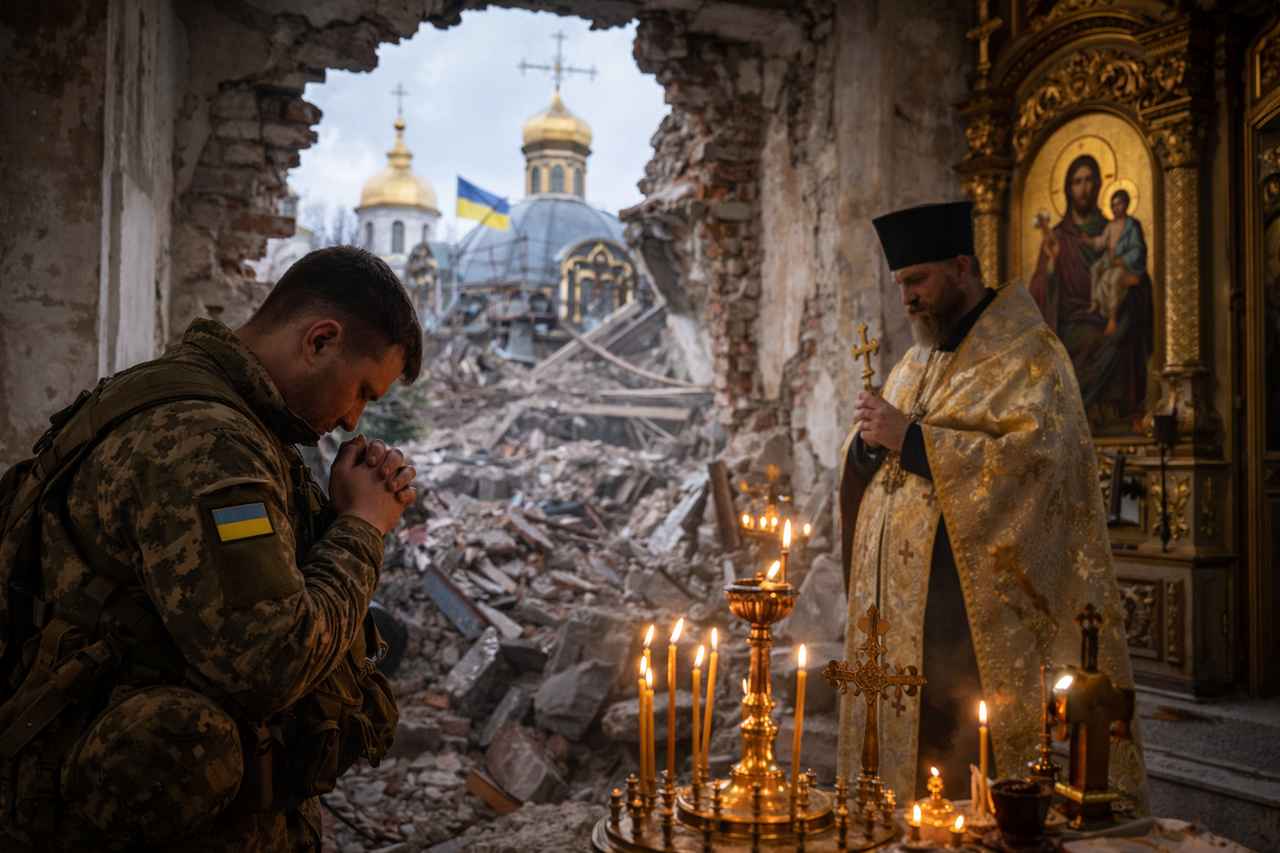
Ukraine is not a distant headline for Christians to glance at and move past. It is a nation where war has entered homes, churches, hospitals, schools, villages, cities, military units, refugee shelters, and gravesides. Pastors are comforting the bereaved. Chaplains are praying with exhausted soldiers. Churches are receiving displaced families. Believers in occupied or frontline areas face fear, pressure, loss, and grief that can continue long after an attack has ended.
Prayer for Ukraine must therefore be more than a general wish for peace. It should be specific enough to remember wounded families, displaced children, grieving churches, faithful pastors, soldiers carrying heavy moral burdens, and believers trying to serve Christ without being consumed by hatred, despair, propaganda, or revenge.
Prayer Burden at a Glance
Pray for Christians in Ukraine—especially pastors, chaplains, displaced families, grieving communities, churches serving the wounded, and believers in occupied or frontline areas—to endure in Christ, serve with mercy, resist hatred and despair, seek justice and peace, and bear faithful gospel witness amid prolonged war.
Last verified: June 2026
Why Ukraine Needs Prayer Now
Ukraine needs prayer because prolonged war is shaping ordinary life, church life, family life, and public life.
Ukraine needs prayer now because the war is still shaping ordinary life, church life, family life, and public life. Russian missile and drone attacks continue to harm civilians and infrastructure. Many Ukrainians live with interrupted sleep, damaged homes, grief, separation, and uncertainty about whether the next attack will reach their town, apartment block, school, power station, or church community.
The humanitarian burden remains severe. UNHCR reports that millions of Ukrainians remain displaced inside the country or outside its borders, while many more inside Ukraine continue to need urgent humanitarian assistance. These figures are not only statistics. They represent children learning in disrupted conditions, elderly people left far from familiar support, mothers carrying families across borders, family members serving in the military, and churches trying to care for people whose lives have been uprooted.
For Christians, the burden is both practical and spiritual. Churches are serving displaced people, grieving families, wounded soldiers, widows, orphans, elderly people, and traumatized communities. Pastors and chaplains are helping people face death, guilt, fear, anger, and exhaustion. Believers must pray and serve in a way that tells the truth about evil without becoming ruled by hatred. They need courage, endurance, mercy, repentance, justice, and hope in Christ.
Prayer for Ukraine should be honest about real suffering while still asking God to keep His people faithful. Christians should pray for protection and justice, but also for mercy, truth, forgiveness, spiritual endurance, and a clear witness to Christ amid war.
Country Snapshot
A concise orientation to Ukraine’s region, wartime setting, religious landscape, and Christian-pressure context.
Ukraine’s church landscape is complex. Many Ukrainians identify with Orthodox Christianity, but Orthodox life itself is divided across different bodies and loyalties. Greek Catholic, Roman Catholic, Protestant, evangelical, Jewish, Muslim, and other communities also form part of Ukraine’s religious life. Readers should not reduce Ukraine’s religious life to one simple label.
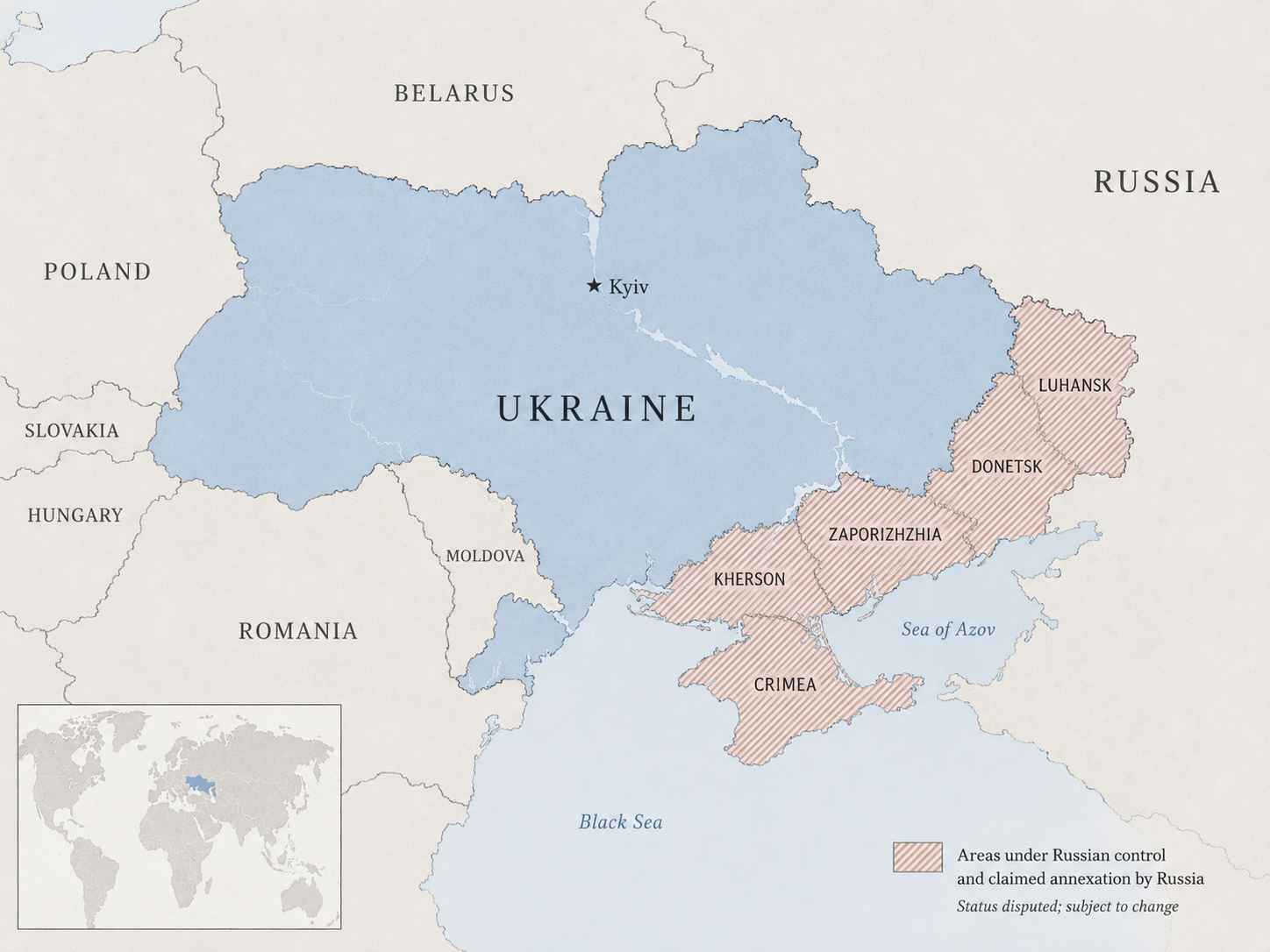
The key distinction is between government-controlled Ukraine and Russian-occupied territories. In government-controlled areas, the prayer burden includes war strain, displacement, pastoral exhaustion, religious-liberty concerns, and the challenge of protecting national security without unjust collective punishment. In occupied areas, the prayer burden is often sharper: pressure on clergy, forced re-registration, church seizures or closures, surveillance, and restrictions on religious communities that do not fit Russian occupation rules.
Restrictions and Opposition Facing Christians
Specific restrictions, opposition, hostility, or vulnerabilities that materially affect Christians in Ukraine.
War itself
Christians in Ukraine are not praying from a normal peacetime setting. Churches are serving people who have lost homes, family members, health, livelihoods, and the ordinary stability of life. Pastors may be asked to preach hope while burying the dead, comforting the wounded, and caring for congregations whose members have scattered.
Displacement
Refugees outside Ukraine and internally displaced people inside Ukraine often face exhaustion, uncertainty, legal and economic questions, school disruption, language barriers, family separation, and the ache of not knowing whether home will still be there. Churches that receive displaced people need wisdom, resources, patience, and protection from growing weary.
Frontline and occupied areas
Believers in frontline communities may face shelling, loss of electricity or water, damaged church buildings, limited medical care, and the constant difficulty of gathering safely. In Russian-occupied territories, religious communities not aligned with Moscow-backed structures may face monitoring, forced registration under occupation rules, property pressure, restricted worship, or direct pressure on clergy and active believers.
Moral and spiritual exhaustion
Long war can harden hearts. It can make hatred feel natural, make revenge feel righteous, and make despair feel reasonable. Ukrainian Christians need prayer not only to survive war, but to remain faithful in it: truthful without cruelty, courageous without pride, merciful without naivety, and hopeful without denial.
Religious and legal complexity
Ukraine’s action against religious organizations linked to Russia, especially the Ukrainian Orthodox Church historically connected with Moscow, must be handled carefully. Ukraine needs protection from genuine wartime collaboration and Russian religious-political manipulation, while ordinary worshippers should not be treated as guilty simply because of church affiliation.
Ukrainian officials present action against Russia-linked religious organizations as a national-security issue because of Russia’s war and the Russian Orthodox Church’s support for it. Critics and observers have raised concerns about religious freedom and collective punishment. Both concerns are real. Christians should pray for careful evidence, fair process, protection from Russian interference, and freedom for peaceful worship.
Christian Life and Witness in Ukraine
How churches and believers in Ukraine worship, serve, endure, and bear witness in the country’s actual setting.
For many Christians in Ukraine, church life now includes both worship and emergency care. Congregations may gather for prayer and then organize food, shelter, evacuation help, repairs, children’s support, grief care, or assistance to soldiers’ families. The Sunday service and the humanitarian response are often not separate parts of life. They belong to the same calling to love God and neighbor in a country at war.
Pastors carry heavy burdens. They may shepherd people who are grieving, displaced, frightened, angry, exhausted, or spiritually numb. They may serve congregations whose members are serving in the military, living abroad, returning from occupation, or trying to rebuild after damage. They need strength to preach Christ without turning sermons into slogans and to help people lament honestly without surrendering hope.
Military chaplains also need sustained prayer. Current reporting describes Ukrainian chaplains from multiple faith traditions serving along the front lines, offering moral and spiritual support to soldiers who face fear, guilt, loss, and battle fatigue. Their work is not merely ceremonial. They stand close to suffering, help soldiers speak about death and conscience, and often carry wounds of their own.
Christians in occupied territories face a different burden. Some cannot gather freely, speak openly, or maintain normal ties with churches in government-controlled Ukraine. Clergy and active believers may face surveillance, pressure to register under occupation structures, or the loss of buildings and ministries. These believers need prayer for protection, wisdom, endurance, and the comfort of Christ when they feel unseen.
Families are also under strain. Some are separated across borders. Some have loved ones in the military. Some are grieving the dead or caring for the wounded. Some children are growing up with air-raid alarms, disrupted schooling, absent parents, and fear. Christian prayer should remember not only public leaders and soldiers, but also ordinary households carrying the war day by day.
Recent Developments
Recent developments matter because they affect how Christians should pray for Ukraine’s churches, families, pastors, chaplains, displaced people, and communities under attack.
-
June 2026
Russian missile and drone attacks continue to harm civilians
In early June 2026, Associated Press reported a major Russian aerial assault using missiles and drones across Ukrainian cities, including Kyiv, Dnipro, Kharkiv, and Zaporizhzhia. The attack killed and injured civilians and damaged homes, infrastructure, and energy facilities.
Prayer significance: Pray for protection of civilians, endurance for first responders, and churches serving people after attacks.
-
December 2025 / accessed June 2026
Displacement and humanitarian needs remain high
UNHCR’s Ukraine emergency page says millions of people remain displaced and more than twelve million people inside Ukraine need urgent humanitarian assistance.
Prayer significance: Pray for refugees, internally displaced people, returnees, children, elderly people, host families, and churches that continue to serve them.
-
2025
Ukraine’s action involving Russia-linked religious organizations remains contested
Ukraine’s legal action involving Russia-linked religious organizations remains a sensitive religious-freedom issue. Associated Press has reported on Ukraine’s move against the Ukrainian Orthodox Church, which the government says remains tied to the pro-war Russian Orthodox Church, even though the church says it has separated from Moscow. Critics argue that the action risks violating religious liberty or punishing believers collectively.
Prayer significance: Pray for truth, justice, careful evidence, protection from Russian manipulation, and genuine religious freedom for ordinary worshippers.
-
2025–2026
Religious pressure in Russian-occupied territories remains a distinct concern
Russian-occupied territories remain a distinct concern. Occupied-territory religious-freedom reporting describes pressure on clergy, church closures or seizures, forced re-registration, and restrictions on religious life under Russian control. This should shape prayer for believers in Crimea, parts of Donetsk, Luhansk, Zaporizhzhia, Kherson, and other areas under Russian control or pressure.
Prayer significance: Pray for believers in occupied areas to receive protection, wisdom, endurance, and the comfort of Christ when worship and fellowship are restricted.
The present burden is therefore not only that the war continues. It is that prolonged war is pressing on churches, families, consciences, children, rulers, soldiers, refugees, and believers in occupied places. Prayer for Ukraine must remain concrete, compassionate, morally serious, and Christ-centered.
How to Pray
These prayer points turn Ukraine’s present burden into specific intercession for churches, families, pastors, chaplains, occupied believers, rulers, and gospel witness.
-
Pray for churches to remain faithful under prolonged war. Ask God to strengthen congregations, pastors, elders, deacons, ministry workers, and volunteers as they worship, preach, counsel, serve, and care for people whose homes, families, churches, and communities have been deeply wounded.
-
Pray for displaced families, refugees, and returnees. Ask the Lord to protect children, elderly people, widows, single parents, separated families, and those trying to rebuild after displacement. Pray that churches would have wisdom, patience, resources, and long-term endurance as they serve people whose needs do not end quickly.
-
Pray for pastors, chaplains, and trauma-care workers. Ask God to give them courage, humility, compassion, and clear faith in Christ as they walk with soldiers, the wounded, the bereaved, and people wrestling with fear, guilt, death, justice, and hope.
-
Pray for believers in occupied and frontline areas. Ask the Lord to protect Christians who face shelling, surveillance, restricted worship, church closures, pressure on clergy, or forced registration under occupation rules. Pray that they would receive wisdom, courage, trusted fellowship where possible, and the comfort of Christ when they feel isolated.
-
Pray for Ukrainian Christians to resist hatred and despair. Ask God to make His people truthful about evil without becoming cruel, courageous without becoming proud, and committed to justice without being ruled by revenge. Pray that lament, grief, and anger would be brought honestly before the Lord and not become bitterness.
-
Pray for rulers and those with authority. Pray for Ukrainian, Russian, and international decision-makers, including military leaders, judges, diplomats, and local officials. Ask God to restrain corruption, falsehood, cruelty, and reckless decisions; to protect civilians; to uphold justice; and to grant any peace that does not abandon truth or the vulnerable.
-
Pray for gospel witness amid war. Ask the Lord to keep the name of Christ clear in Ukraine through faithful preaching, patient service, costly mercy, forgiveness where repentance is needed, and hope that rests in Christ’s kingdom rather than in changing circumstances.
Give Thanks
These thanksgivings name real mercies without minimizing Ukraine’s suffering.
-
Give thanks for churches serving their neighbors. Many congregations continue to worship, pray, feed, shelter, counsel, evacuate, repair, and comfort those harmed by war.
-
Give thanks for pastors, chaplains, and volunteers who stay close to suffering people. Their ministry among soldiers, grieving families, displaced people, wounded communities, and fearful households is a real mercy from God.
-
Give thanks for refugee and humanitarian support. International agencies, local churches, volunteers, host families, and Christian ministries continue to serve refugees, internally displaced people, children, elderly people, and returnees.
-
Give thanks for every mercy that holds back wider suffering. Every preserved life, every successful evacuation, every repaired home, every opened shelter, every honest negotiation, and every act of mercy is a reason to thank God.
-
Give thanks that Christ’s church continues to endure under war. Even when buildings are damaged, families are scattered, and communities are exhausted, believers continue to pray, serve, sing, grieve, forgive, and confess Christ.
Last Verified / Update Note
This note helps readers understand when the guide was reviewed and which developments may affect future prayer use.
Review Status
Reviewed for current prayer use
Current reporting on the ongoing war, recent Russian missile and drone attacks, humanitarian need and displacement, church and chaplaincy burdens, religious-freedom concerns in government-controlled Ukraine, and pressure on religious communities in Russian-occupied territories.
Major changes in the front line, attacks on civilians or infrastructure, refugee and internally displaced population movements, ceasefire or negotiation developments, religious-freedom cases involving Russia-linked religious organizations, and new reporting on churches or believers in occupied territories may affect how readers should pray for Ukraine.
Key Sources Consulted
These are the sources that materially informed the current version of this prayer guide.
Current war and civilian suffering
- Associated Press. “Massive Russian attack kills 22 people across Ukraine, officials say, as Moscow escalates fighting.” Associated Press, June 2, 2026. Used for current missile, drone, civilian-casualty, and infrastructure-strike context.
- The Guardian. “Ukraine war briefing: Russia losing on the ground so pivots to air war, say analysts.” The Guardian, June 4, 2026. Used for current war-context and escalation framing, with caution because live war analysis can change quickly.
Humanitarian need and displacement
- UNHCR. “Ukraine Emergency.” United Nations High Commissioner for Refugees, updated December 2025, with 2026 operational materials linked. Used for humanitarian need, internally displaced people, refugee figures, and response-planning context.
- UNHCR Operational Data Portal. “Ukraine Refugee Situation.” United Nations High Commissioner for Refugees, accessed June 2026. Used for refugee-response documents, population-movement factsheets, and displacement-related source context.
Church life, chaplaincy, and pastoral burden
- Le Monde. “Ukraine’s Military Chaplains Bear Witness to the Hell of the Front Lines.” Le Monde, April 22, 2026. Used for current chaplaincy, frontline pastoral care, and spiritual-moral strain.
Religious freedom, occupation, and contested church-law issues
- Associated Press. “Ukraine Moves to Ban an Orthodox Church It Says Is Linked With Pro-War Moscow Church.” Associated Press, 2025. Used for the Ukrainian Orthodox Church legal case, Ukraine’s stated national-security rationale, and criticism related to religious freedom and collective punishment.
- Mission Eurasia. “Faith Under Russian Terror: Analysis of the Religious Situation in Ukraine.” Mission Eurasia, January 2025. Used for occupied-territory religious-freedom context, including pressure on clergy, forced registration, church closures or seizures, and restrictions on religious education and charity work.
Source Context
These notes explain how different sources were used in this guide.
Source Context
- Current war reporting: Associated Press and other current news sources were used for recent attacks, civilian harm, and war developments because those details can change quickly.
- Humanitarian and displacement data: UNHCR was used for humanitarian need, refugees, internally displaced people, and response planning. UNHCR figures are essential for scale, but the prayer guide does not reduce displaced people to numbers.
- Chaplaincy and pastoral burden: Le Monde was used for chaplaincy and pastoral-strain reporting because it gives current detail about the spiritual and emotional burdens carried by chaplains and soldiers.
- Contested church-law issue: The Associated Press report on Ukraine’s action against the Ukrainian Orthodox Church was used because that issue requires careful lane distinction. It includes both Ukraine’s national-security rationale and concerns about religious freedom.
- Occupied-territory pressure: Mission Eurasia was used for religious-freedom pressures under Russian occupation. Those claims should be kept distinct from the religious-freedom debate inside government-controlled Ukraine.
A Closing Prayer for Ukraine
Gathering this prayer guide into one focused prayer before God.


