

Russia should be prayed for with grief, humility, and clear Christian hope. It is a vast country with visible Orthodox worship, long Christian history, and millions who still identify with Christianity. Yet Russia is also marked by war, fear around public speech, tighter state control, pressure on minority religious communities, and the danger that Christian language may be used to support national power rather than call people to repentance, mercy, and truth.
To pray for Russia faithfully, Christians must hold several truths together. We should grieve the suffering caused by the war against Ukraine. We should pray for Russians living under propaganda, censorship, suspicion, and wartime strain. We should ask God to strengthen believers whose consciences are troubled by the war. We should pray for churches to honor Christ above nationalism, public favor, fear, or state pressure. And we should plead for repentance, mercy, justice, restraint, and a peace that does not depend on denial or falsehood.
Pray for Russia as the war against Ukraine wounds Ukrainians and Russians, public speech is constrained, and Christians face pressure to confuse loyalty to Christ with loyalty to state or nation. Ask God to restrain evil, expose lies, protect civilians and prisoners, strengthen believers and minority churches under scrutiny, and bring repentance, mercy, and a just peace.
Last verified June 12, 2026
Why Russia Needs Prayer Now
Russia needs prayer now because war, public fear, restricted speech, church-state entanglement, and nationalist pressure all affect Christian conscience, church life, and public witness.
Russia needs prayer now because the war against Ukraine continues to affect conscience, families, public speech, pastoral courage, church witness, and ordinary life. As of June 2026, Russia remains a central military actor in the conflict. Vladimir Putin rejected Volodymyr Zelenskyy’s proposal for a direct meeting and said he saw no point in such talks at that time. Reporting on Putin’s remarks says he framed Russia’s position as seeking a broader settlement rather than a temporary pause alone.
Russian officials have explained the conflict through claims about security, sovereignty, territorial settlement, Western pressure, and Ukraine’s political direction. Christians should not accept those claims simply because they are official, but neither should they ignore them. Careful prayer requires distinguishing Russia’s stated explanation from confirmed facts, outside criticism, contested claims, and the moral judgments Christians bring before God.
The war also reaches far beyond the battlefield. It affects conscience, families, public speech, pastoral courage, and the church’s witness. Some Russians are shaped by official narratives, some are fearful, some support the war, some quietly grieve it, and some have paid a price for speaking against it. Christians should pray neither with hatred toward Russia nor with blindness toward injustice. They should pray for truth, repentance, restraint, and mercy.
Russia also needs prayer because public space for dissent and independent civil society has narrowed. AP reported that Russia’s Supreme Court designated Memorial, the Nobel Prize-winning rights movement, as “extremist,” and Russia’s Ministry of Justice extremist-organization list now includes the International public movement Memorial and its structural subdivisions. Memorial is not a church body, but its case matters for Christian prayer because restrictions on truth-telling, historical memory, civil society, and freedom of conscience affect the setting in which believers speak, worship, teach, and act.
Digital restrictions also affect daily life and witness. Mobile internet shutdowns, messaging disruption, and possible whitelist-style controls do not only inconvenience citizens. They shape what people can read, say, verify, organize, and share. In a country where public speech is already costly, control over communication can deepen fear and isolation.
Russia therefore calls for sober prayer: for peace, for the restraint of evil, for courage among believers, for mercy toward victims, for truthful witness, and for churches that remain faithful to Christ when national power asks for spiritual approval.
Country Snapshot
A brief orientation to Russia’s scale, religious landscape, and church context before turning to prayer.
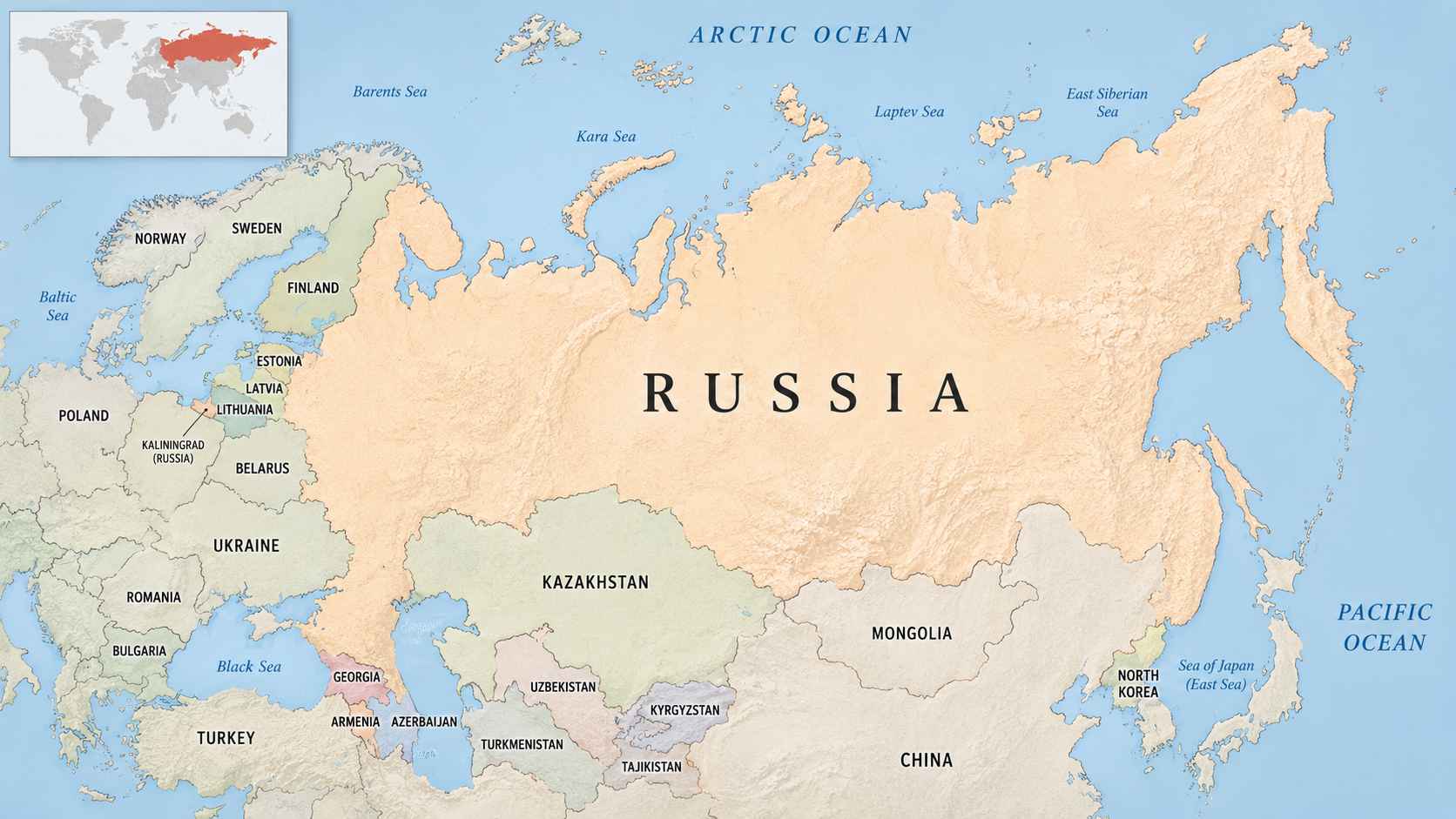
Russia stretches across Eastern Europe and northern Asia. It is the largest country in the world by land area and is home to more than 140 million people, though population figures vary depending on source and territorial methodology. Moscow is the capital, and Vladimir Putin remains Russia’s president as of June 2026.
Orthodoxy is the dominant religious identity in Russia. Pew Research Center has described Russia as having the world’s largest Orthodox Christian population, with more than 100 million Orthodox Christians. Pew’s regional survey materials also identify a significant Muslim minority and a sizable unaffiliated population. Other Christian communities, including Protestants and Catholics, are much smaller.
Russia’s religious landscape cannot be understood only by counting affiliation. Public Christianity remains visible, especially through the Russian Orthodox Church. At the same time, religious identity, national identity, state power, and wartime narratives can overlap in ways that test conscience and make it harder for believers to speak, worship, and obey Christ truthfully.
Spiritual and Practical Challenges Affecting Christians and Churches
The burdens facing Russian believers differ by church tradition, legal status, public visibility, conscience, and local setting.
Church-state entanglement
Christians in Russia do not all face the same conditions. The Russian Orthodox Church has a privileged public place and remains deeply woven into national history and public life. Many Orthodox believers worship sincerely, keep family and church traditions, and live ordinary Christian lives in their communities. That must not be ignored or caricatured.
Yet the church-state relationship creates serious spiritual danger. When public Christianity is closely joined to state power or wartime narratives, believers may feel pressure to treat loyalty to national policy as though it were loyalty to Christ. Pastors and church members whose consciences are troubled by the war may fear isolation, discipline, public suspicion, or legal consequences.
Legal and administrative burdens on minority religious communities
Minority Christian communities and other religious minorities face more direct burdens. Russia’s anti-extremism and anti-missionary frameworks have been used against groups the state regards as dangerous, foreign, disloyal, or socially harmful. Jehovah’s Witnesses have faced criminalization under extremist labeling. Some evangelical and Baptist communities have faced legal and administrative pressure connected to worship, missionary activity, or unregistered gatherings. Religious leaders who oppose the war from Christian conviction may also face serious consequences.
Fear, speech, and conscience
The word “pressure” needs to be made concrete. For some believers, it may mean a closed building, a fine, a raid, an interrogation, a restricted meeting, an online post treated as disloyal, or a sermon that cannot be preached freely. For others, especially inside larger and more publicly accepted churches, the burden may be quieter: the temptation to stay silent, to repeat official language, or to avoid naming sin where truth would be costly.
War and contested authority
These burdens can be heavier in Crimea, which Russia annexed in 2014 and claims as its own, and in the parts of Donetsk, Luhansk, Zaporizhzhia, and Kherson regions that Russia controls and claims to have annexed from Ukraine. In those places, war, contested authority, identity pressure, damaged infrastructure, fear of detention, property loss, and religious-control concerns can affect the same families, churches, and communities at once.
Christian Life and Witness in Russia
Christian life in Russia includes visible worship, quiet discipleship, minority-church endurance, and conscience tested by war and public fear.
Christian life in Russia can look very different from one place to another. In some settings, believers attend public liturgies, gather for prayer, celebrate Christian holy days, baptize children, and live with little immediate fear. In other settings, especially among smaller or less favored communities, gathering, evangelism, public teaching, or even private religious identity can carry risk.
For Orthodox Christians, one prayer burden is that visible worship, church tradition, and national religious identity would lead to repentance, faith in Christ, obedience to Scripture, and mercy toward neighbors rather than remain only cultural inheritance. Pray especially for pastors and believers who want to speak truthfully without despising their people or surrendering to fear.
For evangelical Christians, Baptists, Pentecostals, and other minority Christian communities, faithfulness may require patience under legal scrutiny, wisdom in public speech, and courage to continue worship and discipleship when official suspicion rises. Some believers may gather quietly. Some may avoid online attention. Some may face family or local hostility, especially if they are viewed as belonging to a foreign or nontraditional religious group.
For Christians troubled by the war, the burden can be deeply personal. A believer may have relatives in the military, Ukrainian neighbors or family ties, a pastor under pressure to use state-approved language, or a conscience wounded by propaganda and fear. Faithfulness may involve refusing hatred, resisting lies, praying for enemies, grieving civilian suffering, and asking God for a peace rooted in truth.
For believers in Russian-controlled areas of Ukraine, daily Christian life may be shaped by destroyed infrastructure, shortages, Russian administrative control, pressure around identity, fear of detention or accusation, and uncertainty over property, movement, worship, and public speech. Pastors and families there need prayer not only for the principle of religious freedom, but for endurance, safety, truthfulness, and the preservation of worship under harsh conditions.
Recent Developments
Recent developments are included only where they sharpen how Christians should pray for Russia now.
-
June 2026
Russia rejects direct talks while diplomatic pressure continues
In June 2026, Vladimir Putin rejected Volodymyr Zelenskyy’s proposal for a direct meeting and said he saw no point in such talks at that stage. Current reporting described Russia’s position as favoring a broader settlement rather than a temporary ceasefire alone. Around the same period, European diplomatic efforts continued to press for renewed peace discussions, while Russian officials accused European governments of prolonging the war.
Direct talks have not moved forward, distrust remains deep, and civilians continue to suffer while leaders debate the terms of peace. Christians should pray for truth, restraint, repentance, wise diplomacy, protection for civilians, and a just peace that does not rest on denial, revenge, or falsehood.
-
June 2026
Strikes inside Russia and pressure on Crimea’s fuel supply
Recent reporting described intensified Ukrainian strikes inside Russia and against Russian supply routes. AP reporting in June 2026 described attacks affecting fuel supplies to Crimea, which Russia annexed in 2014 and claims as its own, causing shortages and rationing on the peninsula.
These strikes show how the war is reaching supply networks, civilian households, and territories where control and legal status remain contested. Christians should pray for protection of civilians, restraint in warfare, mercy for ordinary families, and truthful public reporting while wartime claims and counterclaims continue.
-
April 2026
Orthodox Easter ceasefire fails
In April 2026, a brief Orthodox Easter ceasefire quickly faltered, with Russia and Ukraine accusing each other of repeated violations. Even a pause connected to one of the church’s greatest feasts did not produce lasting quiet.
The failed pause shows how deep mistrust, retaliation, and wartime hardness remain. It also raises a painful spiritual concern: Christian holy days may be publicly recognized while mercy, restraint, truth-telling, and protection of life remain weak.
-
April 2026
Memorial listed under Russia’s extremist framework
On April 9, 2026, AP reported that Russia’s Supreme Court designated Memorial as “extremist,” criminalizing its activities inside Russia. Russia’s Ministry of Justice extremist-organization list now includes the International public movement Memorial and its structural subdivisions.
Memorial is not a church body, but its case matters for Christian prayer because restrictions on truth-telling, historical memory, civil society, and freedom of conscience affect the setting in which believers speak, worship, teach, and act.
Christians should pray for truth, justice, wise courage, and protection for those who seek to speak honestly under pressure.
-
2026
Internet restrictions and communication control deepen
In 2026, reporting on Russia continued to describe mobile internet shutdowns, messaging disruption, and concerns about more controlled access to approved online services. Such restrictions can affect ordinary citizens, churches, families, pastors, journalists, lawyers, and believers trying to communicate, verify information, or act according to conscience.
Control over information can deepen fear and isolation. Christians should pray that God would preserve truth, protect conscience, strengthen believers who must speak carefully, and give courage to those seeking mercy and honesty in a controlled public space.
How to Pray
Turn Russia’s war, public fear, church pressures, and remaining mercies into specific intercession.
-
Pray for a just peace and the restraint of evil. Pray that God would restrain evil, expose lies, humble rulers, and bring a just peace to the war against Ukraine. Ask Him to give wisdom and moral courage to those with power over military decisions, negotiations, courts, prisons, and public information, and to protect civilians whose lives are shaped by those decisions.
-
Pray for Ukrainians and Russians suffering because of the war. Pray for civilians under attack, grieving families, prisoners, soldiers, displaced people, and communities living with fear and loss. Ask God to preserve life, return captives, comfort the bereaved, restrain revenge, and bring mercy where hatred has deepened.
-
Pray for Russian Christians whose consciences are strained. Pray for believers burdened by war, propaganda, censorship, and fear. Ask the Lord to give them wisdom to know when to speak and when to act quietly, courage to refuse hatred and lies, and grace to remain faithful to Christ when silence feels safer.
-
Pray for churches in Russia to honor Christ above national loyalty. Ask God to purify worship, strengthen faithful preaching and discipleship, deepen repentance, and keep Christian language from being used to bless what is false or unjust.
-
Pray for Orthodox believers and minority Christian communities. Pray for Orthodox believers, evangelical churches, Baptists, Pentecostals, and other Christian communities in their different settings. Ask God to strengthen sincere worship, family discipleship, pastoral care, mercy toward neighbors, and clear witness to Christ without contempt, compromise, or fear.
-
Pray for minority congregations and other religious minorities under scrutiny. Pray for those whose worship, missionary activity, public speech, or unregistered gatherings may be treated by authorities as extremism, disloyalty, or unlawful religious activity. Ask God to protect the vulnerable, preserve access to Scripture, sustain pastors and families under scrutiny, and guard believers from bitterness or reckless speech.
-
Pray for believers in Crimea and Russian-controlled areas of Ukraine. Pray for believers in Crimea, which Russia annexed in 2014 and claims as its own, and in the parts of Donetsk, Luhansk, Zaporizhzhia, and Kherson regions that Russia controls and claims to have annexed from Ukraine. Ask God to protect pastors, children, families, churches, elderly believers, and displaced people living where war, damaged infrastructure, property insecurity, identity pressure, and contested authority meet.
Give Thanks
Give thanks carefully and honestly for real mercies that remain visible amid Russia’s heavy burdens.
-
Give thanks that Christian worship remains visible in many parts of Russia. Many believers still have space to gather, pray, baptize, teach, serve, and mark Christian holy days.
-
Give thanks for Russian believers who refuse hatred and resist lies. Some believers grieve suffering honestly and seek to follow Christ truthfully even when public speech is costly and silence may feel safer.
-
Give thanks for churches and families that continue quiet faithfulness. Give thanks for Scripture reading, teaching children, caring for the vulnerable, praying for peace, and serving neighbors in daily life.
-
Give thanks for every mercy that preserves life amid war. Give thanks for prisoner exchanges, families kept together or reunited, and acts of compassion that restrain cruelty.
Last Verified / Update Note
This note helps readers understand when the guide was reviewed and which developments may affect future prayer use.
Review Status
Reviewed for current prayer use
This review included current war-related developments; Russia’s June 2026 negotiation posture as represented in current reporting; European diplomatic pressure; the failed April 2026 Orthodox Easter ceasefire; Memorial’s April 2026 extremist designation; internet and communication-control concerns; religious-freedom conditions; broad religious-demographic background; and conditions affecting Crimea and the parts of Donetsk, Luhansk, Zaporizhzhia, and Kherson regions that Russia controls and claims to have annexed from Ukraine.
Direct Russian official sources were used where accessible and materially relevant, especially for legal and information-regulation context. Some specific war-diplomacy claims still rely on reputable reporting that quotes or summarizes Russian official positions because direct Kremlin, Ministry of Foreign Affairs, or Ministry of Defence pages for those specific claims were not retrieved in this review.
Major changes to watch include any ceasefire or peace negotiation; significant Russian or Ukrainian military escalation; new prisoner exchanges; new religious-freedom prosecutions; changes in anti-extremism, missionary, or internet-control enforcement; new official Russian statements, legal materials, or court records affecting the guide’s claims; or major developments affecting Crimea and the Russian-controlled parts of Donetsk, Luhansk, Zaporizhzhia, and Kherson regions.
Help keep this guide accurate and current
If you noticed a possible correction, broken link, or significant country update, please contact the Nations Prayer Directory so we can review it carefully.
Key Sources Consulted
Sources that materially informed this Russia prayer guide, including direct official materials, current reporting, religious-freedom assessment, and demographic background.
Direct Russian official sources
- Ministry of Justice of the Russian Federation. “List of organizations recognized as extremist under Russian Federation law.” Official Ministry of Justice page. Used for Russia’s official listing of the International public movement Memorial and its structural subdivisions, and for the official listing of Jehovah’s Witnesses-related organizations.
- Roskomnadzor. “Statute of Roskomnadzor.” Official Roskomnadzor page. Used for the agency’s official role in supervising communications, information technology, mass media, telecommunications, personal-data compliance, and related information-regulation functions.
- Supreme Court of the Russian Federation. Official website. Accessed June 2026. Checked for Memorial-related court materials; this review did not identify a usable Memorial-specific page. The Ministry of Justice extremist-organization list and AP reporting are therefore used for the Memorial designation unless a specific Supreme Court decision page is later found.
Current war, diplomacy, civilian impact, and civil-society developments
- Associated Press. “Ukraine targets St. Petersburg again after Putin rejects Zelenskyy’s offer for direct talks.” Associated Press, June 2026. Used for Ukrainian drone strikes inside Russia, Russia’s reported response, domestic security concerns, and the widening effect of the war inside Russia.
- The Guardian. “Ukraine war briefing: Putin says ‘no point’ meeting Zelenskyy, insists Russia will win the war.” The Guardian, June 6, 2026. Used for Putin’s public posture at the St. Petersburg International Economic Forum, Russia’s stated war aims, and Russia’s response to Zelenskyy’s direct-meeting proposal as represented in reporting.
- The Guardian. “Ukraine war briefing: France, Germany and UK make push in Moscow for peace talks.” The Guardian, June 12, 2026. Used for European diplomatic efforts in Moscow, Russia’s response to the E3 countries’ peace-talk push, Russian accusations that European governments were prolonging the war, and reported pressure on Russian supply routes.
- Associated Press. “Ukraine hits fuel supplies to Crimea, sparking a fuel crisis on the Russian-held peninsula.” Associated Press, June 2026. Used for current conditions affecting Crimea’s fuel supply, civilian strain, wartime logistics, and the effects of strikes on ordinary life.
- The Guardian. “Ukraine war briefing: Easter truce falters as Russia and Ukraine exchange prisoners.” The Guardian, April 12, 2026. Used for the failed Orthodox Easter ceasefire, mutual accusations of violations, and the prisoner exchange.
- Associated Press. “Russian court criminalizes the activities of the Nobel Prize-winning rights group Memorial.” Associated Press, April 9, 2026. Used for reporting on the Russian Supreme Court’s Memorial designation, the official legal characterization reported in the case, Memorial’s response, and outside criticism.
- Le Monde. “Putin’s ‘Davos’ in Saint Petersburg ends as it began, under a barrage of Ukrainian drones.” Le Monde, June 7, 2026. Used as supporting context for Ukrainian drone strikes around St. Petersburg, the psychological and civilian effects of the war inside Russia, and the connection between the war and public fear.
Internet restrictions and communication control
- The Guardian. “Unexplained Moscow internet blackouts spark fears of web censorship plan.” The Guardian, March 12, 2026. Used for mobile internet shutdowns, communication disruption, whitelist-system concerns, state-security explanations, and the effect of internet restrictions on ordinary life.
- The Guardian. “Russia slowly trying to splinter its internet from rest of world, analysts say.” The Guardian, March 31, 2026. Used as supporting context for gradual internet isolation, mobile blackouts, Telegram concerns, and wider information-control pressures.
Religious freedom and church-context sources
- U.S. Commission on International Religious Freedom. “Religious Freedom Conditions in Russia.” USCIRF country page, accessed June 2026. Used for current religious-freedom conditions, including the criminalization of peaceful religious groups, pressure on Jehovah’s Witnesses, religiously based opposition to the war, and Russia’s enforcement of its legal framework in Ukrainian territory it controls.
- U.S. Commission on International Religious Freedom. “Russia Country Update.” USCIRF, June 30, 2025. Used for additional religious-freedom context, anti-extremism enforcement, minority-religion pressure, and religious-control concerns.
- U.S. Commission on International Religious Freedom. “Prosecuting Blasphemy in Russia.” USCIRF, April 14, 2025. Used for background on Russia’s blasphemy-enforcement environment and its relevance to public religious speech.
Population and religious-background sources
- World Bank Data. “Population, total — Russian Federation.” World Bank, 2024 value. Used for broad population background and demographic orientation.
- Pew Research Center. “Religious Belief and National Belonging in Central and Eastern Europe.” Pew Research Center, May 10, 2017. Used for background on Orthodoxy, Russian religious identity, Russia’s significant Muslim minority, unaffiliated population, and the relationship between religion and national belonging.
- Pew Research Center. “Orthodox Christianity in the 21st Century.” Pew Research Center, November 8, 2017. Used for background on Russia’s place in global Orthodoxy and the size of its Orthodox Christian population.
Source Context
How to read the sources behind this guide in a disputed, fast-changing, and religious-freedom-sensitive setting.
Source Context
- Source mix. This guide uses a mix of direct Russian official sources, current reporting, religious-freedom assessment, and older demographic background sources.
- Official Russian sources. Direct Russian official sources are used where accessible and materially relevant, especially for Russia’s official extremist-organization list and Roskomnadzor’s institutional role in communications, information technology, mass media, and related legal compliance.
- War-diplomacy claims. Some specific war-diplomacy claims rely on reputable reporting that quotes or summarizes Russian official positions because this review did not identify direct Kremlin, Ministry of Foreign Affairs, or Ministry of Defence pages for those specific April–June 2026 claims.
- Fast-changing developments. Current reporting is used for issues such as the war, ceasefire conditions, peace-talk efforts, Ukrainian strikes inside Russia, fuel shortages affecting Crimea, internet restrictions, and civil-society repression. Readers should understand these claims in light of the June 12, 2026 review date, especially if major war, diplomatic, legal, internet-control, or religious-freedom developments occur after publication.
- Religious-freedom reporting. USCIRF material is used for religious-freedom assessment and should be read as an external religious-freedom source, not as the sole basis for all current political or military claims.
- Religious-demographic background. Pew Research Center material is older and is used only for broad religious-demographic and church-context background, not for current war, legal, or religious-freedom conditions.
- Population wording. Population wording is intentionally rounded because sources differ and because territorial counting can be sensitive in Russia’s case, especially where Crimea and other contested territories are involved.
- Official framing. Official Russian materials are used to represent Russia’s stated legal and institutional framing. They are not treated as independent verification of disputed claims or as morally decisive simply because they are official.
A Closing Prayer for Russia
Gathering this prayer guide into one focused prayer before God.


