


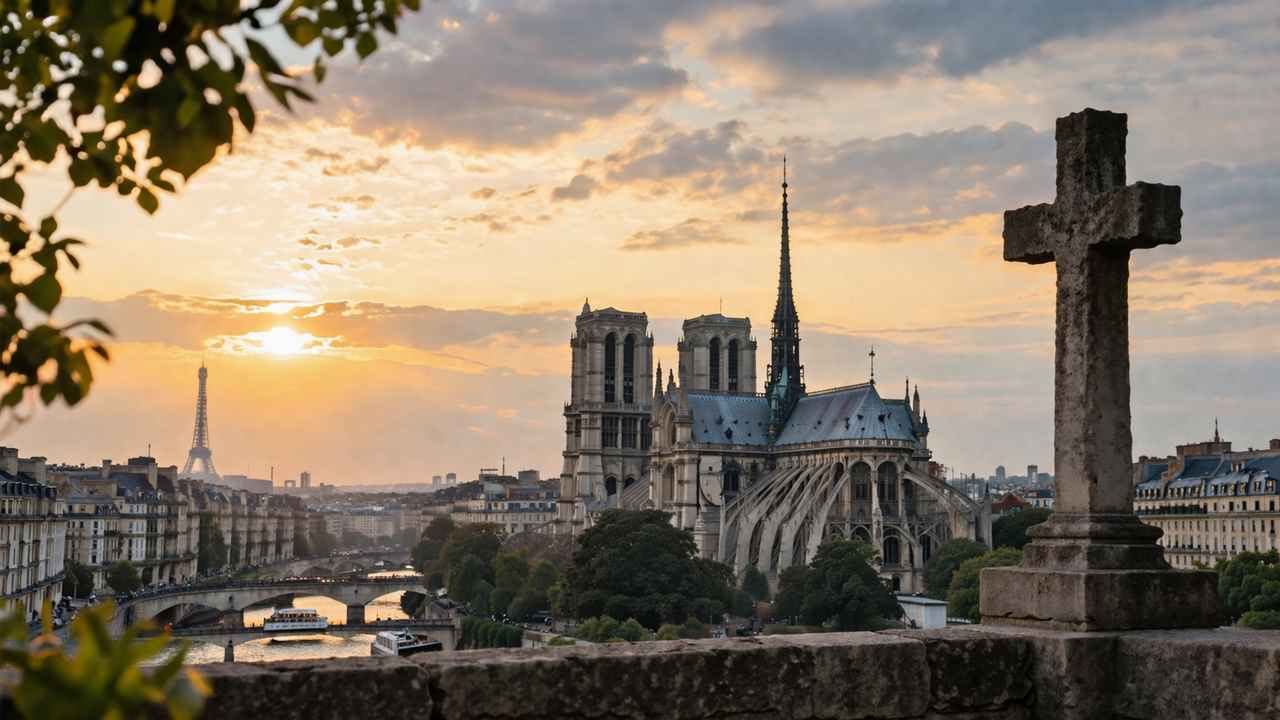
France still carries the memory of Christianity in its cathedrals, villages, public holidays, and long national story. Yet much of modern French life is now marked by deep secular drift, growing unease with visible faith in public life, and a moral tiredness that can make steady Christian witness feel strange or unwelcome. That is why France deserves informed prayer now. The country is not closed to the gospel, and it is not without clear signs of grace. Churches still gather openly, Scripture is still read, and many are still coming to baptism. But many believers are learning to follow Christ in a setting where faith is often treated as something private, marginal, or best kept quiet.
Why This Country Needs Prayer Now
France needs prayer now because spiritual hunger and spiritual indifference live side by side. The country still bears the marks of a deeply Christian past, but it has become one of the most secularized societies in Europe. The National Institute of Statistics and Economic Studies (INSEE) reported that in 2019–2020, 51% of people ages 18 to 59 in metropolitan France said they had no religion. The U.S. State Department’s 2023 religious-freedom report also described a country in which large parts of the population either identify weakly with religion or do not identify with it at all.
This does not mean religion has disappeared from public life. In France, religion is often debated precisely because it remains sensitive. The country’s model of laïcité, its constitutional form of secularism, is defended by many as a way of preserving public neutrality. Yet in practice, its application continues to spark controversy, especially in schools, sports, and other state-linked settings where visible religious expression is restricted or closely watched. Christians in France do not usually face the kind of direct repression seen in more restrictive countries, but they do live in a culture where serious faith can be treated as awkward, disruptive, or better kept private.
France also needs prayer because anti-religious hostility remains real. In February 2026, the Interior Ministry reported that anti-religious acts in 2025 remained just under 2,500 nationwide. Of these, 843 were anti-Christian acts, a 9% increase over 2024. That should not be exaggerated into a dark caricature of the whole nation. But neither should it be minimized. It is a sober reminder that churches and Christian communities cannot simply assume social peace.
And yet France is not only a story of decline. In March 2026, the French bishops’ conference reported record Easter baptism figures: more than 13,000 adults and more than 8,000 adolescents preparing for baptism. Those numbers do not tell the whole story of the church in France, and they belong especially to the Roman Catholic context. Still, they are too striking to ignore. In a country known for secularism, they are a reminder that the Lord is still drawing people to Himself.
Country Snapshot
France is a major Western European republic with an estimated population of 69,082,000 people as of January 1, 2026. Emmanuel Macron remains President of the Republic, and Sébastien Lecornu has served as prime minister since February 26, 2026.
Historically, France was deeply shaped by Roman Catholic Christianity. That inheritance still matters, but it no longer describes the spiritual condition of the country by itself. Modern France is religiously mixed and strongly secular. INSEE’s 2019–2020 findings for adults ages 18 to 59 in metropolitan France reported 29% identifying as Catholic, 10% as Muslim, 9% as adherents of another Christian tradition, and 51% with no religion. Other surveys use different methods and produce somewhat different totals, so these figures should be handled with care. Even so, the broad pattern is clear: Christianity remains visible, Islam is a significant part of the national landscape, and secularization is now one of the strongest forces shaping French public and private life.
France is also home to a wide range of Christian traditions, including Roman Catholic, Reformed, Lutheran, evangelical, Orthodox, migrant, and international congregations. That matters for prayer. It means France is not merely a museum of Christian memory. It is still a place where real churches gather, preach, disciple, serve, and bear witness in a demanding age.
Main Pressures Facing Christians
The main pressure facing Christians in France is not usually the outright banning of worship. It is the steady pressure of secularization. Many believers live in a culture that is happy to preserve religious buildings, language, and tradition as heritage, yet uneasy with confident, public, truth-claiming Christianity in the present. Faith may be tolerated as private sentiment while being viewed with suspicion when it becomes visible, moral, or evangelistic.
A second pressure comes from the way religion is negotiated in public life. France’s understanding of laïcité is meant to protect the neutrality of the state, but debates over its reach continue to affect schools, sports, and public institutions. The result is a setting in which believers may feel they must constantly explain why visible faith is not a civic threat. That burden does not fall only on Christians, and it should not be described carelessly. Still, it shapes the atmosphere in which Christians teach, serve, and witness.
A third pressure is anti-religious hostility itself. The Interior Ministry’s 2025 figures included 843 anti-Christian acts, most involving property, though physical, verbal, and online hostility also rose. This should not be turned into sensational rhetoric, and it should not erase the state’s stated effort to protect places of worship. But it is a real reminder that some churches and believers face more than indifference. They also face contempt, vandalism, and fear.
There is also an inward pressure that may be harder to measure but just as serious: discouragement. In a deeply secular setting, Christians can grow tired, privatized, or theologically thin. They may still attend church, yet with shrinking confidence that the gospel is truly good news for their neighbors and for the life of the nation. France needs prayer not only for protection from hostility, but also for deeper faith, courage, and endurance within the church.
What Life Is Like for Christians in France
For many believers in France, ordinary Christian life is legally possible but spiritually demanding. Churches can gather. Scripture can be preached. Christian organizations can serve openly. Yet everyday discipleship often unfolds in a setting where faith is assumed to be personal, optional, and best kept from shaping public claims about truth, morality, and hope.
That means faithfulness often looks quiet before it looks dramatic. It looks like pastors who keep preaching Christ when the culture has grown tired of transcendence. It looks like parents discipling children in a society full of distraction but short on spiritual depth. It looks like young believers learning not to be ashamed of the gospel in universities, workplaces, and neighborhoods where Christian conviction can seem strange or old-fashioned.
For churches, ministry in France often requires patience. The task is not simply to react against secularism, but to bear witness within it: to speak clearly without becoming shrill, to love neighbors without surrendering conviction, and to hold together truth and tenderness in a climate that may reward neither. This is one reason France should not be painted in flat, hopeless colors. The burden is real, but so is the grace God gives for long obedience.
There are also visible signs of life. The National Council of French Evangelicals (CNEF) says it represents a large share of France’s evangelical churches and reports roughly 2,530 places of worship and about 745,000 practitioners in France. That does not remove the country’s spiritual need, but it does show that evangelical witness is organized, present, and not negligible.
Christian witness also appears through service and mercy. The Protestant Federation of France reported in its 2025 activity report that it renewed a humanitarian-corridors agreement to welcome vulnerable Syrian and Iraqi refugees from Lebanon, extending a project first begun in 2017. That kind of work does not solve France’s spiritual crisis, but it is a real sign of neighbor love and public good.
Recent Developments
Several recent developments should shape prayer for France now.
First, the French Interior Ministry reported in February 2026 that anti-religious acts in 2025 remained at a very high level. It counted just under 2,500 anti-religious acts in total, including 843 anti-Christian acts, while also pledging continued efforts to strengthen protection for places of worship and improve prevention. That combination matters. France should not be described as though the state is indifferent to these crimes, but neither should the scale of the problem be softened.
Second, debates around laïcité continue to shape the broader moral climate. Recent reporting described how French secularism still strongly affects public religion in schools, sports, hospitals, courts, and other civic settings. These disputes do not always target Christians directly. Even so, they reinforce a wider expectation that religion should remain carefully bounded.
Third, there are meaningful signs of spiritual openness. The French bishops’ conference reported record Easter 2026 baptism figures, with more than 13,000 adults and more than 8,000 adolescents preparing for baptism. Those numbers do not tell the whole story of Christian life in France, and they belong especially to the Roman Catholic Church. Still, they are significant and should stir gratitude as well as prayer.
Fourth, Bible engagement continues in public-facing ways. United Bible Societies reported that Bible Month 2025 in France involved more than 200 bookstores, churches, and individuals through the French Bible Society and its partners. That may seem modest beside the scale of national secularization, but Scripture often works quietly before its fruit becomes widely visible.
How to Pray
- Pray that God would awaken France to the glory of Christ. Ask the Lord to use Scripture, preaching, friendship, and ordinary church life to draw many beyond vague spirituality or cultural religion into repentance and living faith.
- Pray for Christians to be bold, patient, and unashamed. In a society where faith is often expected to stay private, ask God to give believers courage without harshness, clarity without fear, and love without compromise.
- Pray for protection over churches, clergy, and worship sites. Ask the Lord to restrain evil, expose hatred, and bring justice where crimes are committed.
- Pray for wisdom in France’s public debates about religion and common life. Ask God to guide rulers, judges, educators, and civil servants so that legitimate concerns for civic order do not harden into unfair burdens on conscience or peaceful religious expression.
- Pray for pastors and churches to disciple new believers well. Where the Lord is drawing adults and young people toward baptism and church life, pray for faithful teaching, doctrinal depth, holy love, and perseverance.
- Pray for deeper unity in gospel work. Give thanks for evangelical cooperation, Bible engagement, and Protestant service ministries, and ask God to strengthen faithful churches across France in truth, holiness, and mission.
Give Thanks
- Give thanks that Christians in France can still gather openly, preach the Word, organize national ministries, and serve publicly.
- Give thanks for the record number of adult and adolescent baptisms reported for Easter 2026, and pray that this response will mature into lasting discipleship.
- Give thanks for Bible Month and other efforts that continue to place Scripture before the public in thoughtful, accessible ways.
- Give thanks for Christian mercy shown through humanitarian-corridor work and other acts of service for vulnerable people.
Last Verified
Last updated: April 17, 2026.
Next review due: July 2026, or sooner if major religion-policy developments, anti-religious violence, or significant political shifts materially change the prayer burden.
Key Sources Consulted
- French Presidency biography page for Emmanuel Macron.
- French government pages on Sébastien Lecornu and the February 2026 government composition.
- INSEE population estimates for January 1, 2026, and INSEE analysis of religion in metropolitan France.
- U.S. Department of State, 2023 Report on International Religious Freedom: France.
- Associated Press reporting on laïcité and religion in French public life.
- French Interior Ministry, Actes antireligieux – Tendances 2025.
- French bishops’ conference catechumenate report for Easter 2026.
- National Council of French Evangelicals overview materials.
- United Bible Societies on Bible Month 2025 in France.
- Protestant Federation of France 2025 activity report and humanitarian-corridor materials.


