

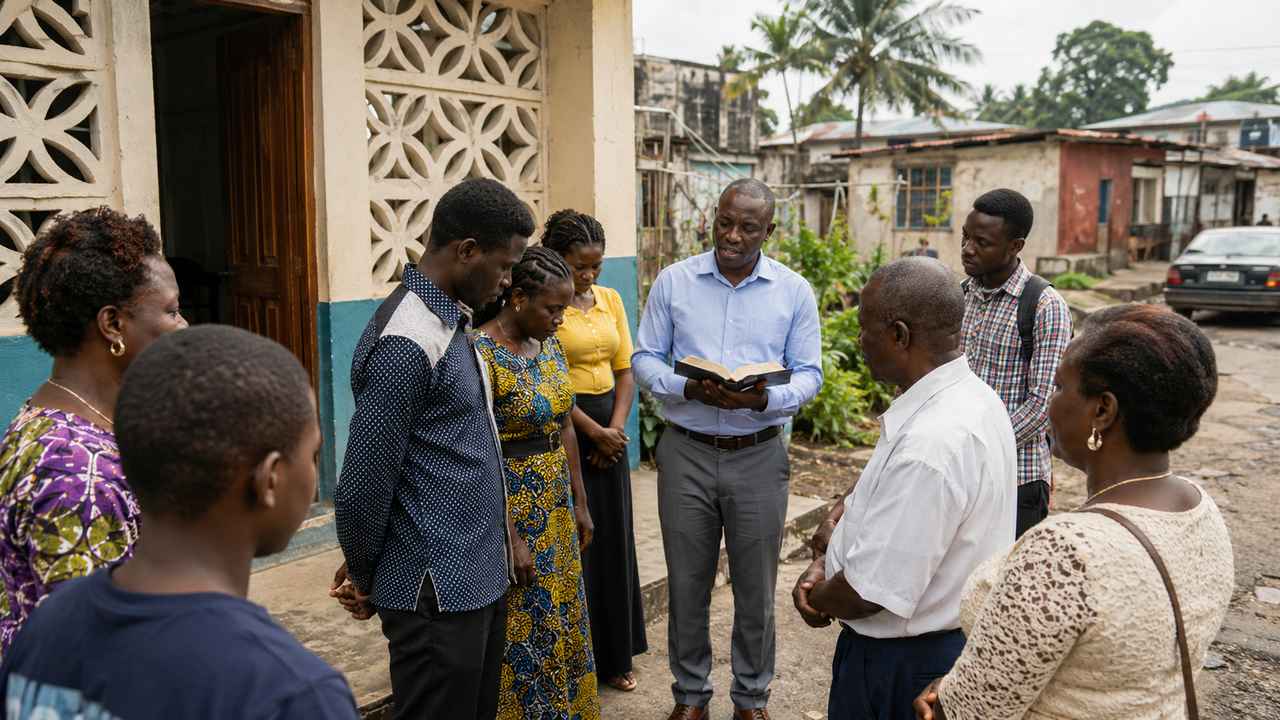
Gabon’s prayer burden is not hidden-church survival, but visible-church faithfulness. Churches gather openly, Christianity is widely known, and the name of Christ has a public place in national life. Yet that visibility brings its own searching burden: that inherited Christian identity would deepen into living faith, that churches would be strengthened in Scripture and holiness, and that believers would bear faithful witness in a nation still walking through political transition, economic strain, and questions about public trust.
Gabon also needs prayer because national change has not removed ordinary pressure from homes, churches, workplaces, and public life. The country has moved through a coup, a new constitution, elections, communication restrictions, and ongoing economic strain. Christians should therefore pray not with panic, but with sober hope: asking God to deepen His church, restrain evil, provide for the vulnerable, and teach believers to live truthfully before Christ in ordinary places.
Why Gabon Needs Prayer Now
Gabon needs prayer for gospel depth, faithful churches, public integrity, and steady Christian witness during national transition.
Gabon needs prayer now because the country is trying to move from a military-led transition into a more settled constitutional order, while many ordinary people still face poverty, unemployment, fragile services, and uncertainty about public life.
In April 2025, Gabon’s Constitutional Court confirmed Brice Clotaire Oligui Nguema as winner of the presidential election with 94.85% of votes cast. Oligui Nguema had first come to power through the 2023 coup that ended the Bongo family’s long political rule. The election was widely presented as a step toward constitutional order, but it also left continuing questions about power, public trust, and whether promised reforms would reach ordinary people.
That combination matters for prayer. Many Gabonese hoped the end of the old political order would open a better future. Yet a country can exchange one visible burden for another if power remains concentrated, public trust weakens, or reform promises do not reach ordinary households. Christians should pray for rulers with sober charity, not partisan excitement or cynicism, asking God to grant justice, restraint, truth, and real care for the people.
The pressure is also economic. The World Bank reported in 2025 that Gabon’s economy grew by an estimated 2.9% in 2024, but limited job creation and modest growth contributed to rising poverty, with an estimated 34.6% of Gabonese living below the poverty line. The same report noted that the country’s fiscal position deteriorated sharply in 2024 because of lower oil revenues and higher public spending. A nation may be rich in oil, manganese, wood, and rainforest, yet still leave many families wondering how to pay for food, schooling, medicine, water, transport, and daily needs.
For the church, these realities are not distant political facts. They shape ordinary faithfulness: pastors preaching to anxious people, parents raising children in uncertainty, young believers seeking work, church members tempted by bitterness or empty prosperity hopes, and Christians learning to speak truth with humility in a tense public square.
Country Snapshot
Compact background that helps readers pray with clearer understanding.
Gabon lies on the west coast of Central Africa, astride the Equator. It borders Equatorial Guinea and Cameroon to the north, the Republic of the Congo to the east and south, and the Atlantic Ocean to the west. Its capital, Libreville, is the main administrative and commercial center. Britannica lists the 2026 estimated population at about 2,548,000 and identifies French as the official language. Britannica
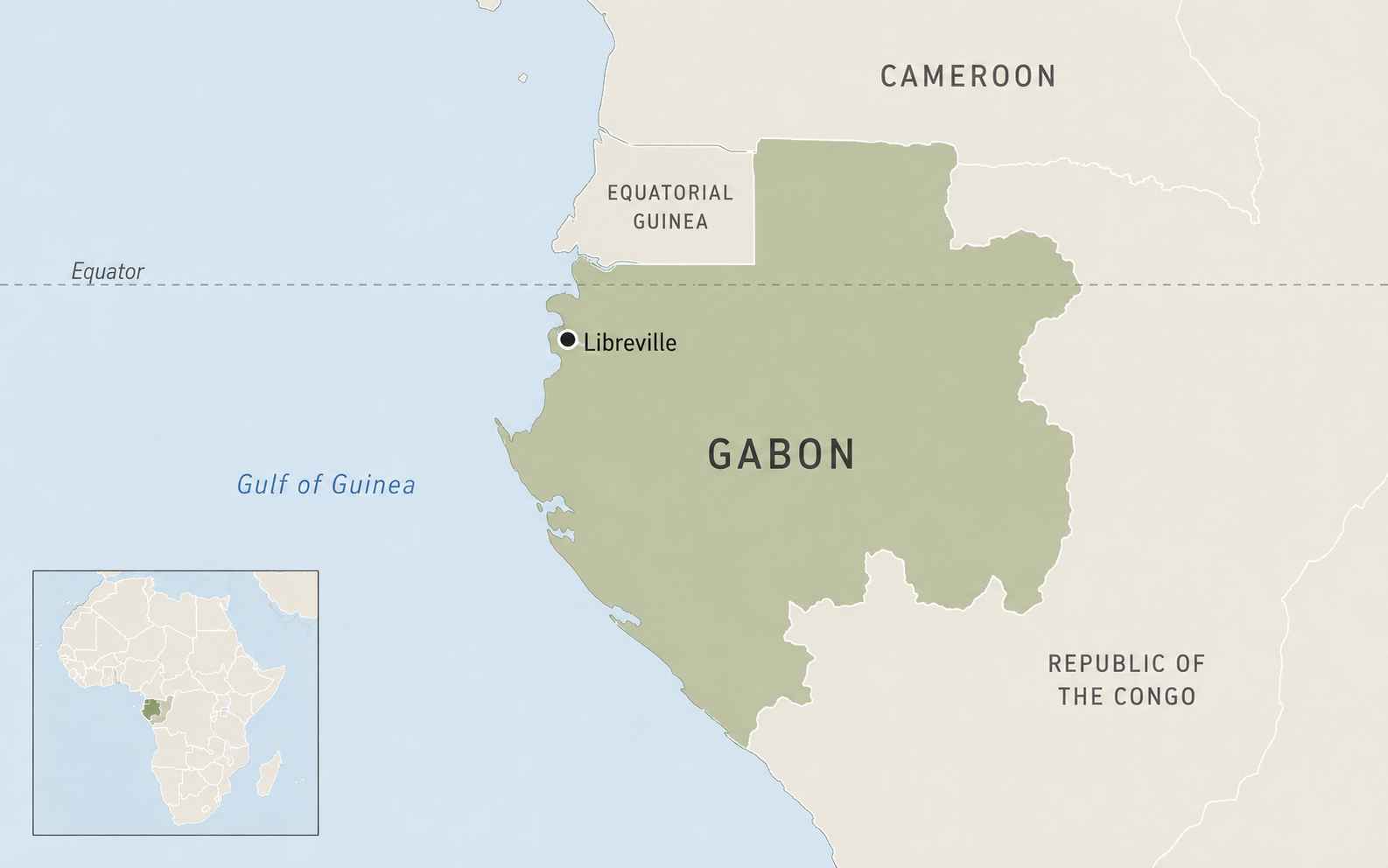
The country is marked by dense equatorial rainforest, high humidity, oil and timber resources, and a heavily urban population. Britannica notes that more than four-fifths of Gabon’s population is urban, with about half the people living in Libreville. Britannica
Religiously, Gabon is not a small hidden-church environment. Christianity is the main religion and is practiced by more than three-fourths of the population, according to Britannica. Roman Catholics make up a large share of Christians, while the Evangelical Church of Gabon, Christian Alliance churches, Pentecostal churches, Adventists, and other Christian bodies are also present. A smaller portion of the population is Muslim, and some Gabonese also practice traditional or syncretic beliefs, including Bwiti, a religious movement that blends older spiritual traditions with later religious influences. Britannica
That broad Christian presence is a mercy. It is also a responsibility. Where Christianity is socially visible, the church’s danger may be less about survival and more about spiritual health: whether congregations remain faithful to Scripture, clear about the gospel, serious about holiness, and willing to serve neighbors with integrity.
Main Pressures Facing Christians
The main burdens are less about severe anti-Christian persecution and more about spiritual depth, public integrity, and faithful witness.
The main pressures facing Christians in Gabon are not primarily severe state persecution or widespread anti-Christian violence. They are more ordinary, but still spiritually serious: nominal Christianity, syncretism, weak discipleship, public corruption, economic strain, and the challenge of faithful witness in a changing political environment.
Nominal Christianity and spiritual shallowness
Because Christianity is socially widespread in Gabon, many people may identify as Christian without being deeply formed by Scripture, repentance, faith, and life in the local church. In such settings, the church needs more than visibility. It needs faithful preaching, meaningful discipleship, biblical literacy, and pastors who are not merely religious functionaries but shepherds under Christ.
Nominal Christianity can be quiet and respectable while still spiritually dangerous. It can fill church buildings without filling hearts with the fear of God. It can keep Christian language while losing the gospel. Pray that churches in Gabon would not mistake religious inheritance for living faith.
Syncretism and confused spiritual trust
Some Gabonese combine elements of Christianity, Islam, traditional beliefs, or syncretic religion. Syncretism means blending different religious beliefs or practices into one mixed system. In Christian terms, the danger is that Christ is treated as one spiritual power among many, rather than the only Lord and Savior.
This matters pastorally. A believer may attend church on Sunday and still fear ancestral powers, seek protection through other rituals, or treat prayer as one spiritual technique among many. Churches need patience, clarity, and courage to teach that Christ is sufficient, Scripture is authoritative, and salvation is by grace, not by spiritual mixture or human control.
Economic hardship and prosperity temptations
Gabon’s oil wealth has not removed poverty. The World Bank reported that limited job creation and modest growth contributed to rising poverty, with an estimated 34.6% of Gabonese living below the poverty line. World Bank In such conditions, churches may face heavy pastoral burdens: unemployment, debt, family pressure, frustration, and the temptation to look for quick spiritual promises.
This is where prosperity theology can become especially harmful. People under pressure may be drawn to messages that promise wealth, health, or breakthrough without repentance, cross-bearing, ordinary work, or contentment in Christ. Gabonese churches need grace-shaped teaching that neither ignores suffering nor exploits it.
Public trust, speech, and civic pressure
In February 2026, Gabon’s High Authority for Communication, the national media regulator, ordered the suspension of social media and digital platforms. Authorities said the measure responded to harmful online content threatening human dignity, national security, and social cohesion; critics described it as pressure on dissent. AP reported that Meta, TikTok, and WhatsApp were significantly disrupted.
As of May 11, 2026, Internet Society Pulse, a public internet-measurement and shutdown-tracking resource, still listed major service blocking in Gabon as ongoing, including Facebook, Facebook Messenger, Instagram, Telegram, TikTok, and YouTube. Internet Society Pulse Because service-blocking status can change quickly, this claim should be rechecked if publication is delayed.
For Christians, this is not only a politics issue. Communication restrictions can affect how people receive information, organize community life, maintain contact, and speak responsibly in public. The church should not be careless with rumors or inflammatory speech. But believers also need space to speak truthfully, encourage one another, and serve the public good without fear.
Leadership, integrity, and public witness
Where public life has been marked by corruption concerns, concentrated power, and uneven trust, Christian leaders need special prayer. Pastors, elders, ministry workers, school leaders, and Christian professionals are called to model honesty, humility, and courage. If the church mirrors the same patterns of favoritism, pride, and materialism that trouble public life, its witness becomes dim. If it walks in truth, repentance, mercy, and integrity, it can shine quietly but powerfully.
What Life Is Like for Christians in Gabon
A pastoral picture of ordinary Christian life in a country where the church is publicly visible.
For many Christians in Gabon, church life is public and ordinary. Believers may gather openly, attend worship, run schools, preach, sing, baptize, celebrate Christian holidays, and participate visibly in national life. This is a gift that should not be taken lightly.
But public visibility does not automatically mean spiritual maturity. In a majority-Christian country, the challenge may be that Christianity becomes part of the background music of society: present everywhere, but not always heard deeply. A young person may grow up around church language without being taught the cost of following Christ. A family may value Christian customs but still struggle with fear, resentment, corruption, or divided spiritual loyalties. A church may be busy with programs while lacking doctrinal depth.
Daily Christian faithfulness in Gabon may therefore look like ordinary, costly obedience: a pastor refusing to flatter wealthy patrons, a civil servant declining a bribe, a young believer resisting sexual compromise, a church member choosing truth instead of rumor, a mother teaching her children to pray in Christ’s name alone, or a congregation caring for the poor without turning mercy into public performance.
In such a context, Christians need prayer for depth. They need more than religious stability. They need the Holy Spirit to make the Word fruitful, to form churches that love sound doctrine, and to raise up leaders who serve rather than use the flock.
Gabon also needs churches that know how to speak into national uncertainty without becoming captive to party loyalty, ethnic pride, or bitterness. The church belongs to Christ. Its hope is not in coups, constitutions, elections, foreign investment, or oil revenue. Christians may pray for all these public matters, but they must never let them become a substitute savior.
Recent Developments
Time-sensitive developments that materially shape how Christians should pray now.
-
2023–2025
A post-coup political transition has reshaped national life
Gabon’s current political setting is still shaped by the 2023 coup that removed Ali Bongo Ondimba after decades of Bongo-family dominance. In November 2024, voters approved a new constitution in a referendum. International IDEA, an intergovernmental organization that tracks democracy and electoral developments, reported that Gabon’s Constitutional Court validated the referendum result on November 29, 2024, with 91.6% approval and 54.2% turnout. The new constitution abolished the role of prime minister, prohibited dynastic succession, and introduced a seven-year presidential term renewable once.
In April 2025, Brice Clotaire Oligui Nguema won the presidential election with 94.85% of votes cast, according to the final result reported by AP. Associated Press The election was presented by many as a step toward constitutional order after military rule, but it also raised continuing questions about concentration of power, the fairness of political competition, and whether the transition would produce deeper public accountability.
-
2025
Legislative elections strengthened the president’s political position
International IDEA reported that the president’s party, the Democratic Union of Builders, won a large majority in the 2025 legislative elections. The same report noted irregularities, including missing ballots and falsified results, which led to annulments in several contests and further litigation. This development matters for prayer because institutions need more than formal elections. They need truth, restraint, justice, and leaders willing to govern for the common good rather than merely consolidate their advantage.
-
February 2026
Social media restrictions sharpened public-expression concerns
In February 2026, Gabon’s High Authority for Communication ordered the suspension of social media and digital platforms. AP reported that officials cited harmful online content and national-security concerns, while critics accused the government of clamping down on dissent.
This development should not turn the prayer post into a political campaign. But it should shape prayer. Christians should ask God for truthfulness in public speech, restraint from rulers, protection from slander and manipulation, and space for families, churches, journalists, workers, and citizens to communicate without fear.
-
2025–2026
Economic and fiscal pressures remain heavy
The International Monetary Fund said its staff visited Libreville from February 25 to March 6, 2026, for discussions with Gabonese authorities on economic and policy developments. The statement said discussions highlighted reforms related to public financial management, governance, the business climate, anti-corruption, and prudent fiscal and financial policies.
These issues matter because economic pressure lands in homes, schools, hospitals, churches, and workplaces. Pray that reform would not remain paperwork, but would lead to honest stewardship and tangible mercy for ordinary people.
How to Pray
Specific prayers rooted in the realities described above.
-
Pray for gospel depth in a visibly Christian nation.
Ask God to make the gospel clear, treasured, and obeyed in Gabon’s churches. Pray that Christianity would not remain merely a social identity, family inheritance, or public label, but that many would be brought to true repentance and faith in Christ. Ask the Lord to give pastors and congregations love for Scripture, seriousness about holiness, and joy in the finished work of Christ.
-
Pray for faithful pastors and spiritually mature churches.
Pray that pastors, elders, Bible teachers, evangelists, and ministry leaders would shepherd Christ’s people with humility, courage, and integrity. Ask God to protect churches from greed, manipulation, shallow teaching, and empty religious performance. Pray for faithful preaching, patient discipleship, meaningful church membership, and congregations that are marked by prayer, holiness, mercy, and truth.
-
Pray for wisdom where syncretism confuses Christian faith.
Pray for believers who are tempted to blend Christianity with other spiritual practices or fear-based traditions. Ask God to free hearts from fear, divided loyalties, and spiritual confusion, and to help churches teach clearly that Christ is sufficient and His Word is true.
-
Pray for believers under economic pressure.
Pray for Christians facing unemployment, poverty, family burdens, debt, and uncertainty about daily needs. Ask God to provide honest work, wise stewardship, generosity in the church, and endurance without bitterness. Pray that hardship would not make believers vulnerable to prosperity teaching, false promises, corruption, or despair, but would deepen their dependence on God’s fatherly care.
-
Pray for rulers and public officials to govern with justice.
Pray for President Brice Clotaire Oligui Nguema, lawmakers, judges, local officials, civil servants, and security leaders. Ask God to give them wisdom, restraint, truthfulness, and concern for the weak. Pray that public reforms would serve ordinary people, that corruption would be restrained, and that leaders would remember they are accountable before the God who rules over nations.
-
Pray for truthful speech and wise public witness.
Pray for Gabon’s public life, especially where communication restrictions and political tension have made speech more sensitive. Ask God to restrain slander, rumor, hatred, manipulation, and fear. Pray also for space for truthful communication, responsible journalism, peaceful civic life, and churches that speak with courage, humility, and love rather than partisan anger or careless accusation.
-
Pray for the church to shine through ordinary faithfulness.
Ask God to make Gabonese believers faithful in homes, workplaces, schools, churches, and public service. Pray for Christians who refuse bribes, tell the truth, care for the poor, honor marriage and family, disciple children, and serve neighbors quietly in Christ’s name. Pray that the church’s witness would not rest on political influence or social respectability, but on the grace, truth, and holiness of Christ.
Give Thanks
Honest thanksgiving for real signs of God’s preserving mercy and common grace.
-
Give thanks for open and visible church life.
Give thanks that many Christians in Gabon can gather publicly for worship, preaching, baptism, discipleship, and service. This public space for church life is a real mercy, especially when many believers elsewhere must worship under far heavier restriction.
-
Give thanks for Christian heritage and gospel opportunity.
Give thanks for Gabon’s broad Christian presence and for every faithful church, pastor, teacher, parent, and believer seeking to honor Christ there. Pray with gratitude that the name of Christ is widely known, while asking God to deepen that knowledge into living faith, repentance, holiness, and persevering obedience.
-
Give thanks for God’s restraining mercy in national life.
Give thanks that Gabon is not presently marked by nationwide war, mass displacement, or severe anti-Christian violence. Ask God to preserve peace, restrain evil, and use this relative stability for the strengthening of churches, families, schools, and honest public service.
-
Give thanks for every sign of common grace and public good.
Give thanks for every real effort toward public accountability, better stewardship of national resources, improved services, and care for ordinary citizens. Common grace refers to God’s kindness in preserving life, restraining evil, and allowing genuine good even in a fallen world. Pray that such mercies would not be wasted, but would lead to humility, justice, and deeper dependence on the Lord.
-
Give thanks for believers called to faithful witness in ordinary places.
Give thanks for Gabonese Christians who seek to follow Christ quietly and steadily in daily life. Praise God for every act of honesty, mercy, prayer, neighbor love, patient discipleship, and gospel witness that may never be noticed by the world but is seen by the Lord.
Last Verified
A compact update note for future review.
- Last updated
- May 11, 2026
- Recommended next review
- Review by June 2026, or sooner if social media restrictions are lifted or intensified, if major new protest or repression reports emerge, if economic negotiations materially change Gabon’s fiscal outlook, or if a new religious-freedom report becomes available.
Key Sources Consulted
Descriptive source documentation for later review, updating, and editorial transparency.
- Associated Press, “Gabon’s constitutional court confirms Oligui Nguema’s victory in presidential election” — April 2025. Used for the April 2025 presidential election result, turnout context, and post-coup transition framing.
- Associated Press, “Gabon suspends access to social media as critics accuse its leader of crackdown on dissent” — February 2026. Used for the social media suspension, official rationale, affected platforms, and criticism from outside voices.
- Internet Society Pulse, “Social media blocked in Gabon” — February 2026 shutdown entry, checked May 11, 2026. Used for the latest available service-blocking status and platform-disruption details.
- International Monetary Fund, “IMF Staff Concludes Visit to Gabon” — March 6, 2026. Used for current leadership verification, economic-policy discussions, public-finance reform, governance, anti-corruption, and fiscal-stability context.
- World Bank, “Gabon Economic Update 2025: Developing and Preserving Gabon’s Wealth to Improve Living Standards” — June 26, 2025. Used for poverty, growth, oil-sector, fiscal-risk, and public-spending context.
- World Bank, “Gabon Economic Update 2025: Building and Preserving Gabon’s Wealth for Better Livelihoods.” Used for economic structure, unemployment, public-finance pressure, and natural-resource context.
- Britannica, Gabon country profile — updated February 18, 2026. Used for stable background on geography, capital, population estimate, language, religious landscape, Christian communities, urbanization, and regional setting.
- International IDEA Democracy Tracker, Gabon — November 2024. Used for the constitutional referendum, final validated result, turnout, and key constitutional changes.
- International IDEA Democracy Tracker, Gabon — October 2025. Used for legislative-election context, the president’s party’s parliamentary majority, and reported election irregularities.
- Gabon Constitution of the Fifth Republic, December 19, 2024, hosted by Digithèque MJP, University of Perpignan. Used for constitutional language on secular state structure, separation of state and religions, equality before the law, freedom of conscience, religion, worship, association, and religious communities.