

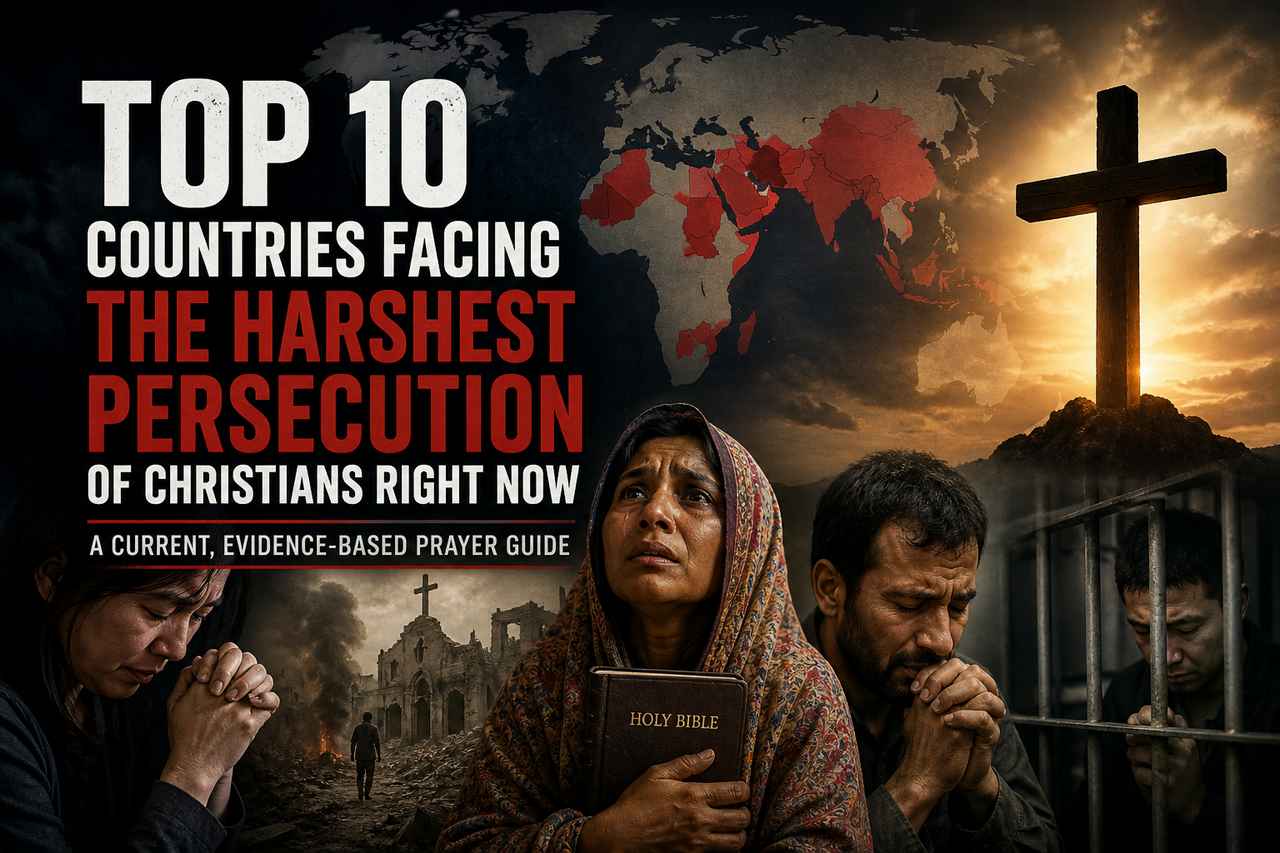
Across the world, many Christians follow Christ under conditions that make ordinary faithfulness costly. In some places, believers worship in secret because discovery could bring imprisonment, violence, or death. In others, converts face severe family rejection, churches endure state suspicion, pastors are watched or detained, and Christian witness is narrowed by law, fear, social hostility, or armed conflict. These pressures are not the same in every country, and they should not be flattened into one simple story. Yet together they remind the church that the suffering of Christ’s people is not distant, theoretical, or rare.
This April 2026 ranking identifies ten countries where Christians appear to face the harshest persecution or pressure right now. The list considers not only violence, but also the wider burden placed on Christian life: restrictions on worship and conversion, surveillance, family and communal hostility, militant threats, imprisonment, displacement, and the difficulty of faithful witness under fear. The purpose is not to stir alarm for its own sake, nor to reduce nations to their worst realities, but to help readers pray with clearer understanding, deeper compassion, and sober confidence in the Lord who rules over nations and preserves His church.
As you read, let these countries be more than names on a list. Think of hidden believers gathering quietly, parents teaching children the faith with trembling courage, pastors serving under pressure, converts counting the cost, and churches seeking to remain faithful where public confession of Christ may bring suffering. This ranking is offered as a prayer guide: a call to remember persecuted brothers and sisters, to ask God for endurance and gospel fruitfulness, and to plead for justice, mercy, wisdom, and the advance of Christ’s kingdom in some of the hardest places on earth.
Persecution Ranking Method Note
A broad comparative analysis was used to identify the countries where Christians face the harshest persecution or pressure.
This ranking uses a broad candidate analysis rather than starting with a fixed top ten. We compared a serious field that included North Korea, Somalia, Yemen, Sudan, Eritrea, Syria, Nigeria, Pakistan, Libya, Iran, Afghanistan, India, Saudi Arabia, Myanmar, China, and several others. We prioritized recent persecution and religious-freedom sources first, then checked current-affairs reporting where recent national developments materially changed the burden.
Working Definition
This definition clarifies what qualifies as persecution or major pressure on Christians in this ranking.
Persecution or Major Pressure on Christians
For this ranking, a country qualifies if Christians there currently face persecution or major pressure at meaningful scale through one or more of these: violence, imprisonment, abduction, killing, severe legal restriction on worship or conversion, organized social or family hostility, surveillance or registration barriers, or broad coercive pressure that makes faithful Christian life unusually costly, hidden, dangerous, or unstable. “Most affected” is not limited to the most violent countries only; it includes the full lived reality of Christian pressure across church life, family life, public witness, discipleship, and conscience.
Ranking Criteria
The following weighted criteria shaped the final comparative order.
We used the following weighting:
-
Severity of anti-Christian pressure 25% Measures how severe the pressure is, including violence, imprisonment, legal danger, coercion, intimidation, or forced hiding.
-
Breadth of pressure across Christian life 20% Considers how many parts of Christian life are affected, including worship, conversion, discipleship, family life, public witness, and church leadership.
-
State, social, or militant hostility 15% Assesses whether pressure comes from the state, extremist actors, family or community enforcement, dominant religious structures, armed groups, or a combination of these.
-
Current urgency / escalation 15% Weighs whether pressure has worsened recently or whether current conditions have made the burden especially acute.
-
National reach and structural entrenchment 15% Considers how widespread, durable, and institutionally embedded the pressure is across the country.
-
Prayer-and-ministry relevance 10% Considers whether the country’s present burden materially shapes church life, Christian witness, suffering, endurance, mercy ministry, or the need for focused prayer.
Top Ten Countries Facing the Harshest Persecution or Pressure on Christians
Each country entry explains why the country qualifies, why it ranks where it does, and how Christians can pray.
North Korea
The clearest case of nationwide, structurally entrenched, top-tier persecution.
Christian faith is treated as disloyalty to the state, and discovery can lead to imprisonment, forced labor, torture, or execution. Even family members can be punished under guilt-by-association logic.
No other country combines such total state control, near-complete criminalization of independent Christian life, and such severe penalties so consistently. It remains the clearest case of nationwide, structurally entrenched, top-tier persecution.
Christians cannot live openly as Christians. House-church life is nearly impossible, children are at grave risk if family faith is discovered, and the regime continues to treat religion as an existential threat to its ideology. The pressure is not episodic but totalizing.
Overwhelming state persecution, backed by surveillance, ideological control, and brutal punishment.
This is one of the starkest places on earth to pray for hidden believers, prison sufferers, faithful parents, and the endurance of an almost invisible church.
Key current sources used: Open Doors, World Watch List 2026 and North Korea country profile; USCIRF, 2026 Annual Report: North Korea.
Somalia
One of the most dangerous places in the world for any convert or hidden believer.
Conversion from Islam is effectively intolerable, clan and family enforcement is severe, and Al-Shabaab continues to kill or target suspected Christians. The constitution and legal order leave almost no protected public space for Christianity outside an Islamic framework.
Somalia is slightly below North Korea because state control is less total, but it remains one of the most dangerous places in the world for any convert or hidden believer. Pressure is both social and militant, and it is pervasive.
Christians, especially converts, must hide almost completely. Discovery can trigger lethal retaliation from family, clan networks, or jihadist actors. Broader insecurity also keeps Christian life unstable and extremely fragile.
Combined family/clan hostility, Islamist militant violence, and near-zero safe public Christian space.
Pray especially for hidden believers, safe fellowship, courageous discipleship, and for the Lord to preserve converts in a setting where exposure can be fatal.
Key current sources used: Open Doors, World Watch List 2026 and Somalia country profile; U.S. Department of State background on Somalia’s religion-and-law framework.
Yemen
Severe legal and social hostility combined with conflict-driven collapse.
Apostasy remains punishable by death in law, public Christian life is essentially impossible for Yemeni believers, and war plus fragmentation make Christian vulnerability even worse. The few Christians who remain from Muslim backgrounds must stay deeply hidden.
Yemen combines severe legal and social hostility with conflict-driven collapse. It ranks just below Somalia because its enforcement is more fragmented, but the cost of open Christian faith remains extreme.
Ongoing war, shattered institutions, and militant or de facto-authority pressure make Christian gathering perilous. USCIRF’s 2025 update on Houthi-controlled areas also points to escalating systematic violations against religious minorities.
A mix of legal danger, family/community hostility, and conflict-fragmented militant pressure.
Yemen remains a place to pray for hidden believers, survival amid war, and quiet gospel endurance where almost everything pushes Christians into secrecy.
Key current sources used: Open Doors, World Watch List 2026 and Yemen country profile; USCIRF 2025/2026 Yemen materials on Houthi-controlled areas and minority violations.
Sudan
A place where broader national catastrophe is now inseparable from the persecution burden.
Sudan’s civil war has sharply intensified Christian vulnerability. Churches have been attacked or occupied, earlier religious-freedom gains have been reversed, and broader war conditions now materially deepen the burden on Christians.
Sudan rises this high because it combines already-serious anti-Christian pressure with live war conditions, displacement, and militia abuse. It is one of the clearest cases where broader national catastrophe is now inseparable from the persecution burden.
Since the war began in 2023, Christians have faced attacks from both conflict dynamics and direct anti-Christian pressure. Open Doors and USCIRF both indicate worsening conditions, including attacks on churches, coercion, and heightened vulnerability for minority communities amid collapse and displacement.
War-intensified persecution, involving both armed-conflict disruption and specifically anti-Christian abuse.
Sudan now demands prayer not only for survival and relief, but for Christian endurance in a setting where war and persecution feed each other.
Key current sources used: Open Doors, World Watch List 2026 and Sudan country profile; USCIRF, 2026 Annual Report; Open Doors WWL 2026 Trends.
Eritrea
One of the harshest state-persecution environments in the world.
Only a handful of religious communities are recognized, and many evangelicals and other unapproved Christians remain exposed to raids, detention, and indefinite imprisonment. 2025 reporting continued to document arrests and long-term detention.
Eritrea remains one of the harshest state-persecution environments in the world. It ranks just below Sudan because Sudan’s war has made its present burden more acute, but Eritrea’s system is more classically entrenched and brutally repressive.
USCIRF reported fresh detentions in 2025, including groups of Christians and many held long-term. Forced military service, church restrictions, and the regime’s hostility to unregistered Christian life continue to make ordinary faithfulness costly and dangerous.
Severe state persecution, especially through detention, church illegality, and coercive control.
Pray for imprisoned believers, underground fellowships, and for courage and steadfastness where the state keeps trying to shrink Christian life into fear and silence.
Key current sources used: Open Doors, World Watch List 2026 and Eritrea country profile; USCIRF, 2026 Annual Report: Eritrea.
Syria
A sharply deteriorated context of fragmentation, fear, and direct anti-Christian violence.
Syria’s burden changed sharply after the fall of the Assad government in December 2024. Open Doors and USCIRF both describe a steep deterioration in 2025, including instability under new authorities, sectarian violence, and the June 2025 bombing of Mar Elias Church in Damascus.
Syria is not as uniformly closed as North Korea or Somalia, but its 2025–26 deterioration is too severe to place lower. It now combines fragmentation, fear among minorities, jihadist threat, and direct anti-Christian violence at a level that moved it decisively into the top tier.
Christians are living through renewed uncertainty after regime change, weak state protection, and major sectarian violence. The June 2025 church bombing, along with broader deterioration and instability, made clear that Christian communities remain highly vulnerable.
Conflict-fragmented and sectarian pressure, intensified by weak governance and direct attacks on churches.
Pray for frightened congregations, faithful clergy and lay leaders, and for perseverance where instability now directly threatens Christian presence and witness.
Key current sources used: Open Doors, World Watch List 2026 trends and Syria profile; USCIRF, 2026 Annual Report: Syria; AP and Reuters reporting on the June 2025 Damascus church bombing.
Nigeria
A country where anti-Christian violence remains severe, recurring, and prayer-defining.
Nigeria remains the most violent country in the world for Christians by multiple Christian-monitoring measures, with mass killings, abductions, and attacks concentrated especially in the Middle Belt and north. At the same time, not every violent incident in Nigeria is simply reducible to anti-Christian persecution alone.
Nigeria’s violence is staggering, but it ranks below Syria in this list because the pattern is not as uniformly totalizing nationwide and because some violence is part of broader insecurity affecting Muslims too. Even with that nuance, the anti-Christian burden is severe enough to keep Nigeria firmly in the top tier.
Christian villages, clergy, and worshippers continue to face attacks, killings, displacement, and kidnappings. USCIRF’s 2026 report described conditions as abysmal, with inadequate state response, while Open Doors again highlighted Nigeria’s overwhelming share of Christian killings in its reporting period.
Mixed jihadist violence, communal attacks, and state failure to protect, with particularly heavy impact on Christian communities.
Nigeria requires prayer for protection, justice, wise pastoral leadership, and faithful witness amid grief, fear, displacement, and recurring violence.
Key current sources used: Open Doors, World Watch List 2026 and Nigeria profile; USCIRF, 2026 Annual Report: Nigeria; AP reporting on the wider violence pattern.
Pakistan
A broad, structural Christian vulnerability shaped by blasphemy-law pressure and mob coercion.
Pakistan combines harsh blasphemy-law pressure, mob violence, discrimination, and severe vulnerability for Christians and converts. Recent USCIRF material shows a troubling trajectory, especially around vigilante attacks and misuse of blasphemy accusations.
Pakistan remains a textbook case of broad, structural Christian vulnerability. It ranks below Nigeria because its burden is less war-like and less mass-fatal in scale, but it outranks lower entries because of the breadth and embeddedness of pressure across ordinary life.
Christians face false accusations, mob attacks, workplace and school discrimination, and serious danger if accused of blasphemy or if they convert from Islam. USCIRF’s 2025 reporting also highlighted ongoing violent attacks and failures of protection.
Legal pressure plus mob coercion, reinforced by social discrimination and weak protection.
Pray for courage, legal protection, faithful churches, and steadfast witness in a setting where accusation alone can place believers in grave danger.
Key current sources used: Open Doors, World Watch List 2026 and Pakistan profile; USCIRF, 2026 Annual Report: Pakistan and 2025 Pakistan updates.
Libya
A dangerous environment where fragmentation removes reliable protection for Christians.
Libya’s lack of stable central authority leaves Christians, especially converts and migrant believers, exposed to militias, criminal groups, and hostile security actors. USCIRF and Open Doors both describe serious present risk for non-Muslim minorities and those suspected of conversion.
Libya is less nationally structured than Pakistan, but the danger for Christians can be extreme, especially because governance fragmentation removes reliable protection. It remains inside the top ten because both state-linked and non-state actors contribute to a highly dangerous environment.
Converts from Islam must remain hidden, and migrant Christians face kidnapping, extortion, forced labor, torture, detention, or deportation. USCIRF also noted worsening conditions for non-Muslim minorities and those accused of apostasy or deviant belief.
A dangerous mix of state-fragmented coercion, militia abuse, and anti-conversion hostility.
Pray for hidden Libyan believers, migrant Christians, and for gospel endurance where lawlessness and suspicion make Christian visibility acutely risky.
Key current sources used: Open Doors, World Watch List 2026 and Libya profile; USCIRF, 2026 Annual Report: Libya and Libya country materials.
Iran
An active and nationally significant state campaign against converts and house churches.
Iran continues to target converts and house churches through raids, arrests, prosecutions, and prison sentences. USCIRF’s 2026 reporting documents both broad anti-minority repression and specifically criminalized Christian activity in 2025.
Iran remains an extreme case, but I place it tenth because the current comparative evidence for Syria, Sudan, Eritrea, and Libya is slightly more acute or structurally comprehensive for this cycle. Iran still stays in the ten because the state’s campaign against converts is active, serious, and nationally significant.
2025 reporting pointed to dozens of arrests across many cities, criminalization of ordinary Christian practices such as prayer and baptisms, and broader state rhetoric portraying Christians and converts as threats. House-church Christians remain especially exposed.
Strong state persecution, especially against converts, house churches, and independent Christian activity.
Pray for imprisoned believers, bold but wise witness, and endurance for converts who face sustained state pressure and social cost.
Key current sources used: Open Doors, World Watch List 2026 and Iran profile; USCIRF, 2026 Annual Report: Iran and Iran country materials.
Near-Miss / Watchlist Countries
These countries remain important for prayer and close attention, even though they were not placed in the final top ten.
- Afghanistan — Probably the closest exclusion: Taliban rule leaves virtually no room for open conversion or independent Christian life, but in this cycle I judged the current, specifically documented Christian-pressure picture in Iran and Libya slightly stronger for a top-ten slot.
- India — The pressure is severe and worsening in several states through anti-conversion laws, mob attacks, and systemic discrimination, but it remains less uniformly totalizing nationwide than the final ten.
- Saudi Arabia — Public non-Muslim worship remains prohibited and the state still punishes deviation harshly, yet the comparative evidence still places it just below this year’s final ten.
- Myanmar — Christians face grave suffering through war, displacement, military attacks, and destruction of religious sites, but the burden is more conflict-driven and less consistently a nationwide Christian-specific system than in the final ten.
- China — State control of Christianity remains severe and 2025 saw renewed pressure on major house-church networks, but the overall comparative severity still falls a step below the selected ten.
How to Pray Through This List
Use this ranking as a guide for informed, compassionate, and Christ-centered intercession.
-
Pray for hidden believers gathering quietly, parents teaching children the faith with trembling courage, pastors serving under pressure, converts counting the cost, and churches seeking to remain faithful where public confession of Christ may bring suffering.
-
Pray for Christians who cannot live openly as Christians, for those facing state surveillance, family rejection, militant threat, imprisonment, displacement, or social hostility, and for the Lord to preserve His church in places where pressure is severe and costly.
-
Pray for endurance, gospel fruitfulness, justice, mercy, wisdom, and the advance of Christ’s kingdom in some of the hardest places on earth.
-
Pray that this list would not merely inform readers, but move them to steady remembrance, deeper compassion, and faithful intercession for persecuted brothers and sisters.
What most distinguishes this top ten is not one single kind of persecution but the combination of severity, breadth, entrenchment, and present urgency. North Korea, Somalia, and Yemen remain the clearest examples of near-total Christian vulnerability; Sudan and Syria have risen because broader national catastrophe now sharply intensifies Christian danger; Eritrea, Nigeria, Pakistan, Libya, and Iran remain in the highest tier because Christian life there is still being constrained, threatened, or punished in ways that are both serious and prayer-defining right now. This result does track closely with the World Watch List 2026, but only because that watch list broadly survived a fresh comparative test against recent USCIRF and current-affairs evidence, not because it was accepted uncritically.
Key Sources Consulted
Descriptive source documentation for review, transparency, and future updating.
- Open Doors, World Watch List 2026 and country profiles for North Korea, Somalia, Yemen, Sudan, Eritrea, Syria, Nigeria, Pakistan, Libya, and Iran.
- Open Doors, WWL 2026 Trends.
- USCIRF, 2026 Annual Report materials for North Korea, Sudan, Eritrea, Syria, Nigeria, Pakistan, Libya, Iran, and related country conditions.
- USCIRF 2025/2026 Yemen materials on Houthi-controlled areas and minority violations.
- USCIRF 2025 Pakistan updates on attacks targeting religious minorities and blasphemy-related pressure.
- U.S. Department of State background on Somalia’s religion-and-law framework.
- AP and Reuters reporting on the June 2025 Mar Elias Church bombing in Damascus.
- AP reporting on the wider violence pattern affecting Christian communities in Nigeria.