


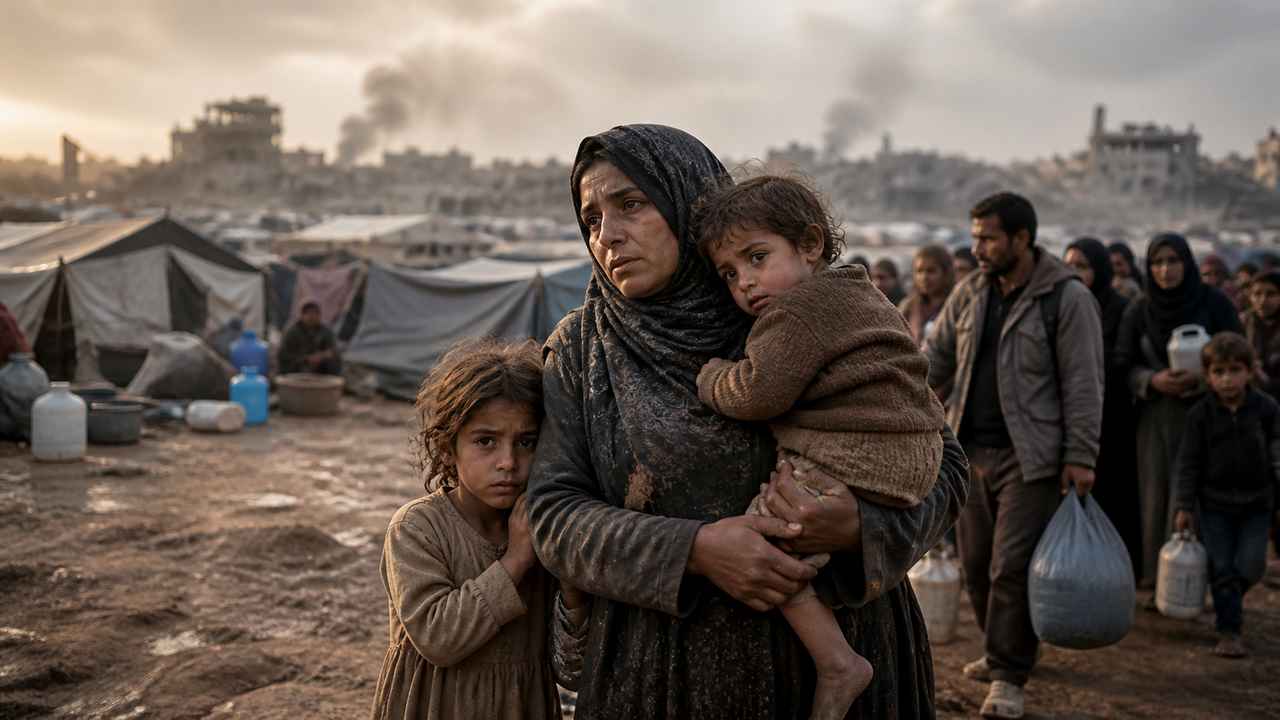
The countries in this list are not gathered here because they briefly dominated headlines or because their suffering is dramatic enough to seize public attention for a moment. They are here because, as of April 2026, they represent some of the clearest and most painful concentrations of humanitarian crisis and severe human suffering in the world right now. In these places, war, displacement, hunger, collapse of essential services, fear, and prolonged instability have combined to make ordinary life deeply fragile for millions. This is not a ranking of passing distress, but a comparative attempt to identify where suffering is presently most acute, most widespread, and most life-disrupting.
Such a list should be read with sobriety. Human suffering cannot finally be reduced to numbers, and no ranking can fully measure the grief of families driven from home, the exhaustion of communities living under siege, the anguish of parents unable to secure food or medicine, or the weariness of those trying to endure one more day under conditions that have become almost unbearable. Yet careful comparison still has value. It helps us resist vague concern, pay closer attention to the world as it truly is, and pray with greater clarity, compassion, and seriousness for those whose burdens are especially heavy now.
For Christians, this kind of attention should never become detached observation. It should move us toward thoughtful, informed, and humble intercession. Behind every entry in this list are image-bearers of God living through fear, loss, deprivation, upheaval, and uncertainty. Many are ordinary families struggling to survive. Many are churches and believers seeking to remain faithful amid disorder, danger, and grief. As you read, the aim is not merely to understand which countries rank highest, but to see more clearly where mercy is urgently needed and to let that clearer sight lead to prayer marked by truth, compassion, and reverent dependence upon God.
Humanitarian Ranking Method Note
A brief explanation of how this list was prepared and what kind of judgment it represents.
Date basis: April 23, 2026. We prioritized humanitarian sources first, then recent current-affairs reporting where escalation materially affected ranking: chiefly UN OCHA, UNHCR, WFP, UNICEF, WHO, UN country/appeal updates, with recent Reuters/AP-style reporting or UN Geneva briefings where needed for fresh deterioration signals. We conducted a broad candidate analysis rather than defending a preset list; the serious field included Sudan, the State of Palestine, DRC, Yemen, Syria, Afghanistan, Haiti, Myanmar, South Sudan, Ukraine, Lebanon, Somalia, and Ethiopia. The closest borderline calls were at the back end of the list, especially Ukraine vs. Lebanon, and South Sudan vs. Myanmar/Haiti. Positions 8–10 are the least fixed; if one weighted acute short-term escalation slightly more heavily than scale, Lebanon could plausibly replace Ukraine.
This Top Ten prayer ranking was reviewed in APRIL 2026. It has now been superseded by the MAY 2026 ranking. Use this page for prayer-trend comparison, movement transparency, and historical context, not as the current ranking.
Working Definition
The working definition used to decide which countries qualify for this humanitarian-crisis ranking.
Humanitarian crisis and severe suffering
For this ranking, a country qualifies if it is currently experiencing humanitarian crisis and severe suffering at meaningful scale through some combination of mass displacement, acute food insecurity or famine risk, major civilian harm, severe disruption of health care/shelter/water/sanitation, and broad national conditions that make ordinary life deeply unstable or unsustainable. This is not limited to war alone; conflict is a major driver in many cases, but state collapse, economic breakdown, disease burden, disaster shocks, and blocked humanitarian access also matter. We are using “most affected” as a multi-factor comparative judgment, not a single-metric list.
Ranking Criteria
We used the following weighting:
-
Humanitarian Severity 25% Measures the present intensity of hunger, displacement, civilian harm, health strain, service collapse, and acute vulnerability.
-
Scale of Affected Population 20% Measures how many people are materially affected by the present crisis.
-
Depth of National Disruption 20% Measures how deeply ordinary life, public order, essential services, and national stability are being disrupted.
-
Current Urgency / Escalation 15% Measures whether suffering has worsened recently or is presently in an especially acute phase.
-
Structural Entrenchment / Difficulty of Relief 10% Measures how hard relief, recovery, or stabilization is because of blocked access, prolonged conflict, institutional collapse, or similar barriers.
-
Prayer-and-Ministry Relevance 10% Considers whether the crisis materially shapes church life, Christian witness, public fear, ordinary family life, suffering, endurance, mercy ministry, or focused prayer.
Top Ten Countries Facing Humanitarian Crisis and Severe Suffering
Each country entry explains the burden, the ranking judgment, and the prayer relevance of the present humanitarian suffering.
Sudan
The clearest current case of nationwide humanitarian collapse driven by war, hunger, mass flight, and restricted aid.
Sudan remains the world’s largest humanitarian and displacement crisis. Nearly 34 million people need aid, and roughly 14 million have been displaced by the war, with famine conditions confirmed in some areas and access badly constrained.
No other country currently combines Sudan’s scale of need, scale of displacement, hunger severity, active warfare, and difficulty of relief so starkly. It leads both on absolute burden and on the entrenchment of suffering.
Three years into the war, civilians face bombardment, atrocities, hunger, disease, and service collapse. UNHCR says nearly 13 million have fled their homes, including 10.1 million internally displaced by fighting on its December 2025 baseline page, while April 2026 UN reporting puts overall displacement closer to 14 million and people in need near 34 million. Famine conditions and catastrophic food insecurity remain especially severe in Darfur and other hard-to-reach areas.
Sudan is not just a severe emergency; it is the clearest current case of nationwide humanitarian collapse driven by war, hunger, mass flight, and restricted aid.
The country’s suffering is reshaping ordinary survival, church endurance, displacement, and mercy ministry at immense scale.
Key current sources used: UN Geneva Sudan briefing of 14 April 2026; UNHCR Sudan emergency page; AP reporting on Sudan entering a fourth year of war.
State of Palestine
One of the world’s most acute examples of dense civilian suffering under conflict, with extraordinary impacts on children, health care, sanitation, and daily survival.
Gaza remains an extreme humanitarian catastrophe, with mass child casualties, mass displacement, collapsed health functionality, severe aid constraints, and widespread disease and malnutrition risk. UNICEF says 3.6 million people in the State of Palestine require assistance; in Gaza, no hospital is fully functional and about 1.3 million people remain displaced.
Its scale is smaller than Sudan’s, but the severity density is extraordinary: extreme civilian harm, crippled hospitals, repeated displacement, damaged water systems, and aid bottlenecks in a tightly confined battlespace. That pushes it above DRC and Yemen on pure immediacy and service collapse.
UNICEF reports that by early February 2026 at least 21,289 children had been reported killed in Gaza, with 44,500 children injured, and about 101,000 children at risk of malnutrition. OCHA reported in April 2026 that living conditions remained dire, most families were still displaced and reliant on aid, and shortages, damaged roads, reduced crossing hours, pest infestations, and water-production strain were undermining survival conditions further. WFP says 1.6 million people are facing high levels of acute food insecurity.
This is one of the world’s most acute examples of dense civilian suffering under conflict, with extraordinary impacts on children, health care, sanitation, and daily survival.
The burden here is intensely human and immediate: protection of civilians, relief access, exhausted families, damaged medical care, and survival under repeated trauma.
Key current sources used: UNICEF State of Palestine 2026 appeal; OCHA Humanitarian Situation Report, 10 April 2026; WFP Palestine emergency page.
Democratic Republic of the Congo
A vast and chronic crisis where conflict, hunger, displacement, and weak services continue to feed each other.
DRC combines massive displacement, huge food insecurity, continuing armed violence, cholera and other health pressures, and entrenched multi-decade fragility. UNHCR says displacement reached 8.2 million by September 2025 and could reach 9 million by end-2026; WFP says 26.6 million people face acute food insecurity in early 2026.
DRC slightly trails Gaza on concentrated collapse, but it exceeds almost every other country on sheer breadth of sustained suffering. It is a top-tier global crisis on both scale and entrenchment.
Eastern violence continues to uproot families and destroy livelihoods, while food insecurity remains enormous nationwide. UNHCR describes one of the world’s most complex displacement crises, and WFP highlights emergency-level hunger surging in eastern provinces. The crisis is also layered with epidemics, climate shocks, and chronic insecurity that repeatedly undo recovery.
DRC is a country where humanitarian suffering is both vast and chronic, with conflict, hunger, displacement, and weak services feeding each other.
The combination of violence, hunger, displacement, and prolonged instability makes this a major burden for families, churches, and local relief efforts.
Key current sources used: UNHCR DRC emergency page; WFP DRC emergency update; UNHCR DRC country page.
Yemen
A national-scale survival crisis marked by hunger, fragile health care, weakened livelihoods, and repeated shocks.
Yemen remains one of the world’s most complex emergencies, with more than 22 million people needing assistance in 2026, 18.3 million acutely food insecure, and only about 59 percent of health facilities fully functional.
Yemen’s suffering is broader in scale than Haiti or Lebanon and more entrenched than Myanmar’s. It ranks below DRC mainly because current displacement and overall national upheaval are even larger there, but Yemen remains a top-tier hunger-and-services crisis.
The 2026 Yemen HNRP describes a deeply stressed operating environment shaped by conflict, economic deterioration, climate shocks, disease, and sharp funding reductions. More than 5.2 million IDPs, 2.2 million acutely malnourished children under five, and 1.3 million malnourished pregnant or breastfeeding women underscore the severity. WHO says the health system is stretched to its limits.
Yemen is still a national-scale survival crisis, especially around hunger, health access, water, and long-term erosion of coping mechanisms.
The burden is deeply structural: families under prolonged deprivation, fragile health care, weakened livelihoods, and communities living under repeated shocks.
Key current sources used: OCHA Yemen Humanitarian Needs and Response Plan 2026; WHO Yemen health emergency appeal, 12 February 2026.
Syria
A deeply national crisis in which displacement, damaged services, food insecurity, drought, and uncertain return conditions remain severe.
Syria remains one of the world’s largest displacement and humanitarian crises, even after the 2024 political upheaval. UNHCR says 12.3 million people need humanitarian and protection assistance, while UNICEF describes 6.2 million people still internally displaced, 14.6 million food insecure, and the worst drought-like conditions in 36 years.
Syria’s suffering remains extremely broad, but it ranks below Yemen because the most acute nationwide deterioration is somewhat less immediate than Yemen’s current hunger-and-services profile. It stays above Afghanistan because displacement, damaged infrastructure, and return pressure remain exceptionally large.
Syria is now marked by a volatile transition layered over 14 years of destruction. Millions remain displaced, millions more are returning to areas with damaged or minimal services, explosive ordnance remains deadly, and health facilities remain badly under-functional. Food insecurity and drought are worsening the humanitarian load.
Syria remains a deeply national crisis, not merely a post-conflict recovery problem. Returns are occurring into conditions still defined by damaged systems and uneven security.
The burden includes displaced families, returnees, fearful communities, and local institutions trying to function in damaged, uncertain conditions.
Key current sources used: UNHCR Syria emergency page; UNICEF Syrian Arab Republic Appeal 2026; WFP Syria emergency page.
Afghanistan
A broad-based and systemic crisis where food insecurity, malnutrition, returns, weak services, and protection pressures are interacting at once.
Afghanistan remains one of the world’s largest humanitarian crises, with about 21.9 million people needing assistance in 2026, 17.4 million requiring urgent food help, and nearly 5 million women and children projected to be malnourished.
Afghanistan’s scale is immense, but it ranks below Syria because its present crisis is somewhat less defined by front-line warfare and more by converging hunger, returns, rights restrictions, disasters, and economic fragility. It stays above Haiti because the total scale of need is much larger.
UNICEF says nearly half the population requires humanitarian assistance. WFP describes a sharp hunger surge driven by drought, economic distress, forced returns, earthquake shocks, and shrinking aid; UNHCR adds that returns from neighbouring states and restrictions affecting women and girls are compounding vulnerability. This is a very large crisis, even if it is less headline-dominant than Sudan or Gaza.
Afghanistan’s crisis is broad-based and systemic: food insecurity, malnutrition, natural hazards, returns, weak services, and protection pressures are all interacting at once.
This is a setting of prolonged strain on ordinary survival, especially for women, children, returnees, and poor households.
Key current sources used: UNICEF Afghanistan Appeal 2026; WFP Afghanistan emergency page; UNHCR Afghanistan emergency page; UNICEF February 2026 situation report.
Haiti
One of the most rapidly deteriorating humanitarian crises in the Western Hemisphere, marked by hunger, displacement, violence, and service collapse.
Haiti is now one of the most rapidly deteriorating humanitarian crises in the Western Hemisphere. UN humanitarian officials say 6.4 million people need assistance, 5.7–5.8 million are going hungry, and around 1.4–1.5 million people are displaced amid armed violence, protection collapse, and failing services.
Haiti’s absolute scale is smaller than Afghanistan’s, but its combination of gang violence, mass hunger, public-service collapse, and fast deterioration makes it more acute than many larger but less sharply worsening crises.
UN and IPC updates in April 2026 describe a country in freefall: more than half the population faces acute food insecurity, emergency hunger is spreading, displacement is at record levels, and insecurity is pushing humanitarian operations into a harsher environment. The crisis is no longer just urban insecurity; it is national destabilization with direct humanitarian consequences.
Haiti stands out because state weakness, gang control, food insecurity, and displacement are now reinforcing each other in ways that make everyday life highly precarious.
The burden here is immediate and deeply human: survival, displacement, fear, trauma, and the collapse of normal civic protection.
Key current sources used: UN Geneva OCHA briefing on Haiti, 10 April 2026; Haiti 2026 Humanitarian Response Plan launch; Reuters/IPC reporting from 16 April 2026.
Myanmar
A broad, layered, and difficult-to-relieve crisis shaped by conflict, displacement, damaged services, and underfunding.
Myanmar remains one of Asia’s most complex humanitarian crises. OCHA’s 2026 plan says 16.2 million people need humanitarian assistance and more than 4 million people are displaced amid conflict, economic collapse, and disaster layering.
Myanmar’s scale is very large, but it ranks below Haiti because Haiti’s current humanitarian collapse is more sharply acute right now. It stays above South Sudan because Myanmar’s total people in need and displacement burden are larger.
OCHA’s March 2026 update says conflict continues to drive suffering, civilian harm, displacement, and access challenges, while underfunding is forcing families into impossible choices. The 2026 HNRP describes a country already deeply strained by conflict and economic decline, with disaster shocks compounding the crisis further. Humanitarian delivery remains hard and uneven.
Myanmar’s suffering is broad, layered, and difficult to relieve: conflict, displacement, damaged services, and underfunding are all active.
The burden includes repeated displacement, fear, and exhausted communities trying to survive conflict plus disaster aftershocks.
Key current sources used: OCHA Myanmar Humanitarian Needs and Response Plan 2026; OCHA Myanmar Humanitarian Update No. 51.
South Sudan
A severe fragility crisis where hunger, displacement, insecurity, and weak systems are converging.
South Sudan enters 2026 with over 70 percent of the population — about 9.3 million people — needing assistance, while 7.56 million face crisis-or-worse hunger and some 28,000 people face catastrophic hunger conditions.
South Sudan’s crisis is exceptionally severe, especially on hunger and fragility, but its total affected population is smaller than Myanmar’s and Afghanistan’s. It edges above Ukraine because the humanitarian profile is harsher on hunger, malnutrition, and service fragility.
Conflict, climate shocks, economic stress, and spillover from Sudan are intensifying needs. UNICEF says the country has absorbed major refugee and returnee pressure from Sudan; WFP warns of catastrophic hunger pockets; and early 2026 violence displaced roughly 280,000 people in Jonglei alone. This is a severe fragility crisis, not merely a chronic low-income setting.
South Sudan is one of the clearest cases where hunger, displacement, insecurity, and weak systems are converging in a highly fragile state.
Families are facing layered suffering: hunger, flight, insecurity, and weakened access to health, education, and protection.
Key current sources used: UNICEF South Sudan appeal; WFP South Sudan emergency page; UNICEF reporting on early-2026 violence escalation.
Ukraine
A massive war emergency where displacement, infrastructure attacks, and prolonged disruption continue to affect millions.
Ukraine still has one of the world’s largest war-driven humanitarian caseloads, with 10.8–12.7 million people needing assistance inside the country, about 3.7–3.8 million internally displaced, and around 5.1–5.3 million refugees abroad.
Ukraine remains top-ten on scale and national disruption, but it falls to tenth because several other crises now combine broader hunger, weaker state systems, worse humanitarian access, or sharper collapse of ordinary life. It stays in the top ten because the humanitarian caseload remains huge and infrastructure attacks continue to deepen vulnerability.
WFP says 10.8 million people need assistance and funding shortfalls have already forced cuts, while UNHCR notes continuing displacement and escalating attacks on infrastructure. UNICEF adds that children remain exposed to intensified attacks, damaged services, and prolonged disruption, with energy and gas systems badly hit. The country’s crisis is large, persistent, and still nationally disruptive.
Ukraine remains a massive war emergency, but compared with countries higher on this list, the humanitarian profile is somewhat less defined by famine-risk conditions or state-system collapse.
The burden remains heavy for displaced families, children, elderly civilians, and communities living under repeated attack and uncertain recovery.
Key current sources used: WFP Ukraine emergency page; UNHCR Ukraine emergency page; UNICEF Ukraine and Refugee Response Appeal 2026.
Near-Miss / Watchlist Countries
Countries that remained close to the final list and should stay in view for prayer and future review.
- Lebanon — The country is in a genuinely critical humanitarian phase, with about 1–1.2 million people displaced and roughly one fifth of the population uprooted after the March 2026 escalation, but the overall scale of affected population still trails Ukraine and the larger protracted crises above it.
- Somalia — Somalia is worsening fast, with 6.5 million people facing crisis-level hunger and 1.84 million children projected to suffer acute malnutrition, but it falls just outside the top ten because current displacement and nationwide institutional collapse are still somewhat less severe than in South Sudan or Haiti.
- Ethiopia — Ethiopia remains highly burdened by conflict, disease, climate shocks, and displacement, but on the evidence I reviewed it does not currently outrank the ten countries listed above on combined severity, scale, and urgency.
How to Pray Through This List
Use this ranking as a guide for informed, compassionate, and Christ-centered intercession.
What most distinguishes this top ten is not hardship alone, but the convergence of several factors at once: very large populations in need, severe hunger or malnutrition, major displacement, damaged or collapsing essential services, and difficult relief conditions caused by war, insecurity, or state breakdown. Sudan stands alone as the clearest number one. The State of Palestine, DRC, and Yemen form the next highest tier. The back end of the list is closer and more debatable, but the common thread is the same: these are places where suffering is not merely chronic but presently grave, broad, and life-disrupting on a national scale.
-
Pray for mercy for families facing displacement, hunger, disease, insecurity, damaged services, and the daily strain of survival.
-
Pray for believers and churches in these countries to be sustained in Christ, strengthened in endurance, and made faithful in worship, mercy, discipleship, and witness.
-
Pray that the Lord would restrain evil, grant wisdom and justice to rulers, open paths for relief, and protect the vulnerable from further harm.
-
Pray for humanitarian workers, local churches, and mercy ministries to serve with courage, wisdom, integrity, and compassion amid difficult relief conditions.
-
Pray that this list would not merely inform readers, but move them to steady remembrance, generous concern, and faithful intercession for nations facing grave suffering.
Key Sources Consulted
Descriptive source documentation for review, transparency, and future updating.
- Sudan: UN Geneva Sudan briefing of 14 April 2026; UNHCR Sudan emergency page; AP reporting on Sudan entering a fourth year of war.
- State of Palestine: UNICEF State of Palestine 2026 appeal; OCHA Humanitarian Situation Report, 10 April 2026; WFP Palestine emergency page.
- Democratic Republic of the Congo: UNHCR DRC emergency page; WFP DRC emergency update; UNHCR DRC country page.
- Yemen: OCHA Yemen Humanitarian Needs and Response Plan 2026; WHO Yemen health emergency appeal, 12 February 2026.
- Syria: UNHCR Syria emergency page; UNICEF Syrian Arab Republic Appeal 2026; WFP Syria emergency page.
- Afghanistan: UNICEF Afghanistan Appeal 2026; WFP Afghanistan emergency page; UNHCR Afghanistan emergency page; UNICEF February 2026 situation report.
- Haiti: UN Geneva OCHA briefing on Haiti, 10 April 2026; Haiti 2026 Humanitarian Response Plan launch; Reuters/IPC reporting from 16 April 2026.
- Myanmar: OCHA Myanmar Humanitarian Needs and Response Plan 2026; OCHA Myanmar Humanitarian Update No. 51.
- South Sudan: UNICEF South Sudan appeal; WFP South Sudan emergency page; UNICEF reporting on early-2026 violence escalation.
- Ukraine: WFP Ukraine emergency page; UNHCR Ukraine emergency page; UNICEF Ukraine and Refugee Response Appeal 2026.
Continue praying
Continue praying for the nations
Use this list as one doorway into a wider rhythm of prayer for the nations.


