

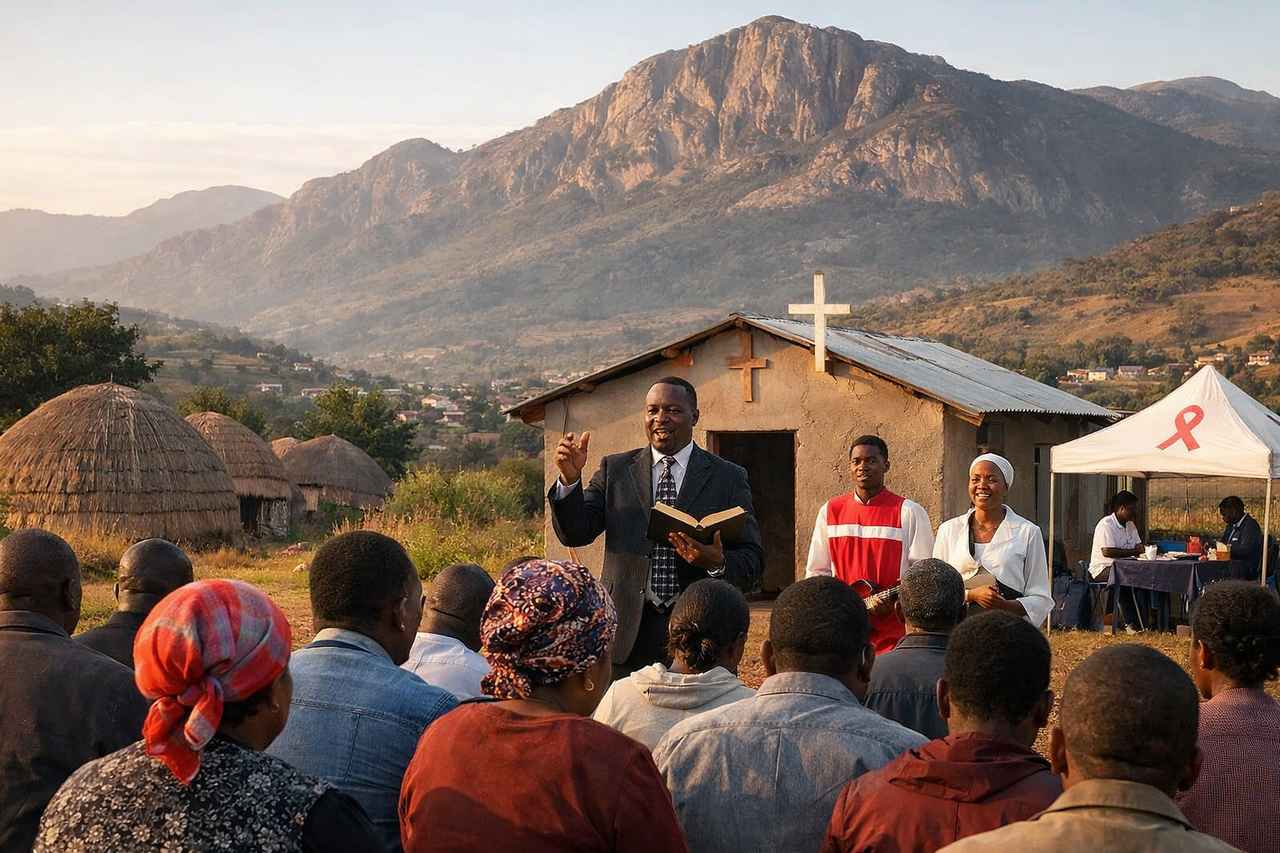
Eswatini is not a country where Christian life is generally forced underground. Churches are visible, the name of Christ is publicly known, and freedom of religion is constitutionally protected. Yet this small kingdom carries a serious present burden. Political power remains highly concentrated, civic freedoms remain sharply restricted, poverty and unemployment still weigh on ordinary households, and the HIV crisis continues to press on families, clinics, and congregations. For Christians, that means prayer is needed not only for freedom to worship, but also for truth, justice, mercy, faithful witness, and steadfast endurance under the rule of Christ.
1. Why This Country Needs Prayer Now
Eswatini remains Africa’s last absolute monarchy, and current human-rights reporting says political parties are still banned and civic space remains tightly closed. That matters for prayer because churches do not live apart from the wider life of the nation. Believers raise children, work, suffer, serve, and speak about Christ in a setting where fear, silence, and concentrated power can shape public life far beyond formal church walls.
At the same time, Eswatini should not be described only through the lens of repression. The country is overwhelmingly Christian, public worship is normal, and the law protects freedom of religion. Still, there are signs that church life can be shaped unevenly by state preference, administrative control, and older blends of traditional and Christian practice. That is one reason the current discussion around a national policy for religious institutions calls for careful, sober prayer rather than either panic or complacency.
The country also carries a deep social burden. International Monetary Fund and World Bank reporting points to high unemployment, severe inequality, and persistent poverty, while the Joint United Nations Programme on HIV/AIDS (UNAIDS) says recent U.S. funding cuts have disrupted parts of HIV prevention work. Together, these pressures mean many churches are ministering not only to spiritual need, but also to fragile households, anxious young people, and communities living under long strain.
2. Country Snapshot
Eswatini is a small landlocked country in Southern Africa, bordered by South Africa and Mozambique. The World Bank lists its 2024 population at 1,242,822. Public religion remains overwhelmingly Christian. The U.S. State Department’s 2023 international religious freedom report says religious leaders estimate that about 90 percent of the population is Christian, around 2 percent is Muslim, and the rest belong to other faiths or indigenous belief traditions.
The constitution protects freedom of thought, conscience, and religion. Politically, however, the country remains strongly monarchy-centered. Official Eswatini sources identify King Mswati III as the reigning monarch, and April 2026 marks both his 58th birthday and 40 years on the throne. Parliament identifies Russell Mmiso Dlamini as prime minister, appointed in November 2023.
All of this means that church life in Eswatini unfolds in a setting where Christianity is common and public, yet political authority remains unusually centralized. The church is not generally erased from public life, but it still needs wisdom, courage, and doctrinal steadiness.
3. Main Pressures Facing Christians
For many believers in Eswatini, the main pressure is not mass violent persecution of the kind seen in some other nations. The burden is more layered than that. Christians live in a country where public life is tightly shaped by monarchy-centered power and where civic restrictions can foster caution, fear, and self-censorship. Over time, that atmosphere can weaken bold witness, discourage principled speech, and tempt churches either to withdraw too far or to confuse gospel faithfulness with political reaction.
There are also religious-freedom questions beneath the surface of a Christian-majority society. The U.S. State Department reported that some faith leaders said the government favored Zionist churches, a broad stream of locally rooted churches that often blend Christian and traditional practices, above others. The same report noted longstanding concerns about advance permission requirements for major public religious events and about unequal practical treatment of some faith communities.
That concern has now taken a newer form. In late 2025, church leaders took part in consultations over a proposed policy for religious institutions and the transfer of church registration to the Ministry of Home Affairs. The government said it did not want to regulate sermons and wanted churches to remain independent, but it also spoke of bringing order and creating a clearer national system. That may yet prove limited and administrative. Even so, it is exactly the kind of development that deserves watchful prayer before its long-term effects are known.
Economic and health pressures add another layer. High unemployment, widespread poverty, and the continuing HIV burden place strain on marriages, young people, pastors, and local congregations. In such a setting, the church needs grace not merely to keep going, but to remain holy, compassionate, and gospel-centered rather than being swallowed by fatigue or reduced to social maintenance alone.
4. What Life Is Like for Christians in Eswatini
For many Christians, ordinary church life in Eswatini is still possible in public view. Worship services, Christian schools, denominational life, and visible church structures remain part of the nation’s fabric. That is a real mercy and should not be minimized. Eswatini is not a place where most believers must hide the name of Christ simply to gather on a Sunday.
Yet visible Christianity is not the same thing as spiritual health. In practice, believers may need to navigate a society where Christian identity is common, but deeper discipleship, biblical clarity, and moral courage are not automatic. Some churches remain closely tied to long-standing cultural patterns or umbrella structures. Others may quietly wonder how future registration rules or policy changes could affect their freedom to order their life under Christ and His Word.
For ordinary believers, daily faithfulness may also mean carrying burdens that do not always make headlines. A congregation may be caring for families weakened by unemployment, walking with households touched by HIV, helping the young resist despair, or trying to speak truth in a climate where public confidence is low. In that kind of setting, Christian endurance often looks quiet: steadfast prayer, sound preaching, practical mercy, patient discipleship, and a refusal to surrender hope.
5. Recent Developments
One of the most relevant recent church-related developments is the government’s effort to develop a national policy for religious institutions. In November 2025, the Home Affairs minister said the aim was not to regulate churches or control sermons, but to create order, improve registration clarity, and move church registration under the Ministry of Home Affairs. The consultations drew broad church participation, which is encouraging. Still, the proposal deserves careful watching as it continues to develop.
The broader political environment remains strained. Human Rights Watch’s 2026 assessment says political parties remain banned, civil rights are severely restricted, and authorities have not brought accountability for earlier abuses linked to the 2021 crackdown. That background shapes the national atmosphere in which churches pray, disciple, and speak.
Economically, the picture is mixed. The International Monetary Fund says growth strengthened after 2024 and could rise further in 2026, but it also highlights high unemployment, severe inequality, and persistent poverty. The World Bank likewise points to continuing vulnerability even alongside some positive indicators. So the country’s needs are not only constitutional or political. They are also social, material, and deeply human.
Health developments show the same mixture of burden and mercy. UNAIDS reported in 2025 that U.S. funding cuts disrupted parts of HIV prevention in Eswatini, including services affecting adolescent girls and young women. Yet later in 2025, the Associated Press reported that Eswatini became the first African country to receive lenacapavir, a twice-yearly HIV prevention injection seen as a major breakthrough. That does not erase the strain, but it does give genuine reason for hopeful thanksgiving.
6. How to Pray
- Pray that the Lord would rule over Eswatini in mercy and truth, granting the king, the prime minister, and other authorities wisdom, restraint, and a genuine concern for justice, peace, and the common good.
- Pray that churches across Eswatini would remain spiritually faithful and wisely independent as discussions continue around the proposed policy for religious institutions, and that no future regulation would hinder sound preaching, biblical discipleship, or the free ordering of church life under Christ.
- Pray for pastors, elders, and other church leaders to preach Christ clearly, shepherd courageously, and resist both fear and unhealthy compromise in a nation where public power remains highly concentrated.
- Pray for believers serving under economic strain, especially families affected by poverty, unemployment, and rising pressure on daily life, that God would provide for them, preserve their hope, and make local churches rich in mercy and practical love.
- Pray for those living under the continuing weight of the HIV burden, including patients, caregivers, health workers, widows, grandparents, and vulnerable children, that the Lord would sustain them and use the church as a place of truth, compassion, and steady care.
- Pray for young people in Eswatini, that they would not be swallowed by despair, empty religion, or cynicism, but would come to living faith in Christ and grow into holiness, courage, and joyful obedience.
- Pray that the church in Eswatini would not merely remain visible, but spiritually strong—marked by repentance, sound doctrine, love, endurance, and fruitful gospel witness in every place God has planted it.
7. Give Thanks
- Give thanks that Christians in Eswatini are still generally able to gather openly for worship and that freedom of religion remains protected in the country’s legal framework.
- Give thanks for the visible presence of many churches across the nation and for the continued public witness of the gospel in a land where the name of Christ is still widely known.
- Give thanks that church leaders were included in recent consultations about the proposed policy for religious institutions, and that the government publicly stated it does not intend to regulate sermons.
- Give thanks for signs of God’s common grace in public health efforts, including meaningful progress in HIV prevention and care, and for every mercy that helps protect life, strengthen families, and relieve suffering.
- Give thanks for every faithful pastor, congregation, and ordinary believer who continues to serve quietly, love sacrificially, and hold fast to Christ amid social, economic, and political strain.
8. Last Verified
Last updated: April 18, 2026.
Key sources consulted
- U.S. Department of State, 2023 International Religious Freedom Report: Eswatini
- Parliament of the Kingdom of Eswatini, Prime Minister & Minister for Parliamentary Affairs page identifying Russell Mmiso Dlamini
- Human Rights Watch, World Report 2026: Eswatini
- International Monetary Fund and World Bank materials on Eswatini’s economy and development indicators
- UNAIDS, Impact of US funding cuts on HIV programmes in Eswatini
- UNAIDS, “We Can’t Afford to Go Back” — UNAIDS Country Director on HIV funding cut in Eswatini
- Associated Press, Eswatini is the first African country to get twice-yearly HIV prevention shot
- Times of Eswatini, Minister: Government will not regulate churches