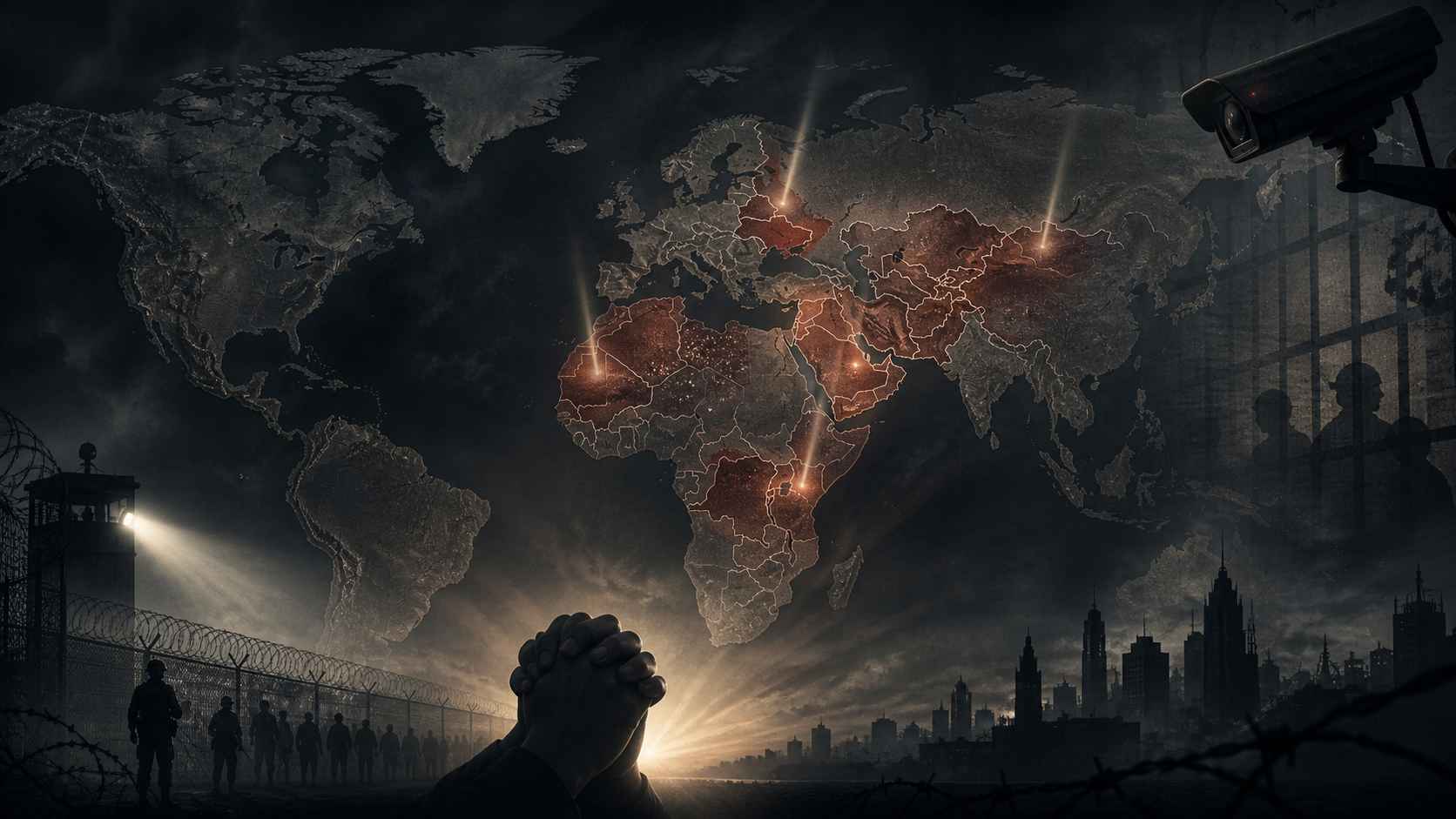
Top Ten Countries Facing Heavy State Pressure and Crackdown in April 2026

Dark editorial world map with highlighted regions across Africa, the Middle East, Asia, and Eastern Europe, alongside barbed wire, a surveillance camera, a watchtower, clasped hands, and a shadowed city skyline.
Top Ten Prayer Watchlist

Top Ten Countries Facing Heavy State Pressure and Crackdown in April 2026

A prayer-focused guide to help Christians understand where coercive state pressure is bearing most heavily on public life, conscience, church life, and ordinary endurance right now.

State Pressure Restriction and Control Watchful Prayer

State pressure does not always announce itself through one dramatic headline. Often it advances through a steady tightening of public life: surveillance, censorship, arbitrary detention, punitive laws, pressured silence, restricted worship, weakened institutions, and the growing cost of speaking, gathering, or living openly according to conscience. In some countries, that pressure has become so broad and so deeply embedded that fear settles into ordinary life. Churches learn to endure under scrutiny. Families live more cautiously. Independent voices grow quieter. What may appear from a distance to be mere political control often becomes, on the ground, a heavy burden on truth, worship, witness, and everyday human dignity.

That is why this ranking matters. This is not a slogan-driven digest of authoritarian headlines, nor a simple list of governments that attract the most criticism. It is a comparative effort to identify, as of April 2026, the countries where state pressure and crackdown are weighing most heavily on public life right now — through law, policing, surveillance, coercion, institutional control, and the narrowing of civic and spiritual space. For Christians, such realities should do more than inform us. They should move us to prayer: for believers called to stand firm under pressure, for those silenced by fear, for justice and restraint in the exercise of power, and for the mercy of God to sustain His church, preserve the truth, and cause the light of Christ to shine even where public life is increasingly ruled by intimidation.

Ranking Method

How this comparative state-pressure ranking was framed and weighed.

Our analysis was based on the following: Severity of State Pressure 25%, Breadth Across National Life 20%, Structural and Institutional Entrenchment 20%, Current Urgency / Escalation 15%, Reach and National Impact 10%, and Prayer-and-Ministry Relevance 10%. I treated this as a country-based ranking, so Hong Kong’s repression was folded into China rather than listed separately. I conducted a broad analysis across a larger candidate field that included North Korea, Eritrea, Turkmenistan, Afghanistan, China, Myanmar, Nicaragua, Belarus, Iran, Russia, Cuba, Tajikistan, Saudi Arabia, Vietnam, and Burkina Faso. I used very recent current-affairs reporting where available, but for structural comparison I relied heavily on 2026 editions of Freedom House, Human Rights Watch, USCIRF, and relevant UN material. Official state rationale was checked where it materially mattered: for example, regimes invoked national security, extremism, counterterrorism, election protection, morality, anti-foreign-influence, anti-corruption, or revolutionary-state language, but I did not treat those claims as self-validating.

Working Definition

What qualified a country for inclusion in this present-burden ranking.

Heavy state pressure / crackdown

For this ranking, a country qualified if it was currently experiencing broad state repression, coercion, or intimidation affecting public life, including severe restrictions on speech, protest, association, worship, conscience, media, church life, or civil society; major arrests, surveillance, raids, closures, forced registration, or punitive legal measures tied to dissent, religion, or independent organization; and coercive state action that materially increases fear, silence, instability, or restricted public life. This is not a list of the “worst governments” in some abstract moral sense; it is a present-burden ranking focused on where state pressure is now weighing most heavily on national life, conscience, church life, civil society, public fear, and ordinary endurance.

Ranking Criteria

The six-factor framework used to compare countries facing heavy state pressure and crackdown.

  • Severity of State Pressure 25%
  • Breadth of Pressure Across National Life 20%
  • Structural and Institutional Entrenchment 20%
  • Current Urgency / Escalation 15%
  • Reach and National Impact 10%
  • Prayer-and-Ministry Relevance 10%

Top Ten Countries

The countries where state pressure and crackdown are weighing most heavily on public life, conscience, and ordinary endurance in this ranking.

Why It Qualifies / Why It Ranks Here

North Korea remains the clearest case of near-total state domination across speech, information, movement, religion, labor, and daily survival. Human Rights Watch says 2025 brought tighter surveillance, harsher information controls, wider forced labor, stronger restrictions on border crossings, and continued severe punishment for political offenses; a February 2026 HRW update says the Party Congress was set to deepen repression still further. Freedom House continues to score the country at 3/100, describing pervasive surveillance, arbitrary detention, and severe punishment for political offenses. This is the most structurally totalizing state-pressure environment in the ranking.

State-Pressure Pattern

Totalitarian control enforced through surveillance, forced labor, censorship, and collective fear.

Prayer Relevance

Public worship, conscience, truthful information, and ordinary faithfulness are all constrained by a regime that leaves almost no independent civic space.

Key current sources used: Human Rights Watch’s World Report 2026 North Korea chapter and February 2026 updates; Freedom House Freedom in the World 2026.

Why It Qualifies / Why It Ranks Here

Eritrea combines one-party rule, arbitrary detention, indefinite national service, severe religious restriction, and an almost total lack of independent media or political life. Freedom House still scores Eritrea 3/100 and describes a militarized authoritarian state with arbitrary detention as commonplace and national service that often lasts for working lives; USCIRF’s 2026 material says religious freedom conditions remained “extremely poor,” with only four recognized groups and systematic persecution of others. Eritrea ranks just below North Korea because the system is slightly less closed and technologically comprehensive, but it remains among the world’s harshest state-pressure environments.

State-Pressure Pattern

Militarized repression through arbitrary detention, forced service, and tight control of religion, media, and exit.

Prayer Relevance

Church life, conscience, and simple endurance are heavily shaped by fear, secrecy, and long-term coercion.

Key current sources used: Freedom House Freedom in the World 2026 country material; USCIRF 2026 annual report chapter on Eritrea; UK government December 2025 country note on national service and illegal exit.

Why It Qualifies / Why It Ranks Here

Turkmenistan is one of the world’s most closed and least free states, with virtually no independent media, deep restrictions on movement, religious persecution, politically motivated prosecutions, and pressure on critics and their families, including those abroad. Freedom House scores it 1/100; HRW says authorities continued to severely restrict expression, association, religion, internet access, movement, and exile activism; USCIRF’s 2026 annual report says vague religion and extremism laws continue to be used to arbitrarily punish peaceful religious activity. It ranks above Afghanistan because its repression is more structurally frozen into a fully closed state, though Afghanistan is more acute on gender and public morality.

State-Pressure Pattern

Closed-state coercion sustained through surveillance, isolation, religion controls, and fear.

Prayer Relevance

Believers and citizens face a suffocating public environment with little lawful room for independent worship, dissent, or mercy-shaped civic action.

Key current sources used: Freedom House Freedom in the World 2026 / country profile; Human Rights Watch World Report 2026 Turkmenistan chapter; USCIRF 2026 annual report chapter on Turkmenistan.

Why It Qualifies / Why It Ranks Here

Taliban rule remains the world’s most systematic contemporary campaign to erase women from public life while also shrinking media freedom, public expression, humanitarian work, and ordinary civil space. HRW says the Taliban in 2025 intensified repression of women and girls and enforced regulations further curbing media freedom; its 2026 country chapter describes raids, checkpoints, work restrictions, detention for morality infractions, and further constraints on women’s movement and employment. Reuters reported in February 2026 that a new Taliban decree would further deepen repression and broaden punishments, especially for women, while UN Women said in March 2026 that the justice gap for women and girls was widening further.

State-Pressure Pattern

Morality-based authoritarian rule enforced through decrees, checkpoints, media pressure, and gendered exclusion.

Prayer Relevance

Church life is tiny and hidden, and the broader climate of fear, gender repression, and legal coercion sharply heightens the burden on conscience, mercy, and witness.

Key current sources used: Human Rights Watch February 2026 update and World Report 2026 Afghanistan chapter; Reuters reporting via February 2026 UN rights briefing; UN Women March 2026 Afghanistan briefing.

Why It Qualifies / Why It Ranks Here

China’s ranking rests on breadth, scale, and state capacity: repression reaches speech, religion, digital life, universities, civil society, lawyers, labor, ethnic minorities, and extraterritorial pressure. Freedom House says the CCP maintains tight control over bureaucracy, media, online speech, religious practice, universities, and business, and that 2025 included new crackdowns on underground churches; HRW says Chinese authorities systematically deny expression, association, assembly, and religion, while continuing harsh repression in Xinjiang, Tibet, unofficial churches, and Hong Kong. Recent Hong Kong national-security cases, including asset seizure moves against Jimmy Lai, show how national-security logic is still being used to criminalize dissent, with authorities insisting the case is about security rather than journalism. China ranks below the top four because ordinary daily coercion is not as universally immobilizing as in North Korea, Eritrea, or Turkmenistan, but its national reach and institutional sophistication are unmatched outside that tier.

State-Pressure Pattern

High-capacity party-state repression through surveillance, censorship, national-security law, forced assimilation, and controlled religion.

Prayer Relevance

Churches, conscience, minority faith communities, and public truth-telling all face sustained pressure from a state that insists ideological loyalty outranks independent conviction.

Key current sources used: Freedom House Freedom in the World 2026 China report; Human Rights Watch World Report 2026 China chapter and February 2026 China update; AP reporting on Hong Kong’s use of national-security law in the Jimmy Lai case.

Why It Qualifies / Why It Ranks Here

Myanmar’s junta combines conflict violence with one of the world’s most brutal active state crackdowns on dissent, media, aid workers, lawyers, and religious leaders. HRW says the junta has arrested more than 30,000 people since the coup, more than 2,200 have reportedly died in custody, torture is rampant, family members are detained as coercion, and 2025 saw a new cyber law, martial-law expansion, and an “election protection” law criminalizing criticism of sham elections. Freedom House still scores Myanmar 4/100 and notes that protesters, journalists, activists, and ordinary people face criminal charges, detention, and lethal violence for dissent. Myanmar ranks below China because the junta’s territorial control is weaker and the repression is bound up with civil war, but in severity and cruelty it is plainly top ten.

State-Pressure Pattern

Military coercion through detention, torture, aerial violence, cyber controls, and politicized law.

Prayer Relevance

Churches, aid ministries, and ordinary believers are pressured not only by war but by a state apparatus that punishes dissent, restricts organizing, and normalizes fear.

Key current sources used: Human Rights Watch World Report 2026 Myanmar chapter and January 2026 junta-atrocities update; Freedom House Freedom in the World 2026 / country profile.

Why It Qualifies / Why It Ranks Here

Nicaragua has become one of the clearest Western Hemisphere examples of an all-branch, all-sector authoritarian consolidation. Freedom House says 2025 constitutional reforms made Daniel Ortega and Rosario Murillo “copresidents,” gave the presidency power to coordinate the legislature, judiciary, electoral bodies, and police, and accompanied continued regime control over media, universities, NGOs, and religious life; it also records surveillance of clergy, confiscation of church property, bans on Easter processions, closure of more than 5,670 NGOs since 2018, and closure of 1,294 religious organizations since 2018. HRW likewise says the government tightened authoritarian rule through arbitrary arrest, prosecution, forced exile, citizenship stripping, and confiscation of assets. Nicaragua ranks this high because the crackdown is no longer episodic; it is structural, normalized, and extending into church life in especially stark ways.

State-Pressure Pattern

Dynastic executive consolidation backed by police-state pressure on churches, media, NGOs, academia, and dissidents.

Prayer Relevance

Public Christian witness, pastoral leadership, mercy work, and civil society resilience are all under unusually direct state pressure.

Key current sources used: Freedom House Freedom in the World 2026 Nicaragua report; Human Rights Watch World Report 2026 Nicaragua chapter; Library of Congress summary of the 2025 constitutional overhaul.

Why It Qualifies / Why It Ranks Here

Belarus remains one of Europe’s harshest state-crackdown environments, with repression still radiating outward from the 2020 protest cycle into journalism, law, civil society, religion, exile communities, and even online interaction. HRW says at least 1,110 people remained imprisoned on politically motivated grounds at the end of 2025, at least 28 journalists and media workers were behind bars, lawyers were imprisoned or stripped of licenses, and any interaction with organizations or individuals labeled “extremist” or “terrorist” can be prosecuted. Freedom House scores Belarus 7/100 and describes violently assaulted journalists, activists, and ordinary citizens, with no meaningful institutional check on Lukashenka’s power. Belarus ranks below Nicaragua because the crackdown is somewhat less church-centered and below Iran because 2026 escalation is less dramatic, but it remains a severe, entrenched coercive state.

State-Pressure Pattern

Post-protest authoritarian lock-in enforced through extremism labels, prison, exile pressure, and institutional terror.

Prayer Relevance

Believers, journalists, lawyers, and families all live under a state that criminalizes association and treats independent civic life as a threat.

Key current sources used: Human Rights Watch World Report 2026 Belarus chapter; Freedom House Freedom in the World 2026 / country profile.

Why It Qualifies / Why It Ranks Here

Iran is in the top ten because 2025–26 brought a fresh, highly coercive phase: execution surges, force against dissent, intensified minority repression, mass arrests during conflict, and cross-border intimidation. Freedom House’s 2026 report says executions surged sharply in 2025, the regime intensified crackdowns on religious and ethnic minorities, authorities used force against late-2025 protests, and during the June conflict authorities imposed an internet shutdown, made mass arrests on alleged spying charges, and executed people on such charges by year’s end. Amnesty said January 2026 saw a heavily militarized clampdown with arbitrary detentions, disappearances, bans on gatherings, and attacks aimed at hiding mass protest killings, while recent reporting says threats to critics and journalists have extended abroad as well. Iran ranks below Belarus only narrowly; its lower placement reflects the difficulty of separating crackdown severity from broader wartime conditions, not any lightness of repression.

State-Pressure Pattern

Security-state repression through executions, detentions, internet controls, minority targeting, and transnational intimidation.

Prayer Relevance

Fear, imprisonment, surveillance, and coercive religious-state power continue to weigh heavily on conscience, witness, and endurance.

Key current sources used: Freedom House Freedom in the World 2026 Iran report; Amnesty International January 2026 Iran crackdown report; recent reporting on transnational intimidation of Iranian journalists.

Why It Qualifies / Why It Ranks Here

Russia remains a major crackdown state because the war has further hardened an already authoritarian system against NGOs, journalists, anti-war speech, migrants, LGBT people, education, and religion. HRW says the number of political prisoners rose to 1,217, prosecutions under the “foreign agents” law escalated, dozens more organizations were branded “undesirable,” and new criminal penalties and discrimination measures continued to multiply in 2025. Freedom House says Russia’s system relies on subservient courts, security forces, a controlled media environment, manipulated elections, and relentless persecution of NGOs and anti-war speech. Russia ranks tenth because the coercive system is severe and national, but compared with countries above it, some non-totalized private space still survives and church-life repression is less singularly central than in Nicaragua, China, or Eritrea.

State-Pressure Pattern

War-hardened authoritarianism enforced through foreign-agent/undesirable/extremism laws, prison, censorship, and surveillance.

Prayer Relevance

Believers, dissidents, independent ministries, and families are pressured by a state that increasingly treats independent moral or civic action as suspect.

Key current sources used: Human Rights Watch February 2026 Russia update; Freedom House Freedom in the World 2026 Russia report.

Near-Miss / Watchlist Countries

Countries that remained serious enough to watch, but fell just outside the final ten after comparison.

Cuba — Extremely repressive and still not free, with continued arbitrary detention, surveillance, and hundreds of political prisoners, but in this comparison it falls just outside the top ten because the 2025–26 coercive phase looks slightly less totalizing than Nicaragua, Belarus, or Iran.

Tajikistan — A serious contender because of long prison terms for public figures and journalists, continuing repression in GBAO, tight control of religion, and transnational repression, but it remains somewhat narrower in breadth and global weight than the countries placed above it.

Saudi Arabia — Still a hard authoritarian state with pervasive surveillance, criminalization of dissent, continuing detentions, and broad restrictions on expression and religion, but recent releases and limited reform areas make it less acute than the final ten at this moment.

Vietnam — A one-party system with tight limits on speech, religion, and civil society, and it remains important in transnational repression discussions, but its current pressure level appears less acute and less nationally suffocating than the top ten.

Burkina Faso — A rapidly worsening 2026 case because the junta has dissolved scores of civic groups, used repressive laws, and widened pressure on NGOs, media, and dissent, but it is still better treated as a fast-rising watchlist country than a settled top-ten inclusion.

Final Summary Judgment

What most distinguishes this ranking from a general list of troubled countries.

How to Pray Through This List

A brief prayer response shaped by the article’s actual burden: truth under pressure, churches under scrutiny, and ordinary people living under fear.

  • Pray for believers called to stand firm under surveillance, restriction, intimidation, and isolation, asking God to preserve truth, courage, holiness, and quiet faithfulness where public life is ruled by fear.

  • Pray for churches, pastors, families, and small fellowships living under state pressure, that the Lord would sustain them in worship, strengthen them in witness, and keep them from despair, compromise, or silence born of terror.

  • Pray for prisoners, detainees, monitored dissidents, targeted minorities, and ordinary citizens whose daily lives are narrowed by coercive power, asking God to restrain evil, uphold the weak, and grant mercy where earthly protection is thin.

  • Pray for rulers, officials, judges, police, and security bodies, that God would curb cruelty, expose falsehood, limit the reach of oppressive power, and turn hearts away from injustice toward truth, restraint, and accountability.

Key Sources Consulted

Descriptive source documentation drawn from the article’s own cited materials.

  • Freedom House. Freedom in the World 2026 country reports and country profiles used across the ranking.
  • Human Rights Watch. World Report 2026 country chapters and relevant February 2026 or January 2026 updates where cited in the country entries.
  • U.S. Commission on International Religious Freedom. 2026 annual report chapters where cited, including Eritrea and Turkmenistan materials.
  • United Nations materials referenced in the article, including the March 2026 UN Women briefing on Afghanistan.
  • Reuters reporting used for recent escalation checks, including February 2026 reporting referenced in the Afghanistan entry.
  • Amnesty International. January 2026 Iran crackdown reporting.
  • Library of Congress. Summary of Nicaragua’s 2025 constitutional overhaul.
  • Relevant current-affairs reporting clusters referenced within the article, including Hong Kong national-security coverage and reporting on transnational intimidation connected to Iran.

May the Lord teach us to pray with sober minds and compassionate hearts for believers, families, and whole societies living under heavy state pressure — asking Him to preserve His church, restrain evil, uphold the weak, and cause the light of Christ to shine where fear and coercion seem strongest.