

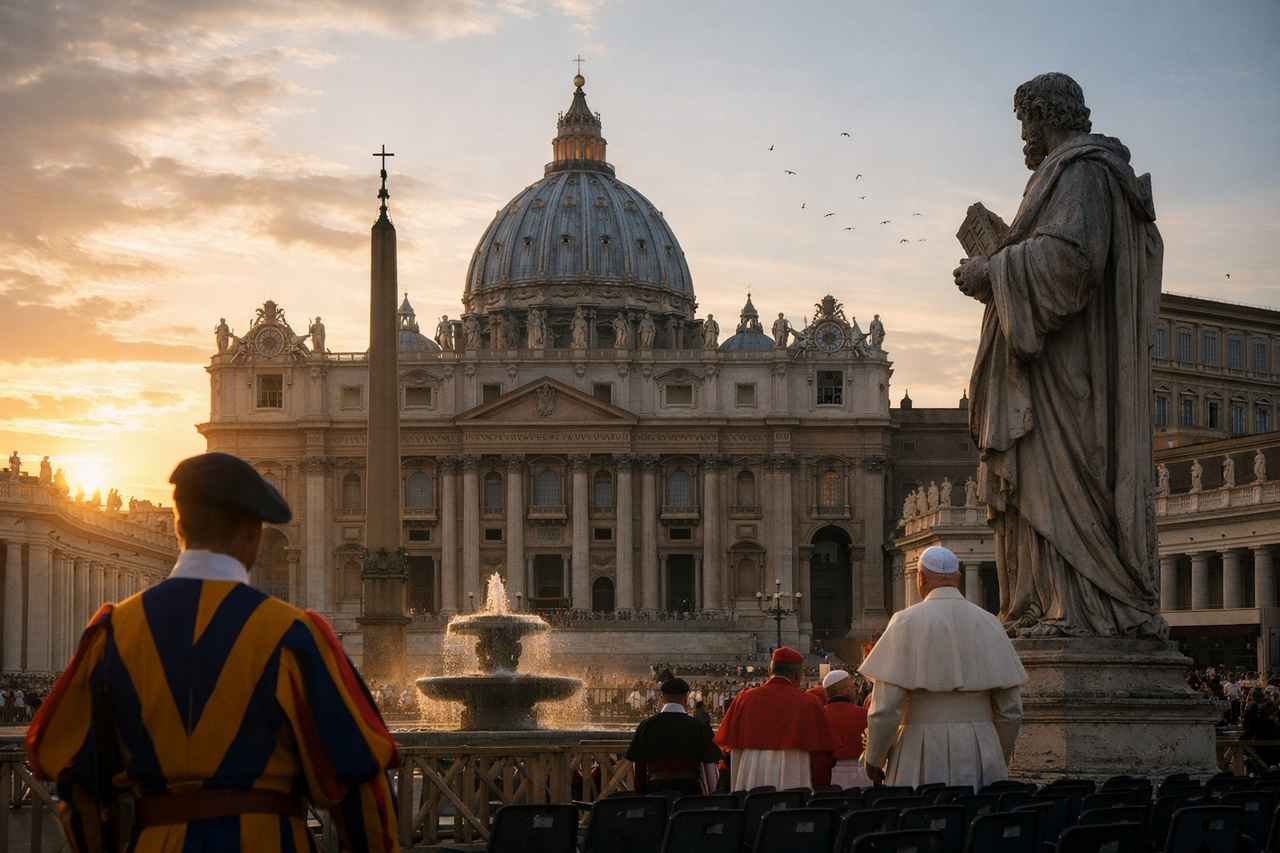
The Holy See, the central governing authority of the Roman Catholic Church, occupies very little territory, yet its influence reaches across the world. What is said and done there can shape doctrine, diplomacy, public witness, and the spiritual outlook of millions far beyond Rome. In April 2026, it stands in a particularly weighty moment: Pope Leo XIV is still in the first year of his pontificate, public appeals for peace continue amid ongoing conflict, and longstanding burdens tied to safeguarding, truthfulness, and institutional integrity remain unresolved. For these reasons, the Holy See is not merely a subject of religious interest or institutional observation. It is a place Christians should remember before God with honesty, discernment, and charity.
Why This Country Needs Prayer Now
The Holy See needs prayer now because its influence is spiritual, moral, and global long before it is territorial. It helps shape the teaching, tone, and public witness of the Roman Catholic Church worldwide, while also maintaining a significant diplomatic presence among the nations. As of January 2026, it maintained diplomatic relations with 184 states, along with the European Union and the Sovereign Military Order of Malta. That means its strengths can serve many people, but its failures can also have far-reaching consequences. Where influence is great, the need for prayer is great as well.
At present, that burden is sharpened by several realities at once. Pope Leo XIV is still establishing the tone and direction of his pontificate. The Holy See continues to speak publicly about peace, war, religious freedom, and human dignity. Yet at the same time, it still bears the heavy moral damage left by abuse scandals, ongoing safeguarding failures, and continued questions about financial and institutional integrity. These are not isolated concerns. Together, they shape whether the Holy See’s public witness will be received as truthful, humble, and credible.
For evangelical Christians, praying for the Holy See does not mean ignoring serious theological differences or minimizing deep institutional failures. It means bringing those realities before the Lord in a way that is truthful, reverent, and distinctly Christian. We should pray that Christ would be honored above ceremony, that repentance would go deeper than public language, that truth would be loved more than reputation, and that all who serve within this sphere of influence would be brought under the authority of God’s Word.
This is also a place where Christian love must remain visible. Many sincere Roman Catholics look to the Holy See for guidance, and many ordinary believers connected to it are far removed from public power. The right response, then, is neither flattery nor contempt. It is sober, faithful prayer: asking God to expose evil, strengthen what is commendable, purify what is compromised, and cause His truth to shine more clearly wherever confusion, fear, or human pride has dimmed it.
Country Snapshot

The Holy See is not the same thing as Vatican City State, though the two are closely connected. The Holy See is the central governing authority of the Roman Catholic Church. Vatican City State, created by the Lateran Treaty of 1929, exists to secure that authority’s visible independence and freedom to act in the world. This distinction matters, because the Holy See’s significance is not measured mainly by land, population, or ordinary state power. Its importance is spiritual, institutional, and diplomatic.
Vatican City State itself is very small. Official statistics updated to December 31, 2024, report 882 residents. Yet the Holy See’s reach is global. As of January 2026, it maintained diplomatic relations with 184 states, along with ties to the European Union and the Sovereign Military Order of Malta, a historic Catholic lay order with international humanitarian and diplomatic standing. Through the Roman Curia, the central administrative structure that helps govern the Roman Catholic Church, the Holy See oversees a far-reaching network of leadership, doctrine, diplomacy, and public witness. In other words, this is a very small place with very great influence.
Main Pressures Facing Christians
The main pressure connected to the Holy See is not violent persecution. Rather, it is the strain that arises when spiritual authority, institutional responsibility, global visibility, and constant public scrutiny are concentrated in one place.
One major pressure is doctrinal and moral clarity. When a body speaks often and is heard around the world, confusion can spread widely as well. That is why prayer should include a plea for greater faithfulness to Christ, deeper submission to Scripture, and clearer witness wherever tradition, ambiguity, or institutional instinct begins to obscure the gospel.
A second pressure is safeguarding credibility. In March 2026, Pope Leo XIV told the Pontifical Commission for the Protection of Minors, the Vatican body that advises on abuse prevention and child protection, that protecting minors is essential for the life of the Church. Yet the deeper burden remains painfully clear: abuse has left real wounds, institutional failures have damaged trust, and vulnerable people need more than carefully worded statements. They need truth, justice, repentance, and protection that is real rather than merely procedural.
A third pressure is integrity in governance. In March 2026, the Vatican Court of Appeal ordered a partial mistrial in the Holy See financial-management case, requiring the renewal of specific phases of the trial and fuller disclosure of investigative materials before proceedings continue. Even where every fact is not yet settled, the prayer burden is already plain: that wrongdoing would be exposed, that truth would not be bent to protect reputation, and that those entrusted with oversight would act with justice, transparency, and integrity.
A fourth pressure is diplomatic faithfulness. The Holy See’s international role can serve peace, conscience, and human dignity, and that is no small good. Yet diplomacy also brings difficult tensions. Efforts to preserve dialogue can sometimes raise hard questions about compromise, moral clarity, and the cost borne by believers living under pressure. That tension is still visible in the Holy See’s 2024 extension of its provisional agreement with China on the appointment of bishops, which remains relevant because it continues to raise difficult questions about church order, diplomacy, and religious freedom.
Taken together, these pressures show why prayer for the Holy See must be both honest and careful. The aim is neither to condemn from a distance nor to admire without question, but to ask that Christ would purify what is compromised, strengthen what is commendable, and make truth, holiness, and humility more evident in a place whose influence extends far beyond its borders.
What Life Is Like for Christians in the Holy See
Life in and around the Holy See is shaped by worship, administration, diplomacy, ceremony, and constant visibility. Clergy, religious workers, lay staff, diplomats, journalists, and pilgrims move through a setting where sacred language is familiar, public symbolism is strong, and decisions made in a very small place can affect believers across the world. That can give daily life a sense of seriousness and privilege. It can also create quieter spiritual dangers.
The pressure is often not dramatic, but it is real. In such a setting, sacred things can become routine. Institutional habits can dull spiritual urgency. Reputation can be guarded more carefully than truth. People can learn how to speak in religious language without walking in repentance, humility, or transparent obedience. Where authority and ceremony are always close at hand, the temptation to confuse office with faithfulness can become especially strong.
For Christians serving within this world, ordinary faithfulness may look quieter and less visible than outsiders expect. It may mean telling the truth when it is costly, caring well for the wounded, resisting cynicism, refusing institutional self-protection, and carrying out daily responsibilities with a sincere fear of God. It also means remembering that the Church belongs to Christ, not to any office, personality, or human structure.
This is one reason the Holy See should be spoken of with care. Many sincere Roman Catholics look to it for guidance, and many believers connected to it are not public figures at all. Some serve quietly, pray faithfully, and labor conscientiously within difficult structures. That does not erase serious theological differences or moral failures. It does mean, however, that Christian prayer should remain truthful without becoming contemptuous, and discerning without losing tenderness, dignity, or fairness.
Recent Developments
The clearest recent development is the continuing first year of Pope Leo XIV’s pontificate. Elected on May 8, 2025, he has already given the Holy See a public tone marked by peace appeals, diplomatic engagement, and explicitly Christian witness. That matters because the opening phase of a pontificate often shapes priorities, language, appointments, and global expectations well beyond Rome.
That public direction has remained visible in 2026. In January, the Holy See reported diplomatic relations with 184 states, and Pope Leo XIV used his address to ambassadors to warn against a world increasingly shaped by force rather than dialogue. In April, he led a prayer vigil for peace in St. Peter’s Basilica, urging leaders to turn away from arms and death toward dialogue and mediation. These developments matter because they help define the Holy See’s present burden: it is trying to speak morally into a violent and unstable world.
Another important current development is the pope’s April 13–23, 2026, journey to Algeria, Cameroon, Angola, and Equatorial Guinea. Because the visit was still underway at the time of writing, its full significance should not be overstated. Even so, it already reflects a continuing concern for Africa, peace, human dignity, and interreligious encounter. That broad direction is worth noting because it helps readers see where the Holy See’s present attention is being directed.
At the same time, the recent picture is not only outward-facing. Safeguarding remained prominent in March and April 2026 through the work of the Pontifical Commission for the Protection of Minors. That continued emphasis is important, but it also reminds readers that the deeper wounds are not healed by statements alone. The burden remains one of repentance, justice, truthfulness, and credible protection for the vulnerable.
Financial and legal integrity also remained in view. In March 2026, the Vatican appeal court ordered a partial mistrial in the Holy See financial-management case, keeping questions of procedure, transparency, and institutional honesty very much alive. That does not justify sweeping conclusions beyond the evidence. It does, however, reinforce the need for prayer that truth would prevail and that institutional credibility would rest on what is righteous, not merely on what is defensible.
One older development still shaping the present moment is the Holy See’s October 2024 extension of its provisional agreement with China on the appointment of bishops. It is no longer new, but it remains relevant because it continues to raise difficult questions about church order, diplomacy, religious freedom, and the cost borne by believers living under pressure. For that reason, it still belongs in the present prayer picture, even alongside newer developments.
How to Pray
- Pray that Pope Leo XIV, the cardinals, bishops, and senior officials who help lead the Roman Catholic Church would fear God, submit to His Word, and prize truth above reputation, influence, or institutional self-protection.
- Pray that the gospel of Jesus Christ would be seen more clearly wherever ceremony, tradition, or moral confusion has dimmed the sufficiency of Christ, His finished work, and the authority of Scripture.
- Pray for real repentance, justice, and tender care in all safeguarding work, so that survivors of abuse would be heard, the vulnerable would be protected, and no rank or office would be allowed to shield sin.
- Pray for honesty and fairness in financial and legal matters connected to the Holy See, that hidden wrongdoing would be exposed, due process would be respected, and those responsible for oversight would act with integrity.
- Pray for wisdom and moral courage in the Holy See’s diplomacy, especially in matters touching war, peace, persecuted Christians, and freedom of religion, so that the desire for dialogue would not weaken clarity about truth and righteousness.
- Pray for priests, religious workers, diplomats, lay staff, and worshipers connected to the Holy See to walk humbly before God, resist cynicism, and serve with sincerity, purity, and quiet faithfulness in places where power and visibility can easily distort the soul.
Give Thanks
- Give thanks that the Lord Jesus Christ rules over every church body, institution, and nation, and that no structure of human power lies beyond His authority, mercy, or power to reform.
- Give thanks for every sincere confession of Christ, every faithful act of service, and every quiet labor for holiness, truth, protection, and mercy within the wider Roman Catholic world.
- Give thanks for public calls for peace, for stated concern for persecuted believers and freedom of religion, and for any real effort to strengthen safeguarding and protect the vulnerable, while continuing to pray that these good aims would be joined to truth, justice, and lasting faithfulness.
- Give thanks for signs of common grace still visible in and around the Holy See: restraint where evil might have spread further, courage where truth has been spoken, and patient service by those who labor without public notice.
8. Last Verified
Last updated: April 21, 2026
Key Sources Consulted
- Vatican City State, Origins and Characteristics
- Vatican City State, Population (statistics updated to December 31, 2024)
- Holy See Press Office, Informative Note on the Diplomatic Relations of the Holy See (January 9, 2026)
- Vatican News, Pope Leo at Prayer Vigil for Peace: Stop Planning Arms and Death (April 11, 2026)
- Holy See Press Office, Apostolic Journey of His Holiness Pope Leo XIV in Algeria, Cameroon, Angola and Equatorial Guinea (13 to 23 April 2026) – Notice no. 1 (March 16, 2026)
- Holy See Press Office, Apostolic Journey of His Holiness Pope Leo XIV in Algeria, Cameroon, Angola and Equatorial Guinea (13 to 23 April 2026) – Programme (March 16, 2026)
- Vatican News, Pope Leo XIV: Protecting Minors Is Essential for Life of the Church (March 16, 2026)
- Vatican News, Tutela Minorum Reaffirms Guidelines, Highlights Emerging Forms of Abuse (March 2026)
- Vatican News, Vatican Appeal Court Orders Partial Mistrial in Holy See Funds Trial (March 17, 2026)
- Holy See Press Office, Communiqué on the Extension of the Provisional Agreement Between the Holy See and the People’s Republic of China Regarding the Appointment of Bishops (October 22, 2024)
- United States Commission on International Religious Freedom, USCIRF Welcomes the Holy See’s Commitment to Advance Freedom of Religion or Belief for the Persecuted (May 16, 2025)


