

Montenegro has a long Christian history, and most people identify with a religious community, but census figures cannot show whether they have repented of sin and trusted in Christ. The country’s small evangelical community serves in a setting where religion is often inherited and closely tied to ethnicity and politics. Corruption, youth emigration, and unequal access to work and services also affect public life. Pray for clear gospel preaching, faithful discipleship, honest institutions, and compassionate service across the country.
Prayer Burden at a Glance
Pray that people throughout Montenegro would hear the gospel clearly, turn from sin, and trust in Jesus Christ. Ask God to lead those who identify with Christianity away from relying on family tradition, religious ceremony, or cultural belonging, and to bring them to repentance, personal trust in Christ, and faithful obedience to His Word.
Pray for pastors and congregations to teach Scripture carefully, make disciples patiently, and serve their neighbours with courage and compassion. Pray also for honest courts and public offices, peaceful relations among religious and ethnic communities, meaningful work and stability for young people and families, and practical care for people who are poor, displaced, disabled, or excluded.
Last verified: 5 August 2026
Why Montenegro Needs Prayer Now
Montenegro needs prayer for people to trust in Christ rather than inherited religion, for churches to be reformed by Scripture, and for public reforms to strengthen justice and protect ordinary people.
Montenegro has a long Christian history, and most residents identify with a religious community. In the 2023 census, 71.10% identified as Orthodox, 19.99% as Muslim, and 3.27% as Catholic.
These figures describe the country’s religious composition. They do not show whether people have repented of sin, trusted in Christ, understood the gospel, joined in faithful worship, or learned to obey God’s Word. Religious ancestry, baptism, church membership, ceremony, and cultural belonging are not themselves proof of regeneration or saving faith.
Montenegro therefore needs prayer for people to hear that sinners are reconciled to God by grace alone, through faith alone, in Christ alone. Pray that those who identify as Christian would examine their beliefs and practices in the light of Scripture. Ask God to reform churches and professing Christian communities through His Word and to raise up congregations marked by faithful preaching, prayer, holiness, mercy, and patient discipleship.
Montenegro’s negotiations to join the European Union have also moved forward quickly. This has created opportunities to improve the courts, public administration, anti-corruption work, and protection of citizens’ rights. Yet corruption, political influence, regional inequality, youth emigration, and low public trust remain serious concerns.
Pray that reforms would not exist only on paper or be adopted merely to satisfy accession requirements. Ask God to establish public institutions that act fairly, protect vulnerable people, and use authority for the good of the country.
Country Snapshot
A brief orientation to Montenegro’s location, people, government, religious setting, economy, and progress toward European Union membership.
Montenegro stretches from the Adriatic coast into mountainous and less-developed northern regions. Tourism, services, investment from abroad, and external financing are important to the economy. These provide employment and income, but they also leave the country vulnerable when tourism, investment, or borrowing conditions worsen. Economic opportunity is also unevenly distributed between the coast, Podgorica, and communities with fewer jobs and services.
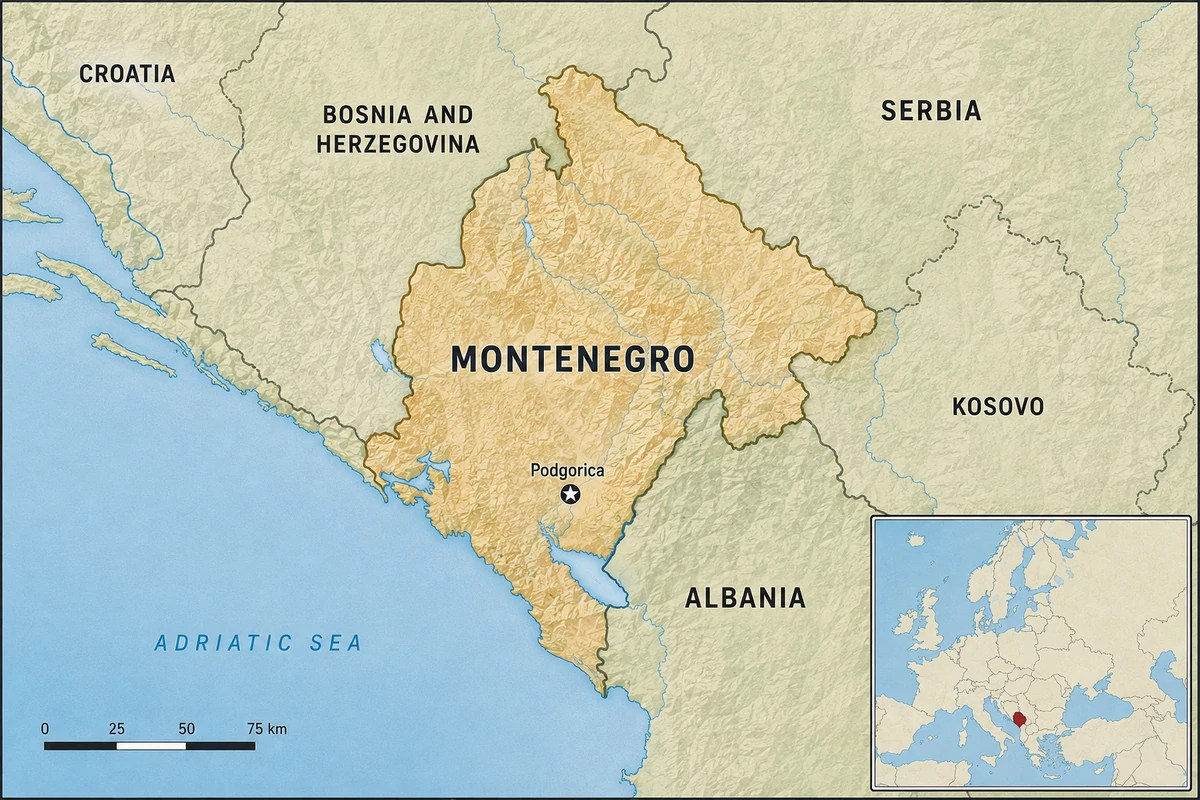
The population is ageing, the birth rate is low, and many young adults leave to study or work abroad. Movement toward Podgorica and the coast is also reducing the population of some northern and rural communities. These changes affect families, schools, care for older people, local employment, and the number of young adults and children in smaller churches.
Spiritual and Practical Challenges Affecting Christians and Churches
The main burdens include religious identity without clear gospel understanding, few evangelical churches and trained leaders, ethnic and political tensions, weak public trust, demographic change, and hardship among vulnerable communities.
Religious identity without clear gospel understanding
Christian history, church buildings, religious festivals, and inherited customs remain visible in Montenegro. Yet people may participate in religious life while knowing little about repentance, justification through Christ, or the authority of Scripture.
Reliable nationwide data do not show how many people have personally trusted in Christ, worship regularly, understand the Bible, or take part in active discipleship. The available figures therefore cannot tell us what any individual believes or describe every church community. Even so, the difference between identifying as Christian and trusting in Christ remains central to prayer.
Pray that churches would explain clearly that sinners are saved through the finished work of Christ—not through ancestry, national identity, religious observance, moral effort, or institutional membership. Ask God to bring people to repentance and faith and to lead all professing Christian communities into greater submission to His Word.
Few evangelical churches and trained leaders
Mission sources differ in their estimates, but they agree that evangelical Christians form only a very small part of Montenegro’s population. Small congregations may have limited finances, few trained leaders, and little public recognition. Pastors and church planters may serve for many years without seeing rapid growth.
Pray that small churches would not become discouraged or divided. Ask God to protect them from theological confusion, rivalry, excessive dependence on one leader, and reliance on outside support that prevents healthy local responsibility.
Pray for mature local pastors, elders, teachers, and ministry workers who can explain Scripture faithfully, train others, shepherd families, and prepare younger believers for long-term service.
Religion tied to ethnicity and politics
Religious affiliation is often connected with ethnicity, historical memory, and different understandings of Montenegro’s national identity. Disagreements about history, church identity, political loyalty, or regional events can therefore increase suspicion between neighbours.
Christians need wisdom to tell the truth about the past without feeding ethnic pride, hostility, or revenge. They also need to treat people from other religious backgrounds with respect without pretending that serious theological differences do not matter.
Pray that believers would refuse ethnic contempt and political manipulation. Ask God to give His people genuine unity grounded in the gospel, wherever truth and conscience permit. Pray that Christians would live peacefully with Orthodox, Catholic, Muslim, secular, Roma, Egyptian, migrant, and refugee neighbours.
Corruption and weak public trust
Corruption, slow court proceedings, political influence, and concerns about media independence have weakened confidence in public institutions. When influential people appear able to avoid consequences, citizens may conclude that honesty does not matter and that personal connections are more useful than fair procedures.
These problems also test professing Christians. Believers may be tempted to separate religious observance from their conduct in business, employment, government, and public responsibility.
Pray that churches would teach honesty, justice, and responsible use of authority as necessary parts of Christian obedience. Ask God to protect judges, investigators, journalists, civil servants, employers, and citizens who act truthfully. Pray for wrongdoing to be exposed and for those who misuse authority to repent.
Young people leaving and communities ageing
Low birth rates, an ageing population, youth emigration, insecure work, and unequal development are changing families and communities. Some northern and rural areas are losing younger residents, while older people may have less family support nearby.
These changes also affect churches. Congregations in smaller communities may lose young adults and families, struggle to maintain regular ministry, or find it difficult to train the next generation of leaders.
Pray for stable and meaningful employment, strong marriages, wise parents, and churches that disciple children and young adults. Ask God to provide compassionate care for older people and renewed opportunity in communities beyond Podgorica and the coast.
Roma, Egyptian, and displaced families facing hardship
Roma and Egyptian communities continue to face poverty, discrimination, insecure housing, unemployment, and barriers to education. School enrolment has improved in some places, but many children still struggle to remain in school, and many families continue to face unequal access to education and employment.
Montenegro also hosts people displaced from Ukraine, including families living with grief, separation, financial pressure, and uncertainty about the future.
Pray that Christians would see vulnerable people as neighbours made in God’s image rather than only as recipients of government programmes or charity. Ask God to protect children from exploitation, strengthen families, provide dignified work and housing, and lead churches to serve with patience, humility, and genuine friendship.
Christian Life and Witness in Montenegro
Believers generally have freedom to gather and speak about their faith, but small congregations need faithful leaders, patient discipleship, and wisdom to witness in a society where religion is often tied to identity and politics.
Montenegro’s laws generally allow believers to gather, worship, teach Scripture, serve their communities, and speak publicly about their faith. Available reporting does not indicate systematic persecution of Christians.
Believers can use this freedom to teach the Bible, disciple families, train leaders, care for people in need, and speak openly about Christ. Freedom of worship is therefore both a mercy and a responsibility.
Local evangelical congregations and ministries report church planting, biblical teaching, discipleship, community outreach, and practical service in places including Bar and Podgorica. Some have worked among Roma children, families affected by disability, and neighbours facing other practical needs.
Public reporting on evangelical church life is limited and does not support claims of nationwide revival or rapid church growth. It does show that believers are present, pastors are serving, congregations are gathering, and opportunities to proclaim the gospel remain open.
Pray for churches to teach sound doctrine, pray seriously, disciple believers carefully, hold leaders accountable, and care generously for their neighbours. Ask God to help small congregations become firmly established in their communities and train believers from one generation to the next.
Because religion is often tied to ethnicity and politics, speaking about Christ can easily be misunderstood as taking sides in national or historical disputes. Believers need grace to make the gospel clear without insulting or dismissing their neighbours.
Pray that Christians would be known for honest work, hospitality, mercy, faithfulness in family life, care for the vulnerable, and love for people from every community. Ask God to help them serve Orthodox, Catholic, Muslim, secular, Roma, Egyptian, migrant, and refugee neighbours without fear, manipulation, or doctrinal compromise.
Churches and individual believers also have opportunities to welcome people displaced from Ukraine. Pray that practical help, friendship, and patient listening would uphold their dignity and, when welcomed, open opportunities to speak about the hope found in Christ.
Recent Developments
Three current developments especially affect prayer for Montenegro’s public institutions, progress toward European Union membership, and care for displaced people.
-
14 July 2026
EU accession talks moved forward
By this date, Montenegro had opened all 33 negotiating chapters required for European Union accession and had provisionally closed 18. The government has stated its ambition to join the European Union in 2028, but this remains a national goal rather than a guaranteed outcome. Negotiations, reforms, and agreement among EU member states are still required.
Prayer significance: Pray that accession-related reforms would strengthen impartial justice, accountable government, media freedom, and protection for ordinary citizens rather than serving mainly as a political achievement.
-
16 July 2026
Parliament filled the Constitutional Court vacancies
The Montenegrin government reported that Parliament had elected the two remaining Constitutional Court judges, returning the Court to full membership. This gives reason for thanksgiving, while concerns about judicial independence, political influence, delays, and public trust still need attention.
Prayer significance: Pray for the Constitutional Court and the wider judiciary to judge impartially, resist political pressure, uphold the Constitution, and protect the rights of all citizens.
-
Valid through 4 March 2027
Protection for people displaced from Ukraine continues
Under Montenegro’s current procedures, temporary protection provides access to residence, employment, education, health care, family reunification, and the opportunity to apply for asylum.
Prayer significance: Pray for displaced families living with grief, financial pressure, separation, and uncertainty, and for wisdom and compassion among the institutions, schools, health services, churches, and neighbours receiving them.
How to Pray
Bring Montenegro before God through these specific requests for salvation, church faithfulness, justice, mercy, and enduring hope.
-
Pray for people to repent and believe in Christ. Ask God to help people understand that salvation is by grace through faith in Jesus Christ. Pray that those relying on religious identity, ceremony, or moral effort would turn from sin and rest in Christ alone.
-
Pray for pastors and churches to teach Scripture faithfully. Ask God to strengthen pastors, elders, teachers, and church planters. Pray for congregations that explain sound doctrine clearly, pray faithfully, pursue holiness, correct sin with love, and disciple children and adults patiently.
-
Pray for small evangelical congregations to persevere. Pray that they would not be weakened by isolation, rivalry, theological confusion, dependence on a single leader, or unhealthy reliance on outside funding. Ask God to raise up mature local leaders and provide wise training and fellowship.
-
Pray for Christians to love their neighbours without hiding the gospel. Ask God to help believers reject ethnic contempt and political manipulation. Pray that they would treat people from every religious and ethnic background with respect while speaking clearly about repentance and faith in Christ.
-
Pray for honest government and impartial justice. Pray for the president, prime minister, members of Parliament, judges, investigators, journalists, civil servants, local officials, and employers. Ask God to restrain corruption, expose wrongdoing, protect honest workers, and establish fair treatment under the law.
-
Pray for young people, families, older people, and development that benefits the whole country. Ask God to provide meaningful work, strengthen marriages and families, and give young adults reasons to build their lives in Montenegro. Pray for compassionate care of older people and for tourism and investment to benefit communities without damaging the land or leaving poorer regions behind.
-
Pray for vulnerable and displaced people. Pray for Roma and Egyptian families, people affected by poverty or disability, displaced Ukrainians, and those living in insecure housing. Ask God to protect children, provide dignified work and education, and strengthen churches and public services that care for people faithfully.
-
Pray for Christ to build His Church in Montenegro. Ask God to bring the lost to repentance and faith, reform professing Christian communities through Scripture, and keep believers holy, hopeful, and faithful in witness as they await Christ.
Give Thanks
Give thanks for religious freedom, faithful Christian service, practical care for people in need, and peaceful opportunities to strengthen justice and protect Montenegro’s people and land.
-
Thank God for freedom to gather and speak about faith. People generally have freedom to worship, read Scripture, teach, and speak publicly about their beliefs.
-
Thank God for congregations where Christ is faithfully proclaimed. Give thanks for places where Scripture is taught, believers are discipled, and prayer is offered.
-
Thank God for pastors and believers who continue serving. Praise God for church planters, ministry workers, and ordinary Christians who persevere despite small numbers or limited resources.
-
Thank God for practical Christian care. Give thanks for ministries serving children, Roma and Egyptian families, people affected by disability, displaced people, and neighbours in practical need.
-
Thank God that Parliament filled the remaining Constitutional Court vacancies. Pray that the Court will now act independently and earn public trust.
-
Thank God for improved educational access for some Roma and Egyptian children. Give thanks for teachers, mediators, families, and advocates helping children remain in school.
-
Thank God for protection and hospitality offered to people displaced from Ukraine. Pray that displaced families will continue to receive dignified and compassionate care.
-
Thank God for Montenegro’s coast, mountains, forests, towns, and communities. Pray that these gifts will be protected and used wisely for future generations.
-
Thank God for peaceful opportunities to improve public institutions. Pray that reforms to courts, public administration, and other institutions will serve justice and the daily good of citizens.
Last Verified / Update Note
This note explains when the guide was reviewed, what was checked, and which developments may affect prayer for Montenegro in the months ahead.
Review Status
Reviewed for current prayer use
Religious composition, population and demographic trends, current national leadership, the legal setting for religious communities, available reporting about evangelical churches and ministry, economic pressures, Roma and Egyptian inclusion, EU accession negotiations, Constitutional Court appointments, and temporary protection for people displaced from Ukraine.
Clear preaching of salvation by grace through faith in Christ; repentance and personal trust in Christ rather than reliance on inherited religion; faithful pastors and small evangelical congregations; truthful and gracious witness across religious and ethnic boundaries; honest government and impartial justice; hope for young people and families; care for older people; and practical mercy toward Roma and Egyptian communities, people with disabilities, people living in poverty, migrants, and displaced neighbours.
Progress in Montenegro’s EU accession negotiations and whether agreed reforms are put into practice; whether the recent Constitutional Court appointments strengthen the Court’s independence and effectiveness; whether reforms improve the courts, anti-corruption work, media transparency, and public trust; demographic change and youth emigration; and any change to temporary protection for people displaced from Ukraine after 4 March 2027.
Official Montenegrin sources are used for current officeholders, government actions, the register of religious communities, and the government’s stated positions. MONSTAT supplies official population and census data. European and international institutions provide independent assessment of public institutions, economic pressures, minority inclusion, and displacement. Church and mission sources are used carefully for limited information about evangelical congregations and ministry. Official statements describe the government’s position or action; they are not treated as independent proof of wider institutional performance.
Help keep this guide accurate and current
If you noticed a possible correction, broken link, or significant country update, please contact the Nations Prayer Directory so we can review it carefully.
Key Sources Consulted
Sources that informed this Montenegro prayer guide, including official statistics, government information, European and international assessments, and limited church and mission reporting used only for the activities and estimates those sources directly describe.
Official country and statistical sources
- MONSTAT. “2023 Census: Population by Ethnicity, Religion, Mother Tongue, and Language.” Used for the official religious-composition figures and the explanation that answers were based on free self-declaration.
- MONSTAT. “Population Estimates and Main Demographic Indicators, Mid-2025.” Used for the official mid-2025 population estimate and age-related demographic indicators.
- President of Montenegro. “President Jakov Milatović.” Used to verify the current President of Montenegro.
- Government of Montenegro. “Prime Minister of Montenegro.” Used to verify Prime Minister Milojko Spajić and current government information.
- Ministry of Justice. “Unified Register of Religious Communities,” 18 February 2026. Used to confirm the current official register of religious communities.
Public institutions, social conditions, and current developments
- European Commission. “EU and Montenegro Close Negotiations on Competition Policy and Customs Union,” 14 July 2026. Used for the dated count of 33 opened negotiating chapters and 18 provisionally closed chapters, and for the caution that chapter closures are not final until an overall agreement is reached.
- European Commission. “2026 Rule of Law Report: Montenegro Country Chapter.” Used for independent assessment of judicial reform, perceived judicial independence, anti-corruption capacity, media ownership and independence, access to information, and public consultation.
- Government of Montenegro. “Constitutional Court Appointments Confirm Montenegro’s Reform Capacity,” 16 July 2026. Used for the official government account of Parliament’s election of the two remaining Constitutional Court judges.
- MINA. “Ružičić and Krstonijević Elected as Constitutional Court Judges.” Used as independent national confirmation that the two judges were elected and took their oaths on 16 July 2026.
- UNDP Montenegro. “Human Capital as the Key to Montenegro’s Growth and Development.” Used for low birth rates, population ageing, youth emigration, movement from the north toward the coast, regional inequality, and the need for long-term investment in families and human development.
- World Bank. “Montenegro Country Overview.” Used for the structure of Montenegro’s economy, including its exposure to external shocks and dependence on tourism, foreign investment, and external financing.
- UNHCR Montenegro. “Information for People Fleeing Ukraine.” Used for the current temporary-protection period and the main rights available under that protection.
- Council of Europe ECRI. “Country Monitoring in Montenegro.” Used for its 2025 Montenegro report concerning hate speech, interethnic and religious relations, education, and the inclusion of Roma and Egyptian communities.
- U.S. Department of State. “2023 Report on International Religious Freedom: Montenegro,” hosted by ecoi.net. Used for the constitutional and legal religious-freedom framework, the relationship between religious and ethnic identities, and reported disputes and social tensions.
Church and mission context
- World Evangelical Alliance. “European Evangelical Alliance Announces Leadership Transition.” Used for the September 2025 meeting in Bar with local pastors and discussion of mission and support for Montenegro’s evangelical community.
- Operation Mobilisation. “Montenegro Ministry Overview.” Used for first-party descriptions of ministry in Bar and Podgorica, including church planting, discipleship, Roma literacy work, and service to families affected by disability.
- Operation World. “Montenegro.” Used as one ministry estimate of the country’s very small evangelical population. Its figures draw substantially on material published in 2010 and 2015 and are not treated as current official statistics.
- Joshua Project. “Montenegro.” Used as a second approximate mission-data source. Its people-group and evangelical figures are estimates rather than exact national counts.
Source Context
How to understand the sources used for religious identity, church life, public institutions, the economy, and recent developments.
Source Context
- Religious identity. MONSTAT’s census figures record how residents described their own religious affiliation. They do not measure conversion, personal trust in Christ, church attendance, biblical knowledge, doctrinal belief, or active discipleship.
- Evangelical estimates. Operation World and Joshua Project give different estimates for the evangelical population. Both indicate that the community is very small, but neither figure should be treated as official census data. The guide therefore describes it as “a very small evangelical community.”
- Church-life reporting. Public reporting about evangelical churches in Montenegro is limited. Several available descriptions come from ministries reporting their own work. They are used only for specific activities and locations they describe, not as proof of nationwide revival, rapid church growth, or the condition of every congregation.
- Official and external perspectives. Government sources state current officeholders, appointments, official registers, accession goals, and other official actions. European Union, United Nations, Council of Europe, World Bank, religious-freedom, and independent national sources help assess wider conditions. An official statement is not treated as independent proof that a reform has succeeded.
- Constitutional Court timing. The European Commission’s 2026 Rule of Law chapter was published on 17 July 2026 but appears to reflect information collected before Parliament’s vote on 16 July. Its text says that full composition had not yet been achieved. Later reports from the government and an independent national news source confirm that Parliament elected the two remaining judges and that they took their oaths. The guide therefore reflects the later appointments when describing the Court’s current composition, while retaining the EU report for its broader assessment of the justice system.
- EU accession figures. The guide uses the European Commission’s dated release of 14 July 2026 for the current total of 18 provisionally closed negotiating chapters. Some general overview pages update more slowly and may still display an earlier total. Provisional closure does not make a chapter final before an overall accession agreement.
- Economic information. The World Bank overview is used for Montenegro’s economic structure and exposure to external shocks. Because that overview updates its accession figures more slowly, the guide takes the current chapter count from the dated European Commission accession release.
- Religious-freedom reporting. The most detailed accessible annual religious-freedom report covers 2023. It is supplemented by the Ministry of Justice’s February 2026 religious-community register and the Council of Europe’s report published in October 2025. The guide therefore avoids claiming that every reported religious dispute or social tension has continued unchanged into 2026.
- Time-sensitive details. The named officeholders, EU chapter count, Constitutional Court composition, and temporary-protection period were rechecked on 5 August 2026. These facts are accurate through that review date and may change afterward.
A Closing Prayer for Montenegro
A prayer for Montenegro’s spiritual needs, churches, public life, and vulnerable communities.


