


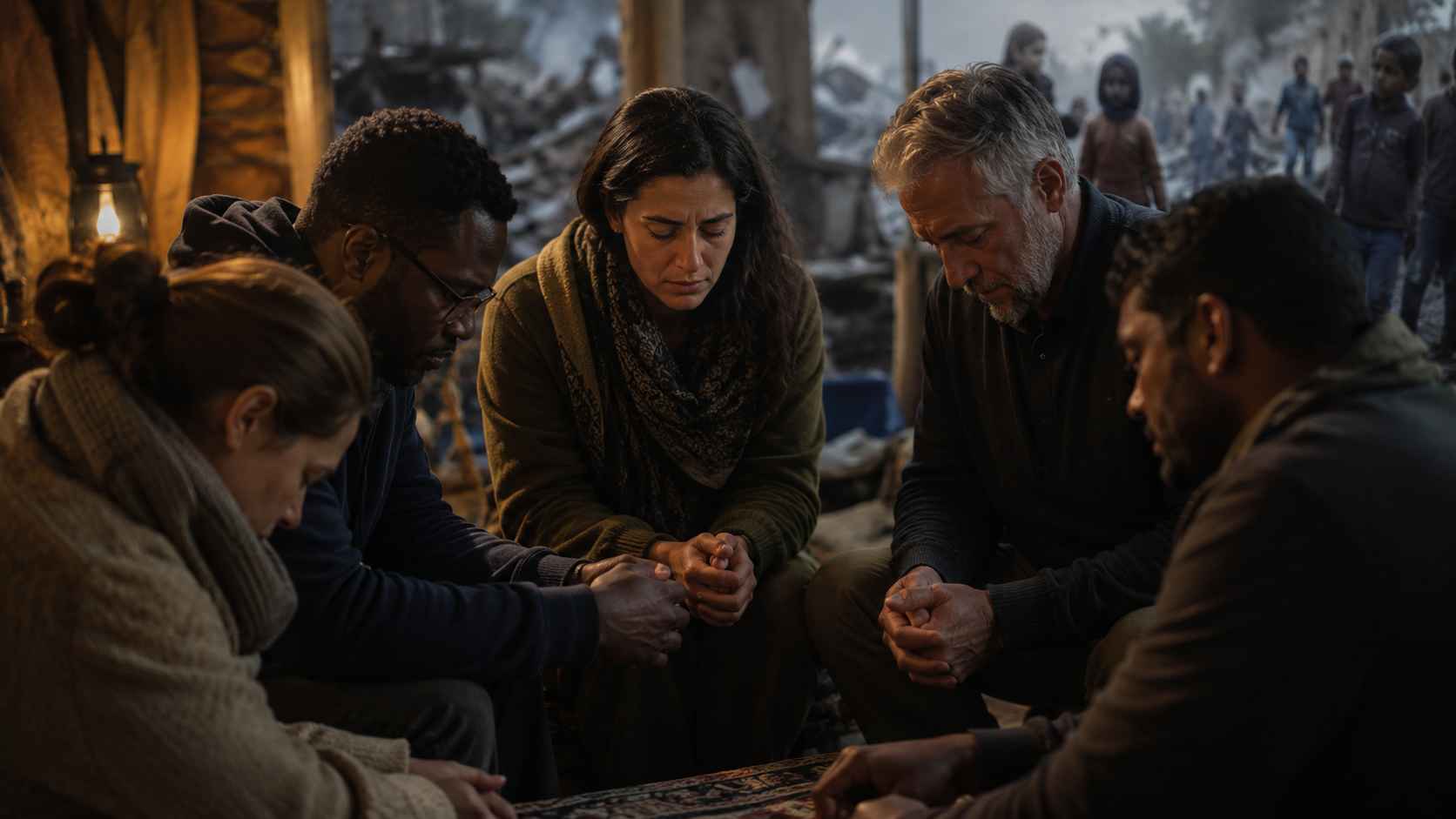
Some burdens in the world are so severe, so immediate, and so far-reaching that they call for more than passing awareness. They call for informed, earnest, and persevering prayer. In May 2026, several countries stand out with particular urgency—not because they are the only places marked by suffering, but because conflict, displacement, hunger, persecution, state pressure, and national instability are converging in ways that sharply deepen the present burden of intercession.
This ranking is meant to help Christians pray with sobriety, compassion, and confidence in the Lord who rules over the nations. It is not a crisis scoreboard or a permanent measure of which countries matter most. It is a current prayer guide for believers who want to look steadily, think carefully, and bring the burdens of suffering nations, vulnerable churches, and fearful families before God.
List Burden at a Glance
A compact summary of the present prayer burden shaping this month’s ranking.
This month’s list is marked by overlapping burdens: war joined to hunger, displacement joined to persecution, and national collapse joined to church vulnerability. Sudan and Gaza remain the clearest top tier, while Haiti and South Sudan move upward because their present deterioration is sharper than it was in the previous ranking.
Last Reviewed / Ranking Date
The date context for this current prayer-urgency assessment.
Last reviewed: May 21, 2026
Previous ranking used for movement comparison: April 23, 2026 ranking
How to Read This Ranking
A note on what this ranking is—and what it is not.
This is a present prayer-burden ranking, not a ranking of national worth, human dignity, divine concern, or permanent importance. Countries outside the Top Ten may still need urgent prayer. The order reflects comparative urgency as of this review date, and the lower half of the list is more fluid than the top tier.
The purpose is not to stir panic or to reduce complex nations to crisis headlines. It is to help Christians pray with informed compassion, sober attention, and confidence in the Lord who rules over the nations.
What Changed Since the Previous Ranking
A brief movement note comparing this ranking with the late-April assessment.
There are no new entries and no exits compared with the late-April ranking, but there is meaningful internal movement.
Sudan and State of Palestine remain fixed at #1 and #2 because their burdens still combine severe humanitarian need, displacement, infrastructure strain, and continuing danger at extraordinary scale. Haiti rises from #5 to #3 because fresh gang violence, deep displacement, hunger, and collapsing services sharpen its present urgency. South Sudan rises from #9 to #6 because recent warnings about escalating humanitarian and human-rights crisis, blocked aid, and forced displacement make its current burden more acute.
Ukraine rises slightly because May brought another visible wave of long-range attacks and civilian harm. Lebanon falls slightly because the ceasefire / pause context gives some reason for cautious thanksgiving and reduces the immediate escalation score, though mass displacement, damaged homes, insecurity, and regional fragility keep it inside the Top Ten. Syria rises slightly because its church-pressure dimension remains especially sharp alongside humanitarian fragility. Iran falls from #6 to #10, not because its burden is light, but because other countries now combine wider humanitarian collapse with sharper current escalation.
Previous ranking reviewed: APRIL 2026.
Prayer-Urgency Ranking Method Note
How this May 2026 prayer-urgency ranking was prepared and compared.
This May 2026 ranking treats an urgent prayer need as a present, unusually weighty burden that should draw focused Christian intercession right now. It is broader than a war list, a persecution list, or a humanitarian list. The ranking weighs overlapping realities: active conflict, humanitarian collapse, displacement, persecution or anti-Christian pressure, major crackdowns, national instability, difficulty of relief, and the effect of these burdens on churches, families, public fear, and ordinary endurance.
The strongest sources prioritized for this assessment include recent reporting and updates from the United Nations Office for the Coordination of Humanitarian Affairs (OCHA), the UN refugee agency (UNHCR), UNICEF, the World Health Organization, the Integrated Food Security Phase Classification (IPC), AP, Reuters-connected reporting, Human Rights Watch, Open Doors, and other high-trust humanitarian or religious-freedom sources. Current May 2026 reporting received particular weight where conditions are moving quickly.
The ranking criteria and weighting are listed separately below so readers can see clearly how the countries were compared.
Visible broad analysis: This ranking seriously considered active war and mass-displacement cases such as Sudan, State of Palestine, Myanmar, Democratic Republic of the Congo, Ukraine, South Sudan, Yemen, Syria, Lebanon, Mali, Burkina Faso, and Nigeria; humanitarian-collapse cases such as Haiti, Afghanistan, Yemen, Sudan, Gaza, and South Sudan; persecution and church-pressure cases such as Iran, Syria, Nigeria, Afghanistan, North Korea, Eritrea, India, Pakistan, Somalia, and Burkina Faso; and crackdown or instability cases such as Iran, Afghanistan, Eritrea, North Korea, China, Cuba, and Nicaragua.
The closest borderline tier was roughly ranks 8–15, where Lebanon, Syria, Iran, Yemen, Nigeria, Afghanistan, Mali, North Korea, and Eritrea all carried serious prayer claims.
Working Definition
What “urgent prayer need” means in this present-burden ranking.
Urgent prayer need
For this ranking, an urgent prayer need means that a country’s present realities create an unusually strong and immediate need for focused Christian prayer because of some combination of war, persecution, humanitarian collapse, mass displacement, legal repression, leadership crisis, severe national disruption, or conditions that materially affect church life, public fear, family survival, and daily endurance.
Ranking Criteria
The weighted criteria used to compare countries across different kinds of urgent prayer burden.
The ranking used six weighted criteria to compare countries across different kinds of urgent prayer burden:
-
Present-Burden Severity 25%
-
Current Urgency / Escalation 25%
-
Breadth of National Impact 15%
-
Spiritual and Ministry Relevance 15%
-
Difficulty of Relief / Near-Term Stability 10%
-
Comparative Prayer Priority 10%
Together, these criteria are meant to keep the list from becoming a simple news digest, a persecution-only ranking, or a humanitarian-severity table. The goal is to identify where the present prayer burden is most acute now.
Top Ten Countries
The ten countries most needing urgent prayer right now, based on the supplied May 2026 ranking.
Sudan
War, hunger, displacement, and famine risk at unmatched scale.
Sudan combines active war, mass displacement, acute food insecurity, famine risk, atrocities, damaged infrastructure, and blocked or difficult relief at a scale unmatched by any other country in this ranking.
It remains first because it has both the greatest breadth of suffering and one of the sharpest relief-access and near-term-stability problems. AP reported that nearly 19.5 million people face high levels of acute food insecurity, including 135,000 in Integrated Food Security Phase Classification (IPC) Phase 5 conditions—the highest food-insecurity category—and that Sudan’s war has killed at least 59,000, displaced about 13 million, and left more than 30 million needing humanitarian assistance. (AP News)
Unchanged — #1. Sudan remains the clearest first-place case because recent food-security reporting confirms that the crisis is still not merely severe but nationally catastrophic.
The June–September lean season is expected to worsen food conditions further, and an estimated 825,000 children under five are expected to suffer severe acute malnutrition in 2026. (AP News)
Sudan is not a localized crisis. War, hunger, displacement, and fear are reshaping national life and straining ordinary patterns of family stability, church life, survival networks, and mercy ministry.
Pray for protection of civilians, repentance and restraint among armed actors, food access, courage for believers, mercy for children and the displaced, and open doors for relief where people are trapped.
Key current sources used: AP News May 2026 Sudan food-insecurity and war reporting; OCHA Sudan 2026 humanitarian planning material.
State of Palestine
Especially Gaza — dire humanitarian conditions, displacement, infrastructure collapse, and continuing insecurity.
Gaza remains one of the world’s clearest current urgent-prayer burdens because of prolonged displacement, damaged housing, limited basic services, health-system strain, protection risks, and continued insecurity.
OCHA’s 15 May report says the humanitarian situation in Gaza remains dire, with displaced families still sheltering in overcrowded tents or damaged structures, limited access to clean water, impaired waste management, unsafe areas exposed to strikes and shelling, and continuing deaths and injuries since the ceasefire announcement. (OCHA oPt)
Unchanged — #2. Gaza remains in the top tier because conditions are still dire even where some aid activity continues.
OCHA reports constraints on humanitarian operations, shortages of fuel and equipment, sewage failures, disease risks near homes and displacement sites, and rehabilitation services that are critically overstretched for tens of thousands of people with life-changing injuries. (OCHA oPt)
Gaza’s burden is both physical and psychological. Injury, displacement, family fear, damaged infrastructure, and constrained aid all continue to shape ordinary life. The West Bank also remains under mounting pressure from settler violence, demolitions, displacement, and access restrictions. (OCHA oPt)
Pray for protection of civilians, relief access, healing for the injured, comfort for the bereaved, wisdom for churches and believers serving under trauma, and a just peace that reaches ordinary families.
Key current sources used: OCHA occupied Palestinian territory Humanitarian Situation Report, 15 May 2026.
Haiti
Gang violence, hunger, displacement, and state fragility.
Haiti’s crisis is now one of the clearest urgent-prayer burdens in the Western Hemisphere. Gang violence, hunger, displacement, collapsing services, and public fear are damaging ordinary life at scale.
UNICEF’s 2026 Haiti appeal says armed violence, displacement, and collapsing services continue to endanger children; about 1.4 million people are displaced, including more than 741,000 children, and 5.7 million people face high levels of acute food insecurity. (UNICEF) AP also reported in May that a new wave of gang violence in Port-au-Prince forced hundreds to flee, with families scattered near the road to the main airport. (AP News)
Up from #5 to #3. Haiti rises because the May picture shows fresh displacement layered onto an already severe national collapse.
Haiti is not only hungry or unsafe. It is suffering from the convergence of insecurity, forced movement, weak governance, children under threat, and exhausted public systems.
The present burden reaches families, churches, schools, health access, daily movement, and basic survival. Haiti has moved from chronic instability into acute prayer urgency.
Pray for protection from gang violence, food and shelter for the displaced, courage for churches, rescue for children, and righteous leadership that can restore public order and mercy.
Key current sources used: UNICEF Haiti 2026 Humanitarian Action for Children; AP Haiti May 2026 reporting; recent OCHA / IOM Haiti displacement materials.
Myanmar
Civil war, displacement, economic collapse, and deepened humanitarian need.
Myanmar remains a severe multi-burden country. Conflict, displacement, natural-disaster aftereffects, economic weakness, attacks on civilians, and repression continue to compound one another.
OCHA’s 2026 planning material says Myanmar’s humanitarian crisis has continued to deepen because of intensifying conflict, recurrent natural disasters, and economic collapse, with protection risks severe and community resilience stretched to breaking point. (OCHA)
Down from #3 to #4. This is not an improvement signal; Haiti’s present deterioration moved more sharply upward.
Conflict and disaster layers continue to drive displacement, insecurity, disrupted services, and difficulty of relief. Myanmar remains a broad national crisis rather than a narrow localized emergency.
The crisis affects daily survival, mobility, health access, and the possibility of stable church life across multiple regions.
Pray for civilians under bombardment and fear, for believers under surveillance or pressure, for mercy ministries, and for the church to remain courageous, wise, and faithful.
Key current sources used: OCHA Myanmar Humanitarian Needs and Response Plan 2026; IOM Myanmar Crisis Response Plan 2026.
Democratic Republic of the Congo
Eastern conflict, atrocities, displacement, and targeted church vulnerability.
Eastern DRC remains one of the world’s most serious combined conflict, displacement, protection, and church-vulnerability burdens.
Human Rights Watch reported in May that M23 and Rwandan forces carried out an abusive occupation of Uvira, shooting fleeing civilians, summarily executing more than 50 people, raping at least 8 women, and forcibly disappearing at least 12 people. (Human Rights Watch) UNHCR also describes DRC as one of the world’s most complex displacement crises, with millions uprooted and humanitarian needs deepening. (UNHCR)
Down from #4 to #5. The DRC remains in the top five; the movement reflects Haiti’s sharper current rise, not a meaningful easing in Congo.
Armed violence in the east continues to drive civilian terror, displacement, abuses, and instability, while Christian communities in the region remain vulnerable to militant violence and disrupted church life.
The DRC’s burden is both humanitarian and spiritual. Ordinary people are displaced and attacked, while churches are trying to worship, bury the dead, serve the wounded, and endure repeated trauma.
Pray for protection of civilians and churches, justice for atrocities, restraint of armed groups, healing for victims, and strong gospel witness amid fear.
Key current sources used: Human Rights Watch May 2026 DRC report; UNHCR DRC emergency reporting; Open Doors DRC 2026 country material.
South Sudan
Escalating violence, blocked aid, displacement, and fragile national survival.
South Sudan is again moving toward a catastrophic human-rights and humanitarian situation, with violence, displacement, disease risks, economic fragility, and aid obstruction overlapping.
UN experts warned in April that South Sudan is turning into a catastrophic human-rights and humanitarian crisis, urging immediate protection of civilians and humanitarian access. (OHCHR) Human Rights Watch reported that both government and opposition forces have blocked humanitarian access and ordered civilians to evacuate populated areas, forcing hundreds of thousands to flee. (Human Rights Watch)
Up from #9 to #6. South Sudan rises because current warnings show renewed escalation, aid obstruction, and forced displacement becoming more acute.
OCHA’s 2026 plan says over 10 million people, about two-thirds of the population, are projected to need humanitarian assistance. (OCHA)
South Sudan’s present danger is not only chronic poverty or instability. It is renewed national fragility, with protection, aid access, and displacement risks rising at once.
Pray for protection of civilians, open humanitarian access, repentance and restraint among leaders and armed groups, and persevering hope for churches in a repeatedly shaken country.
Key current sources used: OHCHR / UN experts April 2026 warning; Human Rights Watch April 2026 South Sudan report; OCHA South Sudan Humanitarian Needs and Response Plan 2026.
Ukraine
Active war, civilian strikes, infrastructure damage, and national exhaustion.
Ukraine remains a major active-war prayer burden, with repeated attacks on civilians and infrastructure, displacement, grief, national fatigue, and uncertainty about the war’s trajectory.
OCHA says Ukraine’s humanitarian crisis remains severe as the country enters the fifth year of full-scale war, driven by relentless attacks on civilians and critical infrastructure, recurrent displacement, and the degradation of essential services. (OCHA) AP reported in May that Russia launched a significant nighttime drone and missile offensive across eight Ukrainian regions, injuring more than two dozen civilians, including children. (AP News)
Up from #8 to #7. Ukraine rises slightly because May brought another visible intensification of long-range strikes and civilian harm.
The war’s current pattern is prolonged rather than sudden, but May’s renewed aerial barrage keeps the burden urgent and nationally consequential.
Ukraine’s churches and families continue to live under grief, fatigue, displacement, air alerts, infrastructure strain, and the long spiritual pressure of endurance.
Pray for protection of civilians, endurance for churches, comfort for the bereaved, justice, wise leadership, and mercy for the wounded and displaced.
Key current sources used: OCHA Ukraine overview; AP May 2026 Ukraine war reporting.
Lebanon
Fragile ceasefire, mass displacement, continued insecurity, and regional spillover.
Lebanon remains under a sharp conflict and displacement burden after major escalation, mass civilian movement, damaged infrastructure, and a fragile ceasefire environment.
OHCHR reported that during the first three weeks of the March 2026 escalation, at least 1,029 people were killed, 2,786 injured, and more than 1 million displaced in Lebanon, according to the Government of Lebanon. (OHCHR) UNHCR also reported in May that life in displacement remains a struggle and that the ceasefire has brought little respite for many who cannot return home because of destruction and insecurity. (UNHCR)
Down from #7 to #8. Lebanon falls slightly because the ceasefire/pause context reduces immediate escalation compared with April, but the burden remains severe and unstable.
The ceasefire is a reason for cautious thanksgiving, but not enough to move Lebanon out of the Top Ten. Displacement, damaged homes, continuing insecurity, and regional tension remain strong prayer burdens.
Churches and ministries are serving amid displacement, trauma, uncertainty, and the fear that a temporary pause may not become durable peace.
Pray for lasting peace, safe returns, protection of civilians, comfort for displaced families, and wisdom for believers serving amid grief and instability.
Key current sources used: OHCHR Lebanon human-rights update; UNHCR Lebanon displacement reporting.
Syria
Humanitarian fragility, political uncertainty, and renewed Christian vulnerability.
Syria remains a high-need country because humanitarian suffering, displacement, weak governance, insecurity, and Christian vulnerability are converging in a fragile post-Assad environment.
Open Doors’ 2026 Syria dossier says that since the fall of the Assad regime, Christians have reported unprecedented levels of persecution since ISIS control, including a sharp rise in deaths and attacks on churches; it also notes that the interim constitution lacks sufficient protections for minorities. (Open Doors) UNHCR’s 2026 Syria overview notes that Syrians remain one of the world’s largest refugee populations, with millions of registered refugees still hosted in neighboring countries. (UNHCR)
Up from #10 to #9. Syria rises slightly because its church-pressure dimension remains unusually sharp alongside humanitarian fragility.
Syria’s burden is not only material. It is also spiritual and social, especially for minority believers wondering what kind of public order is emerging.
This is a fragile recovery-or-relapse case. Conditions may open doors for return and rebuilding, but weak protection, militant pressure, and social fear keep the prayer burden acute.
Pray for safety, wise church leadership, courage for Christians, protection of minorities, genuine peace, and faithful witness in a fragile national transition.
Key current sources used: Open Doors Syria 2026 country dossier; UNHCR Syria Global Appeal 2026 situation overview.
Iran
Crackdown, Christian scapegoating, repression, and national uncertainty.
Iran remains a major urgent-prayer case because state repression, Christian convert pressure, harsh sentencing, political uncertainty, and fear of further crackdown overlap.
Middle East Concern, Article18, Open Doors, and CSW reported that rights violations against Christians in Iran intensified in 2025, with arrests nearly doubling from 139 to 254, more Christians serving prison, exile, or forced-labor sentences, and a sharp rise in arrests after the 12-day war with Israel. (Middle East Concern) Open Doors also notes that repression intensified after the June 2025 Israel-Iran war, with converts accused of aiding Israel and at least 50 Christians detained in the immediate crackdown. (Open Doors)
Down from #6 to #10. Iran falls because other countries now show sharper combined humanitarian and conflict escalation, but Iran remains in the Top Ten because the pressure on Christians and the broader crackdown are still severe.
Iran’s burden is less mass-displacement-driven than several countries above it, but it remains spiritually urgent because Christian converts and house-church believers face direct state suspicion and punishment.
Iran is a pressure-and-crackdown case. National unrest and geopolitical tension intensify the danger for religious minorities and dissenters.
Pray for imprisoned and monitored believers, courage for house churches, relief from repression, wise endurance, and mercy for a nation marked by fear and heavy state pressure.
Key current sources used: Middle East Concern / Article18 / Open Doors / CSW Iran 2026 report; Open Doors Iran 2026 country dossier.
Near-Miss / Watchlist Countries
Countries that remained serious enough to watch, but fell just outside the final ten after comparison.
Yemen — Yemen remains extremely close because humanitarian needs are massive, with the 2026 Humanitarian Needs and Response Plan (HNRP) aiming to reach 12 million people and prioritizing 9.4 million for targeted assistance. It stayed just outside the Top Ten because this month’s ranking gave slightly more weight to countries where sharper conflict escalation, displacement surges, or church-pressure overlays made the present prayer burden more acute. (United Nations Yemen)
Nigeria — Nigeria remains a very serious contender because anti-Christian violence and broader insecurity are severe. Open Doors reports that around 70% of Christians killed for their faith in the latest World Watch List research period were in Nigeria, and sub-Saharan Africa remains the most violent region for Christians. Nigeria stayed outside the Top Ten because the national burden is more regionally uneven than the current ranked cases. (Open Doors US)
Afghanistan — Afghanistan remains one of the harshest environments for Christians and a major humanitarian burden. Human Rights Watch reports worsening humanitarian crisis, more than 22 million people facing food insecurity by year’s end 2025, aid cuts, Taliban restrictions, and large-scale forced returns. It stayed outside the Top Ten because its urgency is grave but more entrenched than newly escalatory in this May comparison. (Human Rights Watch)
North Korea — North Korea remains one of the most dangerous places to be a Christian, but this list is not a permanent persecution ranking. It stayed just outside because the current Top Ten is weighted toward present multi-burden escalation as well as severity. (Open Doors)
Mali / Burkina Faso watch zone — Mali and Burkina Faso deserve close watching because jihadist violence and state fragility are worsening prayer burdens across the Sahel. Open Doors describes Burkina Faso’s Christian persecution as tied to state collapse, escalating insecurity, and jihadist expansion, while recent reporting points to renewed violence and instability in Mali. (Open Doors)
Final Summary Judgment
What most distinguishes this urgent-prayer ranking from a general list of troubled countries.
How to Pray Through This List
Let this ranking move you beyond awareness into sober, informed, compassionate intercession.
Pray through this list with sober attention, not panic. Begin with the people most exposed: children, displaced families, widows, prisoners, pastors, health workers, aid workers, and believers whose worship and witness are strained by fear.
-
Pray for food access, clean water, safe roads, functioning hospitals, just courts, restrained armed actors, wise leadership, and protection from retaliatory violence.
-
Pray for the church in each place to remain faithful, merciful, courageous, and clear in hope—not detached from suffering, but not swallowed by despair.
Key Sources Consulted
Descriptive source notes materially used in this ranking.
- AP News May 2026 Sudan food-insecurity and war reporting for Sudan’s acute food insecurity, famine risk, death toll, displacement, and humanitarian need.
- OCHA occupied Palestinian territory Humanitarian Situation Report, 15 May 2026 for Gaza and West Bank humanitarian conditions, access constraints, protection risks, infrastructure damage, supplies, displacement, and settler-violence context.
- UNICEF Haiti 2026 Humanitarian Action for Children, AP Haiti May 2026 reporting, and recent OCHA / IOM Haiti displacement materials for displacement, food insecurity, children affected, service collapse, and fresh gang-violence displacement.
- OCHA Myanmar Humanitarian Needs and Response Plan 2026 and IOM Myanmar Crisis Response Plan 2026 for conflict, natural disasters, economic collapse, protection risks, displacement, and deepening humanitarian need.
- Human Rights Watch May 2026 DRC report, UNHCR DRC emergency reporting, and Open Doors DRC 2026 country material for atrocities, displacement, conflict, protection crisis, and church vulnerability in eastern DRC.
- OHCHR / UN experts, Human Rights Watch South Sudan reporting, and OCHA South Sudan Humanitarian Needs and Response Plan 2026 for escalating humanitarian and human-rights crisis, blocked aid, displacement, and national fragility.
- OCHA Ukraine overview and AP May 2026 Ukraine war reporting for continued active war, civilian attacks, displacement, infrastructure damage, and renewed aerial barrages.
- OHCHR Lebanon human-rights update and UNHCR Lebanon displacement reporting for escalation, deaths, injuries, mass displacement, damaged homes, and fragile post-ceasefire conditions.
- Open Doors Syria 2026 country dossier and UNHCR Syria Global Appeal 2026 situation overview for Christian vulnerability, minority pressure, humanitarian fragility, displacement, and refugee context.
- Middle East Concern / Article18 / Open Doors / CSW Iran 2026 report and Open Doors Iran 2026 country dossier for Christian persecution, arrests, sentencing, convert pressure, state suspicion, and post-conflict crackdown concerns.
- OCHA Yemen 2026 Humanitarian Needs and Response Plan, Open Doors Nigeria reporting, Human Rights Watch Afghanistan World Report 2026, and Open Doors North Korea / Burkina Faso 2026 materials for near-miss and watchlist judgments.
Continue praying
Continue praying for the nations
Use this list as one doorway into a wider rhythm of prayer for the nations.